Inflation Generalisation and RBI Diffusion Index Explained
An inflation diffusion index measures how widely prices are rising across the consumer basket, helping distinguish isolated shocks from broader pressures.
Oct, 2026
•11 min read

Overview
The Reserve Bank of India tracks the Consumer Price Index diffusion index to gauge price dispersion. This tool shows whether price rises are spreading across the broader economy or staying confined to volatile items, helping the Monetary Policy Committee prevent costly policy errors. Under Section 45ZB of the Reserve Bank of India Act, 1934, the six-member committee determines the policy repo rate to anchor headline inflation at 4 per cent within a statutory tolerance band of 2 to 6 per cent.
Standard headline indices aggregate price changes by fixed consumption weights. In contrast, the diffusion index measures price dispersion by capturing the proportion of goods and services registering month-on-month increases.
This analytical tool enables monetary authorities to look through temporary supply spikes in perishable food while watching for broad-based second-round inflation pass-through across non-food categories. Breadth tracking provides empirical protection against premature monetary tightening, though central banks must guard against lagging responses when generalised price momentum silently accelerates.
Why in the News: The Monetary Policy Committee's Inflation Dilemma
As of October 2026, the Reserve Bank of India highlighted mounting trade-offs between managing transient food price shocks and maintaining aggregate economic expansion. Central banks face a recurring operational challenge when supply-side disruptions create sudden headline price spikes.
When headline numbers spike, rate setters face two opposing hazards:
- Premature overtightening: Mechanical interest-rate hikes against transient food or fuel supply spikes risk dampening aggregate demand and choking output growth without curing underlying supply bottlenecks.
- Costly inaction: When supply shocks persist over consecutive quarters, uninterrupted price pressures can trigger second-round wage-price spillovers and de-anchor long-term household inflation expectations, as noted in the August 2026 Monetary Policy Committee minutes.
Statutory mandates leave little margin for misjudgment. Section 45ZA of the Reserve Bank of India Act, 1934, tasks the central bank with targeting a headline CPI anchor of 4 per cent with an upper limit of 6 per cent and lower limit of 2 per cent, renewed through March 31, 2031. Section 45ZN of the Act establishes statutory accountability by requiring a formal explanatory report if inflation breaches this band for three consecutive quarters.
To balance these dual risks, the central bank must examine the breadth of price pressures rather than headline levels alone. The Governor's Statement of October 2026 stressed that containing second-round effects and anchoring household expectations require rate setters to evaluate price momentum across the entire consumption basket.
The Flaw in Headline Numbers: Why Standard CPI Can Deceive Central Banks
The Consumer Price Index published by the National Statistical Office can mislead central bankers because high-weight volatile components often distort aggregate price signals. Headline metrics reflect an expenditure-weighted average across hundreds of goods and services. When extreme climate events disrupt agricultural supply chains, violent spikes in perishable items artificially inflate the aggregate reading.
Headline tracking presents three core operational distortions:
- Excessive food sensitivity: Food and beverages historically account for roughly 46 per cent weighting in India's consumer price basket.
- Persistent weather vulnerability: The Ministry of Statistics and Programme Implementation updated this statistical foundation by launching a revised Consumer Price Index series with base year 2024=100 on February 12, 2026, incorporating consumption patterns from the 2023-24 Household Consumption Expenditure Survey. Even with updated consumption patterns, food categories continue to drive massive headline volatility.
- Blunt monetary instruments: Raising the repo rate raises borrowing costs economy-wide, but interest rates cannot repair damaged crops or unblock logistics. Tightening credit during localised harvest failures suppresses manufacturing and services output, penalising productive sectors while leaving farmgate prices completely unaddressed.
Discuss with Superkalam
Recall the statutory tolerance band and the target inflation rate specified under Section 45ZA of the Reserve Bank of India Act, 1934.
Ask NowHow the Diffusion Index Works: Measuring the Breadth of Price Spikes
The Reserve Bank of India defines the Consumer Price Index diffusion index as an indicator tracking the proportion of basket items registering price increases. Rather than calculating how high prices have surged in rupee terms, the metric evaluates how widely price changes have dispersed across individual consumption goods.
The mathematical mechanics behind the indicator operate through three distinct steps:
- Categorisation of Price Movement: The central bank categorises every commodity in the consumer basket based on whether its month-on-month seasonally adjusted price has risen, remained stagnant, or fallen.
- Threshold Aggregation: The indicator tallies the expanding items into an aggregate ratio. A diffusion index reading above 50 denotes an expansion of price increases, whereas a reading below 50 reflects a broader dispersion of falling prices.
- Threshold Boundary Tracking: To track severe price pressures, the central bank computes specialised threshold indices that measure the proportion of items recording annualised price gains above statutory tolerance limits of 4 per cent and 6 per cent.
Granular price monitoring requires categorising basket components across four discrete inflation buckets: below 2 per cent, between 2 and 4 per cent, between 4 and 6 per cent, and above 6 per cent. When price increases remain confined to the highest bucket while other buckets stay subdued, monetary authorities can establish that inflation is isolated rather than systemic.

Headline CPI vs Core Inflation vs Diffusion Index: A Direct Comparison
The Monetary Policy Committee assesses headline inflation, core measures, and diffusion indices to construct a complete profile of domestic price stability. Each analytical gauge addresses a specific dimension of inflation dynamics but possesses inherent blind spots that require institutional calibration.
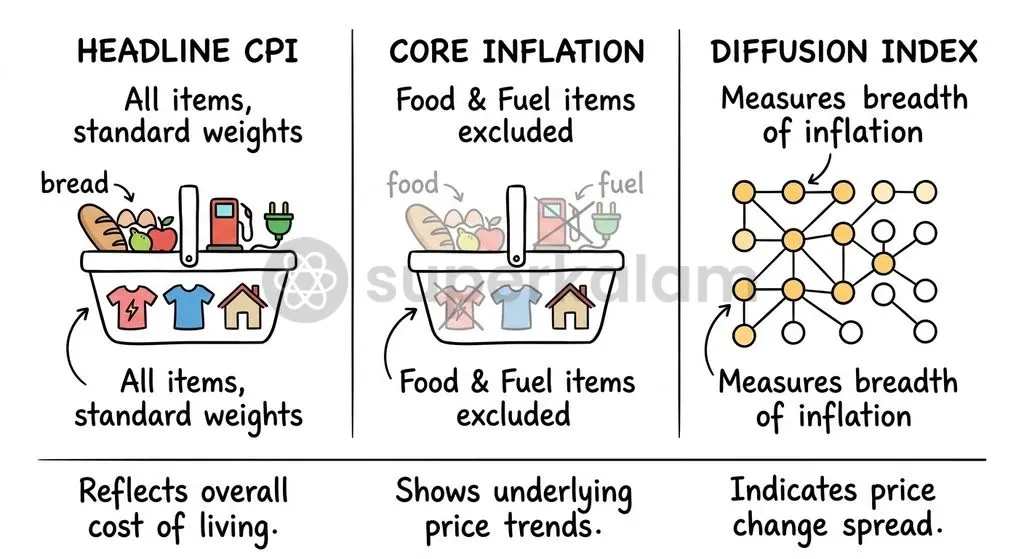
Core Consumer Price Index inflation addresses headline volatility by mechanically excluding all food and fuel components. While this approach insulates monetary authorities from transient agricultural volatility, it blinds rate setters when sustained energy or food spikes spill into transport, hospitality, and processed goods. The diffusion index bridges this analytical gap by tracking momentum across all commodities without excluding essential household expenditure categories.
| Feature / Dimension | Headline CPI | Core CPI (Exclusion-Based) | CPI Diffusion Index |
|---|---|---|---|
| Primary Metric | Weighted magnitude of aggregate price level changes | Weighted magnitude of non-food, non-fuel price changes | Breadth and dispersion of price changes across basket items |
| Statistical Formula | Laspeyres expenditure-weighted index across all items | Expenditure-weighted index excluding food and energy | Proportion of items showing month-on-month price increases |
| Sensitivity to Food Shocks | High; volatile farm commodities heavily skew aggregate levels | Zero; food components are completely removed from calculations | Neutral; tracks whether food spikes spread to non-food categories |
| Statutory Role | Official nominal policy target under Section 45ZA mandate | Internal operational metric for underlying demand pressures | Supplementary diagnostic tool for evaluating second-round pass-through |
| Key Operational Limitation | Can trigger knee-jerk tightening during purely transient shocks | Ignores direct household distress caused by persistent food inflation | Lacks magnitude sensitivity unless combined with expenditure weighting |
Discuss with Superkalam
How does the mathematical interpretation of a CPI diffusion index reading above 50 differ from one below 50?
Ask NowThe Policy Debate: Does Breadth Tracking Prevent Premature Rate Hikes?
The Monetary Policy Committee relies on diffusion data to avoid aggressive repo rate hikes when headline inflation surges solely due to transient food bottlenecks. By isolating whether price acceleration is confined to isolated sub-sectors or spreading broadly, diffusion metrics provide an empirical buffer against unwarranted monetary contraction.
Breadth tracking shapes monetary decisions in three concrete ways:
- Shielding against transient vegetable spikes: During sharp spikes in perishable goods such as tomatoes, low diffusion index readings in non-perishable categories have repeatedly provided quantitative justification for the committee to maintain status quo rates.
- Reinforcing long-term policy credibility: Central bank research indicates that India's institutional framework has successfully anchored long-term stability. Average headline inflation declined from 6.8 per cent in the pre-framework era (2012–2016) to 4.9 per cent during the first decade of flexible inflation targeting between 2016 and 2025.
- Distinguishing broad trends from local shocks: Central bank economists created the Multivariate Core Trend model to decompose sectoral inflation. The model applies dynamic weights based on sectoral volatility, persistence, and co-movement to isolate common trend inflation from sector-specific shocks. Findings from the study confirmed that durable underlying inflation shifts only when co-movement between volatile and stable commodities rises, validating the role of breadth tracking in monetary decision-making.
Discuss with Superkalam
Analyse why raising the repo rate might fail to contain a spike in headline CPI driven exclusively by unseasonal rainfall damaging vegetable crops.
Ask NowDiscuss with Superkalam
Weigh the risk of a central bank relying heavily on diffusion metrics: does breadth tracking prevent premature tightening, or does it risk delaying rate hikes against generalized inflation?
Ask NowGlobal Precedents: How Central Banks Track Inflation Dispersion
Cross-country monetary frameworks demonstrate that central banks overwhelmingly anchor policy on headline inflation while using dispersion metrics as analytical diagnostics. Broad-based international reviews reveal that 47 out of 48 inflation-targeting central banks designate headline consumer indices as their formal statutory target, with Uganda as the sole exception by targeting core inflation directly.
Major central banks deploy specialised dispersion models to detect underlying price momentum:
- The US Federal Reserve tracks trimmed-mean and median consumer price metrics alongside diffusion indices to evaluate whether supply-chain shocks are transforming into broader service-sector inflation.
- The European Central Bank evaluates sectoral price distributions across eurozone member states to monitor underlying wage-price dynamics and prevent fragmented second-round effects.
- The Reserve Bank of India combines threshold diffusion tracking with multivariate trend models, maintaining statutory accountability to headline numbers while guarding against transient noise.
The global consensus confirms that while headline inflation must remain the public anchor for household expectations, dispersion metrics are an indispensable steering compass during periods of commodity market turbulence.
Way Forward: Building a Smarter Inflation Dashboard for India
The Reserve Bank of India can refine its monetary diagnostics by integrating expenditure-weighted diffusion metrics with dynamic multivariate trend models. Relying on any single inflation gauge creates blind spots, making a multi-layered analytical dashboard essential for modern central banking.
To strengthen monetary policy formulation under the flexible inflation framework, the central bank and statistical agencies should pursue four targeted reforms:
- Deploy Expenditure-Weighted Dispersion: Replace simple diffusion counts with expenditure-weighted threshold metrics across all internal assessments, preventing low-weight luxury goods from distorting broad-based inflation readings.
- Formalise Multivariate Core Trend Monitoring: Embed the Multivariate Core Trend model into regular monetary policy deliberations to monitor real-time co-movement between volatile food items and durable goods.
- Mandate Inflation Bucket Disclosure: Publish the proportion of consumer basket components across the four established inflation buckets (<2%, 2–4%, 4–6%, and >6%) within bi-monthly policy statements to enhance market transparency.
- Calibrate for the Updated Base Year: Continuously recalibrate sectoral diffusion tracking against the newly introduced 2024=100 consumer price series, capturing shifting household spending realities.

Key Takeaways
- The diffusion index measures the proportion of basket goods registering price increases, providing an early-warning radar for broad-based price pressures across non-food categories.
- Under Section 45ZB of the RBI Act, 1934, the Monetary Policy Committee sets the repo rate to achieve a headline target of 4 per cent with a +/-2 per cent tolerance band.
- Headline consumer price measures carry a roughly 46 per cent weighting in food and beverages, leaving aggregate indices vulnerable to transient climate-induced supply shocks.
- Diffusion tracking prevents premature monetary contraction during temporary vegetable price spikes but carries the risk of policy lag due to its backward-looking statistical design.
- International evidence indicates that 47 of 48 inflation-targeting central banks anchor their mandate to headline metrics while using dispersion tools for underlying diagnostics.
Mains Question
"Standard headline indices aggregate price changes by fixed consumption weights, often creating policy dilemmas during supply-side agricultural shocks." In this context, evaluate the utility of the Consumer Price Index (CPI) Diffusion Index as a diagnostic tool for the Monetary Policy Committee. (10 Marks)
Evaluate NowMains Question
Under Section 45ZA of the Reserve Bank of India Act, 1934, the Monetary Policy Committee is mandated to maintain headline inflation at 4 per cent within a statutory band of 2 to 6 per cent. Critically analyse how tracking inflation breadth alongside the Multivariate Core Trend model helps reconcile the trade-off between price stability and economic growth. (15 Marks)
Evaluate NowPractice MCQs
QUESTION 1
With reference to the Consumer Price Index (CPI) Diffusion Index tracked by the Reserve Bank of India, consider the following statements:
- It measures the weighted magnitude of price level changes across goods using fixed Laspeyres consumption weights.
- A diffusion index reading above 50 indicates that a larger proportion of items in the consumption basket are witnessing month-on-month price increases.
- It completely excludes food and energy items to prevent headline agricultural volatility from distorting underlying trends. Which of the statements given above is/are correct?
QUESTION 2
Consider the following statements regarding the statutory monetary policy framework in India:
- Under Section 45ZB of the Reserve Bank of India Act, 1934, a six-member Monetary Policy Committee determines the policy repo rate.
- The headline CPI inflation target of 4 per cent with a tolerance band of 2 to 6 per cent under Section 45ZA is renewed through March 31, 2031.
- Under Section 45ZN of the Act, the Reserve Bank of India is mandated to submit a formal explanatory report if inflation breaches the tolerance band for two consecutive quarters. Which of the statements given above are correct?
QUESTION 3
With reference to inflation monitoring and metrics used by the Reserve Bank of India, consider the following statements:
- The revised Consumer Price Index series launched on February 12, 2026, adopted the base year 2024=100 based on the 2023-24 Household Consumption Expenditure Survey.
- In granular price monitoring, threshold boundary tracking categorises items across inflation buckets of below 2%, 2-4%, 4-6%, and above 6%.
- The Multivariate Core Trend (MCT) model applies dynamic weights based on sectoral volatility, persistence, and co-movement to isolate trend inflation. Which of the statements given above are correct?
QUESTION 4
Which of the following best describes the operational limitation of using headline Consumer Price Index (CPI) targeting when addressing supply-side agricultural shocks?
QUESTION 5
Consider the following statements regarding core inflation and the CPI diffusion index:
- Core inflation removes food and fuel items entirely, potentially blinding rate setters when sustained energy shocks spill over into transport and hospitality.
- The CPI diffusion index is an expenditure-weighted index measuring the rupee value surge of manufactured commodities. Which of the statements given above is/are correct?