Namami Gange: Industrial Pollution, GPI, BOD and CETPs
Under Namami Gange, industrial inspections assess compliance and pollution loads. BOD, effluent treatment and monitoring help track river-basin pollution.
Oct, 2026
•10 min read
Overview
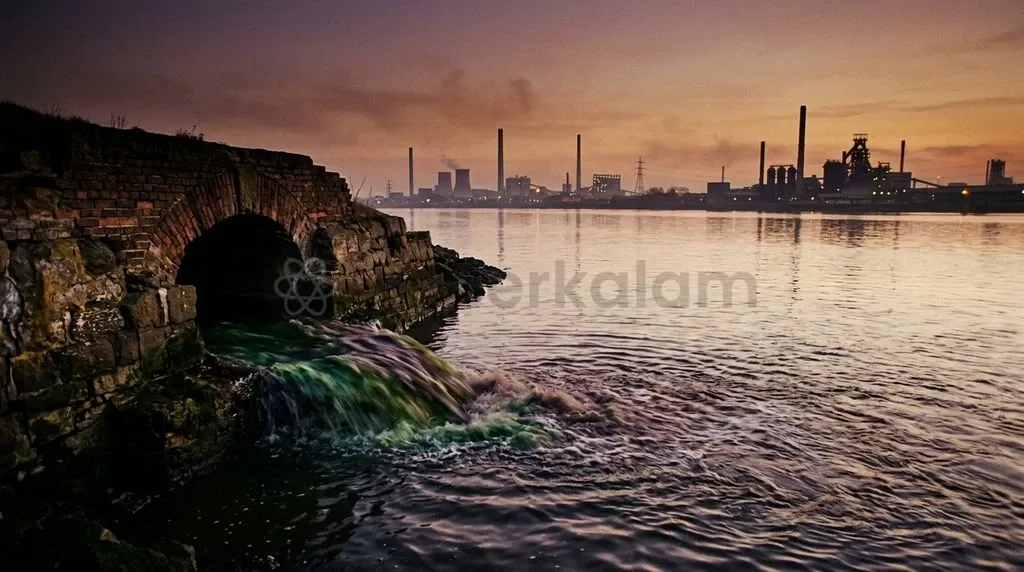
Official figures paint a reassuring picture of the Ganga basin, yet ground realities tell another story. Despite the National Mission for Clean Ganga reporting an eighty-six percent compliance rate among Grossly Polluting Industries in 2025, toxic industrial contamination persists.
Technical audits across 113 districts show that biochemical oxygen demand loads dropped by over seventy percent since 2017. Even so, the river continually receives bioaccumulative heavy metals like chromium and cadmium. Systemic sensor manipulation, recurring treatment plant failures, and severe regulatory vacancies drive this ongoing contamination. Paper compliance does not equal ecological enforcement in running water.
Why in the News: The Persistence of Industrial Effluents in the Ganga
As of October 2026, inspection assessments under the Namami Gange Programme highlighted a seventy percent compliance rate among assessed Grossly Polluting Industries across the Ganga and Yamuna river basins. Technical institutes surveyed 3,703 Grossly Polluting Industries across 113 districts. They evaluated direct and indirect discharges into 46 tributaries and sub-tributaries, according to a Press Information Bureau release.
Across assessed GPIs, compliance rose from 39% in 2017 to 70% in 2025, while BOD load declined from 26 to 12.02 tonnes per day. In the Ganga basin alone, compliance reached 86% and BOD load fell from 26 to 7.16 tonnes per day, a 72.46% reduction.
Five manufacturing sectors generate approximately 70% of Grossly Polluting Industries in the Ganga basin in the earlier assessment:
- Pulp and paper mills
- Sugar mills
- Distilleries
- Textile units
- Tanneries
These five sectors historically account for roughly 88% of industrial pollution in the river basin. Despite the statistical contraction in organic loads, local communities and river scientists continue to document acute toxicity, persistent foam, and chemical discolouration downstream.
The Legal Mandate: How Decades of Court Orders Failed to Stem the Flow
The Supreme Court established environmental jurisprudence for industrial wastewater in M.C. Mehta v. Union of India (1987), ordering the immediate closure of non-compliant Kanpur tanneries. The bench held that financial incapacity is no defence against an enterprise's statutory obligation to treat industrial trade waste before discharging it into public streams.
- Article 21: Interprets the right to a clean, pollution-free environment as a fundamental right.
- Article 48A: Directs the State to protect and improve the natural environment.
- Water Act, 1974: Establishes CPCB and SPCBs while mandating Consent to Establish (CTE) and Consent to Operate (CTO).
- Water Amendment Act, 2024: Decriminalises minor violations and introduces administrative financial penalties.
Article 48A of the Constitution of India obligates the State to protect and improve the natural environment, operating as a non-justiciable directive under Part IV. The judiciary harmonised this directive with the fundamental right to life under Article 21, interpreting environmental integrity as an enforceable constitutional guarantee. This judicial doctrine transformed the Water (Prevention and Control of Pollution) Act, 1974 into an instrument of public health protection.
Parliament altered this enforcement architecture through the Water (Prevention and Control of Pollution) Amendment Act, 2024. The amendment decriminalised minor and procedural violations across Sections 41, 41A, 42, 43, 44, and 45A, replacing criminal prosecution with administrative fines levied by designated Adjudicating Officers. Under Section 42(g), the law established penalties between ₹10,000 and ₹15 lakh for tampering with state-mandated monitoring apparatus, shifting deterrence from criminal sanctions to economic penalties.
Discuss with Superkalam
Which five industrial sectors historically account for nearly 88% of industrial pollution across the Ganga basin?
Ask NowVolume vs Toxicity: Why Factory Waste Packs a Deadlier Punch Than Sewage
Central Pollution Control Board data indicates that industrial effluents constitute only twenty percent of aggregate wastewater volume, yet they deliver the primary concentration of non-biodegradable toxic pollutants. Municipal domestic sewage makes up the remaining eighty percent of discharges by volume, creating high biochemical oxygen demand that depletes dissolved oxygen. However, industrial waste carries a disproportionate environmental burden because it introduces non-biodegradable Chemical Oxygen Demand (COD) and complex synthetic chemicals.
| Parameter | Municipal Domestic Sewage | Industrial Trade Effluents |
|---|---|---|
| Volumetric Share | ~80% of total basin wastewater | ~20% of aggregate discharge volume |
| Primary Pollutants | Pathogens, organic matter, faecal coliform | Heavy metals, synthetic organics, persistent toxins |
| Oxygen Depletion Metric | High Biological Oxygen Demand (BOD) | Severe Chemical Oxygen Demand (COD) |
| Environmental Degradation | Biodegradable through microbial digestion | Resists natural biodegradation; persists indefinitely |
| Aquatic Food Chain Impact | Localised eutrophication and fish asphyxiation | Trophic biomagnification across biological levels |
| Treatment Modality | Standard Sewage Treatment Plants (STPs) | Specialised chemical oxidation and effluent plants |
The Central Pollution Control Board classifies a facility as a Grossly Polluting Industry (GPI) if it discharges trade waste into a watercourse and handles hazardous materials or generates an organic load of 100 kg per day or more.
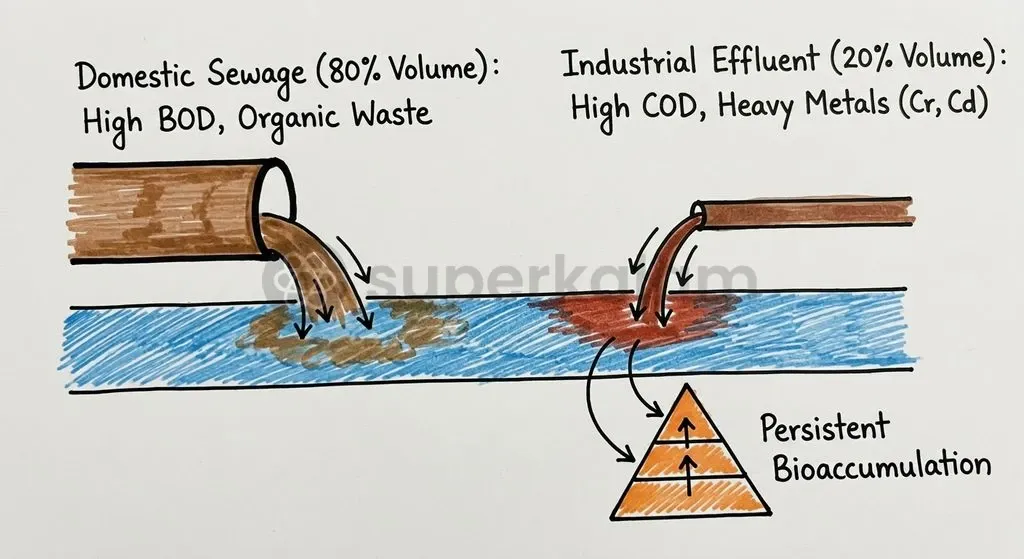
Heavy metals discharged from untreated electroplating units, textile dye houses, and tanneries—especially hexavalent chromium, lead, and cadmium—cannot be broken down by ordinary biological processes. These toxins enter aquatic organisms and undergo trophic biomagnification, escalating in concentration as they move up the food chain. Riparian populations consuming river water and irrigated crops face chronic heavy metal poisoning, kidney damage, and carcinogenic risks that simple BOD-based monitoring fails to capture.
Discuss with Superkalam
How does trophic biomagnification of industrial heavy metals differ fundamentally from the eutrophication caused by municipal sewage?
Ask NowGaming the System: How Industrial Units Bypass Sensors and Treatment Plants
The Central Pollution Control Board requires seventeen categories of heavily polluting industries to maintain Online Continuous Effluent Monitoring Systems. These systems transmit real-time telemetry directly to central regulatory servers. Mandated for all Grossly Polluting Industries and Common Effluent Treatment Plants (CETPs), they record parameters such as pH, COD, BOD, and total dissolved solids around the clock.
Industrial operators subvert this remote monitoring net through several established workarounds:
- Effluent Dilution: Factory technicians dilute sampling lines with freshwater to generate artificially compliant readings.
- Concealed Outlets: Facilities route unrecorded discharges through concealed submerged bypass pipes.
- Nocturnal Discharges: Units schedule illicit chemical flushes at night, exploiting automated sensor platforms while physical inspectors are absent.
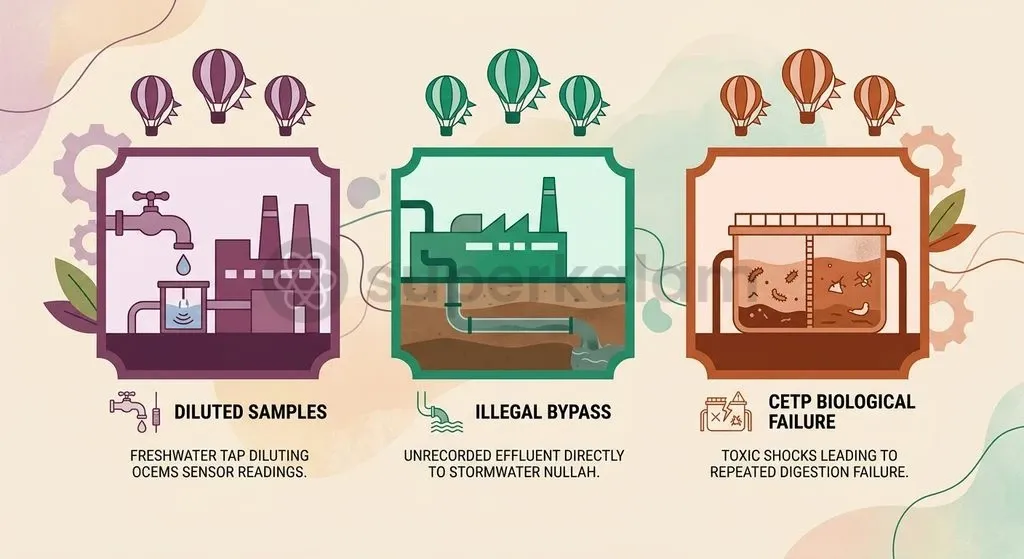
Common Effluent Treatment Plants intended to clean small-scale industrial discharges face severe operational breakdowns. Under the Namami Gange Programme, the National Mission for Clean Ganga commissioned a modern 20 MLD facility at Jajmau, Kanpur, dedicated to processing tannery effluents alongside specialised chrome recovery infrastructure. Yet across Uttar Pradesh, CETPs frequently collapse due to hydraulic surges and the chemical incompatibility of mixed industrial waste streams.
Regulatory assessments note that biological treatment phases fail when unpredictable shocks of toxic waste wipe out the bacterial cultures required for digestion. Operating contractors and industrial Special Purpose Vehicles also clash over operational electricity tariffs, leading to unmetered bypass discharges directly into local storm nullahs.
The resulting toxic sludge—laden with trivalent and hexavalent chromium—is routinely dumped in unlined sites. This allows hazardous chemicals to leach into alluvial groundwater during the monsoon.
Discuss with Superkalam
If you were appointed an Adjudicating Officer under the amended Water Act, 2024, how would you determine penalties to deter covert nocturnal industrial discharges?
Ask NowParalyzed Regulators: Why State Pollution Boards Fail to Enforce the Law
State Pollution Control Boards face severe administrative shortages that prevent physical inspections and chemical forensics across major industrial belts along the Ganga river basin. Decades of expanding industrial mandates have arrived without matching institutional investments, leaving regulatory bodies unable to police thousands of registered units.
- Overall Institutional Deficit: 50.56% overall vacancy rate across 28 SPCBs and 8 PCCs.
- Scientific Cadre Gaps: 47.6% of sanctioned positions in scientific and technical roles remain vacant as of late 2025.
- Forensic Deficiencies: Field laboratories frequently lack dedicated gas chromatography-mass spectrometry (GC-MS) and inductively coupled plasma (ICP) spectrometers.
- Enforcement Imbalance: A statutory transition to administrative penalties proceeds without dedicated investigative capacity.
A single technical officer is often forced to oversee several hundred manufacturing units scattered across wide districts.
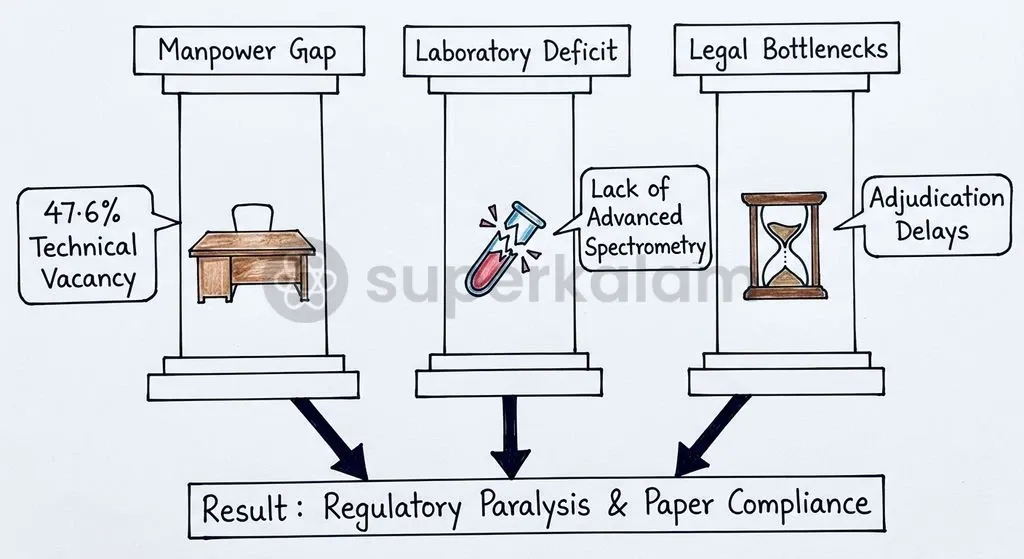
Field laboratories run by state regulators also operate with obsolete testing equipment. As reported by the Centre for Science and Environment in its 2024 assessment, regional monitoring stations along the Ganga corridor frequently lack advanced gas chromatography-mass spectrometry and inductively coupled plasma spectrometers. Without these specialised instruments, inspectors cannot chemically identify the origin of toxic synthetic compounds found in the river, effectively precluding evidentiary prosecution in judicial forums.
The Ethics of Toxic Discharge: Profit, Polluter Impunity, and Public Harm
The National Green Tribunal applies a standardised mathematical formula to calculate environmental compensation for industrial facilities that discharge untreated toxic effluents into public watercourses. This calculation uses the equation:
$$\text{EC} = \text{PI} \times N \times R \times S \times \text{LF}$$
In this formula, PI represents the Pollution Index of the industrial sector, N reflects the number of non-compliant days, R is the base rupee factor, S accounts for facility scale, and LF denotes the location factor based on city population.
- PI (Pollution Index): Industrial sector toxicity index (e.g., Red category = 80).
- N (Non-compliance Duration): Number of days of verified non-compliance.
- R (Rupee Factor): Base environmental compensation factor in Rupees.
- S (Scale Factor): Scale factor based on capital investment (Micro to Large).
- LF (Location Factor): Factor adjusting for local population density.
This financial framework highlights the difficult ethical trade-off between industrial livelihoods and public health. Micro, Small, and Medium Enterprises (MSMEs) dominate clusters like Kanpur's tanneries and Bhadohi's textile units, employing hundreds of thousands of informal wage earners while operating on slim profit margins. Uncompromising plant shutdowns can eliminate working-class livelihoods overnight, but regulatory leniency permits factory owners to endanger downstream communities.
Unchecked industrial pollution represents an unjust transfer of production costs onto vulnerable populations. The Economic Survey 2024-25 noted that non-compliant firms routinely externalise effluent treatment costs onto public health systems and riverbank farming communities. Because recovery rates for penalties remain historically low, many operators treat environmental fines as minor operational expenses, maintaining business-as-usual while the public bears the health consequences.
Discuss with Superkalam
Analyse the structural trade-off between transitioning from criminal prosecution to administrative fines in the context of persistent regulatory vacancy rates.
Ask NowBeyond End-of-Pipe Fixes: A Workable Roadmap for Basin Accountability
The National Mission for Clean Ganga must pivot from reactive end-of-pipe wastewater treatment toward enforceable process-level reforms and transparent technological oversight across all industrial corridors. Remediating toxic trade waste requires stopping contaminated effluents at the factory floor rather than relying entirely on municipal treatment infrastructure.
- Process Engineering: Mandate Zero Liquid Discharge (ZLD) using reverse osmosis and multi-effect evaporators.
- Real-Time Public Transparency: Deploy the PRAYAG dashboard to track industrial telemetry in open public view.
- Financial Autonomy: Ring-fence CTE and CTO fee revenues into non-lapsing funds for SPCB laboratories.
- Sludge Management: Secure hazardous landfill isolation with a traceable chain of custody.
Transitioning water-intensive manufacturing sectors to Zero Liquid Discharge (ZLD) frameworks offers a viable technical solution. The Central Pollution Control Board has already mandated closed-loop recovery systems—combining reverse osmosis membranes with multi-effect evaporators—for all molasses-based distilleries operating within the basin. Expanding this standard to textile processing and chemical synthesis clusters would eliminate direct aquatic discharge routes entirely.
Open data architecture is equally vital to eliminate regulatory capture and inspection corruption. The National Mission for Clean Ganga took a foundational step by deploying the PRAYAG central online dashboard, which consolidates live water quality telemetry, sewage plant performance, and industrial parameters. Making these telemetry streams accessible to the public would enable citizen audits, university research monitoring, and public interest litigation when sensor tampering occurs.
Finally, State Pollution Control Boards require structural financial independence to rebuild their enforcement capacity. As recommended in a study by the Vidhi Centre for Legal Policy, state governments should ring-fence Consent to Establish and Consent to Operate fee collections into dedicated, non-lapsing technical funds. Dedicating these operational revenues to hiring technical specialists and purchasing advanced chemical testing equipment will ensure regulators have the forensic capability needed to enforce environmental laws.
Key Takeaways
- Ganga-basin Grossly Polluting Industry compliance reached 86% in 2025 under the Namami Gange Programme, but statistical reductions in organic BOD loads do not resolve the ongoing discharge of non-biodegradable heavy metals.
- Industrial effluents contribute only 20% of aggregate wastewater volume in the basin, yet they supply the overwhelming majority of non-biodegradable Chemical Oxygen Demand, persistent toxic organics, and bioaccumulative metals.
- The Supreme Court affirmed in M.C. Mehta v. Union of India (1987) that financial incapacity cannot excuse industrial pollution, anchoring river protection within Article 21 and the directive principles of Article 48A.
- Industrial facilities systematically evade Online Continuous Effluent Monitoring Systems through sample dilution, concealed bypass pipes, and nocturnal discharges, while Common Effluent Treatment Plants struggle with incompatible waste streams.
- Over 47% of technical posts across State Pollution Control Boards remain vacant, creating an institutional enforcement void that requires structural reform, dedicated funding, and public telemetry tracking.
Mains Question
"Financial incapacity is no defence against an enterprise's statutory obligation to treat trade waste before discharging it into public streams." In the context of judicial directives under Article 21 and the decriminalisation introduced by the Water (Prevention and Control of Pollution) Amendment Act, 2024, critically analyse the enforcement challenges facing industrial pollution abatement in the Ganga basin. (15 Marks)
Evaluate NowMains Question
Highlighting the difference in environmental impact between volumetric sewage load and toxic industrial effluent, evaluate the efficacy of Common Effluent Treatment Plants (CETPs) in abating river pollution. (10 Marks)
Evaluate NowPractice MCQs
QUESTION 1
With reference to industrial pollution regulations and classifications in India, consider the following statements:
- A facility is classified by the Central Pollution Control Board as a Grossly Polluting Industry if it discharges trade waste into a watercourse and generates an organic load of 100 kg per day or more.
- According to CPCB data, industrial trade effluents account for approximately eighty percent of the aggregate wastewater volume discharged into the Ganga basin.
- The Water (Prevention and Control of Pollution) Amendment Act, 2024 decriminalised minor procedural violations and introduced economic penalties for tampering with state-mandated monitoring apparatus. Which of the statements given above are correct?
QUESTION 2
Consider the following statements regarding environmental governance and constitutional provisions in India:
- In M.C. Mehta v. Union of India (1987), the Supreme Court ruled that financial incapacity cannot be pleaded as a defence against an industry's obligation to treat trade effluents.
- Article 48A directs the State to protect and improve the environment as an enforceable fundamental right under Part III of the Constitution.
- The statutory frameworks of Consent to Establish (CTE) and Consent to Operate (CTO) were instituted under the Water (Prevention and Control of Pollution) Act, 1974. Which of the statements given above is/are correct?
QUESTION 3
Regarding the characteristics of effluents in the Ganga river basin, consider the following statements:
- Municipal sewage is primarily characterised by high Chemical Oxygen Demand (COD) that is non-biodegradable.
- Heavy metals such as hexavalent chromium and cadmium resist microbial decomposition and can undergo trophic biomagnification.
- Five major industrial sectors—pulp and paper, sugar, distilleries, textiles, and tanneries—historically account for almost ninety percent of industrial pollution in the basin. Which of the statements given above is/are correct?
QUESTION 4
Which of the following factors best explains why Common Effluent Treatment Plants (CETPs) frequently fail to achieve biological treatment standards in industrial clusters?
QUESTION 5
Consider the following statements regarding the institutional capacities of State Pollution Control Boards (SPCBs) in India:
- More than fifty percent of overall sanctioned posts across SPCBs and Pollution Control Committees (PCCs) remain vacant.
- Over forty-five percent of sanctioned positions in scientific and technical roles remain vacant. Which of the statements given above is/are correct?