Kigali Amendment: India’s HFC Phase-Down Timeline and Baseline
As India enters its Kigali baseline year, balancing urgent chemical phase-downs with surging heatwaves exposes deep fault lines in sustainable cooling.
Oct, 2026
•13 min read
Context
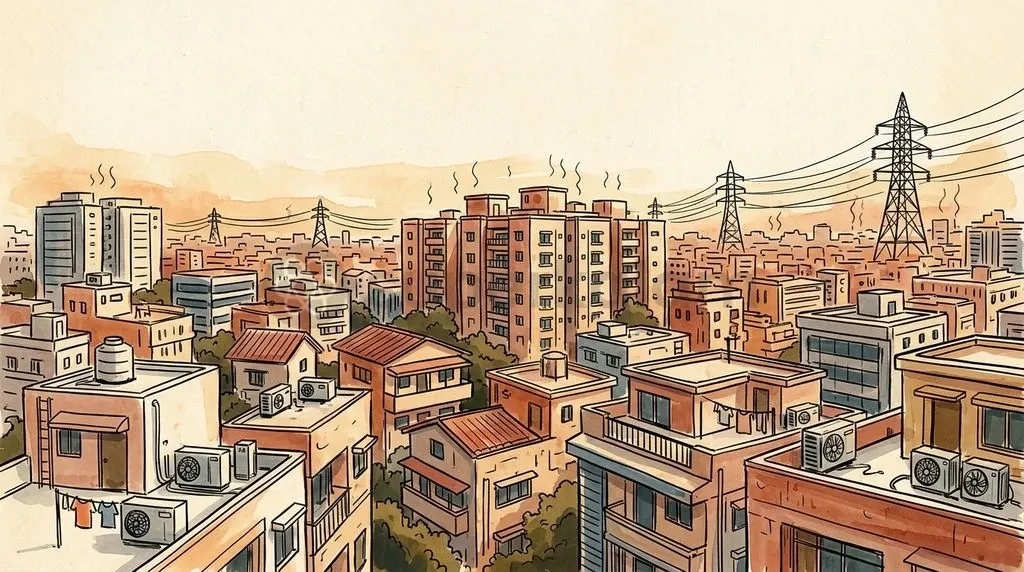
India faces a severe environmental governance challenge under the 2016 Kigali Amendment to the Montreal Protocol. Phasing down hydrofluorocarbons directly collides with surging air-conditioning demand and extreme heat vulnerability.
Reconciling international climate commitments with domestic socioeconomic realities forms a cooling trilemma. This triangle spans mandatory chemical phase-down schedules, power grid instability, and public health protections.
As of mid-2026, India is recording its three-year chemical consumption baseline while managing record peak electricity demand during severe summer heatwaves. Meeting environmental goals requires more than chemical substitution; it demands coupling low-global-warming refrigerants with urban passive cooling and building efficiency standards.
Why Kigali Amendment Matters Now: The 10-Year Mark and India's Baseline
The Kigali Amendment to the Montreal Protocol, adopted in October 2016, reaches its ten-year mark as India enters the final year of its chemical consumption baseline window. Under the treaty, India’s baseline is calculated as the average production and consumption of hydrofluorocarbons during 2024, 2025, and 2026, combined with 65% of its historic baseline for hydrochlorofluorocarbons.
Key domestic and legal milestones shaping India's compliance framework include:
- Treaty Ratification: The Union Cabinet approved ratification in August 2021, and India deposited its formal instrument in September 2021.
- Regulatory Preparation: As of March 2026, the Ministry of Environment, Forest and Climate Change is monitoring industrial output to prepare for a binding production and consumption freeze taking effect in 2028.
- Constitutional Imperative: The Supreme Court of India ruled in M.K. Ranjitsinh v. Union of India (2024) that citizens possess a fundamental right under Article 21 and Article 14 to be free from the adverse effects of climate change.
Meeting chemical compliance targets while shielding citizens from lethal urban heat has thus become a binding constitutional duty.
Discuss with Superkalam
Recall the four phased percentage reductions India must implement between 2032 and 2047 after its 2028 HFC consumption freeze.
Ask NowFrom Ozone Protection to Climate Action: Why HFCs Came Under the Montreal Protocol
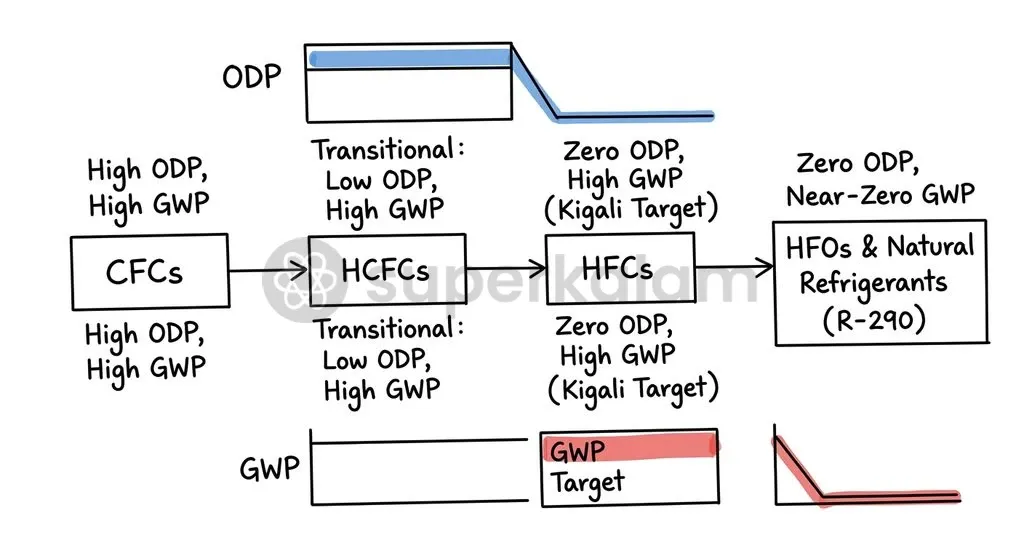
The Montreal Protocol on Substances that Deplete the Ozone Layer, adopted in 1987, originally focused on eliminating chemicals that destroy stratospheric ozone. Chlorofluorocarbons (CFCs) and hydrochlorofluorocarbons (HCFCs) contain chlorine atoms that break down ozone molecules, creating the Antarctic ozone hole. The global refrigeration industry introduced hydrofluorocarbons (HFCs) as commercial substitutes because they contain no chlorine.
Data from the World Meteorological Organization and the United Nations Environment Programme confirm that hydrofluorocarbons have an Ozone Depletion Potential of zero. However, HFCs created a severe climate dilemma. According to the Intergovernmental Panel on Climate Change (IPCC) Sixth Assessment Report, hydrofluorocarbons are powerful greenhouse gases with 100-year Global Warming Potentials (GWPs) thousands of times higher than carbon dioxide. For example, HFC-134a has a GWP of 1,430, while HFC-23 reaches a GWP of 14,800.
| Chemical Class | Ozone Depletion Potential (ODP) | 100-Year Global Warming Potential (GWP) | Regulatory Status Under Montreal Protocol | Primary Use Case in India |
|---|---|---|---|---|
| CFCs (e.g., CFC-12) | 1.0 (High) | 10,200 (Extremely High) | Completely phased out globally | Legacy domestic refrigeration |
| HCFCs (e.g., HCFC-22) | 0.055 (Moderate) | 1,760 (High) | Banned in new Indian equipment since 1 January 2025 | Commercial chillers, room ACs |
| HFCs (e.g., HFC-134a, HFC-32) | 0 (Zero) | 675 to 14,800 (High to Extreme) | Controlled under Kigali Amendment; freeze in 2028 | Modern split ACs, mobile air conditioning |
| Natural Refrigerants (e.g., R-290 Propane) | 0 (Zero) | ~3 (Negligible) | Unrestricted; recommended low-GWP alternative | Next-generation residential room ACs |
The Montreal Protocol operates with distinctive legal mechanisms that contrast sharply with the United Nations Framework Convention on Climate Change (UNFCCC). The Montreal Protocol enforces legally binding quantitative phase-down schedules and mandatory trade bans with non-parties under Article 4. Conversely, the Paris Agreement under the UNFCCC relies on voluntary, nationally determined contributions without punitive trade restrictions. Bringing HFCs under the Montreal Protocol transformed a treaty designed for ozone recovery into one of the world's most enforceable climate compacts.
The Cooling Trilemma: Three Competing Pressures on India
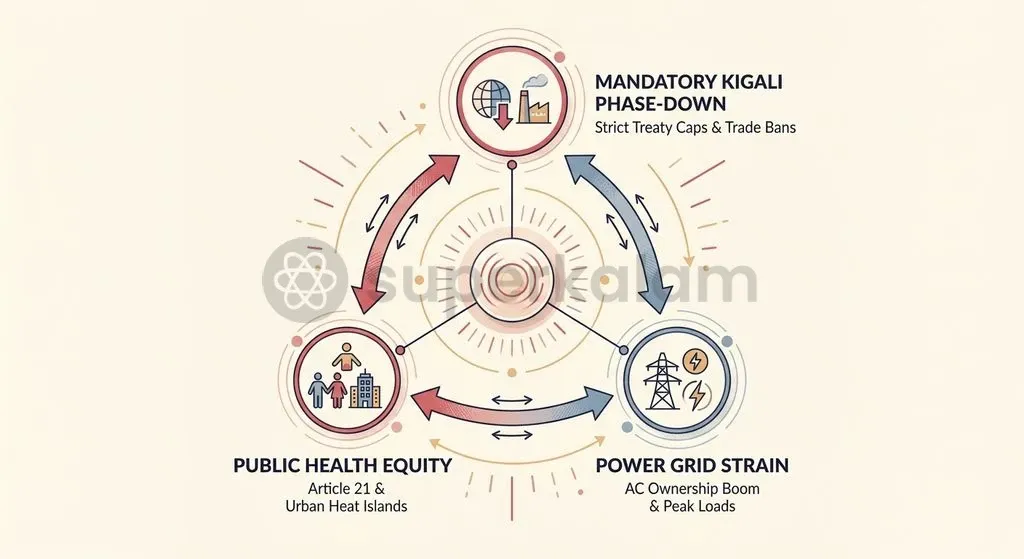
The cooling trilemma represents a policy triangle where India must reconcile environmental compliance, energy infrastructure reliability, and thermal equity. Policymakers cannot adjust one vertex without triggering direct trade-offs across the other two.
| Trilemma Vertex | Core Policy Pressure | Primary Mechanism & Impact |
|---|---|---|
| Mandatory Kigali Phase-Down | International compliance | Enforces legally binding production caps and trade bans under treaty oversight. |
| Power Grid Strain | Infrastructure stability | Summer cooling peaks create acute brownout risks and surge thermal power loads. |
| Public Health Equity | Social justice & Article 21 | High equipment and chemical costs risk locking low-income citizens out of life-saving cooling. |
Treating this transition purely as an industrial equipment retrofit misses the broader crisis. Chemical policies intersect directly with national energy security, grid stability, and human survival during peak summer temperatures.
Discuss with Superkalam
Explain why transitioning from HCFCs to HFCs resolved stratospheric ozone depletion but intensified global climate change.
Ask NowPressure 1: Cutting High-GWP Refrigerants on a Strict Timetable
India belongs to the Article 5 Group 2 category under the Kigali Amendment, granting it a later transition schedule than industrialised countries. The United Nations Environment Programme specifies that India's baseline calculation spans the years 2024, 2025, and 2026, supplemented by 65% of its historic HCFC baseline.
The phase-down trajectory requires India to freeze HFC consumption and production at this baseline level in 2028. Following the freeze, India must implement a structured schedule of four phased reductions:
- A 10% reduction relative to baseline levels by 2032
- A 20% reduction by 2037
- A 30% reduction by 2042
- An 85% plateau reduction by 2047
This schedule follows domestic chemical phase-out milestones. Under the Ozone Depleting Substances (Regulation and Control) Amendment Rules, India achieved the complete phase-out of HCFC-141b in polyurethane foam manufacturing on 1 January 2020. In parallel, the Ministry of Environment, Forest and Climate Change banned HCFCs in the manufacture of all new equipment starting 1 January 2025. Indian manufacturers transitioned rapidly from HCFCs to HFCs, and they must now replace those newly adopted chemicals on a compressed timeline.
Pressure 2: Heatwaves, Air Conditioner Boom, and Power Grid Strain
Rising summer temperatures and household incomes are driving an unprecedented expansion of residential space cooling across Indian cities. Data from the International Energy Agency indicates that domestic air conditioner ownership stands at approximately 8% to 10% of households, leaving immense headroom for market expansion. The overall room air conditioner inventory is projected to expand from roughly 30 million units to over 240 million units by 2030, and approach nearly 1.1 billion units by 2050.
This cooling expansion places acute structural strain on national power generation and distribution networks. The cascading impacts follow a clear operational chain:
- Surging Metropolitan Demand: Space cooling accounts for roughly 10% of India's annual electricity demand, but it drives up to 30% to 50% of peak evening electricity loads during summer heatwaves in major metropolitan areas such as Delhi, per estimates reported by the International Energy Agency.
- Solar Mismatch: Because residential cooling peaks during late evening hours when solar photovoltaic generation is offline, local utilities rely heavily on coal-fired thermal generation to maintain grid frequency.
- Compounding Emissions: If millions of consumers purchase low-efficiency air conditioners running on low-GWP refrigerants, grid-level carbon emissions continue to climb.
Replacing refrigerants alone does not eliminate the indirect carbon footprint caused by inefficient cooling units. Achieving the Kigali targets requires addressing equipment energy performance alongside chemical properties.
Discuss with Superkalam
How does the mismatch between evening peak cooling loads and solar generation hours impact India's reliance on thermal power during heatwaves?
Ask NowPressure 3: Cooling as a Public Health Right vs High Technology Costs
Extreme ambient heat represents a direct threat to human survival, turning access to thermal comfort into an urgent public health priority. Rapid urbanisation has created intense urban heat island effects, where asphalt and concrete trap heat and keep night-time temperatures elevated. For informal workers, slum communities, and agricultural labourers, cooling is an indispensable life-safety requirement.
A major policy tension emerges between maintaining market affordability and adopting advanced low-GWP refrigerants. This conflict centres on several economic barriers:
- Capital Cost Premiums: High purchase costs for imported, patent-protected alternative chemicals make next-generation appliances unaffordable for low-income households.
- Equity Exclusions: Regulatory mandates that inflate retail prices lock vulnerable socioeconomic groups out of mechanical cooling access.
- Health Vulnerabilities: Depriving low-income households of affordable thermal protection directly increases morbidity and heatstroke mortality during severe heatwaves.
Policymakers must ensure that international chemical phase-down targets do not compromise public health equity.
India Cooling Action Plan (ICAP) in Action: Ambition Versus Implementation Reality
The Ministry of Environment, Forest and Climate Change launched the India Cooling Action Plan (ICAP) in March 2019, establishing India as one of the first countries with a comprehensive 20-year cooling framework. ICAP integrates cooling across multiple sectors, including building space cooling, cold-chain logistics, transport air conditioning, and refrigerant production.
The policy sets specific quantitative targets to be achieved by the fiscal year 2037-38:
- Reducing cooling demand across various sectors by 20% to 25%
- Reducing national refrigerant demand by 25% to 30%
- Lowering cooling-related energy requirements by 25% to 40%
- Recognising cooling and thermal comfort as strategic national priorities
A key component of the plan focuses on servicing sector capacity. The Ministry established a programme to train and certify 100,000 servicing technicians in low-GWP refrigerant management and leak reduction in partnership with the Skill India Mission. Because refrigerant venting during maintenance forms a major source of direct fluorinated gas emissions, technician certification prevents accidental atmospheric releases.
Implementation gaps persist between national targets and municipal execution. While ICAP outlines ambitious long-term goals, statutory enforcement remains fragmented across different government bodies. Urban local bodies frequently lack the technical personnel needed to enforce cooling efficiency provisions in local building codes.
Discuss with Superkalam
Evaluate whether legally binding trade bans, like those under Article 4 of the Montreal Protocol, would be effective if applied under the UNFCCC Paris Agreement.
Ask NowRefrigerant Transition Roadblocks: Flammability, Patent Monopolies, and Safety Standards
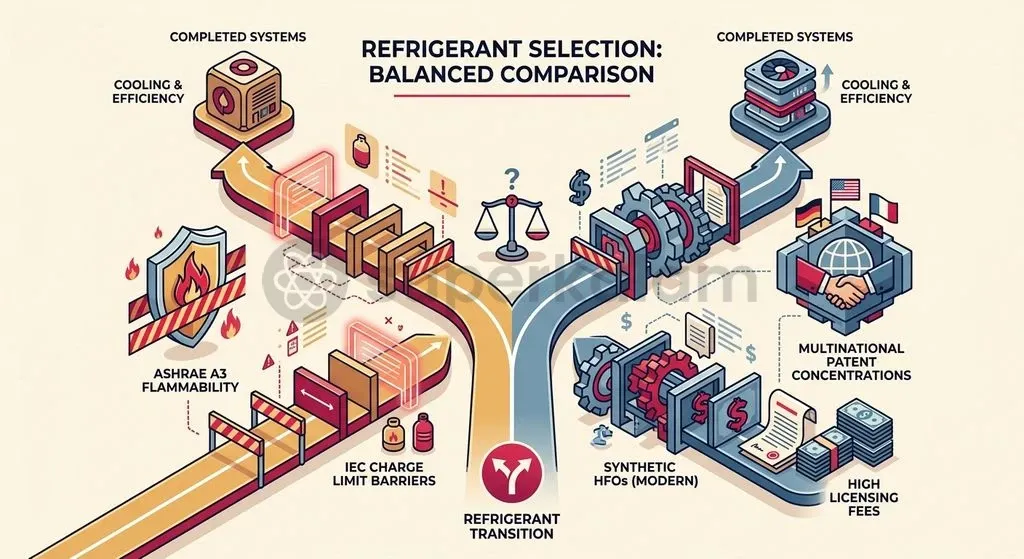
The domestic cooling industry encounters severe physical and commercial constraints when replacing high-GWP hydrofluorocarbons. The two primary replacement pathways face sharply contrasting hurdles:
- Natural Refrigerants (e.g., Propane R-290): Propane offers an Ozone Depletion Potential of zero and a 100-year GWP of approximately 3. However, ASHRAE Standard 34 categorises propane as an A3 highly flammable gas. Safety guidelines under IEC 60335-2-40 (Edition 7) enforce strict maximum refrigerant charge limits based on room floor area. These limits restrict cooling capacity, making it difficult for manufacturers to deploy R-290 in large split-system room air conditioners without expensive structural modifications.
- Proprietary Synthetic Alternatives (HFOs): Hydrofluoroolefins such as HFO-1234yf feature zero ODP and GWPs below 1. However, HFO production relies on patented manufacturing technologies concentrated among multinational chemical firms such as Honeywell and Chemours. Transitioning India's domestic equipment base to HFOs would require recurring royalty payments, raising production costs and increasing foreign supply dependencies for local manufacturers.
Ammonia and carbon dioxide are viable alternatives in industrial cold storage and commercial refrigeration systems. Yet, their toxicity and high operating pressures make them unsuitable for mass-market residential split air conditioning. The cooling sector remains caught between flammability limits and intellectual property barriers.
The Multilateral Fund and Technology Transfer: The Unresolved Global Equity Debate
The Multilateral Fund for the Implementation of the Montreal Protocol was created under Article 10 to assist developing nations with transition costs. The fund provides financing for the agreed incremental costs that Article 5 developing countries incur when retooling manufacturing facilities, licensing alternative chemicals, and training technicians.
Key equity dimensions underpinning the financial mechanism include:
- Common But Differentiated Responsibilities: The principle of Common But Differentiated Responsibilities and Respective Capabilities (CBDR-RC) forms the foundation of this mechanism. The Kigali Amendment operationalised this principle by creating three distinct phase-down schedules for developed nations, Article 5 Group 1 nations, and Article 5 Group 2 nations (including India).
- Funding Frameworks for Energy Efficiency: At its 95th meeting in December 2024, the Executive Committee of the Multilateral Fund approved updated funding guidelines for the HFC phase-down, establishing dedicated operational windows to support energy efficiency upgrades during refrigerant conversion.
- Capital Investment Shortfalls: Developing nations argue that historical allocations have fallen short of the capital investments required to restructure entire manufacturing sectors, particularly as domestic firms face expensive proprietary licensing fees for next-generation refrigerants.
Discuss with Superkalam
Propose policy interventions that ensure access to affordable cooling for low-income urban households without compromising India's Kigali Amendment commitments.
Ask NowWay Forward: Combining Passive Urban Architecture with Energy-Efficient Cooling
Resolving India's cooling trilemma requires moving beyond chemical replacement to implement integrated structural reforms. A multi-pronged decarbonisation strategy spans building envelopes, active appliance efficiency, and community-scale cooling:
- Passive Urban Architecture: Passive cooling design represents the first line of defence against rising cooling demand. According to the Bureau of Energy Efficiency, passive cooling interventions—such as cool roofs, external solar shading, appropriate window-to-wall ratios, and cavity-wall insulation—can reduce indoor ambient temperatures by 2°C to 5°C and lower mechanical cooling requirements by up to 25%.
- Mandatory Building Codes: Urban local bodies must incorporate building efficiency mandates into municipal building bylaws. Following the Energy Conservation (Amendment) Act 2022, the Bureau of Energy Efficiency established the Energy Conservation and Sustainable Building Code (ECSBC 2024) for commercial facilities and updated the Eco-Niwas Samhita (ENS 2024) for residential buildings. State governments must ensure mandatory code compliance for new commercial and high-density residential constructions.
- Appliance Efficiency Ratchets: Energy efficiency standards for active cooling equipment must continue to advance alongside chemical transitions. The Bureau of Energy Efficiency rates room air conditioners using the Indian Seasonal Energy Efficiency Ratio (ISEER), which evaluates appliance performance across ambient operating temperatures ranging from 24°C to 43°C. Effective 1 January 2026, the Bureau implemented stricter ISEER star rating thresholds, increasing minimum efficiency standards by 10% to 14% across label tiers.
- District Cooling Infrastructure: Large-scale commercial developments can adopt centralised district cooling systems. GIFT City in Gujarat operates India's first commercial district cooling system, which centralises chilled water production and distribution to cut cooling energy consumption by up to 30% compared to decentralised building chillers.
Combining district cooling systems with cool-roof initiatives and building efficiency codes allows India to protect vulnerable citizens from extreme heat while maintaining compliance with international climate agreements.
Key Takeaways
- The Kigali Amendment mandates that India freeze its production and consumption of hydrofluorocarbons in 2028, using a 2024–2026 baseline, followed by an 85% phase-down by 2047.
- Hydrofluorocarbons (HFCs) feature an Ozone Depletion Potential of zero but possess Global Warming Potentials thousands of times greater than carbon dioxide, making their regulation under the Montreal Protocol a critical climate priority.
- India's cooling trilemma balances three competing priorities: complying with binding international chemical phase-down targets, preventing power grid instability from surging air conditioner ownership, and guaranteeing thermal comfort as a basic public health right under Article 21.
- Flammability limits under IEC 60335-2-40 restrict the deployment of natural refrigerants like propane (R-290), while proprietary synthetic alternatives such as HFOs involve high patent costs.
- Sustainable compliance requires integrating chemical phase-downs with passive building design under Eco-Niwas Samhita 2024, district cooling systems, and Bureau of Energy Efficiency star-rating efficiency ratchets.
Mains Question
"The cooling trilemma in India is not merely an industrial equipment retrofit, but a complex intersection of international compliance, energy security, and constitutional rights." Critically analyse. (15 Marks)
Evaluate NowMains Question
Highlighting India's commitments under the Kigali Amendment, elucidate the major operational and infrastructural challenges associated with surging domestic space cooling demand. (10 Marks)
Evaluate NowPractice MCQs
QUESTION 1
With reference to the Kigali Amendment to the Montreal Protocol, consider the following statements:
- It mandates the phase-down of hydrofluorocarbons (HFCs) because of their high ozone depletion potential.
- India is placed under the Article 5 Group 2 category, requiring it to freeze its HFC consumption and production in 2028.
- Unlike the Paris Agreement, the Montreal Protocol enforces binding quantitative reduction schedules backed by mandatory trade bans with non-parties. Which of the statements given above is/are correct?
QUESTION 2
Regarding the regulation of refrigerants in India, consider the following statements:
- Under the Ozone Depleting Substances (Regulation and Control) Amendment Rules, India completely phased out HCFC-141b in polyurethane foam manufacturing by 1 January 2020.
- The Ministry of Environment, Forest and Climate Change banned the use of HCFCs in the manufacturing of all new equipment starting from 1 January 2025.
- Natural refrigerants such as R-290 (Propane) possess negligible global warming potential and zero ozone depletion potential. Which of the statements given above is/are correct?
QUESTION 3
Under the Kigali Amendment to the Montreal Protocol, how is India's chemical consumption baseline calculated?
QUESTION 4
Consider the following statements regarding cooling demand and the power grid in India:
- Space cooling accounts for up to 30% to 50% of peak evening electricity loads during summer heatwaves in major metropolitan areas such as Delhi.
- Residential cooling peaks during evening hours when solar photovoltaic generation is unavailable, causing reliance on thermal power generation.
- Current domestic air conditioner penetration in India exceeds 40% of all households. Which of the statements given above is/are correct?
QUESTION 5
Which of the following judicial pronouncements held that citizens possess a fundamental right under Article 21 and Article 14 to be free from the adverse effects of climate change?