WPI vs CPI: Why Index Divergence Distorts India's Inflation Policy
As wholesale and retail inflation diverge, distorted real rates and corporate margins challenge RBI policy, making index mechanics vital for UPSC aspirants.
Oct, 2026
•9 min read

Overview
The widening wedge between the Wholesale Price Index and the Consumer Price Index exposes a structural policy dilemma in India. Upstream factory-gate supply shocks and retail food pressures diverge. This rift distorts corporate earnings, national income accounting, and monetary policy calibration under the Reserve Bank of India's inflation-targeting mandate.
The Wholesale Price Index captures upstream industrial inputs and tradeable commodities. By contrast, the Consumer Price Index tracks retail household living costs dominated by food and essential services. This disconnect complicates macroeconomic management whenever headline gauges move in opposite directions:
- Distorted Real Rates: Deflator divergence skews borrowing costs between industrial producers and retail consumers.
- National Account Mismatches: Single-deflation methods misstate Gross Value Added when factory-gate prices drift.
- Income Redistribution: Price differentials shift economic value between corporate balance sheets and household budgets.
Aligning these price gauges through a dedicated Producer Price Index remains necessary for long-term fiscal and monetary coherence.
Why the Widening Gap Between WPI and CPI Matters Now
The divergence between wholesale and retail inflation shows how factory-gate input pressures split from the cost-of-living realities facing Indian households.
As of September 2026, price prints revealed two conflicting economic dynamics:
- Retail Inflation Pressure: Headline retail inflation measured by the All India Consumer Price Index stood at 5.54% year-on-year, propelled by a Consumer Food Price Index print of 7.74%, with rural inflation reaching 6.08% and urban inflation recorded at 4.88%.
- Upstream Factory-Gate Surge: Concurrently, provisional Wholesale Price Index inflation accelerated to 11.39% year-on-year, driven by a 25.85% surge in Fuel and Power, alongside increases of 9.76% in Manufactured Products and 8.67% in Primary Articles.
This index divergence carries direct policy consequences because India's legal monetary apparatus targets consumer prices alone:
- Statutory Inflation Anchor: Under Section 45ZA of the Reserve Bank of India Act, 1934, inserted via the Finance Act, 2016, the Central Government, in consultation with the Reserve Bank of India, legally mandates the inflation target in terms of the Consumer Price Index once every five years.
- Monetary Framework Origin: This statutory architecture adopted the recommendations of the Urjit Patel Committee report in 2014, establishing headline CPI-Combined as the sole nominal anchor under flexible inflation targeting.
- Transmission Blind Spot: When wholesale and retail gauges drift apart, central bank policy instruments address retail price pressures while remaining blind to upstream supply-chain stresses.
The Basket Divide: Factory-Gate Commodities vs Kitchen-Table Essentials
The National Statistics Office and the Office of the Economic Adviser construct inflation gauges with starkly divergent weighting architectures. Retail prices are monitored by the National Statistics Office under the Ministry of Statistics and Programme Implementation. The Wholesale Price Index comes from the Office of the Economic Adviser in the Department for Promotion of Industry and Internal Trade, Ministry of Commerce and Industry.
The two indices measure price changes at fundamentally different stages of transactions, creating an inherent compositional skew:
- Food and Agricultural Exposure: Under the 2012 series, the Consumer Price Index assigns a dominant 45.86% weight to food and beverages, making retail prints acutely sensitive to localized weather disruptions and perishable crop cycles. In contrast, Primary Articles in the Wholesale Price Index command a weight of only 22.76% under the 2022-23 base series.
- Manufactured and Industrial Weight: The Wholesale Price Index is primarily a measure of tradeable merchandise, allocating 63.12% to manufactured products and 14.11% to fuel and power across an expanded basket of 957 items.
- Treatment of the Services Sector: The Consumer Price Index incorporates non-tradable services including education, healthcare, transport, and housing, whereas the Wholesale Price Index completely excludes services, despite the sector generating over half of India's Gross Value Added.
- Energy Group Reclassification: In the 2022-23 revised series, crude petroleum and natural gas were shifted from Primary Articles into the Fuel and Power group to ensure sectoral consistency.
Discuss with Superkalam
Which statutory provision in the Reserve Bank of India Act, 1934 mandates the Consumer Price Index as India's legal inflation target?
Ask NowCorporate Margins vs Household Budgets: Who Bears the Inflation Burden?
The Reserve Bank of India observes that relative movements between wholesale and consumer indices determine how inflationary pressures redistribute income between firms and households. This transmission creates an economic tug-of-war between corporate gross margins and household purchasing power, depending on which gauge moves faster.
| Inflation Divergence Scenario | Intermediate Impact on Pricing | Net Macroeconomic Outcome |
|---|---|---|
| When WPI Outpaces CPI | Upstream commodity spikes and elevated wholesale transport costs elevate intermediate production expenses, but weak final demand prevents firms from transferring costs downstream. | Enterprises experience severe margin compression, curtailing fresh capital expenditure. |
| When CPI Outpaces WPI | Persistent retail food inflation erodes disposable family income even as soft wholesale prices reduce raw material costs for industrial enterprises. | Manufacturing firms benefit from expanded operating margins, creating an uneven macroeconomic environment where corporate profitability rebounds while lower-income household consumption slows down. |
Discuss with Superkalam
How does the complete exclusion of the services sector from WPI affect its ability to reflect overall economic price pressures?
Ask NowThe Policy Blind Spot: Why Index Divergence Confounds the RBI
The Monetary Policy Committee faces acute operational friction when Wholesale Price Index trends decouple from headline Consumer Price Index movements. Because statutory inflation targeting relies strictly on retail inflation, the Reserve Bank of India cannot formally adjust the policy repo rate to target factory-gate distress. This institutional design generates three major systemic distortions across the wider economy:
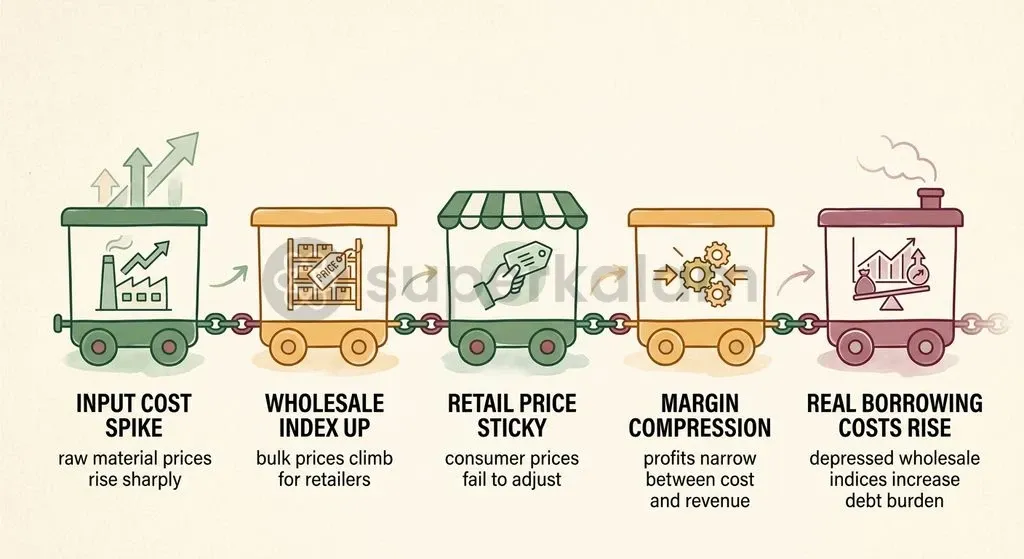
- The Real Interest Rate Conundrum: When wholesale prices contract or remain deeply depressed while retail food inflation remains elevated, monetary policy tightening based on the Consumer Price Index sharply drives up real industrial borrowing costs. Manufacturing producers face high nominal interest rates on credit while their factory-gate pricing power collapses.
- National Accounts Deflator Distortions: India's National Accounts utilise the Wholesale Price Index extensively as a price deflator for manufacturing Gross Value Added. When wholesale inflation diverges widely from consumer inflation, single-deflation methods distort real gross domestic product growth figures, misrepresenting true physical output expansion.
- Fiscal Arithmetic Complications: Subdued wholesale inflation depresses economy-wide nominal growth below Union Budget estimates. This dampens central tax buoyancy, elevating debt-to-GDP and fiscal-deficit-to-GDP ratios despite steady physical production volumes.
Discuss with Superkalam
If global oil and commodity prices surge while domestic farm output experiences a bumper harvest, how would WPI and CPI prints likely diverge?
Ask NowSide-by-Side Comparison: Mechanics, Weights, and Base Year Architecture
India's dual price indices rely on distinct commodity baskets, institutional compilers, and mathematical frameworks to measure domestic price pressures. Understanding these technical distinctions is essential for evaluating inflation metrics and their macroeconomic implications.
| Dimension | Wholesale Price Index (WPI) | Consumer Price Index (CPI-Combined) |
|---|---|---|
| Publishing Authority | Office of the Economic Adviser, DPIIT, Ministry of Commerce and Industry | National Statistics Office (NSO), Ministry of Statistics and Programme Implementation |
| Current Base Year | 2022-23 (expanded to 957 items) | 2024=100 (for latest releases) |
| Food Basket Weight | 22.76% (Primary Articles) | 45.86% (Food and Beverages under 2012 series) |
| Manufacturing Weight | 63.12% | Excluded as a dedicated group; manufactured items captured across consumer sub-categories |
| Services Sector | Completely excluded | Included (housing, health, transport, personal care, education) |
| Price Point Measured | First point of bulk sale / ex-factory basic price | Final retail transaction price paid by consumer |
| Statutory Policy Anchor | None (advisory metric for industrial and trade monitoring) | Sole legal nominal anchor under Section 45ZA of RBI Act, 1934 |
The Structural Gap: Why India Urgently Needs a Producer Price Index
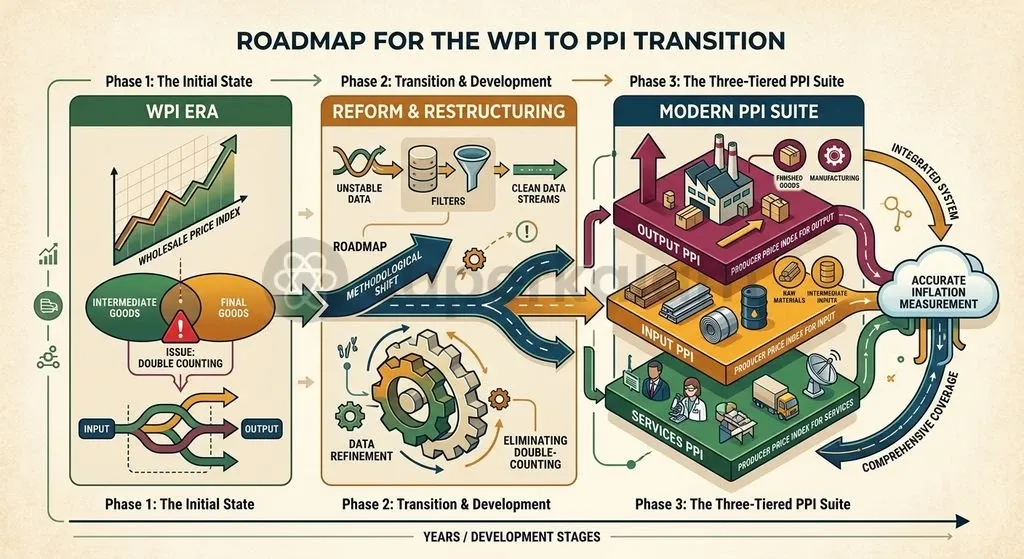
The Ministry of Commerce and Industry initiated structural reforms to replace the Wholesale Price Index with an internationally compliant Producer Price Index framework. The Wholesale Price Index suffers from chronic conceptual weaknesses recognised by global statistical authorities. According to the International Monetary Fund's Manual on Producer Price Indices, wholesale indices measure goods across mixed intermediate supply stages, creating pervasive double-counting errors as identical raw materials pass between intermediary dealers.
In contrast, a true Producer Price Index measures the net transaction value received by domestic producers at the basic ex-factory gate, excluding retail trade markups and indirect net taxes. The transition blueprint was formulated by the Working Group for Revision of WPI, chaired by Prof. Ramesh Chand.
In June 2026, the Department for Promotion of Industry and Internal Trade launched the experimental Producer Price Index suite. This architecture comprises:
- Output Producer Price Index: Gauging basic domestic prices received by primary and manufacturing producers without intermediate logistics markups.
- Trial Input Producer Price Index: Tracking cost variations in domestic and imported intermediate inputs consumed during manufacturing processes.
- Services Producer Price Index: Covering seven foundational service sectors, establishing a formal metric to measure price movements in India's dominant economic sector.
- Phased Transition Schedule: Establishing a five-year institutional roadmap to gradually retire the Wholesale Price Index.
Discuss with Superkalam
Why does using WPI as a manufacturing deflator under single-deflation methodology pose risks to national income accounting accuracy?
Ask NowWay Forward: Building a Coherent Inflation Dashboard for Macro Stability
Macroeconomic stability in India requires modernising price statistics to bridge statistical distortions across monetary policy and national accounts. The existing divergence confirms that relying solely on retail consumer metrics leaves policymakers with an incomplete picture of upstream supply challenges:
- Institutionalise Double Deflation: The Ministry of Statistics and Programme Implementation and the Department for Promotion of Industry and Internal Trade must adopt double-deflation methodology in national accounting. Deflating gross output by an Output Producer Price Index and intermediate consumption by an Input Producer Price Index eliminates distortions in real manufacturing Gross Value Added calculations.
- Incorporate PPI into Monetary Analysis: The Reserve Bank of India should incorporate the experimental Producer Price Index suite into its broader monetary policy monitoring framework. While headline retail inflation must remain the statutory anchor under the Reserve Bank of India Act, 1934, monitoring producer margins offers forward-looking intelligence on cost-push pressures, enhancing inflation forecasting precision before price increases reach retail markets.
- Realise Periodic Basket Revisions: Regular periodic basket revisions of consumption and production baskets remain imperative. Realigning base years ensures that official statistics capture shifting dietary patterns, digital service consumption, and industrial decarbonisation, equipping fiscal and monetary authorities with an accurate dashboard for economic governance.
Key Takeaways
- Section 45ZA of the Reserve Bank of India Act, 1934, inserted via the Finance Act, 2016, mandates headline Consumer Price Index as the sole statutory nominal anchor for monetary policy, based on the 2014 Urjit Patel Committee report.
- The Wholesale Price Index allocates 63.12% to Manufactured Products and 14.11% to Fuel and Power (2022-23 base series), while the Consumer Price Index allocates 45.86% to Food and Beverages (2012 series) and captures household services.
- A widening index gap redistributes financial pressures: when WPI exceeds CPI, corporate profit margins suffer input cost compression; when CPI outpaces WPI, retail household purchasing power contracts.
- Deflating industrial Gross Value Added with wholesale prices distorts real output estimates when wholesale and retail gauges diverge significantly.
- In June 2026, the Ministry of Commerce and Industry rolled out the Producer Price Index suite, formulated by the Prof. Ramesh Chand Working Group, to address double-counting and phase out the Wholesale Price Index over five years.
Mains Question
"Under Section 45ZA of the Reserve Bank of India Act, 1934, the adoption of CPI-Combined as the sole nominal anchor creates a transmission blind spot whenever upstream input costs decouple from retail prices." Critically examine. (15 Marks)
Evaluate NowMains Question
"Divergence between the Wholesale Price Index and the Consumer Price Index generates contrasting distributional impacts between corporate margins and household budgets." Elucidate. (10 Marks)
Evaluate NowPractice MCQs
QUESTION 1
With reference to the inflation measurement framework in India, consider the following statements:
- The Wholesale Price Index (WPI) is published by the National Statistics Office under the Ministry of Statistics and Programme Implementation.
- Non-tradable services such as education and healthcare are excluded from the Wholesale Price Index basket.
- Under Section 45ZA of the Reserve Bank of India Act, 1934, the statutory inflation target is defined in terms of the Consumer Price Index. Which of the statements given above are correct?
QUESTION 2
Consider the following statements regarding the commodity baskets and weightings of India's price indices:
- Under the 2012 series, food and beverages carry a weight exceeding 40% in the Consumer Price Index (CPI-Combined).
- Manufactured products account for more than 60% of the basket weight in the Wholesale Price Index (WPI) under the 2022-23 base series.
- In the 2022-23 revision of WPI, crude petroleum and natural gas were shifted from Fuel and Power to Primary Articles. Which of the statements given above is/are correct?
QUESTION 3
Consider the following statements regarding the macroeconomic implications of divergence between WPI and CPI in India:
- When WPI inflation significantly outpaces CPI inflation, manufacturing enterprises generally experience operating margin compression if cost pass-through is constrained.
- When CPI outpaces WPI, corporate profitability can expand even as household purchasing power weakens.
- In national income accounting, utilizing WPI as a price deflator for manufacturing Gross Value Added can distort real GDP estimates during periods of sharp index divergence. Which of the statements given above is/are correct?
QUESTION 4
The institutional transition to adopt headline CPI-Combined as the sole nominal anchor for flexible inflation targeting in India was based on the recommendations of which of the following?
QUESTION 5
Which of the following represents a primary reason why a persistent wedge between WPI and CPI complicates monetary policy calibration by the Reserve Bank of India?