China Plus One Strategy: Why State Ecosystems Beat PLI
Central PLI subsidies attract capital, but India's industrial rise hinges on competitive federalism across state land, utility, and labour ecosystems.
Oct, 2026
•11 min read
Overview
India's bid to capture global manufacturing relocating under the China Plus One strategy faces a structural test. Central fiscal subsidies cannot substitute for state-level industrial ecosystems.
The Union government committed over ₹1.97 lakh crore through Production Linked Incentive schemes. It also slashed corporate tax rates to attract global value chains. Yet, factories only take root where subnational governments provide reliable utilities, industrial land, rapid regulatory clearances, and housing for workers.
Subsidies may trigger early corporate interest. Sustained industrial depth requires structural reforms in land and labour governance managed by Indian states. As global firms diversify away from mainland China, India's success will turn on competitive federalism and ground-level execution, not central fiscal outlays alone.
Why Global Supply Chains Are Looking Beyond China Today
Multinational corporations are accelerating supply chain diversification away from mainland China. Three compounding vulnerabilities drive this reassessment:
- Erosion of low-cost labour: The Economic Survey 2023-24, published by the Ministry of Finance, observes that rising industrial wages across Chinese coastal provinces have steadily eroded the country's low-cost labour arbitrage.
- Escalating geopolitical risk: Tensions between the United States and China have introduced severe tariff risks and export controls on critical technologies.
- Vulnerability to sudden shutdowns: Corporate boards encountered acute disruptions during China's zero-COVID lockdowns. Those curbs paralysed oceanic shipping hubs and shuttered electronics component factories without warning.
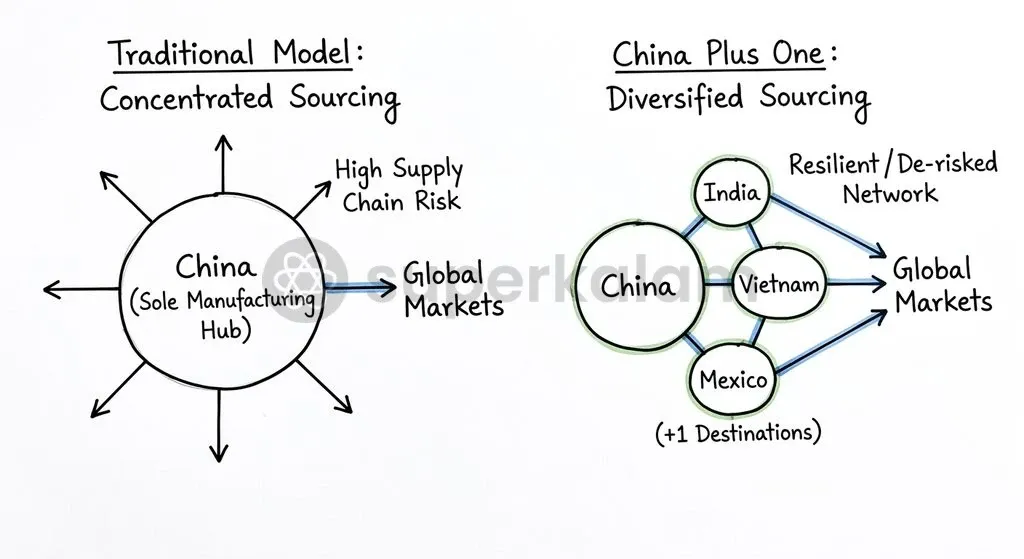
Single-geography sourcing has shifted from a cost-optimisation model into an existential operational risk. Global enterprises are establishing secondary production clusters outside China. This step secures business continuity, lowers concentration risks, and shields corporate balance sheets against sudden trade shocks.
Discuss with Superkalam
Recall the effective corporate tax rate established under Section 115BAB for newly incorporated domestic manufacturing companies.
Ask NowWhat Is the China Plus One Strategy?
The China Plus One strategy is a commercial risk-hedging framework. Multinational corporations establish manufacturing facilities in alternative developing nations while maintaining their primary Chinese operations. According to the Economic Survey 2023-24, the objective of this operational model is not a wholesale abandonment of the Chinese industrial base, but rather the systematic addition of complementary production nodes across alternative geographies.
Table: Structural Drivers of the China Plus One Strategy
| Dimension | Traditional China-Centric Model | China Plus One Hedging Model |
|---|---|---|
| Operational Priority | Maximum scale and lowest unit production cost | Resilience, geographic redundancy, and business continuity |
| Supply Chain Footprint | Concentrated upstream and downstream hubs within China | Primary facilities in China complemented by secondary regional hubs |
| Labour Dynamics | Historically cheap labour, now facing rising industrial wages | Utilisation of competitive wage structures in Southeast and South Asia |
| Geopolitical Exposure | Vulnerable to bilateral tariffs and unilateral export curbs | Multi-jurisdiction compliance insulating against trade restrictions |
| Inventory Philosophy | Strict "Just-in-Time" lean inventory delivery | Hybrid "Just-in-Case" buffers across alternative maritime corridors |
This strategy balances China's unmatched supplier density and domestic logistics against the stability provided by geographically dispersed assembly lines. For destination economies like India, the shift presents an opening to plug into high-value global manufacturing networks.
India's Opening Gambit: The Reliance on Central Cash Incentives and PLI
The Union government responded to supply chain shifts primarily through fiscal interventions. These measures centred on four specific financial and statutory instruments:
- Production Linked Incentive Scheme: Budgetary outlays under the central PLI framework were structured with a total allocation of ₹1.97 lakh crore across 14 key manufacturing sectors to offset India's domestic cost disabilities.
- Capital Investment Inflows: According to data presented in the Economic Survey 2025-26 from the Department for Promotion of Industry and Internal Trade (DPIIT), actual investments realised under the PLI scheme surpassed ₹2.0 lakh crore as of September 2025.
- Disbursement Realities: Aggregate incentive disbursements across all covered sectors stood at ₹23,946 crore, representing roughly 12 percent of the total envisaged outlay.
- Targeted Corporate Tax Cuts: Parliament passed the Taxation Laws (Amendment) Act, 2019, inserting Section 115BAB into the Income-tax Act. The statutory measure established a concessional 15 percent base corporate tax rate, resulting in an effective tax rate of approximately 17.16 percent including mandatory surcharge and cess for newly incorporated domestic manufacturing companies.
Capital allocations within the framework remain heavily concentrated. Ministry of Electronics and Information Technology (MeitY) data indicates that the Large-Scale Electronics Manufacturing sector received the largest single allocation, earmarked at ₹38,645 crore. The Centre also deployed selective Most-Favoured-Nation (MFN) tariff increases to encourage domestic intermediate substitution.
Discuss with Superkalam
Explain why the China Plus One strategy represents a shift from 'Just-in-Time' lean inventory management to a 'Just-in-Case' hedging model.
Ask NowThe Missing Foundation: What Makes a State Industrial Ecosystem Work?
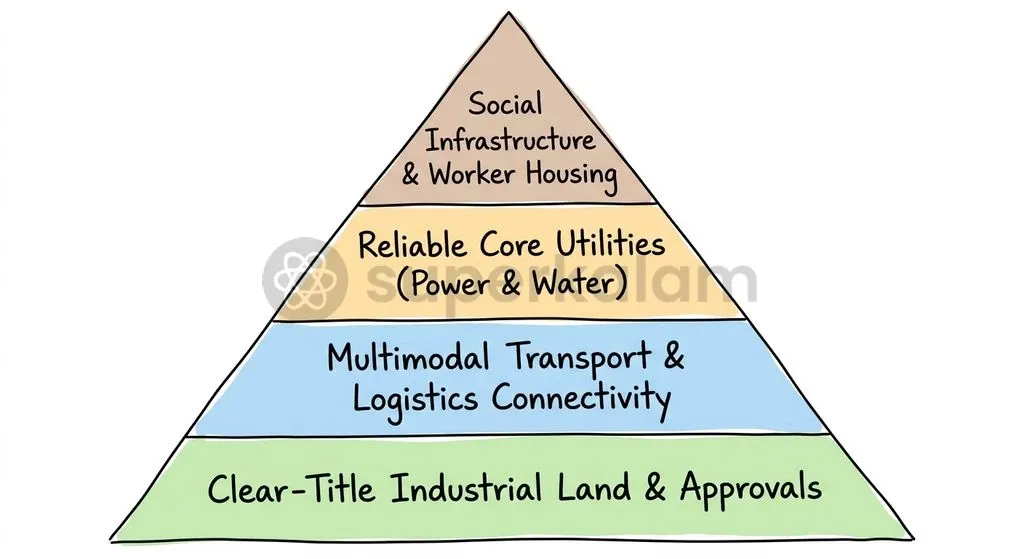
State industrial ecosystems determine whether incoming capital turns into sustained manufacturing output or stalls at the pilot phase. Under the Seventh Schedule of the Constitution of India, 'Land' is an exclusive State subject under Entry 18 of List II. This constitutional allocation leaves industrial site acquisition, agricultural-to-industrial land-use conversion, and spatial zoning entirely under the administrative purview of state governments.
Labour regulation operates under the Concurrent List through Entry 22 and Entry 24 of List III. While Parliament enacts broad national frameworks, state legislatures retain statutory powers to alter working hours, overtime compensation, and shift rules. Industrialists need predictable local ecosystems anchored by four interdependent pillars:
- Contiguous, Encumbrance-Free Land: Industrial parks with pre-cleared titles and existing municipal boundaries avoid protracted land acquisition disputes.
- Uninterrupted Utility Architecture: High-tension industrial power grids with zero voltage fluctuations, paired with dedicated industrial water recycling plants.
- Multi-Modal Transit Access: Direct expressway links to sea container terminals and inland container depots to streamline factory-to-port turnaround times.
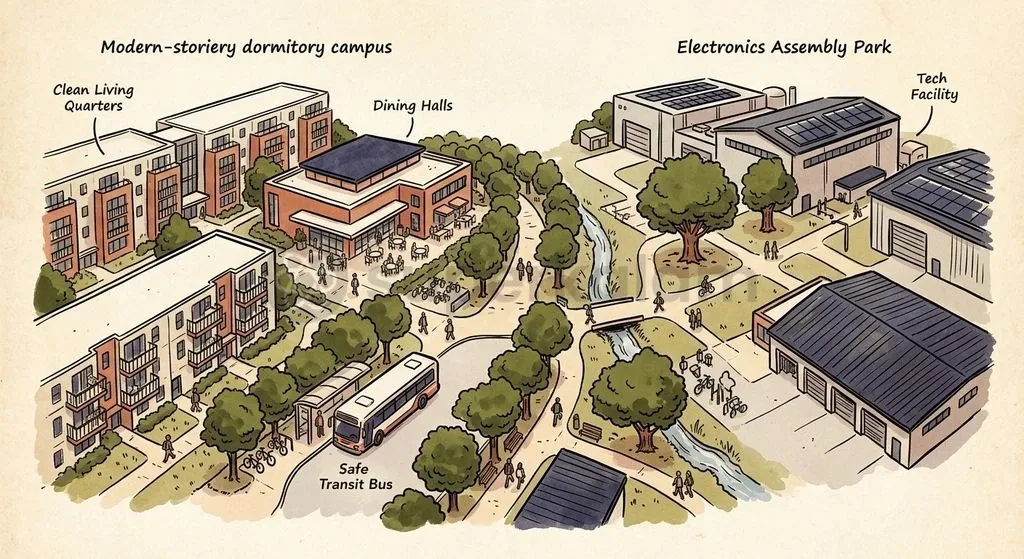
- Social Infrastructure: Safe rental housing, public transit, and primary healthcare clustered near industrial zones to support large technical workforces.
DPIIT's Business Reforms Action Plan (BRAP) evaluates these subnational operating environments by benchmarking regulatory single-window portals, construction permits, utility connections, and inspection rationalisation. States categorised as 'Top Achievers'—such as Tamil Nadu, Karnataka, Gujarat, and Andhra Pradesh—demonstrate that administrative velocity at the district collectorate level matters far more to factory managers than central tax notifications.
Cash vs Infrastructure: Why Subsidies Alone Cannot Retain Manufacturers
Production Linked Incentive sops offer temporary margin relief, but they cannot compensate for structural overheads incurred across fragmented logistics and supply networks. Factories face four key structural bottlenecks:
- High Applied Import Tariffs: According to World Tariff Profiles 2024 published by the World Trade Organization (WTO), India's simple average applied MFN tariff stood at approximately 17 percent. This rate is substantially higher than Vietnam's 9.4 percent and China's 7.5 percent, penalising export-oriented assembly operations that depend on specialised sub-assemblies.
- Restrictions on Upstream Component Suppliers: The pre-budget Economic Survey 2023-24 argued that to benefit from the China Plus One shift, India should actively encourage Foreign Direct Investment (FDI) from China. However, under DPIIT Press Note 3 (2020 Series), foreign investments from countries sharing a land border with India require mandatory prior approval from the central government across all sectors.
- High Bilateral Component Deficits: India recorded a bilateral trade deficit of approximately $85 billion with China in FY 2023-24, heavily driven by imported electronic parts, capital goods, and active pharmaceutical ingredients.
- Limited Domestic Value Addition: In smartphone assembly, domestic value addition is reported to have increased from an initial baseline of 8-10 percent to approximately 18-19 percent by FY26.
Subsidies alone cannot neutralise external dependency. Without comprehensive vendor ecosystems, finished assembly lines remain exposed to sudden import bottlenecks.
Discuss with Superkalam
If you were the Industries Commissioner of an inland state, how would you design an industrial cluster to overcome the lack of direct coastal port access?
Ask NowLearning from Rivals: Why Vietnam and Mexico Won the Early Wave
Vietnam and Mexico captured a dominant share of early supply chain relocations by offering integrated trade environments and predictable regulatory regimes. According to the WTO Regional Trade Agreements Database, Vietnam maintains duty-free market access across key advanced export destinations through plurilateral pacts, including the EU-Vietnam Free Trade Agreement (EVFTA), CPTPP, and the Regional Comprehensive Economic Partnership (RCEP).
India officially withdrew from RCEP negotiations in November 2019, citing inadequate safeguards against import surges, trade deficit concerns, and lack of circumvention rules. This decision left Indian exporters outside Asia's largest integrated tariff-free production zone, reinforcing tariff boundaries between domestic assemblers and regional intermediate suppliers.
Table: Strategic Comparison: India vs Vietnam in Global Supply Chain Capture
| Policy / Operational Factor | India | Vietnam |
|---|---|---|
| Simple Average Applied Tariff | ~17.0% (WTO 2024 Profile) | 9.4% (WTO 2024 Profile) |
| Plurilateral Trade Architecture | Outside RCEP and CPTPP; bilateral deals in progress | Member of RCEP, CPTPP, and EVFTA |
| Border Investment Rules | Mandatory prior central clearance under Press Note 3 (2020) | Open investment regime for Chinese component suppliers |
| Subnational Authority | Fragmented between 28 States (List II Land, List III Labour) | Centralised industrial zoning and standard national labour rules |
| Logistics Performance Index | Ranked 38th out of 139 nations (World Bank LPI 2023) | Strong intra-Asia maritime feeder connectivity |
Mexico leveraged its contiguous border with the United States and the United States-Mexico-Canada Agreement (USMCA) to capture nearshoring capital, offering zero-tariff cross-border transit. Vietnam paired modest corporate incentives with rapid land development, enabling global electronics majors to establish operations with minimal administrative friction.
Discuss with Superkalam
Compare the trade-offs of India's withdrawal from RCEP: protecting domestic intermediate industries from import surges versus integrating into Asian electronics supply chains.
Ask NowA Tale of Different States: Why Investment Gathers in Only a Few Hubs
Subnational policy divergence across Indian states has concentrated advanced manufacturing investments within a small handful of industrialised coastal corridors:
- Karnataka (Shift Flexibility): The Karnataka Legislative Assembly enacted the Factories (Karnataka Amendment) Act, 2023, permitting 12-hour factory work shifts and night shifts for women workers to match global electronics contract assembly schedules.
- Tamil Nadu (Social Infrastructure): The Government of Tamil Nadu tabled the Factories (Tamil Nadu Amendment) Bill, 2023 to enable similar 12-hour work shifts, but revoked the legislative amendment following widespread protests from trade unions and allied political parties. Despite this reversal, Tamil Nadu sustained inflows by building public infrastructure.
- Foxconn Dormitory Benchmark: In August 2024, the Tamil Nadu government inaugurated a ₹706.5 crore industrial housing facility built by the State Industries Promotion Corporation of Tamil Nadu (SIPCOT) at Vallam Vadagal, Sriperumbudur. The facility provides dormitory accommodations for 18,720 women workers employed at Foxconn's iPhone assembly facility, resolving a major operational bottleneck in worker logistics.
Hinterland states often fail to attract these investments despite offering generous stamp-duty exemptions and capital subsidies. Without functioning single-window systems, reliable industrial feeders, and integrated social housing, inland industrial estates struggle to compete against established clusters in Tamil Nadu, Gujarat, and Maharashtra.
Way Forward: How Indian States Can Build Self-Sustaining Manufacturing Hubs
Indian states must transition from offering cash concessions to constructing durable, plug-and-play industrial platforms that systematically lower the cost of doing business. The National Logistics Policy (NLP), launched in September 2022, established targets to improve India's ranking into the top 25 countries of the World Bank Logistics Performance Index by 2030.
According to a joint assessment conducted by DPIIT and the National Council of Applied Economic Research (NCAER), India's national logistics cost stood at 7.97 percent of GDP for FY 2023-24. India ranked 38th out of 139 nations in the World Bank Logistics Performance Index (LPI) 2023 with an overall score of 3.4, rising six places from 44th in 2018. Notably, Indian container ports achieved an average vessel turnaround time of 0.9 days in 2023, outperforming several advanced maritime trading hubs.
Building upon these maritime gains requires systematic subnational interventions across key areas:
- Spatial Coordination via PM GatiShakti: The PM GatiShakti National Master Plan integrates spatial geographic information systems (GIS) data across 16 central ministries to coordinate multimodal infrastructure planning. State planning departments must integrate municipal GIS maps with GatiShakti portals to prevent utility cuts and streamline factory road links.
- Node Execution under Industrial Corridors: The National Industrial Corridor Development Programme encompasses 11 greenfield industrial corridors with 32 approved nodes implemented via Centre-State special purpose vehicles. State administrations must accelerate clear-title land pooling for these SPV nodes.
- Institutionalised Worker Housing: States should adopt the Union Budget 2024-25 provision supporting rental housing with dormitory-style accommodations for industrial workers in public-private partnership mode with viability gap funding. Developing safe housing clusters adjacent to manufacturing nodes reduces absenteeism and stabilises local labour forces.
- Predictable Tariff and Regulatory Timelines: State investment promotion agencies should coordinate with the Centre to establish clear roadmaps for tariff rationalisation, reducing operational uncertainty for foreign component manufacturers.
Discuss with Superkalam
Assess whether central production subsidies or state-level regulatory speed under the Business Reforms Action Plan (BRAP) plays a more decisive role in long-term capital retention.
Ask NowKey Takeaways
- The China Plus One strategy involves multinational corporations diversifying production footprints by adding secondary hubs outside China to hedge against geopolitical friction, zero-COVID supply shocks, and rising Chinese wages.
- The Union government committed ₹1.97 lakh crore under the Production Linked Incentive (PLI) scheme, realizing over ₹2.0 lakh crore in cumulative investments, while disbursing ₹23,946 crore—approximately 12 percent of the outlay—as of September 2025.
- Constitutional distribution of powers places Land under Entry 18 of List II (State List) and Labour under Entries 22 and 24 of List III (Concurrent List), making subnational policy environments the primary determinant of manufacturing success.
- India's applied MFN tariff of approximately 17 percent remains higher than Vietnam's 9.4 percent, while domestic value addition in smartphone assembly is reported to have increased to roughly 18-19 percent by FY26.
- India improved its World Bank Logistics Performance Index ranking to 38th in 2023, with national logistics costs estimated at 7.97 percent of GDP for FY 2023-24, while port vessel turnaround times reached 0.9 days.
- Divergent state responses—such as Karnataka's 12-hour shift law and Tamil Nadu's ₹706.5 crore SIPCOT worker housing facility—demonstrate that physical infrastructure and municipal support outweigh central fiscal sops.
Mains Question
'Central fiscal subsidies cannot substitute for state-level industrial ecosystems.' In light of the implementation of the Production Linked Incentive (PLI) scheme, critically examine the structural bottlenecks that subnational governments must resolve to capture relocating global supply chains. (15 Marks)
Evaluate NowMains Question
Highlighting India's withdrawal from the Regional Comprehensive Economic Partnership (RCEP) and the tariff differentials cited in the WTO World Tariff Profiles 2024, evaluate India's competitiveness vis-à-vis rival destinations like Vietnam in attracting China Plus One investments. (10 Marks)
Evaluate NowPractice MCQs
QUESTION 1
Regarding the constitutional division of powers concerning industrial ecosystem inputs in India, consider the following statements:
- 'Land' is an exclusive State subject under Entry 18 of List II in the Seventh Schedule.
- Labour regulation falls under the Concurrent List through Entry 22 and Entry 24 of List III.
- State legislatures are precluded from modifying working hours or shift regulations enacted by national labour statutes. Which of the statements given above is/are correct?
QUESTION 2
Consider the following statements regarding the Production Linked Incentive (PLI) scheme and related fiscal measures cited in recent Economic Surveys:
- The Union government earmarked a total budgetary outlay of over ₹1.97 lakh crore across 14 manufacturing sectors.
- According to DPIIT data in the Economic Survey 2025-26, actual incentive disbursements exceeded 50 percent of the total envisaged outlay by September 2025.
- The Taxation Laws (Amendment) Act, 2019 introduced Section 115BAB, offering a concessional base corporate tax rate of 15 percent for eligible new domestic manufacturing companies. Which of the statements given above are correct?
QUESTION 3
With reference to India's regulatory and trade environment as highlighted in the article, consider the following statements:
- Under DPIIT Press Note 3 (2020 Series), foreign direct investments from countries sharing a land border with India require mandatory prior government approval across all sectors.
- India's simple average applied MFN tariff according to WTO World Tariff Profiles 2024 is lower than that of Vietnam and China.
- In smartphone assembly, domestic value addition in India reached approximately 18-19 percent by FY26. Which of the statements given above is/are correct?
QUESTION 4
Which of the following bodies evaluates subnational operating environments in India using the Business Reforms Action Plan (BRAP) to benchmark single-window systems, construction permits, and utility connections?
QUESTION 5
Consider the following statements regarding the global 'China Plus One' strategy and trade agreements:
- The strategy seeks the complete and immediate relocation of multinational manufacturing away from mainland China.
- India withdrew from the Regional Comprehensive Economic Partnership (RCEP) negotiations in November 2019 citing inadequate safeguards against import surges and circumvention. Which of the statements given above is/are correct?