India-US Trade Deal: Why Interim Pacts Cannot Replace an FTA
While early-harvest tariff pacts offer quick bilateral wins, overcoming deep regulatory and agricultural barriers remains essential for a true free trade pact.
Oct, 2026
•12 min read
Context
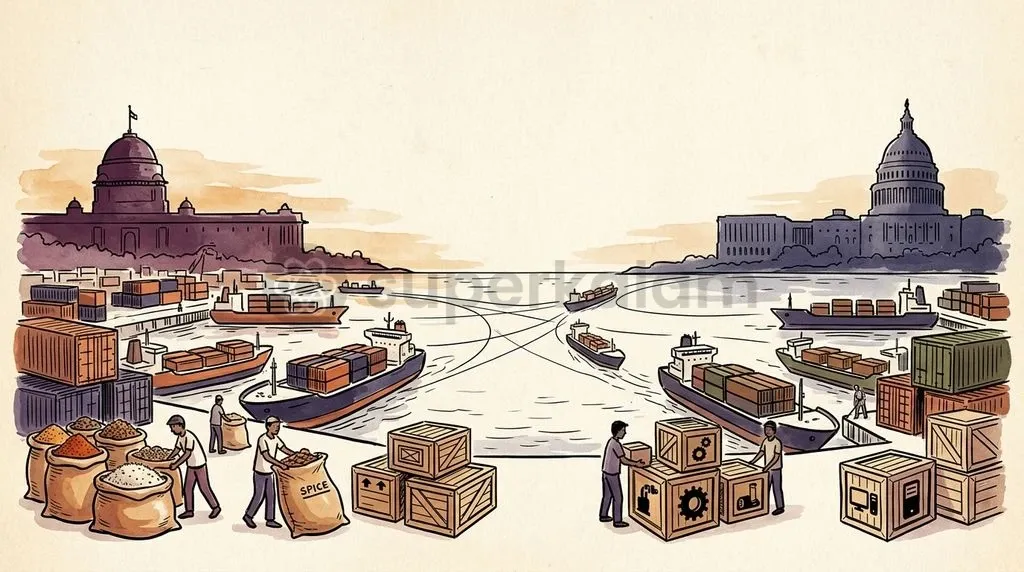
Expanding geopolitical alignment has accelerated bilateral technology and defence collaboration between New Delhi and Washington. Even so, incremental interim trade pacts cannot substitute for a comprehensive Free Trade Agreement. They bypass fundamental statutory, agricultural, and multilateral legal barriers separating both economies.
Bilateral merchandise and services trade surpassed $190 billion in 2023. Yet formal integration remains constrained by entrenched differences over market access, intellectual property, and trade-distorting domestic regulations. Selective sectoral arrangements offer immediate tariff relief on targeted goods, but they fail to establish binding legal frameworks capable of resolving core structural disputes under international trade law.
Why in the News: The Push for an Early Harvest Trade Agreement
Bilateral trade diplomacy between India and the United States has accelerated through ministerial dialogues within the United States-India Trade Policy Forum (TPF), seeking incremental market-access pacts. As of October 2026, both governments continue exploring early-harvest mechanisms to lower tariff barriers on non-sensitive industrial goods and agricultural products without committing to a full-fledged Free Trade Agreement (FTA).
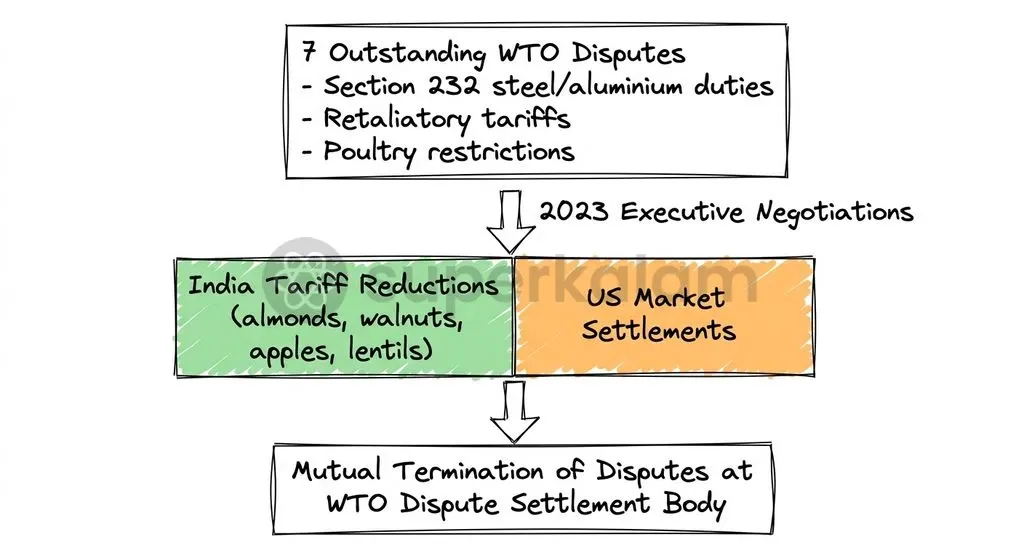
This incremental strategy attempts to build economic convergence alongside expanding strategic ties, building upon the successful bilateral resolution of long-standing trade irritants:
- Terminating Six WTO Disputes (June 2023): Both nations mutually terminated six outstanding World Trade Organization (WTO) disputes. That resolution led New Delhi to dismantle retaliatory tariffs on US goods including chickpeas, lentils, almonds, walnuts, and apples, as confirmed by the Office of the United States Trade Representative (USTR).
- Settling the Poultry Impasse (September 2023): Both capitals settled their final pending WTO dispute regarding poultry (DS430). This agreement lowered Indian duties on US cranberries, blueberries, and turkey to between 5% and 10%.
Yet these ad-hoc resolutions have not culminated in a broader institutional framework. The push for an interim trade arrangement reflects a tactical compromise. It captures low-hanging economic gains while shelving politically explosive disputes over subsidies, dairy certifications, and digital taxation.
Why Both Capitals Want an Interim Agreement Now
Strategic supply-chain realignment drives Washington and New Delhi toward pragmatic, short-term economic deals to hedge against regional geopolitical instability. Both capitals pursue targeted economic integration through specific strategic channels:
- Technology and Defence Integration: Both administrations view selective trade liberalisation as an economic counterpart to expanding technological partnerships. A key example is the Initiative on Critical and Emerging Technologies (iCET) launched in January 2023 to advance co-production in semiconductors, artificial intelligence, and defence innovation.
- Critical Mineral Supply Security: India joined the US-led 14-partner Minerals Security Partnership (MSP) in June 2023. The move marked a joint commitment to secure critical mineral supply chains outside monopolised processing hubs.
- Indo-Pacific Supply-Chain Resilience: Commercial arrangements with its largest single trading partner anchor long-term Indo-Pacific economic resilience, especially as bilateral trade crossed $190 billion in 2023.
- Safeguarding Domestic Autonomy: An interim pact provides immediate tariff relief for domestic exporters without accepting binding external conditionalities on domestic social programmes. India previously opted out of the Trade Pillar of the Indo-Pacific Economic Framework for Prosperity (IPEF) in September 2022, citing sovereignty concerns regarding stringent, enforceable disciplines on labour standards, environmental rules, and cross-border data flows.
An interim bilateral deal allows India to pursue export diversification while shielding sensitive domestic constituencies from sudden external competition.
Discuss with Superkalam
Which specific WTO dispute between India and the United States was resolved in September 2023 regarding agricultural imports?
Ask NowInside the Deal: What Low-Hanging Fruit Can Actually Be Harvested?
Targeted tariff rollbacks and reciprocal non-tariff barrier rationalisation form the operational core of recent bilateral trade breakthroughs. Rather than undertaking across-the-board liberalisation, both nations have focused on specific commodity categories that bypass domestic regulatory vetos.
A concrete example occurred when the Ministry of Finance issued Customs Notification No. 12/2023, reducing the basic customs duty on imported fresh and dried pecans from 100% to 30%. Similar tariff cuts on US agricultural products—including blueberries, cranberries, and tree nuts—demonstrated that selective agricultural tariff realignments remain feasible through executive action.
- Customs Duty Rationalisation: Reciprocal duty reductions on specialised industrial intermediate goods, diagnostic reagents, and high-value agricultural imports.
- Administrative Trade Facilitation: Easing documentation bottlenecks and technical conformity assessment procedures evaluated periodically under the ministerial Trade Policy Forum (TPF).
- Digital Tax Concessions: Rationalising unilateral digital taxation mechanisms to avert international trade friction.
- Selective Agricultural Access: Streamlined import clearances for high-end horticultural goods that do not directly suppress domestic smallholder farm gate prices.
A major structural friction point was eased when Section 168 of the Finance (No. 2) Act, 2024 abolished India's 2% Equalisation Levy on foreign e-commerce operators, effective August 1, 2024. In cross-border data management, Section 16 of the Digital Personal Data Protection Act, 2023 institutionalised a liberalised transfer model. This permits cross-border personal data flows unless explicitly barred via a central government negative notification. These legislative revisions demonstrate that statutory friction can be dismantled selectively when mutual economic incentives align.
The Hard Wall: Agriculture, Price Controls, and Digital Governance
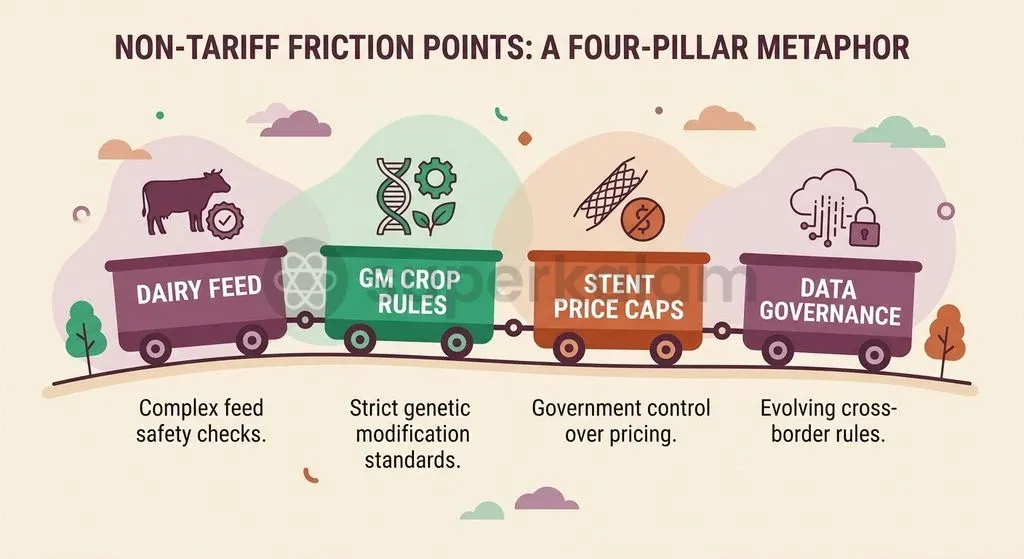
Sovereign domestic policy imperatives create an unyielding structural impasse that prevents interim concessions from expanding into an economy-wide free trade agreement. Bilateral friction centres on three deeply contested domains: sanitary and phytosanitary rules in agriculture, healthcare pricing interventions, and domestic support structures.
In agriculture, India's Department of Animal Husbandry and Dairying enforces strict religious and cultural sanitary mandates. Under Notification F.No. L-110110/12/2019-Trade, all imported dairy products must carry an integrated veterinary health certificate confirming that exporting animals were never fed internal ruminant tissues, blood meal, or mammalian feeds. Because standard US commercial livestock practices permit animal feed ingredients that violate these requirements, American dairy products remain effectively excluded from the Indian market.
Genetically modified (GM) crops face an equally strict regulatory barrier. The Food Safety and Standards Authority of India mandates non-GM origin and GM-free certificates for consignments of 24 major imported food crops. Furthermore, under the 1989 Rules framed via the Environment (Protection) Act, 1986, the commercial import or release of any genetically modified organism is prohibited unless cleared by the Genetic Engineering Appraisal Committee.
| Sector | Core Regulatory Mechanism / Policy Impasse |
|---|---|
| Dairy Imports | DAHD veterinary health certificate mandating ruminant-free and blood-meal-free feed. |
| GM Crop Imports | FSSAI GM-free certification for 24 crops; mandatory statutory clearance from GEAC. |
| Healthcare Pricing | NPPA maximum price ceilings on coronary stents and knee implants via Para 19 of DPCO, 2013. |
| Domestic Farm Aid | Shielding Minimum Support Price stockholding using the WTO 2013 Bali Peace Clause. |
In healthcare, the National Pharmaceutical Pricing Authority enforces statutory price caps on coronary stents and orthopaedic knee implants under Paragraph 19 of the Drugs (Prices Control) Order, 2013, invoking public interest interventions to keep life-saving medical devices affordable. US medical device exporters have long protested these rigid ceiling prices, demanding market-based tiered pricing. Finally, India continues to shield its Minimum Support Price agricultural procurement under the 2013 WTO Bali Ministerial Peace Clause, rejecting US demands to dismantle public stockholding subsidies.
Discuss with Superkalam
Why is an 'early harvest' or interim trade agreement tactically appealing to trade negotiators compared to a comprehensive FTA?
Ask NowThe Legal Dilemma: US Congressional Oversight and WTO Article XXIV
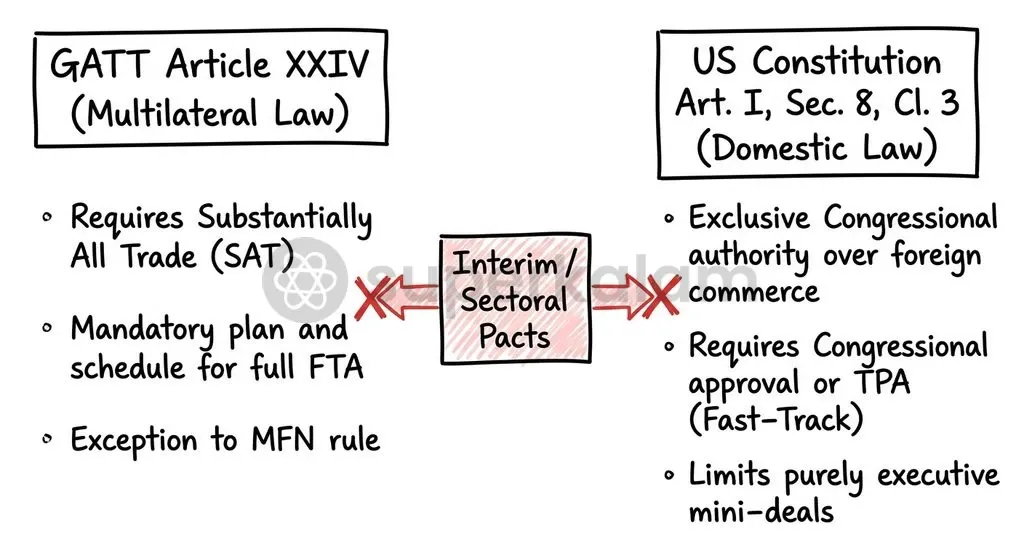
International trade law and US constitutional checks severely restrict the legal durability of informal or interim bilateral trade arrangements. Under Article I, Section 8, Clause 3 of the United States Constitution, the authority to regulate foreign commerce and adjust tariff rates resides exclusively with the US Congress. Consequently, the US Executive cannot unilaterally lower statutory tariff lines through non-binding executive agreements without congressional statutory authorisation.
This constitutional limitation is intensified by the lapse of Trade Promotion Authority (TPA). Enacted under the Bipartisan Congressional Trade Priorities and Accountability Act of 2015, TPA expired on July 1, 2021, and has not been reauthorised by Congress. Without TPA, any negotiated trade treaty that alters US tariffs faces unrestricted congressional amendments, stalling prospective bilateral agreements.
At the same time, the Office of the USTR retains the statutory option to initiate unilateral trade investigations under Section 301 of the Trade Act of 1974, maintaining persistent policy uncertainty for Indian exporters.
| Requirement | Legal Provision and Mandate |
|---|---|
| Substantially All the Trade | GATT Article XXIV:8(b) mandates total tariff elimination across sectors. |
| Interim Timeframe Threshold | Understanding on Art XXIV limits an interim plan to a maximum of 10 years. |
| Clear Implementation Plan | GATT Article XXIV:5(c) requires a firm schedule to achieve a complete FTA. |
| Prohibition on North-South Selective Concessions | 1979 Enabling Clause shields deals exclusively between developing states. |
Multilaterally, selective interim agreements face formidable scrutiny under the General Agreement on Tariffs and Trade (GATT 1994). Article XXIV:8(b) dictates that a legitimate Free Trade Area must eliminate restrictive duties on substantially all the trade between constituent territories. When nations enter an interim arrangement leading to an FTA, Article XXIV:5(c) mandates that the pact must incorporate an explicit, time-bound plan and schedule to achieve complete formation.
Paragraph 3 of the WTO Understanding on the Interpretation of Article XXIV specifies that this transitional timeframe should exceed 10 years only in exceptional circumstances. Because the 1979 WTO Enabling Clause applies exclusively to preferential pacts signed solely between developing nations, a preferential North-South deal between India and the US cannot rely on it to escape legal scrutiny. As codified under Article I:1 of GATT 1994, any selective tariff reduction extended bilaterally violates the Most-Favoured-Nation principle and invites dispute settlement challenges from third-party nations unless sheltered by Article XXIV compliance.
Discuss with Superkalam
How might India's reliance on the WTO Bali Peace Clause for Minimum Support Price buffer stocks affect its bargaining power in future bilateral tariff talks?
Ask NowPostponing or Resolving? The Risk of Mini-Deal Complacency
Relying indefinitely on incremental mini-deals threatens to erode the political appetite required to achieve comprehensive bilateral economic integration. Early harvest pacts are tactical safety valves. They dissipate bilateral diplomatic friction by packaging isolated regulatory concessions as major breakthroughs.
Analytic trade assessments highlighted in Congressional Research Service reports indicate that piecemeal deals generate specific structural risks:
- Erosion of Cross-Sectoral Leverage: Piecemeal deals cherry-pick low-hanging tariff concessions, depleting the cross-sectoral leverage essential to broker deep, legally binding FTAs. In conventional trade negotiations, sensitive domestic sectors are liberalised in exchange for market access gains in competitive export categories.
- Entrenchment of Domestic Protectionism: When intermediate pacts peel away accessible sectors, domestic interest groups opposing wider market openings face reduced pressure to reform.
- Prolonged Stalemate on Core Benefits: India's loss of preferential tariff access under the US Generalized System of Preferences (GSP) remains unaddressed. The United States revoked India's GSP beneficiary eligibility in June 2019 via Presidential Proclamation 9902, after determining that New Delhi had failed to provide equitable and reasonable market access. Instead of using GSP restoration as leverage to settle broader structural impasses, both capitals have bypassed the issue through ad-hoc administrative workarounds.
Comparing Approaches: Comprehensive FTAs vs Incremental Sectoral Pacts
Strategic trade policy can be pursued through comprehensive bilateral treaties or through sequential, single-issue agreements. The following table contrasts the institutional mechanisms, legal coverage, and systemic limitations of both models within the context of Indo-US trade ties.
| Dimension | Comprehensive Bilateral FTA | Incremental Sectoral Pact / Mini-Deal |
|---|---|---|
| Legal Basis | GATT 1994 Article XXIV:8(b) ("substantially all trade") | Executive agreements, ministerial MOUs, or TPF outcomes |
| Domestic Mandate | Requires US Congressional approval and Indian Cabinet assent | Executed through administrative notifications and existing delegated authority |
| Scope of Coverage | Goods, services, investment, IPR, labour, and environment | Specific tariff lines, non-tariff irritants, and procedural barriers |
| WTO Dispute Exposure | Shielded from MFN challenges if meeting Article XXIV criteria | Highly vulnerable under GATT Article I:1 if concessions remain selective |
| Impact on Negotiations | Maximises cross-sectoral trade-offs across sensitive industries | Exhausts political capital on easy concessions, delaying hard reforms |
This structural comparison highlights why interim deals remain inherently fragile. While incremental frameworks mitigate immediate friction, they fail to create the permanent, non-discriminatory market access conditions that long-term industrial planning requires.
Discuss with Superkalam
Should India consider diluting its strict veterinary certification rules on dairy feeds to achieve broader agricultural market access in developed economies?
Ask NowWay Forward: A Credible Roadmap from Interim Terms to a Bilateral FTA
Constructing a viable path toward a bilateral free trade agreement requires transforming informal dialogues into an institutionalised, phased negotiating architecture. Rather than relying on disconnected tariff cuts, New Delhi and Washington must design an interim roadmap that satisfies international trade law while respecting domestic policy sensitivities.
- Establish a Formal Article XXIV Roadmap: Structure any future interim arrangement under GATT Article XXIV:5(c), complete with an explicit schedule that transitions into an FTA within the mandated 10-year ceiling. This legal grounding neutralises third-party WTO challenges under Article I:1.
- Transition from Tariffs to Mutual Recognition: Expand Trade Policy Forum mandates toward Mutual Recognition Agreements (MRAs) for industrial standards and testing certifications, reducing technical barriers to trade without undermining domestic safety protocols.
- Reconcile Sanitary and Phytosanitary Disagreements: Address veterinary health requirements through scientific verification protocols, such as dedicated processing streams for vegetarian-fed livestock, resolving dairy access disputes without violating cultural dietary preferences.
- Build On Recent Digital Policy Alignments: Leverage the statutory abolition of the 2% Equalisation Levy under the Finance (No. 2) Act, 2024, alongside the flexible cross-border transfer framework under Section 16 of the Digital Personal Data Protection Act, 2023, to establish common electronic commerce principles without conceding sovereign regulatory autonomy.
- Sequenced Re-engagement on GSP and TPA: India should tie long-term market access concessions to the restoration of GSP benefits, aligning with eventual US legislative efforts to renew Trade Promotion Authority.
By structuring intermediate economic compromises within an explicit, legally compliant roadmap, India and the United States can prevent mini-deal complacency and establish a resilient foundation for long-term bilateral integration.
Key Takeaways
- The Interim Compromise: Bilateral merchandise and services trade crossed $190 billion in 2023, driving both capitals to seek incremental interim deals to deliver market access without committing to a full Free Trade Agreement.
- Recent Dispute Resolutions: India and the United States mutually resolved all seven outstanding bilateral WTO disputes in 2023, including DS430 on poultry, lowering duties on targeted US agricultural exports such as pecans, blueberries, and cranberries.
- Domestic Regulatory Barriers: Structural impasses persist across dairy products due to DAHD animal-feed certification requirements, strict GEAC and FSSAI rules governing genetically modified foods, and NPPA price ceilings on medical devices under the Drugs (Prices Control) Order, 2013.
- US Constitutional Limits: Article I, Section 8, Clause 3 of the US Constitution vests foreign commerce authority in Congress, while the expiration of Trade Promotion Authority (TPA) in July 2021 prevents the US Executive from lowering statutory tariffs without legislative approval.
- WTO Compliance Vulnerability: Interim preferential deals that exclude entire sectors violate GATT Article I:1 Most-Favoured-Nation rules unless formally structured with an explicit timetable under GATT Article XXIV:5(c) and Article XXIV:8(b) to cover substantially all trade within 10 years.
Mains Question
"Ad-hoc tariff rationalisation and early-harvest pacts offer immediate commercial relief but cannot substitute for a comprehensive Free Trade Agreement." In this context, examine the structural barriers that hinder deep bilateral economic integration between India and the United States. (15 Marks)
Evaluate NowMains Question
Highlighting India's domestic regulatory framework in agriculture and public health, critically analyse how sovereign policy mandates constrain bilateral trade negotiations with developed economies. (10 Marks)
Evaluate NowPractice MCQs
QUESTION 1
Consider the following statements regarding sanitary and phytosanitary regulations governing food imports into India:
- The Department of Animal Husbandry and Dairying mandates that imported dairy products must be accompanied by a certificate confirming animals were not fed blood meal or internal ruminant tissues.
- The Food Safety and Standards Authority of India (FSSAI) mandates non-GM origin and GM-free certificates for consignments of 24 major imported food crops.
- The commercial import or environmental release of genetically modified organisms is sanctioned solely by the Indian Council of Agricultural Research under the Patents Act, 1970. Which of the statements given above is/are correct?
QUESTION 2
With reference to recent regulatory and legislative developments in India's external trade and commercial policy, consider the following statements:
- Section 168 of the Finance (No. 2) Act, 2024 abolished the 2% Equalisation Levy on foreign e-commerce operators.
- Section 16 of the Digital Personal Data Protection Act, 2023 institutes a default ban on all cross-border data transfers unless an explicit positive bilateral agreement exists.
- India opted out of the Trade Pillar of the Indo-Pacific Economic Framework for Prosperity (IPEF) citing concerns over sovereignty and enforceable disciplines on labour and data flows. Which of the statements given above are correct?
QUESTION 3
Consider the following statements regarding the legal and institutional mechanisms in India-US bilateral trade relations:
- The United States-India Trade Policy Forum (TPF) serves as a ministerial dialogue platform evaluating trade facilitation and non-tariff barrier rationalisation.
- Under Article I, Section 8, Clause 3 of the US Constitution, the power to regulate foreign commerce and adjust tariff rates resides with the US President.
- In 2023, India and the US mutually settled long-standing WTO disputes, including the poultry impasse (DS430). Which of the statements given above is/are correct?
QUESTION 4
Under which statutory provision does the National Pharmaceutical Pricing Authority (NPPA) invoke public interest powers to enforce maximum price ceilings on coronary stents and knee implants?
QUESTION 5
Consider the following statements regarding multilateral commitments and critical trade alliances involving India:
- India shields its Minimum Support Price agricultural procurement programmes under the 2013 WTO Bali Ministerial Peace Clause.
- In June 2023, India joined the US-led 14-partner Minerals Security Partnership (MSP) to secure critical mineral supply chains.
- The Initiative on Critical and Emerging Technologies (iCET) was launched in January 2023 to advance cooperation in semiconductors and defence innovation. Which of the statements given above are correct?