Railway Counter Ticket Insurance: SC Mandate on Passenger Equity
By bridging the digital divide in travel insurance, the apex court reinforces Article 14 and establishes transit micro-protection as an essential public right.
Oct, 2026
•9 min read
Overview
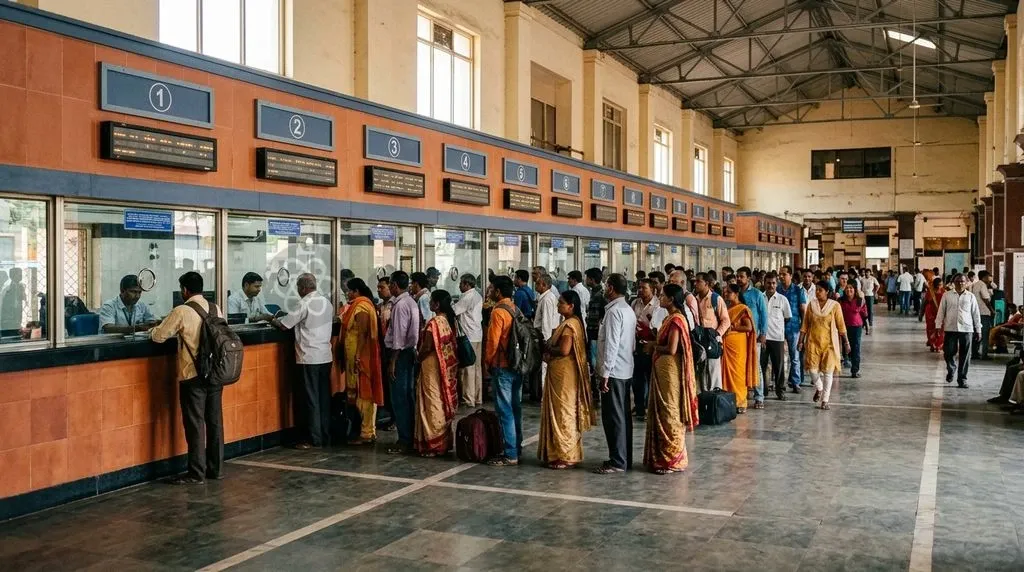
The Supreme Court of India has ordered Indian Railways to extend low-cost transit insurance to passengers buying tickets at physical reservation counters nationwide. The directive eliminates an arbitrary digital divide. Previously, accidental cover applied solely to online bookings on the Indian Railway Catering and Tourism Corporation portal.
Delivered on October 6, 2026, the judicial order mandates that the Railway Board implement this parity framework by October 27, 2026. Offline ticket buyers largely represent vulnerable socioeconomic groups who face the same operational risks as digital users. This judicial intervention establishes that transit micro-insurance is a universal passenger safeguard rather than an exclusive perquisite for internet users.
Why in the News: The Supreme Court Push for Passenger Parity
The Supreme Court has set a firm deadline to end disparity between online and offline railway passengers:
- The Compliance Mandate: On October 6, 2026, a bench comprising Justices Ahsanuddin Amanullah and R. Mahadevan directed Indian Railways to introduce counter-ticket travel insurance nationwide by October 27, 2026. The bench ruled that the Railway Board will face direct accountability if the mandate fails to take effect by the stipulated deadline.
- Administrative Countdown: As of October 2026, the Ministry of Railways has been granted a strict timeline to deploy administrative infrastructure across all reservation windows. The directive originated from a public interest petition filed after the June 2023 Balasore triple-train collision in Odisha. That petition demanded broader passenger safety nets alongside the nationwide rollout of the Kavach train protection system and track fencing.
- Judicial Rationale: During an earlier hearing on March 11, 2026, the bench observed that travel insurance cannot remain an exclusive perquisite for digital bookings. Offline travellers face identical transit hazards on the railway network, prompting the court to order an operational mechanism for physical booking counters.
Discuss with Superkalam
What is the maximum compensation payable under the statutory framework of the Railways Act compared to the IRCTC optional insurance scheme?
Ask NowThe Insurance Gap: IRCTC E-Tickets versus Railway Counter Bookings
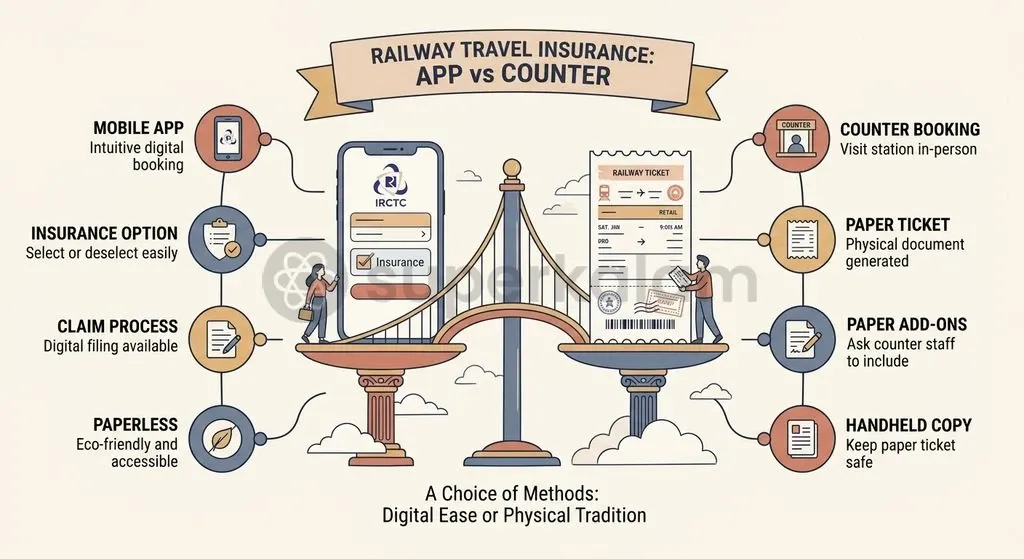
The Indian Railway Catering and Tourism Corporation operates an Optional Travel Insurance Scheme that provides passenger coverage exclusively for confirmed and RAC digital bookings. Digital passengers purchasing tickets through the official web portal or mobile application can opt into this facility by paying a nominal premium of 45 paise per passenger, inclusive of all taxes.
This micro-insurance policy offers financial relief of up to ₹10 lakh for accidental death or permanent total disability resulting from a train accident during the journey. Partial disability and hospitalisation expenses also receive defined coverage under the policy schedule.
Passengers purchasing tickets through physical Passenger Reservation System counters or Unreserved Ticketing System windows have remained entirely excluded from this facility. Counter ticket buyers must rely exclusively on statutory compensation mechanisms, creating an institutional disparity between digital and physical ticket holders.
| Dimension | IRCTC E-Ticket Insurance (OTIS) | Physical Counter Tickets (PRS / UTS) |
|---|---|---|
| Booking Mode | IRCTC web portal and mobile application | Physical railway reservation counters |
| Ticket Eligibility | Confirmed and RAC e-tickets | Historically excluded from optional cover |
| Premium Payable | 45 paise (₹0.45) inclusive of taxes | Nil (no opt-in mechanism available) |
| Maximum Coverage | Up to ₹10 lakh for death / permanent total disability | Relies solely on statutory railway compensation |
| Statutory Relation | Supplementary to statutory compensation | Limited to statutory liability under Railways Act, 1989 |
| Adjudication Path | Commercial claims process via contracted insurer | Adjudicated exclusively by Railway Claims Tribunal |
What the Supreme Court Directed: Key Orders to Indian Railways
The Supreme Court has laid down binding instructions to dismantle discrimination against counter ticket buyers:
- Firm Accountability Deadline: The bench instructed the Railway Board to operationalise counter-ticket passenger insurance coverage before October 27, 2026, or face direct administrative accountability. Judicial tolerance for executive delay had expired, referencing prior observations made during the March 2026 proceedings.
- Protection for Vulnerable Commuters: Socioeconomic equity formed the primary foundation of the order. The bench highlighted that passengers purchasing tickets at railway stations predominantly belong to the lowest socioeconomic strata who lack access to digital smartphones, online payment accounts, or private internet connectivity.
- Rapid Nationwide Deployment: Excluding these travellers from an inexpensive social safety net penalises them for digital exclusion. Under the court's compliance schedule, the Ministry of Railways and the Railway Board were given twelve days from mid-October to modify software modules and issue clear field guidelines nationwide.
Discuss with Superkalam
Explain why the exclusion of counter ticket buyers from optional insurance fails the 'reasonable classification' test under Article 14.
Ask NowConstitutional and Legal Stakes: Equality Before Law and Passenger Welfare
The exclusion of offline railway passengers directly engages Article 14 and Article 21 of the Constitution of India regarding non-discriminatory state action and social security. By offering optional micro-insurance only to passengers who possess digital literacy and digital payments infrastructure, the state created an arbitrary classification between two categories of travellers who pay standard passenger fares and board the same train coaches.
Judicial scrutiny under Article 14 requires that state classifications must rest on an intelligible differentia with a rational nexus to the objective sought. When the objective is passenger protection during railway mishaps, separating digital buyers from counter buyers fails this constitutional test. The Supreme Court has expanded Article 21 to encompass the right to bodily safety, humane treatment, and basic social security protections during public transit.
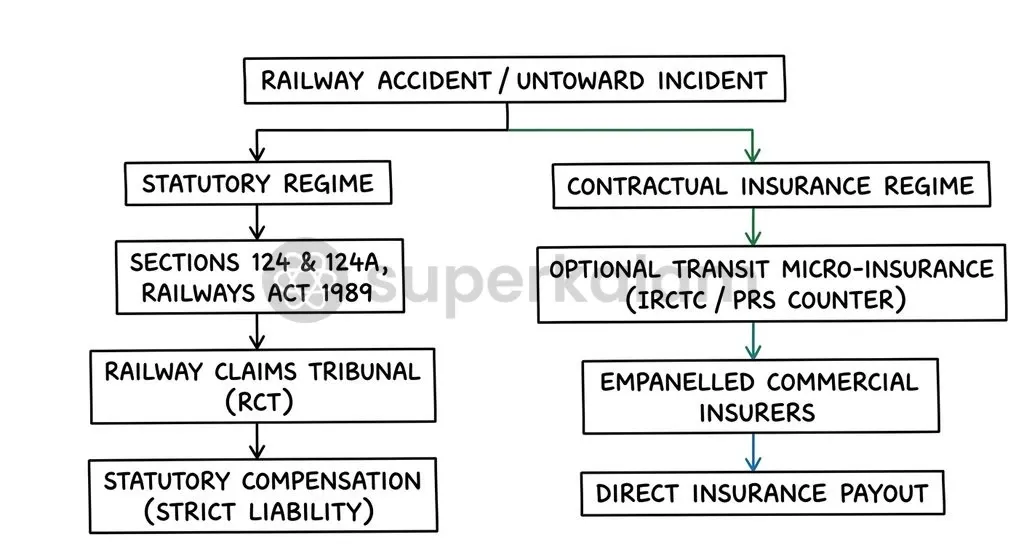
Statutory compensation architectures operate on a separate track from this commercial micro-insurance. The Railways Act, 1989 establishes statutory liability through two core provisions:
- Section 124 of the Railways Act, 1989: Imposes strict liability on the railway administration for death or personal injury caused by train accidents such as collisions, derailments, or mechanical failure, irrespective of any negligence on the part of the administration.
- Section 124A of the Railways Act, 1989: Extends strict liability to 'untoward incidents', including accidental falls from running trains, armed robberies, violent assaults, and terrorist acts.
Statutory payouts under the Railway Accidents and Untoward Incidents (Compensation) Rules, 1990 are capped at ₹8,00,000 for accidental death or permanent total disability. These claims fall under the exclusive jurisdiction of the Railway Claims Tribunal established under the Railway Claims Tribunal Act, 1987, which bars ordinary civil courts. Private travel insurance operates as a supplementary benefit on top of statutory compensation, meaning counter passengers were denied a supplemental tier of financial recovery.
| Feature | Statutory Track (Railways Act, 1989) | Supplementary Track (IRCTC Insurance) |
|---|---|---|
| Legal Basis | Sections 124 & 124A strict liability | Optional commercial policy (45 paise premium) |
| Statutory Scope | Train accidents and 'untoward incidents' | Journey-based accidental death and disability |
| Maximum Payout | Capped at ₹8,00,000 (Rules, 1990 / 2016) | Up to ₹10,00,000 payout |
| Adjudication Path | Adjudicated by Railway Claims Tribunal (RCT) | Disbursed directly by contracted private insurers |
Evidentiary burdens have often complicated statutory claims. On September 25, 2026, the Supreme Court ruled in Sukhabhai Nanjibhai Makwana v. Union of India that the failure to recover a physical paper ticket from an accident site cannot defeat a passenger's claim under Section 124A when bona fide travel is established on a preponderance of probabilities.
Disbursement hurdles have also faced judicial intervention. In September 2026, the Allahabad High Court struck down the Railway Claims Tribunal practice of locking 90 percent of compensation into fixed deposits based on claimants' economic status or literacy levels, declaring such paternalistic curbs unconstitutional under Article 14.
Discuss with Superkalam
If a passenger's physical paper ticket is lost during a major derailment, how does recent Supreme Court jurisprudence protect their right to compensation?
Ask NowOperational Roadblocks: Why Counter Ticket Insurance Is Tough to Implement
Physical ticketing counters managed by the Centre for Railway Information Systems face acute administrative hurdles ranging from non-existent passenger identity data to fractional cash collection constraints. The operational architecture of physical ticketing differs fundamentally from web-based customer interfaces, creating specific deployment barriers:
- Absence of Nominee and Contact Data: Digital portals mandate mobile numbers, passenger identities, and electronic nominee registration. Third-party private underwriters require direct nominee capture via electronic channels, failing which claims must await formal succession certificates. Physical counters routinely issue tickets without recording contact information.
- The Unreserved Commuter Volume: Unreserved Ticketing System windows manage millions of daily suburban and short-distance passengers. These counters issue non-personalised paper tickets, presenting immense authentication and fraud-detection risks for commercial underwriters.
- Fractional Cash Transactions: The 45-paise premium cannot be transacted using physical legal tender. Collecting fractional currency at high-density booking windows creates cash handling bottlenecks and slows queue clearance.
Discuss with Superkalam
Analyze the operational constraints that the Centre for Railway Information Systems faces in capturing nominee data and collecting fractional premiums at physical reservation counters.
Ask NowThe Way Forward: Building an Inclusive Passenger Safety Net
Reforming transit insurance requires Indian Railways to combine automated digital collection prompts with systemic overhauls across the Railway Claims Tribunal framework. Administrative compliance must be matched with technological and procedural interventions:
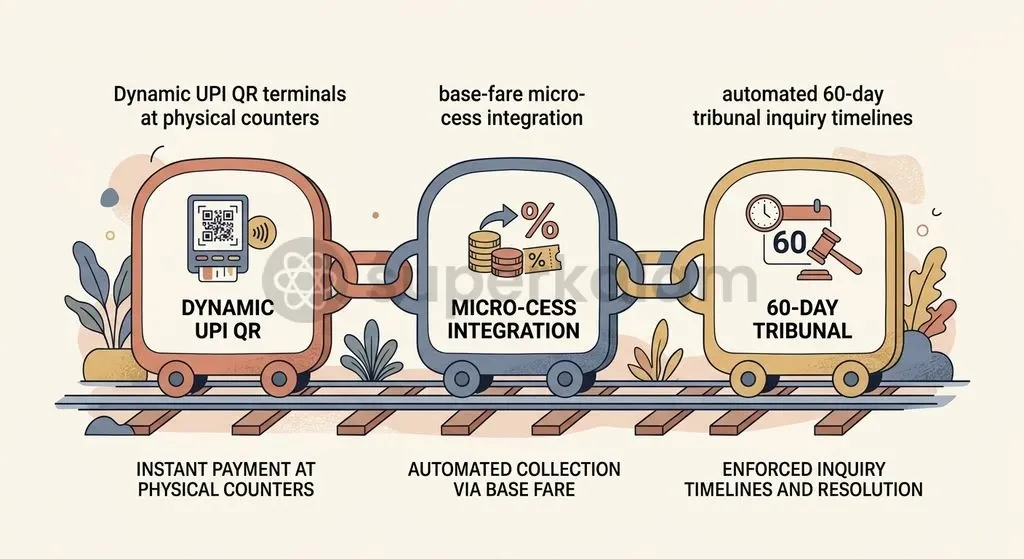
- Dynamic Counter Payment Prompts: Ticketing terminals can present a Dynamic UPI QR code that automatically incorporates the insurance premium while collecting a passenger's mobile contact number via an automated SMS link, per modernised railway ticketing strategies reported by the Centre for Railway Information Systems.
- Universal Safety Micro-Cess: Analysts at NITI Aayog have proposed folding a universal micro-cess directly into passenger base fares, thereby avoiding discretionary opt-in decisions at busy booking windows while creating an automatic group insurance pool.
- Tribunal Procedural Enforcement: Timely relief requires enforcing the Railway Passengers (Manner of Investigation of Untoward Incidents) Rules, 2020, which mandate that railway authorities submit incident investigation reports within 60 days to prevent deliberate processing delays.
- Integrated Claims Infrastructure: Establishing digital linkages between the Railway Claims Tribunal and private insurance underwriters will ensure simultaneous processing of statutory and commercial claims following major derailments or collisions.
Key Takeaways
- The Supreme Court directed Indian Railways to extend optional travel insurance to counter tickets nationwide by October 27, 2026, holding the Railway Board directly responsible for implementation.
- IRCTC e-ticket insurance offers up to ₹10 lakh for accidental death or permanent total disability for a premium of 45 paise per journey, a facility historically denied to counter buyers.
- Excluding physical counter ticket buyers engages Article 14 by creating an arbitrary divide between digital and offline citizens, alongside state duties under Article 21.
- Statutory railway compensation under Section 124 and Section 124A of the Railways Act, 1989 is capped at ₹8,00,000 and operates independently of private travel insurance payouts.
- Operational hurdles at physical counters include lack of passenger nominee details, vast unreserved passenger volumes, and fractional cash collection barriers.
Mains Question
"Differentiating between digital and offline ticket holders in the provision of low-cost transit micro-insurance creates an arbitrary classification contrary to constitutional guarantees." Examine this statement in light of Articles 14 and 21 of the Constitution of India. (10 Marks)
Evaluate NowMains Question
Contrast the statutory liability framework under the Railways Act, 1989 with the supplementary Optional Travel Insurance Scheme. Critically analyse the institutional and operational challenges Indian Railways faces in extending insurance parity to physical counter tickets. (15 Marks)
Evaluate NowPractice MCQs
QUESTION 1
With reference to statutory compensation under the Railways Act, 1989, consider the following statements:
- Section 124 imposes strict liability on the railway administration for train accidents regardless of any negligence.
- Section 124A extends strict liability to untoward incidents such as accidental falls from running trains and violent assaults.
- The statutory compensation payout under the relevant rules is capped at ₹10,00,000 for accidental death. Which of the statements given above are correct?
QUESTION 2
Regarding the Optional Travel Insurance Scheme offered through IRCTC, consider the following statements:
- It covers both confirmed and RAC e-tickets purchased through digital modes.
- It operates as an alternative that replaces statutory compensation under the Railways Act, 1989.
- The policy provides financial relief of up to ₹10 lakh in cases of accidental death or permanent total disability. Which of the statements given above is/are correct?
QUESTION 3
Consider the following statements regarding the adjudication of railway passenger accident claims in India:
- Claims for statutory compensation under the Railways Act, 1989 fall under the exclusive jurisdiction of the Railway Claims Tribunal, barring ordinary civil courts.
- In Sukhabhai Nanjibhai Makwana v. Union of India, the Supreme Court ruled that the inability to recover a physical ticket from an accident site automatically invalidates a compensation claim under Section 124A.
- The Allahabad High Court struck down the practice of arbitrarily locking 90 percent of compensation into fixed deposits based on a claimant's literacy or economic status. Which of the statements given above is/are correct?
QUESTION 4
The public interest litigation that prompted the Supreme Court's October 2026 directive on passenger travel insurance parity originated following which event?
QUESTION 5
Consider the following statements regarding transit safety nets for railway passengers:
- Passengers purchasing tickets at physical reservation counters have historically been excluded from opting into the nominal 45 paise micro-insurance policy.
- The Supreme Court observed that restricting low-cost insurance solely to online ticket buyers creates an arbitrary classification under Article 14 of the Constitution. Which of the statements given above is/are correct?