IDBI Bank Disinvestment: Key Regulatory Hurdles Beyond Cabinet Approval
Cabinet approval of the 60.72% IDBI Bank stake sale initiates a critical test of RBI banking governance, statutory voting caps, and state divestment policy.
Oct, 2026
•9 min read

Overview
The Union Cabinet has approved a 60.72% strategic stake sale in IDBI Bank to Fairfax Financial Holdings subsidiary M/s 10955230 Canada Inc. for ₹52,878.08 crore. It marks a decisive policy shift. Yet executive approval alone does not close the deal. Clearances from the Reserve Bank of India and capital market regulators must follow before ownership actually transfers.
According to a PIB Press Release on the strategic restructuring of IDBI Bank Ltd., the transaction combines a 30.48% equity divestment by the Government of India with a 30.24% stake sale by the Life Insurance Corporation of India. Executive clearance moves the file from the inter-ministerial auction pipeline to statutory review. The buyer must satisfy strict banking governance criteria, promoter dilution glide paths, and public float regulations before taking operational control. This transaction offers an operational blueprint for wider public sector bank reforms in India.
Why IDBI Bank Disinvestment Is Back in the News
The Cabinet Committee on Economic Affairs approved the strategic disinvestment of a 60.72% equity stake in IDBI Bank Ltd. to strategic buyer M/s 10955230 Canada Inc. for ₹52,878.08 crore. As of October 2026, this transaction stands as the largest foreign direct investment in India's financial services sector to date, as confirmed by a PIB Press Release on IDBI Bank's strategic restructuring.
The equity offloaded in this transaction is shared almost equally between the state and its principal insurer:
- Government of India divestment: A 30.48% equity divestment offloaded by the central government.
- LIC divestment: A 30.24% stake divestment by the Life Insurance Corporation of India.
- Pre-transaction state control: According to Lok Sabha Starred Question No. 17, the Government of India and LIC collectively held 94.72% of IDBI Bank, with the government holding 45.48%, LIC holding 49.24%, and public retail shareholders holding just 5.28%.
- Post-sale sovereign footprint: The Government of India will hold a residual equity stake of 15%, while LIC will retain 19%, leaving their combined residual holding at 34%.
Discuss with Superkalam
Recall the year in which IDBI Bank was reclassified by the RBI as a private sector bank following LIC's capital infusion.
Ask NowHow IDBI Bank Shifted from Development Finance to Private Lender
The Industrial Development Bank of India started as an apex development lender rather than a retail commercial bank. Its evolution unfolded across distinct statutory milestones:
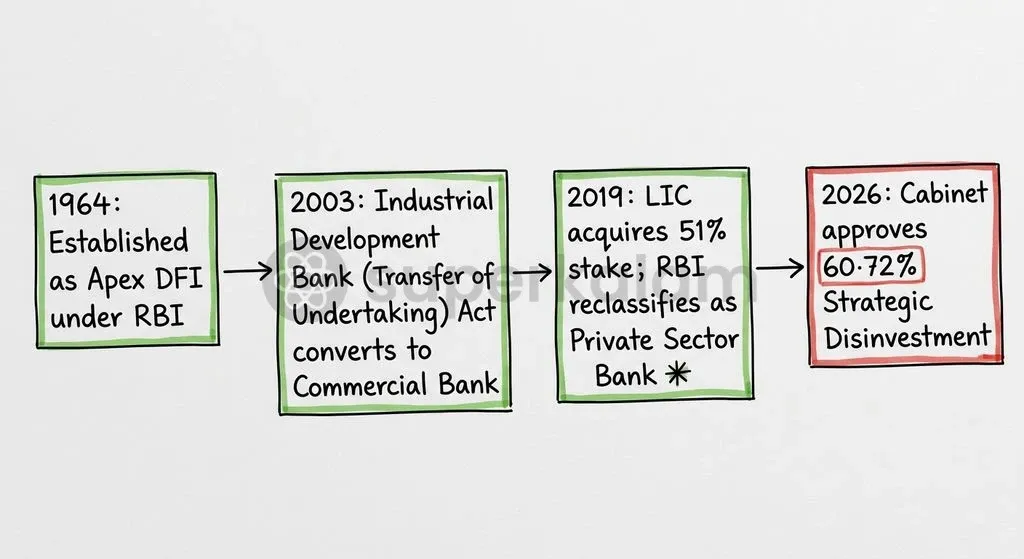
- 1964 (Apex DFI setup): Established as a wholly owned subsidiary of the Reserve Bank of India under the Industrial Development Bank of India Act, 1964, its initial mandate was providing long-term infrastructure finance to post-independence domestic industry.
- 1976 (Direct sovereign ownership): Ownership of the institution transferred directly from the RBI to the central government.
- 2003 (Commercial corporatisation): Parliament enacted the Industrial Development Bank (Transfer of Undertaking and Repeal) Act, 2003, transforming it from a statutory Development Financial Institution into a commercial banking company.
- May 2017 (PCA enforcement): Mounting non-performing assets depleted capital reserves. According to RBI press releases, the central bank placed IDBI Bank under the Prompt Corrective Action framework to halt balance-sheet deterioration.
- January 2019 (LIC majority takeover): LIC infused ₹21,624 crore of equity capital to acquire a 51% controlling stake. Consequently, the RBI reclassified IDBI Bank as a private sector bank for regulatory purposes with effect from 21 January 2019.
- March 2021 (Regulatory exit): The lender exited the Prompt Corrective Action framework after achieving a sustained operational turnaround.
Understanding Strategic Disinvestment: Transfer of Ownership and Control Explained
Strategic disinvestment means transferring both majority equity and executive management control to an external buyer under the Department of Investment and Public Asset Management (DIPAM) framework. It signals a departure from passive fiscal monetisation.
A strategic sale works on different economic principles than a conventional minority stake sale. In a minority divestment, the sovereign offloads equity tranches while retaining at least 51% state ownership and management authority. Strategic disinvestment hands over administrative control to subject corporate choices to private market discipline.
| Structural Dimension | Minority Stake Divestment | Strategic Disinvestment |
|---|---|---|
| Equity Transferred | Typically below 50%; state keeps ≥51% | Substantial block (e.g. 60.72% in IDBI Bank) |
| Management Control | Retained by Government of India | Fully transferred to private strategic buyer |
| Transaction Structure | Offer for Sale (OFS), ETF tranches, or institutional placements | Two-stage competitive bidding via Expression of Interest (EoI) |
| Regulatory Threshold | Standard SEBI listing compliances | Comprehensive RBI banking review and mandatory open offers |
| Primary Objective | Incremental budgetary resource mobilisation | Balance-sheet de-risking and operational productivity gains |
Between fiscal years 2010 and 2020, the central government injected approximately ₹25,000 crore of taxpayer capital into IDBI Bank to absorb bad-loan write-offs, according to The Hindu's reporting on the disinvestment. Strategic disinvestment curtails recurring sovereign recapitalisation liabilities by transferring balance-sheet risk to private equity sponsors.
Discuss with Superkalam
Explain how a strategic disinvestment differs structurally and operationally from a conventional minority stake sale.
Ask NowThe Multi-Stage Sale Pipeline: Why Cabinet Nod Is Only the Beginning
The Department of Investment and Public Asset Management executes divestments through a multi-tier vetting process. Cabinet Committee on Economic Affairs (CCEA) approval marks an intermediate milestone in this statutory journey, not the finish line.
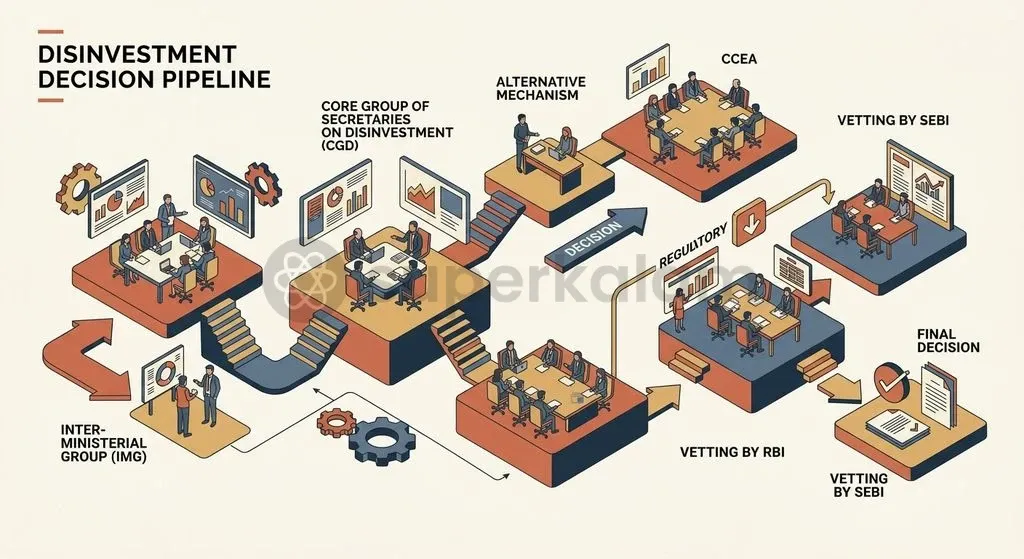
The divestment pipeline requires structured clearances across four distinct bureaucratic stages:
- Inter-Ministerial Group (IMG): Assesses transactional feasibility, selects transaction advisers, and drafts bidding parameters.
- Core Group of Secretaries on Disinvestment (CGD): Reviews bidder evaluations and key transaction covenants before escalating terms to ministers.
- Alternative Mechanism (AM): A ministerial group empowered by the CCEA to settle pricing benchmarks, auction timing, and reserve thresholds.
- Cabinet Committee on Economic Affairs (CCEA): Grants apex executive clearance for commercial bid selection and execution.
Executive clearance settles the commercial agreement, but legal consummation demands deeper regulatory integration. The acquirer must execute definitive agreements, launch mandatory open offers, and clear statutory reviews before management transfers.
The Alternative Mechanism holds delegated power from the CCEA to determine pricing, timing, and tranches for selling the government's residual 15% equity stake through public Offer for Sale (OFS) mechanisms. Sovereign exit is therefore a gradual equity drawdown rather than an overnight departure.
Discuss with Superkalam
Analyse how Section 12(2) voting caps decouple raw equity ownership from effective corporate control in Indian commercial banks.
Ask NowDebating Bank Privatisation: Revenue Gains Versus Public Accountability
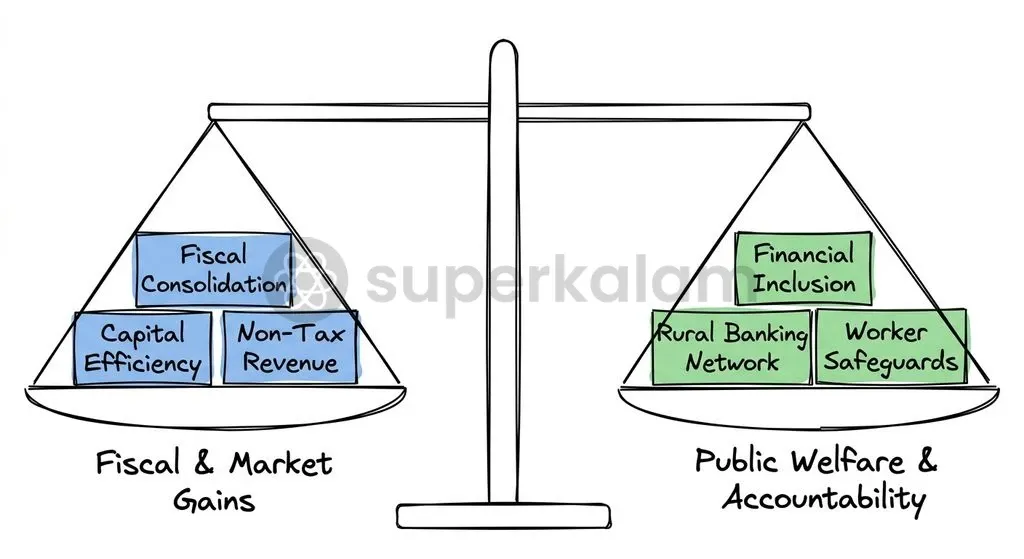
Privatising state-supported lenders enforces fiscal discipline and sharpens capital efficiency across financial markets. However, the policy choice involves balancing budgetary benefits against broader financial inclusion mandates:
- Fiscal discipline and efficiency: According to Chapter 9 of the Economic Survey 2020-21, strategic disinvestment monetises non-core state assets, ends regular recapitalisation calls on the budget, and instils market discipline in capital allocation.
- Moral hazard reduction: Subjecting commercial lenders to market discipline sharpens credit appraisal, curbs moral hazard, and spares taxpayers from recurring bank bailouts.
- Financial inclusion trade-offs: As highlighted in the Report of the Nachiket Mor Committee on Comprehensive Financial Services, private buyers target risk-adjusted return on equity over rural branch presence and low-margin welfare disbursement schemes.
- Industrial relations friction: Bank employee unions regularly raise concerns over post-sale job security, reservation policies in recruitment, and pension liabilities, creating organisational friction during transitions.
Discuss with Superkalam
Weigh the fiscal advantages of eliminating recurrent bank recapitalisations against the potential trade-offs in financial inclusion highlighted by the Nachiket Mor Committee.
Ask NowThe Way Forward for Banking Sector Disinvestment in India
Banking disinvestment demands balancing private commercial efficiency against systemic financial stability and public interest commitments. The IDBI Bank template offers three practical administrative lessons for prospective banking disinvestments:
- Early regulatory synchronisation: Inter-agency alignment between the Ministry of Finance, the Reserve Bank of India, and SEBI must occur well before inviting financial bids. Clarifying ownership glide paths, voting caps, and cross-holding rules early prevents avoidable delays after commercial selection.
- Enforceable inclusion compacts: The central government should safeguard public service access through binding regulatory covenants rather than operational control. Priority Sector Lending (PSL) quotas, lead bank responsibilities, and zero-balance savings mandates require strict RBI oversight to stop acquirers from abandoning essential developmental lending.
- Disciplined residual stake management: The Alternative Mechanism should structure the phased sale of residual public stakes through predictable market windows to optimise non-tax revenue without depressing equity values.
Key Takeaways
- The Cabinet Committee on Economic Affairs cleared a 60.72% strategic stake sale in IDBI Bank for ₹52,878.08 crore, comprising a 30.48% disinvestment by the central government and a 30.24% divestment by LIC.
- Strategic disinvestment differs fundamentally from minority divestment because it transfers executive management control, whereas minority sales maintain at least 51% sovereign equity and operational command.
- Cabinet clearance does not conclude the transaction; the strategic buyer must obtain mandatory fit-and-proper regulatory approval from the Reserve Bank of India under Section 12B of the Banking Regulation Act, 1949.
- Equity ownership is distinct from voting power under Section 12(2) of the Banking Regulation Act, 1949, which caps individual shareholder voting rights at 26% of total voting rights.
- Capital market regulations enforce retail protections, including a mandatory 26% open offer under SEBI Takeover Regulations and a 25% Minimum Public Shareholding target under Rule 19A of the Securities Contracts (Regulation) Rules, 1957.
- Cross-holding compliance remains an active operational condition, as RBI single-promoter regulations require Fairfax Financial Holdings to resolve its 40% stake in CSB Bank Ltd. alongside its IDBI acquisition, per reporting by The Times of India / Department of Financial Services Briefing (as reported, 14 October 2026).
Mains Question
"Executive approval for strategic disinvestment marks only an intermediate commercial milestone rather than the consummation of ownership transfer." In light of IDBI Bank's strategic stake sale, examine the multifaceted statutory and regulatory hurdles governing banking privatisation in India. (15 Marks)
Evaluate NowMains Question
According to the Economic Survey 2020-21, strategic disinvestment instils market discipline and curtails recurring recapitalisation calls on the sovereign budget. Critically analyse this policy rationale in the context of public sector banking in India. (10 Marks)
Evaluate NowPractice MCQs
QUESTION 1
With reference to the regulatory framework governing the acquisition and shareholding in private sector commercial banks in India, consider the following statements:
- Under Section 12B of the Banking Regulation Act, 1949, any entity acquiring 5% or more of shareholding or voting rights in a banking company must obtain prior regulatory clearance from the Reserve Bank of India.
- Under Section 12(2) of the Banking Regulation Act, 1949, individual shareholder voting rights are capped at 26% of total voting rights, irrespective of the proportion of equity owned.
- The Consolidated FDI Policy permits foreign investment in private commercial banks up to 74% entirely under the automatic clearance route.
Which of the statements given above is/are correct?
QUESTION 2
Consider the following statements regarding the evolution and restructuring of IDBI Bank:
- It was initially established in 1964 as a wholly owned subsidiary of the Reserve Bank of India.
- The Industrial Development Bank (Transfer of Undertaking and Repeal) Act, 2003 transformed it into a commercial banking company.
- The Reserve Bank of India reclassified IDBI Bank as a private sector bank for regulatory purposes in January 2019 following LIC's acquisition of a 51% controlling stake.
Which of the statements given above are correct?
QUESTION 3
Regarding disinvestment mechanisms under the Department of Investment and Public Asset Management (DIPAM) framework, consider the following statements:
- In a minority stake divestment, the Government of India offloads equity tranches while maintaining at least 51% state ownership and management control.
- Strategic disinvestment involves transferring both a substantial equity block and executive management control to a strategic buyer.
- Cabinet Committee on Economic Affairs (CCEA) approval marks the final statutory stage, requiring no further clearance before management control is transferred.
Which of the statements given above is/are correct?
QUESTION 4
Under the Securities and Exchange Board of India (SEBI) and central banking regulatory guidelines mentioned in the context of bank disinvestment, consider the following requirements:
- Acquiring more than 25% voting rights triggers a mandatory open offer for at least 26% of expanded equity under SEBI SAST Regulations.
- Rule 19A of the Securities Contracts (Regulation) Rules, 1957 mandates a Minimum Public Shareholding of 25% for listed companies.
- The RBI Master Direction on Ownership in Private Sector Banks requires promoters to dilute their equity to a maximum of 26% within 15 years.
Which of the statements given above are correct?
QUESTION 5
In the multi-tier institutional pipeline for disinvestment in India, which body is specifically empowered by the Cabinet Committee on Economic Affairs (CCEA) to decide pricing benchmarks, auction timing, and reserve thresholds?