BHAVYA Scheme: Can Plug-and-Play Industrial Parks Transform Manufacturing?
Ready-built industrial sheds compress factory gestation timelines, but structural power, freight, and labor rigidities test the BHAVYA scheme's promise.
Oct, 2026
•9 min read
Context
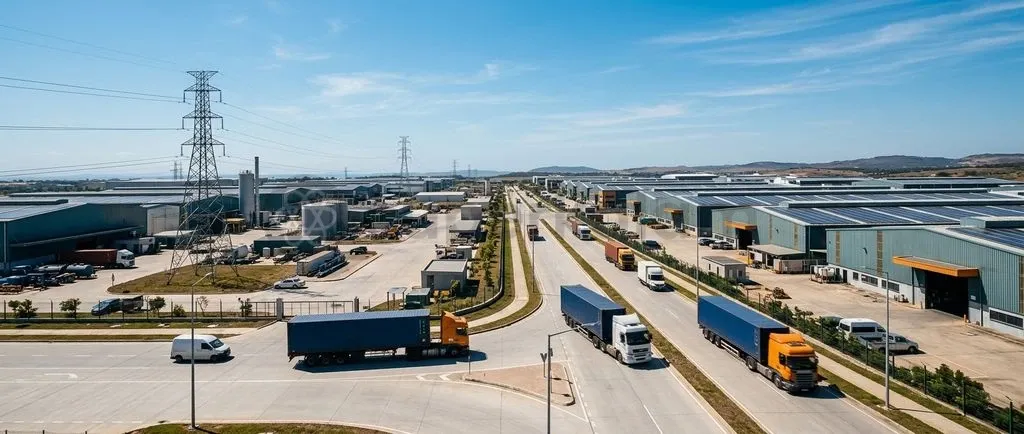
The Union Cabinet approved the Bharat Audyogik Vikas Yojna (BHAVYA) with an outlay of ₹33,660 crore over six years. The initiative aims to build 100 plug-and-play industrial parks across India. It compresses gestation periods from years to months using ready-built sheds and pre-cleared clearances.
Yet physical shells cannot succeed in isolation. The scheme converts front-loaded capital outlays into operating leases. That shift hinges on state-level factor-market reforms. Ready infrastructure cannot independently offset heavy commercial power cross-subsidies, fragmented labour inspections, and elevated rail freight tariffs that stranded capital in legacy estates.
Why in the News? The Rollout of the BHAVYA Scheme
The Union Cabinet approved the Bharat Audyogik Vikas Yojna (BHAVYA) as a flagship national initiative to transform industrial manufacturing infrastructure across Indian states. The rollout operationalises the policy intent announced in the Union Budget 2024–25, which earmarked the development of plug-and-play parks in or near 100 cities in partnership with states and the private sector.
Key pillars of the programme rollout include:
- Targeted capital grants: Central assistance provides up to ₹1 crore per acre for park sizes ranging from 100 to 1,000 acres, with a reduced threshold of 25 acres for Northeastern and Himalayan states.
- Competitive state allocation: Phase I will select up to 50 parks through two competitive bidding rounds that evaluate states on regulatory reform readiness, land contiguity, and multi-modal connectivity.
- Dedicated chemical hubs: The Cabinet sanctioned the BHAVYA-Rasayan sub-scheme to build three dedicated Chemical Parks with central grant assistance of up to ₹1,000 crore per park.
Discuss with Superkalam
What is the maximum central grant per acre provided under the general guidelines of the BHAVYA scheme?
Ask NowWhat is the BHAVYA Scheme and the Plug-and-Play Model?
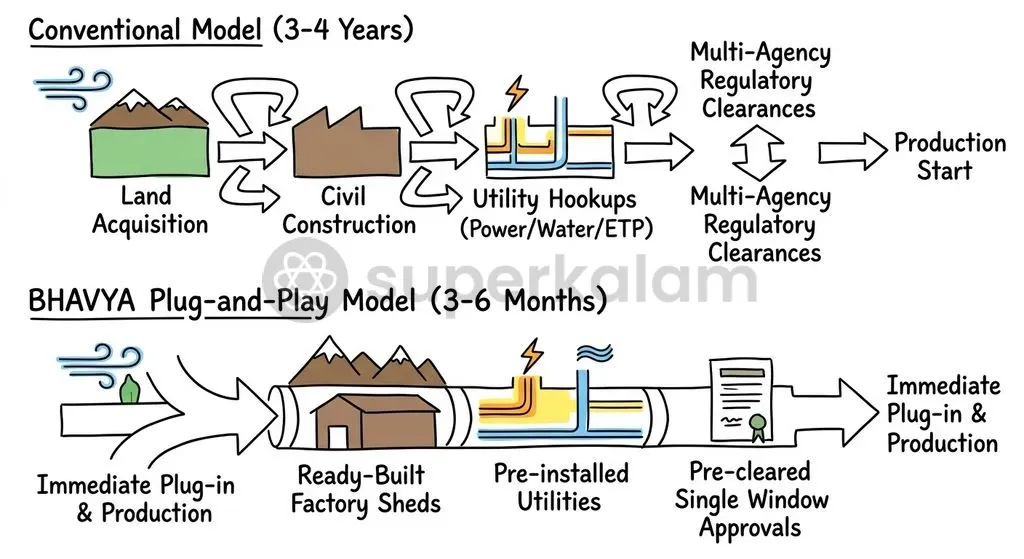
The plug-and-play industrial model provides ready-built standard design factory sheds equipped with pre-cleared statutory clearances, underground utility conduits, and shared effluent treatment systems. Incoming manufacturers install machinery and start production immediately, skipping protracted land-acquisition cycles and zoning clearances.
As of October 2026, the India Industrial Land Bank (IILB) mapped over 4,160 industrial parks, demonstrating that raw land availability is not the primary barrier holding back manufacturing growth. Rather, the bottleneck lies in the prolonged friction of transforming undeveloped plots into operational shop floors. Medium- and high-technology sectors account for 46.3 percent of India's manufacturing value addition, demanding specialised testing labs, steady power, and advanced waste management.
| Feature / Dimension | Conventional Industrial Estate | BHAVYA Plug-and-Play Park |
|---|---|---|
| Allotment Nature | Raw or semi-developed land plots | Ready-built standard factory sheds |
| Gestation Timeline | 24 to 48 months for construction and approvals | Compressed from years to months |
| Regulatory Clearances | Tenant navigates independent state line departments | Pre-cleared statutory approvals provided at park entry |
| Off-Site Connectivity | Often uncoordinated; last-mile hook-ups delayed | Up to 25% of central funds permitted for off-site rail-road links |
| Common Amenities | Basic access roads, open drainage | Testing labs, skill centres, worker dormitories |
The Strategic Promise: How Ready-Built Sheds De-Risk Greenfield Investment
Greenfield capital expenditure carries severe front-loaded risks for micro, small, and medium enterprises (MSMEs) and foreign direct investors entering unfamiliar sub-national markets. According to the Economic Survey 2023–24, ready-built factory sheds de-risk investment by converting upfront capital outlays into manageable operational expenditures via long-term lease arrangements.
This conversion enables prospective manufacturers to conserve liquid capital for core working needs:
- Capital allocation efficiency: Firms allocate scarce equity towards precision tooling, robotics, research, and workforce onboarding rather than immobilising capital in dead earth and brickwork.
- Compressed market-entry cycles: Exporters targeting transient global demand cycles can set up production lines rapidly, avoiding multi-year site approvals.
- Shared ecosystem infrastructure: The BHAVYA framework covers specialised testing labs, common certification facilities, and shared effluent management that individual MSMEs cannot finance alone.
- Workforce welfare assets: Eligible guidelines provide funding for on-site skill development units and worker dormitories to support gender-inclusive workforce participation in assembly corridors.
Discuss with Superkalam
How does shifting from greenfield land purchase to leased ready-built factory sheds alter the balance sheet risks for an MSME?
Ask NowLessons from the Past: Why SITP and Electronics Clusters Stalled
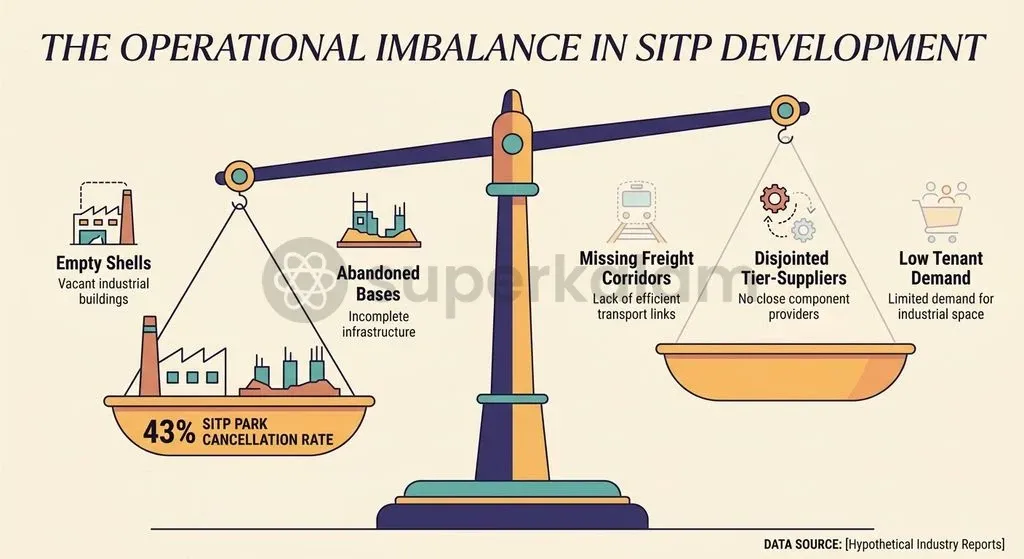
The Scheme for Integrated Textile Parks (SITP) offers a sobering historical precedent for capital-heavy infrastructure projects. A performance audit by the Comptroller and Auditor General (CAG) revealed that legacy SITP projects achieved only 37 percent of target units and 30 percent of projected employment, with 43 percent of all sanctioned parks eventually cancelled.
Past cluster programmes faltered because physical construction outpaced practical industrial demand:
- Remote geographic placement: Parks were frequently sited on peripheral, cheap land lacking natural industrial density or freight links.
- Stranded common facilities: The Ministry of Electronics and Information Technology formulated Modified Electronics Manufacturing Clusters (EMC 2.0) with support up to ₹50 crore per 100 acres because EMC 1.0 faced low tenant absorption from inadequate common facility centres.
- Flawed developer incentives: Special purpose vehicles (SPVs) under SITP often prioritised real-estate development margins over the long-term operational health of tenant manufacturers.
The Unresolved Bottlenecks: Land, Labor Laws, and Power Tariffs
Factor market rigidities remain the decisive barrier that ready-built physical factory shells cannot unilaterally solve. Manufacturing enterprises in most states remain subject to over 1,000 regulatory compliance obligations and repetitive inspectorate visits across labour, boiler, and environmental legislations.
| Factor Dimension | Structural Distortion | Direct Operational Impact |
|---|---|---|
| Power Tariffs | 25–55% mark-up above cost of supply | High cross-subsidies penalise energy-intensive manufacturing |
| Labour Compliance | Over 1,000 compliance obligations | Overlapping state inspectorates create sustained regulatory drag |
| Freight Pricing | Elevated rail freight tariffs | Cross-subsidisation of passenger travel inflates inland freight rates |
The underlying structural hurdles encompass three primary factor areas:
- Distorted power pricing: Indian industrial consumers pay electricity tariffs that are 25 to 55 percent higher than the average cost of supply due to state-mandated cross-subsidisation of agricultural and domestic feeders. This places energy-intensive manufacturing at a major disadvantage against regional competitors like Vietnam.
- Deemed clearance friction: Operational audits of the National Single Window System (NSWS) show that deemed statutory approvals are frequently impeded by state line departments asserting independent rights under municipal and town-planning bye-laws.
- Freight tariff penalties: India's railway pricing imposes artificially elevated freight rates on key industrial commodities to cross-subsidise unremunerative passenger travel. This erodes the logistical viability of operating inland industrial hubs.
Discuss with Superkalam
If you were designing a competitive state bidding proposal under Phase I of BHAVYA, how would you address multi-modal logistics and land contiguity?
Ask NowGlobal Benchmarks: How Vietnam and East Asia Scaled Ready-Built Zones
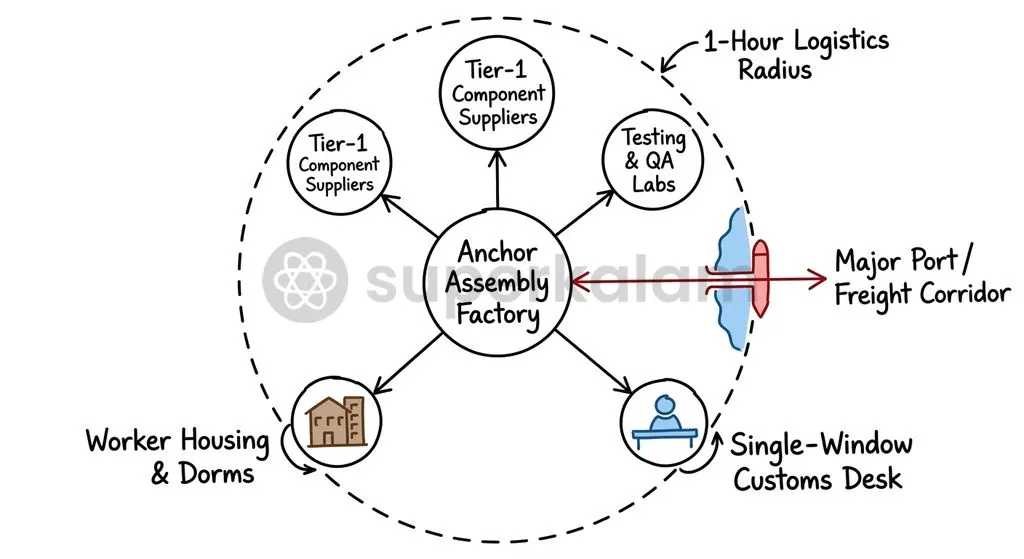
The Vietnam-Singapore Industrial Park (VSIP) joint-venture model demonstrated how plug-and-play infrastructure must integrate with surrounding trade administrative systems. According to World Bank case studies, VSIP hubs secured rapid tenant occupancy by co-locating multi-tiered global component suppliers alongside on-site provincial customs desks and single-window administrative teams.
East Asian industrial hubs tackled spatial fragmentation directly. China's industrial townships across the Pearl and Yangtze River Deltas, including Kunshan and Shenzhen, enforced an aggressive one-hour supply chain cluster rule. This spatial planning mandate required tier-2 and tier-3 component makers to sit within immediate trucking distance of anchor assembly plants. By pairing standard factory sheds with tight local supply chain density, these hubs eliminated buffer inventory costs for global value chains.
| Benchmark Model | Core Operational Strategy | Regulatory & Administrative Integration | Primary Value Proposition |
|---|---|---|---|
| Vietnam-Singapore Industrial Parks (VSIP) | Multi-tiered supplier co-location within integrated zones | On-site customs desks and provincial administrative single windows | Seamless border clearance and immediate supplier matching |
| Chinese Industrial Townships (Kunshan/Shenzhen) | Mandatory 'one-hour supply chain cluster' radius | Integrated municipal zones combining housing, factories, and utility substations | Elimination of logistics transit buffers for tier-2/3 inputs |
| India BHAVYA Parks | Ready-built standard sheds with central funding up to ₹1 crore/acre | Linked with PM Gati Shakti GIS platform and state-level single windows | De-risking greenfield entry and compressing gestation timelines |
Way Forward: Moving from Physical Shells to Full Ecosystem Competitiveness
The National Industrial Corridor Development Programme (NICDC) and the BHAVYA framework must treat ready-built sheds as the starting point rather than the final measure of industrialisation. To prevent newly built parks from turning into under-utilised concrete shells, central and state authorities must implement several targeted interventions.
A sustainable industrial park strategy requires coordinating physical space with broader policy levers:
- Mandatory GIS integration: Implementing the BHAVYA guideline requirement to tie park boundaries directly into the PM Gati Shakti National Master Plan ensures multi-modal rail and road links are operational before tenant allotment.
- Utilising off-site funding provisions: State agencies should fully utilise the provision permitting up to 25 percent of central funding for external connectivity and last-mile utility connections.
- True administrative single windows: State governments must amend local town-planning and municipal statutes to legally enforce deemed approvals granted through the National Single Window System, preventing unauthorised secondary line-department inspections.
- Rationalised industrial power structures: State electricity regulatory commissions must establish dedicated, open-access industrial feeder zones within BHAVYA parks to limit high cross-subsidy surcharges.
- Specialised sub-scheme execution: Expediting chemical park development under the ₹1,000 crore grant assistance provision of BHAVYA-Rasayan can anchor critical intermediate raw-material supply chains on domestic soil.
Discuss with Superkalam
Compare the reasons behind the partial failure of the SITP with the current design safeguards incorporated into the BHAVYA scheme.
Ask NowKey Takeaways
- The Union Cabinet approved the BHAVYA scheme with a ₹33,660 crore outlay across FY 2026–27 to FY 2031–32 to establish 100 plug-and-play industrial parks.
- Financial assistance provides up to ₹1 crore per acre for parks between 100 and 1,000 acres, with up to 25 percent earmarked for off-site rail-road and utility connectivity.
- Ready-built sheds convert heavy greenfield capital expenditure into operational lease outlays, helping MSMEs and foreign direct investors compress gestation cycles.
- Past schemes like the Scheme for Integrated Textile Parks (SITP) suffered from low tenant absorption, with CAG reporting that only 37 percent of target units were achieved and 43 percent of parks were cancelled.
- Physical infrastructure alone cannot resolve structural factor market rigidities, such as industrial power tariffs that sit 25 to 55 percent above the cost of supply and extensive sub-national compliance obligations.
Mains Question
"Physical shells cannot independently succeed in isolation when legacy factor-market distortions remain unaddressed." In the context of the Bharat Audyogik Vikas Yojna (BHAVYA), critically analyse how deep-seated factor market distortions impede the transformation of India's manufacturing sector. (15 Marks)
Evaluate NowMains Question
The Economic Survey 2023–24 highlights that ready-built factory sheds de-risk greenfield investments by converting upfront capital outlays into operational expenditures. Elucidate the strategic advantages of the plug-and-play model for MSMEs and export manufacturing. (10 Marks)
Evaluate NowPractice MCQs
QUESTION 1
Regarding the Bharat Audyogik Vikas Yojna (BHAVYA) scheme, consider the following statements:
- It provides central capital assistance of up to ₹1 crore per acre for eligible industrial parks.
- The threshold park size for central assistance is reduced to 25 acres for Northeastern and Himalayan states.
- The scheme permits up to 25% of central funds to be allocated for off-site rail and road connectivity. Which of the statements given above are correct?
QUESTION 2
With reference to the structural factor bottlenecks hindering industrial manufacturing in India as highlighted in the context of the BHAVYA scheme, consider the following statements:
- Industrial consumers face electricity tariffs that are 25 to 55 percent higher than the average cost of supply due to cross-subsidisation.
- Raw industrial land availability remains the single primary constraint holding back greenfield manufacturing, as reflected in the India Industrial Land Bank.
- Railway freight pricing cross-subsidises unremunerative passenger travel, raising inland transport costs for industrial commodities. Which of the statements given above is/are correct?
QUESTION 3
Consider the following statements regarding the performance and lessons from past industrial cluster initiatives:
- A Comptroller and Auditor General (CAG) audit of the Scheme for Integrated Textile Parks (SITP) found that over 40 percent of sanctioned parks were cancelled.
- The Modified Electronics Manufacturing Clusters (EMC 2.0) scheme was introduced to address low tenant absorption caused by inadequate common facility centres in EMC 1.0.
- Medium- and high-technology sectors contribute less than a quarter of India's manufacturing value addition. Which of the statements given above is/are correct?
QUESTION 4
Under the BHAVYA scheme, the sub-scheme dedicated to establishing specialized chemical hubs is named:
QUESTION 5
Consider the following international practices cited as benchmarks for plug-and-play manufacturing infrastructure:
- The Vietnam-Singapore Industrial Park (VSIP) model incorporated on-site customs desks and single-window administrative teams.
- East Asian hubs in the Pearl and Yangtze River Deltas enforced a spatial planning rule mandating tier-2 and tier-3 component makers to sit within immediate trucking distance of anchor plants. Which of the statements given above is/are correct?