Beating Jobless Growth in India: A 3-Level Reform Strategy - UPSC Notes
Unlocking sustainable employment requires moving beyond GDP headline figures to fix manufacturing, skilling, and gig-worker social security.
Aug, 2026
•10 min read
Overview
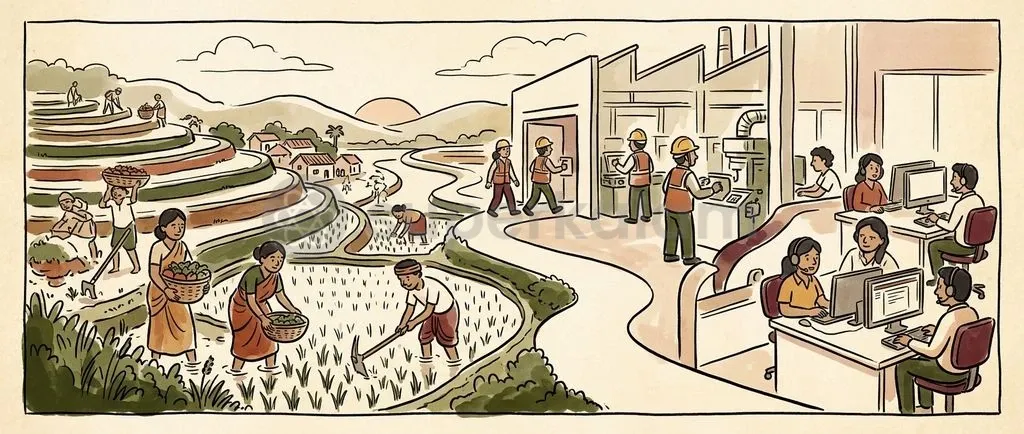
Fig: Tackling jobless growth requires an integrated three-level strategy spanning macro manufacturing, skilling, and informal social security.
India's structural employment deficit cannot be resolved through headline Gross Domestic Product growth alone. Overcoming this challenge requires a three-level reform strategy. This strategy must simultaneously expand labour-intensive manufacturing capacity, align vocational skilling with corporate demand, and extend formal social security to the informal workforce.
The Ministry of Finance notes in the Economic Survey 2024-25 that the Indian economy must generate an average of 7.85 million non-farm jobs annually until 2030 to absorb workers transitioning out of agriculture. While recent empirical data shows a cyclical recovery in employment elasticity, long-term labour absorption demands systemic intervention across macro industrial policy, mid-tier apprenticeship frameworks, and micro social protection funds.
Why India's Current Growth Model Fails to Create Jobs
India's growth model struggles because historical aggregate employment elasticity remained low at 0.18 and 0.20. This created a structural disconnect between GDP growth and non-farm job creation.
- Agriculture Overcrowding: Absorbs 46.1% of the total national workforce while contributing approximately 17.8% to national GDP.
- Manufacturing Stagnation: Historically, manufacturing employment elasticity hovered around 0.3, preventing the sector from absorbing low-skilled rural labour.
- Non-Farm Requirement: The economy requires 7.85 million non-farm jobs annually to rebalance the labour market.
Data from the RBI-KLEMS database reveals that the arc elasticity of employment with respect to Gross Value Added (GVA) shifted upward to 1.11 between FY2017-18 and FY2023-24, compared to 0.008 between FY2011-12 and FY2016-17. This statistical rebound reflects post-pandemic informal sector recovery and expanded public works rather than a complete resolution of structural unemployment.
As of March 2026, data from the Ministry of Statistics and Programme Implementation shows India's overall unemployment rate in usual status for persons aged 15 years and above stood at 3.1% to 3.2%, down from 6.0% in 2017-18. Yet, unemployment among educated youth holding secondary education or above remained elevated at 6.5% in 2025. While female Labour Force Participation Rate reached 40.0% in 2025, female agricultural employment share remains above 60%. This imbalance highlights the urgent need for productive non-farm avenues.
Decoding the Three-Level Reform Blueprint
The Economic Survey 2024-25 outlines a three-tier intervention strategy targeting macro industrial incentives, mid-tier skill development, and micro-level worker social security.
A successful structural transformation requires shifting surplus agricultural labour into higher-productivity manufacturing and formal service sectors. Asian economies like China, Vietnam, and Bangladesh achieved rapid poverty reduction through targeted structural transitions.
| Country | Peak Structural Transformation Strategy | Key Employment Outcome | Relevance to India's Policy Path |
China | Absorbed 5 to 7 million workers annually from agriculture into Township and Village Enterprises (TVEs). | Rapid expansion of domestic industrial clusters and export capacity. | Demonstrates the power of localized light-manufacturing clusters. |
Vietnam | Reduced agricultural employment share from 48% in 2010 to 28% in 2019 via light manufacturing. | High formal enterprise transition and FDI integration. | Highlights the benefit of trade integration and labour-law flexibility. |
Bangladesh | Expanded industrial employment share to 24%, driven by Ready-Made Garments (RMG) exports. | Mass female labour force participation in export industries. | Offers a benchmark for labour-intensive, low-skill export production. |
India | Targeting 7.85 million non-farm jobs yearly through PLI, ELI, and apprenticeship programmes. | Ongoing shift from farm employment (46.1%) toward formal services and industry. | Requires simultaneous focus on manufacturing scale and worker social safety. |
The three-level reform blueprint combines these global insights into an integrated national framework:
- Level 1 (Macro Level): Scaling labour-intensive manufacturing and incentivising direct job creation through capital investment.
- Level 2 (Mid Tier): Re-engineering the educational and skilling ecosystem to align human capital with real-time industry demands.
- Level 3 (Micro Level): Formalising the unorganised workforce and establishing sustainable social safety nets for gig and platform workers.
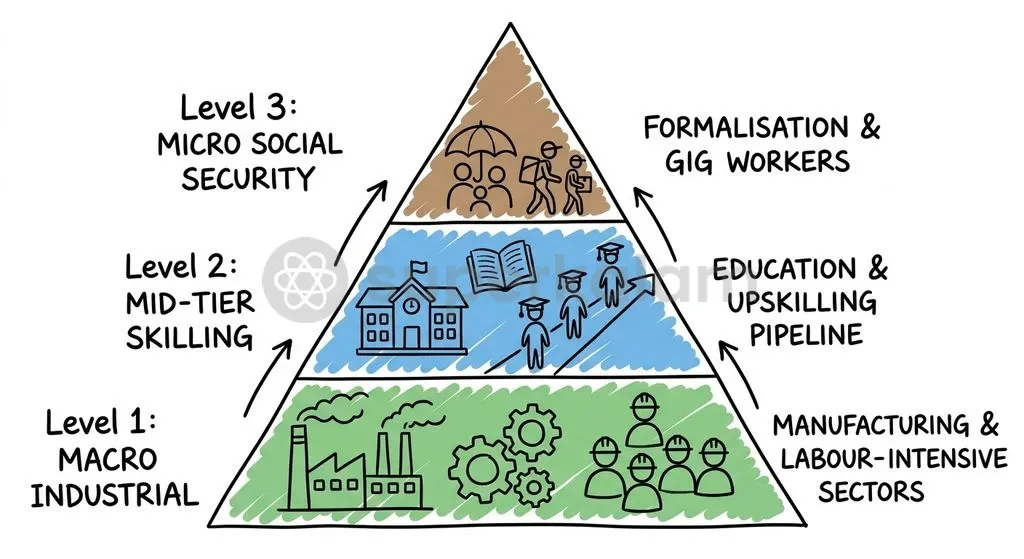
Fig:The three-level reform framework aligns industrial incentives, corporate apprenticeships, and social welfare funds.
Discuss with Superkalam
Which sector absorbs 46.1% of India's total workforce while contributing roughly 17.8% to national GDP?
Ask NowLevel 1: Fixing Manufacturing and Labour-Intensive Sectors
The Production Linked Incentive (PLI) Scheme is India's primary macro tool to boost domestic manufacturing capacity and absorb surplus agricultural labour.
Across 14 strategic sectors, the PLI Scheme generated over 14.39 lakh direct and indirect jobs and attracted cumulative investments exceeding ₹2.16 lakh crore as of December 31, 2025. In the Large Scale Electronics Manufacturing PLI scheme alone, over 1.85 lakh direct jobs were created by early 2026, with female workforce participation reaching nearly 70% in precision assembly lines.
To complement capital-centric incentives, the Ministry of Labour and Employment introduced the Pradhan Mantri Viksit Bharat Rozgar Yojana, an Employment Linked Incentive (ELI) Scheme backed by an outlay of ₹99,446 crore. The ELI scheme directly incentivises corporate employers to expand formal payrolls. It aims to support the creation of over 3.5 crore jobs over a 2-year period, with a focused emphasis on first-time manufacturing workers.
- PLI Scheme: Driven by ₹2.16 lakh crore in cumulative investment, generating over 14.39 lakh jobs, with precision electronics recording 70% female workforce participation.
- ELI Scheme (PMVBRY): Funded with an outlay of ₹99,446 crore, targeting over 3.5 crore jobs through direct payroll incentives for corporate employers.
Labour-intensive sectors such as textiles, leather, food processing, and construction require targeted export promotion to mirror Bangladesh's and Vietnam's industrial trajectories. Removing regulatory bottlenecks and simplifying land and power tariffs remain essential to raising manufacturing elasticity closer to historic global benchmarks.
Level 2: Overhauling the Education and Upskilling Pipeline
The Prime Minister's Internship Scheme addresses structural skill mismatches by embedding youth directly into top corporate supply chains.
The Ministry of Corporate Affairs designed the Prime Minister's Internship Scheme to offer paid 12-month internships in the top 500 companies to 1 crore youth over five years, providing a ₹5,000 monthly allowance and a ₹6,000 one-time grant. During Pilot Phase 1, partner companies posted 1.27 lakh internship opportunities across 24 sectors, attracting over 6.21 lakh applications.
- PM Internship Scheme: Targets 1 crore youth over five years with a ₹5,000 monthly allowance and ₹6,000 one-time grant; Pilot Phase 1 saw 1.27 lakh opportunities and 6.21 lakh applications.
- Skill India Digital Hub: Reached over 20.10 million registered users with 3,643 self-paced courses, contributing to graduate employability rising from 33.95% to 54.81%.
Digital Public Infrastructure reinforces this physical apprenticeship ecosystem. The Ministry of Skill Development and Entrepreneurship operates the Skill India Digital Hub, which reached over 20.10 million registered users and offered 3,643 self-paced courses as of August 2026.
According to the India Skill Report, overall graduate youth employability in India improved from 33.95% in 2013 to 54.81% in 2024-25. Aligning vocational curricula with real-time employer demand ensures that higher educational attainment translates into formal employment rather than educated unemployment.
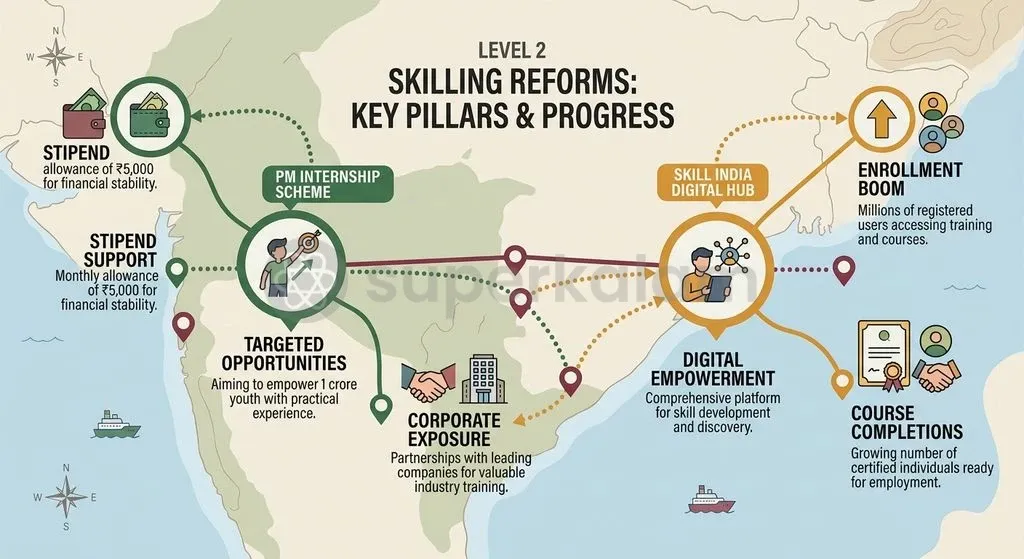
Fig: Apprenticeship programs and digital public infrastructure bridge the gap between graduate education and corporate skill requirements.
Discuss with Superkalam
Compare China's TVE model with Bangladesh's RMG strategy as models for absorbing India's rural agricultural surplus.
Ask NowOvercoming Institutional and Fiscal Roadblocks
State governments and Central Ministries face coordination friction when aligning local skill ecosystems with national industrial policies.
- Coordination Delays: While macro schemes like PLI provide central capital subsidies, state-level land acquisition delays and power tariff disparities slow plant construction.
- MSME Compliance Costs: Small and medium enterprises generate the bulk of off-farm employment but often struggle to access ELI wage subsidies due to formal compliance costs.
- Fiscal Trade-offs: Funding social security for over 31 crore unorganised workers through state exchequer grants risks budget deficits, making dedicated aggregator turnover contributions vital.
Addressing these roadblocks requires structured policy integration across tiers of governance.
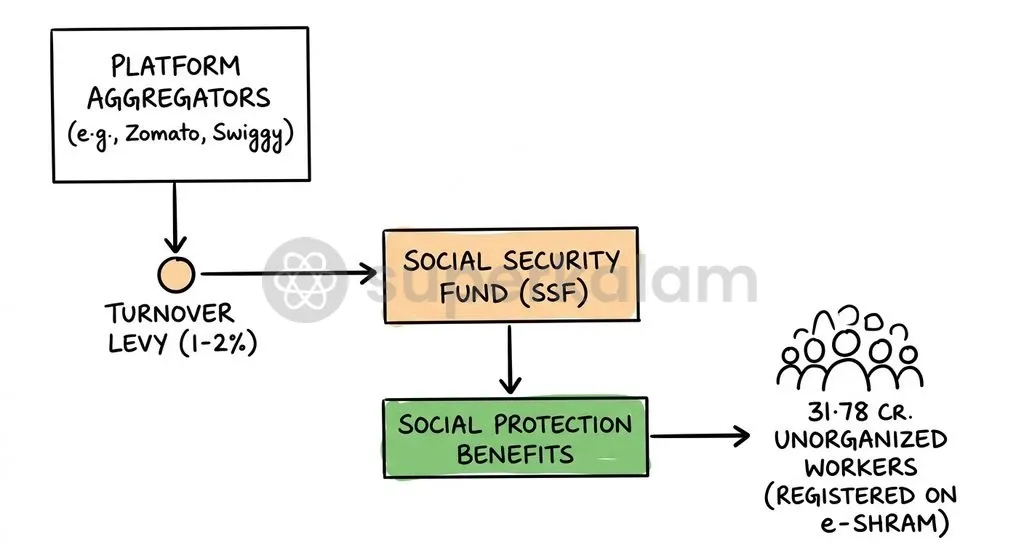
Fig: Financing unorganized worker welfare through aggregator contributions creates sustainable social safety nets without fiscal deficit risks.
The Way Forward for Sustainable Employment
The Ministry of Finance must integrate industrial policy with labour-market reforms to transition millions of agricultural workers into high-productivity jobs.
A comprehensive strategy requires strengthening three policy levers:
- Promoting Labour-Intensive Exports: Reorienting manufacturing incentives toward textiles, footwear, and food processing to replicate high employment elasticity models seen in Vietnam and Bangladesh.
- Expanding Industry-Led Apprenticeships: Broadening the Prime Minister's Internship Scheme to cover tier-2 and tier-3 industrial hubs, matching rural youth with regional MSME clusters.
- Operationalising Social Security Funds: Mandating smooth collection of the 1% to 2% aggregator levy under the Code on Social Security, 2020 to provide universal safety nets for platform workers.
By combining capital-intensive PLI investments with employment-linked ELI payroll incentives and digital skilling platforms, India can convert its demographic dividend into sustainable economic growth.
Key Takeaways
- Structural Disconnect: India's historical post-reform employment elasticity remained low at 0.18–0.20, requiring an annual generation of 7.85 million non-farm jobs until 2030 to absorb agricultural labour.
- Macro Manufacturing Strategy: The PLI Scheme drew over ₹2.16 lakh crore in investment and created 14.39 lakh jobs, complemented by the ₹99,446 crore ELI Scheme aimed at formal job creation.
- Skilling and Internship Pipeline: Graduate youth employability rose to 54.81% in 2024-25, supported by the Prime Minister's Internship Scheme and Skill India Digital Hub's 20.10 million registered users.
- Formal Protection for Gig Workers: The Code on Social Security, 2020 levies a 1%–2% aggregator turnover contribution for gig worker welfare, while the e-Shram portal has registered over 31.78 crore unorganised workers.
- Global Benchmarks: Vietnam, Bangladesh, and China illustrate that rapid poverty reduction depends on shifting agricultural labour (currently 46.1% in India) into export-led light manufacturing and enterprise formalisation.
Mains Question
"India's structural employment deficit cannot be resolved through headline Gross Domestic Product growth alone." In light of the Economic Survey 2024-25, evaluate the efficacy of macro incentive frameworks like the Production Linked Incentive (PLI) and Employment Linked Incentive (ELI) schemes in driving labour-intensive growth. (15 marks)
Evaluate Now