Digital Accessibility in India: Rajive Raturi Judgment
The Rajive Raturi judgment calls for mandatory accessibility standards. Read its meaning for digital services and disability rights in India.
Oct, 2026
•11 min read

Overview
The Supreme Court of India established in Rajive Raturi v. Union of India that digital accessibility is an enforceable fundamental right under Articles 14, 19, and 21. Delivering this ruling in November 2024, the bench struck down discretionary administrative rules to mandate non-negotiable standards across public and private digital interfaces.
Equal participation in democratic life requires barrier-free access to Information and Communication Technology (ICT) systems. By invalidating subordinate rules that treated accessibility as optional guidance, the judgment shifts India's disability jurisprudence from a charity model to an enforceable rights-based regime.
This systemic recalibration compels state bodies and technology developers to embed universal accessibility into the core architecture of India's digital public infrastructure.
Why in the News: Supreme Court's Stance on Digital Accessibility
The Supreme Court of India delivered a foundational ruling in Rajive Raturi v. Union of India on 8 November 2024, establishing that digital access is a constitutional guarantee. Writing for the bench, the court affirmed that the right to accessibility forms an integral facet of fundamental rights guaranteed under Articles 14, 19, and 21 of the Constitution.
The key determinations of the ruling include:
- Striking Down Subordinate Rules: The bench struck down provisions of Rule 15(1) of the Rights of Persons with Disabilities Rules, 2017 as ultra vires the parent statute because it diluted statutory mandates into recommendatory guidelines.
- Eliminating Executive Discretion: The Union Government was directed to formulate binding, enforceable rules under Section 40 of the RPwD Act, 2016 to ensure universal compliance.
Discuss with Superkalam
Which specific Articles of the Constitution of India were cited by the Supreme Court to establish digital accessibility as a fundamental right?
Ask NowBackground: The Rajive Raturi Litigation and the Accessibility Mandate
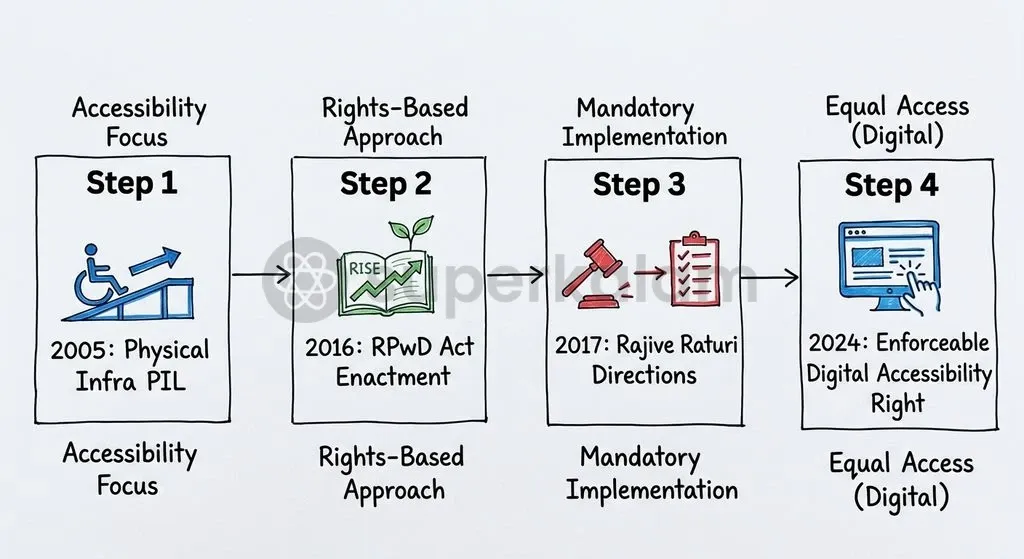
A public-interest petition filed by visually impaired activist Rajive Raturi in 2005 initiated a two-decade judicial effort to secure barrier-free access across India.
The litigation evolved across three distinct phases:
- Physical Infrastructure Focus (2005): Initial petitions sought barrier-free access to government complexes, transport networks, railway stations, and court buildings.
- Judicial Directives and Campaigns (2017): The Supreme Court issued eleven specific directions to eliminate structural barriers within fixed timeframes, running parallel to the Accessible India Campaign (Sugamya Bharat Abhiyan).
- The Digital Shift: As governance, welfare delivery, and commerce moved online, digital platforms became the primary gatekeeper, prompting the petitioner to seek expanded judicial remedies for virtual public services.
Physical vs Digital Accessibility: Evolution Under the RPwD Act 2016
The RPwD Act, 2016 unified physical, transport, and electronic access under a single legal umbrella. Enacted to give domestic effect to the United Nations Convention on the Rights of Persons with Disabilities (UNCRPD), the statute replaced the narrow protections of the 1995 Act with an expansive civil-rights framework.
Section 40 mandates the Central Government to establish binding standards across built environments, transport systems, and ICT ecosystems. Section 42 obligates the appropriate government to ensure access to electronic media, digital interfaces, and public broadcast content through universal design interfaces, sign language interpretation, and closed captioning.
| Dimension | Physical Accessibility Framework | Digital Accessibility Framework |
|---|---|---|
| Primary Statutory Anchor | Section 40 and Section 44 of RPwD Act, 2016 | Section 40 and Section 42 of RPwD Act, 2016 |
| Core Technical Standard | Harmonised Guidelines and Space Standards for Barrier-Free Built Environment | Bureau of Indian Standards standard IS 17802 (Part 1 & 2) and GIGW 3.0 |
| Compliance Mechanism | Mandatory building-plan scrutiny and completion certificates under Section 44 | Accessibility Conformance Reports and digital audits across public portals |
| Retrofitting Deadline | Five-year statutory window under Section 45 | Two-year statutory compliance window under Section 46 |
| Penal Framework | Penalties under Section 89 (up to ₹10,000 for first breach; ₹50,000 to ₹5,00,000 subsequently) | Identical financial penalties under Section 89 for non-compliant service providers |
Discuss with Superkalam
How does an ex-ante structural standard under Universal Accessibility differ fundamentally from an ex-post remedy like Reasonable Accommodation?
Ask NowWhy Advisory Standards Failed: The Reality of Non-Compliant Public Portals
Executive notifications framed digital compliance as an advisory aspiration rather than a binding legal requirement. Rule 15(1) of the RPwD Rules, 2017 incorporated standards like the Guidelines for Indian Government Websites (GIGW) merely as best practices. This allowed departments to operate non-compliant portals without administrative penalties.
Public digital platforms routinely exhibited critical failures, preventing users with visual, auditory, or motor impairments from accessing essential entitlements. Common systemic barriers across state portals included:
- Inaccessible CAPTCHA Verification: Visual CAPTCHA challenges without audio alternatives blocked visually impaired citizens from logging into welfare and tax portals.
- Unlabelled Digital Documents: Scanned PDF files lacking OCR text rendered circulars, forms, and court orders unreadable by assistive technologies.
- Absence of Alternative Text: Missing metadata descriptions for images and charts prevented screen readers from interpreting graphical data.
- Incompatible Electronic Interfaces: Payment gateways and public distribution apps routinely failed basic keyboard-navigation and screen-reader tests.
The Bureau of Indian Standards established technical parameters under IS 17802 (Part 1: 2021 and Part 2: 2022) to govern ICT products and services. Concurrently, the Ministry of Electronics and Information Technology (MeitY) issued GIGW 3.0 to mandate WCAG 2.1 Level AA compliance. Despite these technical blueprints, voluntary adoption produced negligible compliance across state-level platforms.
Legal Principles Established by the Supreme Court Ruling
The Supreme Court held that statutory accessibility mandates cannot be diluted through subordinate rule-making powers. Declaring Rule 15(1) invalid for using non-binding phraseology, the court held that executive discretion cannot undermine statutory rights established by Parliament.
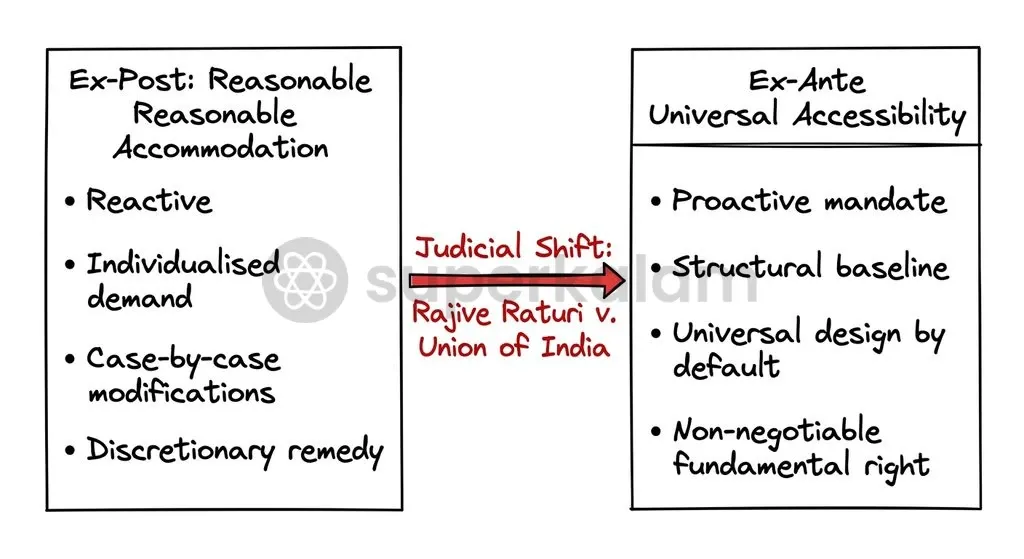
The bench drew a clear distinction between structural accessibility and individual accommodation:
| Principle | Reasonable Accommodation (Vikash Kumar, 2021) | Universal Accessibility (Rajive Raturi, 2024) |
|---|---|---|
| Legal Character | Individualised, case-by-case duty | Non-negotiable baseline obligation |
| Timing of Remedy | Ex-post remedy triggered upon request | Ex-ante structural requirement |
| Operational Focus | Tailored adjustments (e.g., scribes for exams) | System-wide design (e.g., GIGW-compliant apps) |
The Supreme Court rejected arguments that resource constraints excuse prolonged non-compliance. Reaffirming the statutory deadlines in Section 45 and Section 46 of the RPwD Act, the court ruled that digital accessibility is a mandatory precondition for operating public services.
Discuss with Superkalam
If a state welfare portal releases application forms solely as scanned PDF images without text alternatives, what statutory and constitutional violations occur?
Ask NowConstitutional and Legal Framework: Articles 14, 21, and Sections 40-46 of RPwD Act
Constitutional guarantees of equality and personal liberty form the bedrock of India's disability jurisprudence. Exclusion from virtual civic spaces violates the substantive equality guaranteed under Article 14, while the denial of accessible government information impairs freedom of expression under Article 19(1)(a).
The right to live with dignity under Article 21 requires autonomy in accessing education, healthcare, banking, and public employment. Digital platforms that ignore accessibility standards erect artificial barriers. These barriers force persons with disabilities into compulsory dependence on intermediaries.
The RPwD Act, 2016 translates these constitutional guarantees into specific operational duties:
- Section 40: Mandates the Central Government to notify binding accessibility rules across physical, transport, and ICT sectors.
- Section 42: Imposes specific duties on state authorities to ensure all electronic media and digital content adhere to accessible formats.
- Section 44: Bars local authorities from granting building completion certificates or operational approvals to non-compliant physical infrastructure.
- Sections 45 & 46: Fix statutory timelines for retrofitting physical facilities (5 years) and service interfaces (2 years).
- Section 89: Imposes escalating financial penalties on defaulting entities to deter continued statutory contravention.
International treaty law reinforces this domestic statutory mandate. India ratified the UNCRPD in 2007, accepting binding international obligations under Article 9 to eliminate barriers across electronic communications, digital emergency systems, and online public services.
GS4 Ethical Perspective: Universal Design as Dignity and Justice
Ethical governance requires digital public infrastructure to be inclusive from inception. Designing exclusionary digital systems violates the Kantian categorical imperative by treating persons with disabilities as peripheral beneficiaries rather than autonomous rights-holders.
The Supreme Court anchored its reasoning in the ethical philosophy of Universal Design. This concept demands the creation of products and services usable by all individuals without requiring specialised retrofitting. Retrofitting interfaces after launch is an inefficient approach that perpetuates exclusion during deployment.
| Design Paradigm | Exclusionary Digital Architecture | Universal Design Framework |
|---|---|---|
| Target User Base | Optimised exclusively for the average user | Designed accessible for all citizens |
| Autonomy Impact | Forces reliance on third-party intermediaries | Preserves user privacy and self-reliance |
| Remediation Model | Ad-hoc, delayed, and costly retrofitting | Inherent structural compliance by default |
Universal design advances substantive justice by removing structural inequalities. An accessible digital portal allows a visually impaired citizen to independently cast a postal vote, file taxes, or receive welfare disbursements. By eliminating reliance on third-party help, universal design protects privacy and upholds personal autonomy.
Discuss with Superkalam
Why did voluntary and advisory guidelines fail to secure widespread compliance across Indian government websites prior to the 2024 ruling?
Ask NowGlobal Best Practices: Comparing the ADA and European Accessibility Act
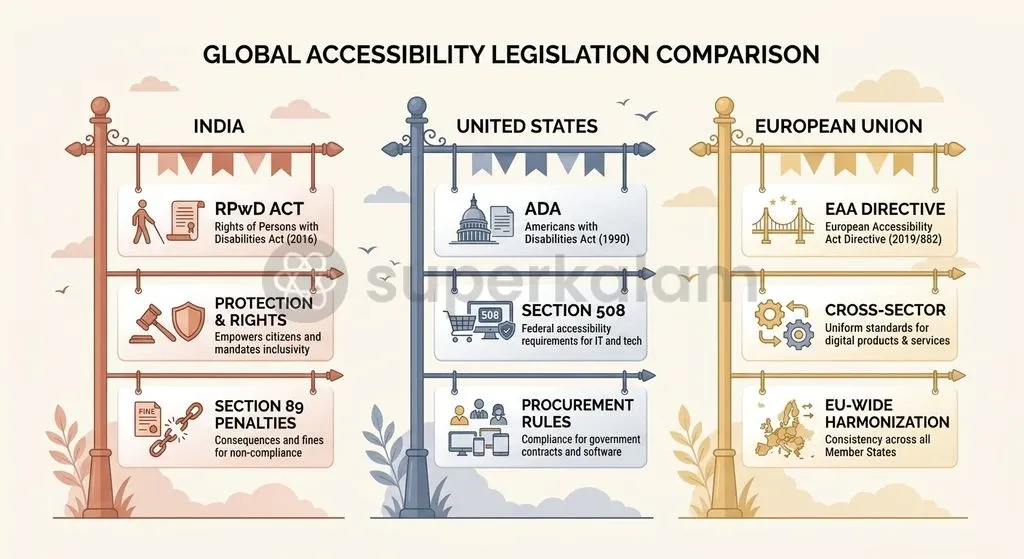
International legal systems demonstrate that mandatory standards backed by commercial consequences generate higher compliance than voluntary guidelines. Statutory models across jurisdictions illustrate distinct approaches to enforcing accessibility across sectors.
The United States operationalises digital inclusion through Section 508 of the Rehabilitation Act of 1973, prohibiting federal departments from procuring or using inaccessible technology. American courts also apply Title III of the Americans with Disabilities Act (ADA) to commercial websites, opening non-compliant businesses to civil litigation.
The European Union enforces cross-sector digital inclusion through the European Accessibility Act (Directive 2019/882). This binding directive applies directly to private digital commerce, consumer banking, operating systems, e-books, and mobile devices across member states.
| Parameter | Indian Legal Framework | United States Model | European Union Framework |
|---|---|---|---|
| Governing Statute | RPwD Act, 2016 & IS 17802 / GIGW 3.0 | Section 508 Rehabilitation Act & ADA (1990) | European Accessibility Act (Directive 2019/882) |
| Enforcement Scope | Public authorities and private service providers | Federal agencies (Sec 508) and public accommodations (ADA) | Comprehensive public and private commercial sectors |
| Primary Mechanism | Administrative rules and Section 89 financial penalties | Public procurement bans and private damages litigation | Harmonised market-surveillance directives and product bans |
| Core Strength | Direct constitutional anchoring under Fundamental Rights | Strict procurement leverage preventing public tech contracts | Unified single-market standards across commercial software |
Challenges in Implementation: Capacity, Audits, and Private Sector Integration
Implementation across India's digital ecosystem faces severe technical bottlenecks that hinder systemic compliance:
- Procurement and Audit Deficits: State and municipal IT departments lack dedicated accessibility testing pipelines. Public procurement tenders routinely award contracts to the lowest commercial bidder without auditing compliance against BIS standard IS 17802 or GIGW parameters.
- Institutional Vacancies: Institutional oversight remains fragile. During follow-up monitoring proceedings on 29 July 2026, the Supreme Court noted extensive defaults, directing non-compliant States to appoint independent State Commissioners for Persons with Disabilities and ordering the Union Government to fill the long-vacant post of Chief Commissioner within four weeks.
- Private Sector Reluctance: Digital payment apps, e-commerce platforms, and ed-tech services argue that refactoring legacy codebases creates disproportionate costs, resisting compliance in the absence of active enforcement under Section 89 penalties.
Way Forward: Building an Enforceable and Inclusive Digital Infrastructure
Executive and regulatory systems must implement structured reforms to translate the Rajive Raturi mandate into reality. The Ministry of Social Justice and Empowerment initiated draft amendments to Rule 15 of the RPwD Rules in July 2026, proposing mandatory Accessibility Conformance Reports (ACRs) and procurement conditionalities for all public ICT contracts.
A comprehensive policy roadmap requires action across five key pillars:
- Mandatory Procurement Conditionalities: Central and State public procurement rules must disqualify vendors whose software solutions fail IS 17802 and GIGW 3.0 certification audits before deployment.
- Institutionalisation of Independent Audits: Independent third-party security and accessibility audits should be conducted annually across all government portals and essential public-facing private services.
- Strict Application of Penalties: Regulatory authorities must actively invoke Section 89 of the RPwD Act, levying statutory fines on defaulting public departments and private enterprises.
- Curriculum Integration in Tech Education: The National Skill Development Corporation (NSDC) and AICTE must embed universal design and accessible frontend engineering into mainstream computer science and software development curricula.
- Strengthening Regulatory Machinery: State governments must operationalise independent offices for State Commissioners for Persons with Disabilities, providing them with technical audit cells to monitor digital compliance.
Discuss with Superkalam
How should administrative authorities balance claims of fiscal constraints against the non-negotiable statutory timelines laid out in Sections 45 and 46 of the RPwD Act?
Ask NowKey Takeaways
- The Supreme Court held in Rajive Raturi v. Union of India (2024) that digital accessibility is an enforceable fundamental right guaranteed under Articles 14, 19, and 21 of the Constitution.
- Provisions of Rule 15(1) of the RPwD Rules, 2017 were struck down as ultra vires for framing statutory accessibility mandates under Section 40 as non-binding advisory guidelines.
- The judgment draws an essential analytical line between universal, ex-ante structural accessibility obligations and individualised, ex-post reasonable accommodation duties.
- Technical compliance requires adherence to Bureau of Indian Standards IS 17802 (Parts 1 & 2) and MeitY's GIGW 3.0 standards, which mandate WCAG 2.1 Level AA compliance.
- Enforceability requires linking public IT procurement contracts directly to mandatory Accessibility Conformance Reports and imposing statutory penalties under Section 89 of the RPwD Act, 2016.
Mains Question
"Digital accessibility is not merely an administrative aspiration but an ex-ante structural requirement rooted in fundamental rights." In light of the Supreme Court's ruling in Rajive Raturi v. Union of India (2024), critically analyse the shift from reasonable accommodation to universal digital design under the Rights of Persons with Disabilities Act, 2016. (15 Marks)
Evaluate NowMains Question
Subordinate legislation cannot dilute the mandatory protections guaranteed by parent statutes. Elucidate how the invalidation of Rule 15(1) of the RPwD Rules, 2017 strengthens the enforceability of accessibility standards across public digital interfaces. (10 Marks)
Evaluate NowPractice MCQs
QUESTION 1
With reference to the Rights of Persons with Disabilities (RPwD) Act, 2016, consider the following statements:
- Section 40 obligates the Central Government to establish mandatory accessibility standards for built environments, transport systems, and ICT ecosystems.
- The Act prescribes a five-year statutory window under Section 46 for retrofitting digital service interfaces.
- Financial penalties under Section 89 can extend up to ₹5,00,000 for subsequent breaches of statutory accessibility provisions.
Which of the statements given above are correct?
QUESTION 2
In the context of Indian disability jurisprudence, consider the following statements distinguishing 'Reasonable Accommodation' from 'Universal Accessibility':
- While Reasonable Accommodation operates as an ex-post remedy upon individual request, Universal Accessibility serves as an ex-ante non-negotiable structural requirement.
- The principle of Reasonable Accommodation was articulated in Vikash Kumar (2021), whereas system-wide Universal Accessibility was reinforced in Rajive Raturi (2024).
- Universal Accessibility allows exemptions for public service providers based on proven financial and resource constraints.
Which of the statements given above is/are correct?
QUESTION 3
Consider the following statements regarding digital accessibility frameworks in India:
- The Supreme Court struck down provisions of Rule 15(1) of the RPwD Rules, 2017 as ultra vires because it converted statutory mandates into discretionary guidelines.
- IS 17802 (Part 1 and Part 2) is a technical standard issued by the Bureau of Indian Standards governing accessibility in ICT products and services.
- Guidelines for Indian Government Websites (GIGW 3.0) mandate compliance with WCAG 2.1 Level AA standards.
Which of the statements given above are correct?
QUESTION 4
Under which of the following Articles of the Constitution of India has the Supreme Court affirmed that the right to digital accessibility is an enforceable fundamental right?
QUESTION 5
Which international convention, ratified by India in 2007, specifically obligates state parties under Article 9 to eliminate accessibility barriers across electronic communications and online public services?