World Habitat Day 2026: Date, Theme and Significance
World Habitat Day 2026 was observed on 5 October with the theme Adequate Housing for All. Read its meaning, housing rights and relevance for India.
Oct, 2026
•10 min read
Overview
World Habitat Day establishes adequate housing as an indispensable foundation for human dignity. Urban governance must look beyond simple brick-and-mortar counts toward tenurial security, spatial inclusion, and basic civic infrastructure.
As urbanisation accelerates across India, housing policy must balance construction targets with universal access to water, sanitation, and legal protection from eviction. Achieving sustainable cities requires embedding shelter rights into municipal master planning, directly aligning domestic schemes with international human rights standards.
Why in the News: The Global Call for Habitat and Urban Dignity
World Habitat Day 2026 was observed globally on 5 October 2026 in Muscat, Oman, focusing on the theme 'Adequate Housing for All'. Multilateral discussions under the United Nations Human Settlements Programme (UN-Habitat) emphasise that urban shelter deficits cannot be resolved by physical construction alone.
The global observance reinforces commitments under the New Urban Agenda, adopted at Habitat III in Quito in 2016 and endorsed by UN General Assembly Resolution 71/256.
Key priorities guiding this global call include:
- Sustainable Economic Growth: Positioning housing as a driver of employment and social equity.
- Upgraded Living Conditions: Scrutinising informal settlements to ensure basic service delivery.
- Global Benchmark Alignment: Integrating targets under SDG Target 11.1 for universal access to safe, affordable shelter by 2030 into domestic programmes like PMAY-U.
Discuss with Superkalam
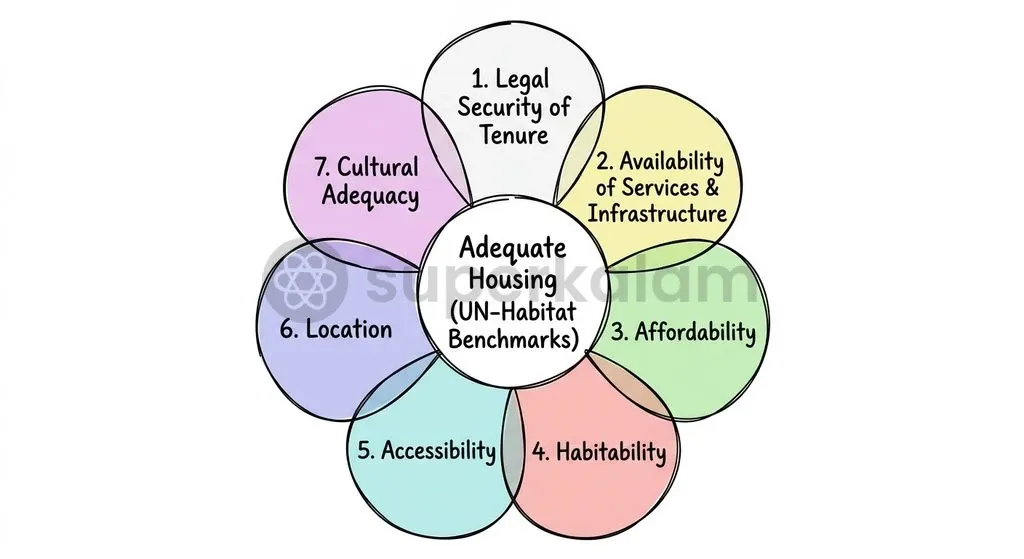
Recall the seven benchmarks of adequate housing defined under UN CESCR General Comment No. 4.
Ask NowWhat is World Habitat Day and the Role of UN-Habitat?
The United Nations General Assembly designated the first Monday of October as World Habitat Day through Resolution 40/202 in 1985. The annual observance assesses human settlement conditions and promotes the collective responsibility to ensure adequate shelter for all.
UN-Habitat acts as the focal coordinating agency within the United Nations system for sustainable urban development. It concentrates on three primary operational pillars:
- Policy Formulation: Assisting national governments in designing integrated national urban policies.
- Service Delivery: Strengthening local municipal capacity and improving public utility distribution.
- Settlement Upgrading: Driving participatory slum improvement and tenure security programmes.
The platform allows policymakers to evaluate domestic frameworks against global commitments. It urges member states to treat housing as a vital social good necessary for public health, climate resilience, and economic mobility.
Defining 'Adequate Housing': The Seven Global Benchmarks
The UN Committee on Economic, Social and Cultural Rights (CESCR) defined the right to adequate housing under Article 11(1) of the International Covenant on Economic, Social and Cultural Rights through General Comment No. 4 in 1991. The committee established that adequate shelter requires far more than physical four walls and a roof, articulating seven distinct criteria.
| Criterion | Core Requirement under CESCR General Comment No. 4 | Indian Urban Policy Application |
|---|---|---|
| Legal Security of Tenure | Protection against forced eviction, harassment, and arbitrary displacement. | Slum land titling under the Odisha Land Rights to Slum Dwellers Act, 2017. |
| Availability of Services | Sustainable access to safe drinking water, energy, sanitation, and waste management. | Basic civic infrastructure delivery under PMAY-U and national municipal missions. |
| Affordability | Housing costs must not compromise the satisfaction of other basic needs. | Credit linked interest subsidies and public funding under PMAY-U 2.0. |
| Habitability | Adequate physical space, structural safety, and protection from climatic extremes. | Building envelope thermal comfort norms under the Eco-Niwas Samhita. |
| Accessibility | Non-discriminatory access prioritising disadvantaged and marginalised groups. | Priority allotments for women, elderly persons, and low-income beneficiaries. |
| Location | Proximity to employment options, healthcare services, schools, and transit nodes. | In-situ slum redevelopment avoiding peripheral spatial segregation. |
| Cultural Adequacy | Construction materials and spatial designs respecting cultural identity and diversity. | Regional architectural adaptations within beneficiary-led construction. |
Complementing these standards, CESCR General Comment No. 7 (1997) affirmed that forced evictions are prima facie incompatible with state obligations under international law. Relocation must occur only in exceptional circumstances, subject to due legal process, genuine consultation, and appropriate alternative accommodation.
Discuss with Superkalam
Explain why structural permanence (pucca construction) alone does not guarantee the fulfillment of adequate housing standards.
Ask NowThe Constitutional Grounding: Right to Shelter Under Article 21
The Supreme Court of India has expanded the interpretation of the Right to Life under Article 21 to encompass human dignity and basic shelter. Although the Constitution of India does not explicitly enumerate housing as a standalone Fundamental Right, progressive judicial rulings have established its constitutional enforceability.
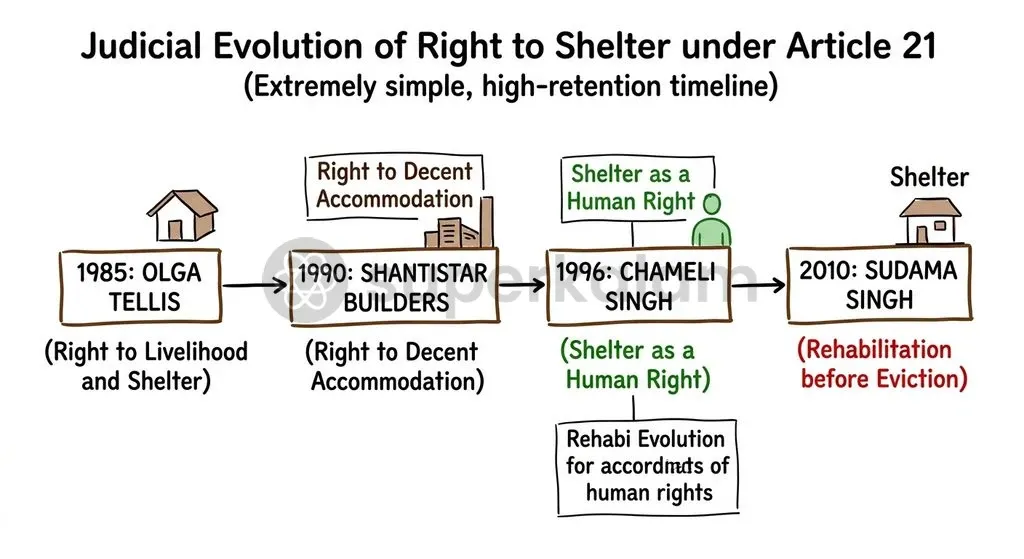
In the landmark ruling Olga Tellis v. Bombay Municipal Corporation (1985), a five-judge Constitution Bench held that the right to livelihood is an integral facet of Article 21. The court observed that evicting pavement dwellers without fair procedure directly deprives them of their means of living.
| Case Landmark | Year | Judicial Principle Established |
|---|---|---|
| Olga Tellis | 1985 | Right to livelihood anchored in Article 21 procedure |
| Shantistar Builders | 1990 | Right to life encompasses a decent living environment |
| Chameli Singh | 1996 | Right to shelter is fundamental for physical and mental growth |
| Sudama Singh | 2010 | Mandatory rehabilitation surveys affirming the Right to the City |
In Shantistar Builders v. Narayan Khimalal Totame (1990), the Supreme Court affirmed that the constitutional guarantee of life includes reasonable accommodation and a decent environment. The principle was consolidated in Chameli Singh v. State of Uttar Pradesh (1996), where the court ruled that the right to shelter is fundamental under Article 21 and Article 19(1)(e), requiring infrastructure that supports physical, mental, and intellectual growth.
The Delhi High Court reinforced these protections in Sudama Singh v. Government of NCT of Delhi (2010), holding that public authorities cannot carry out evictions without conducting eligibility surveys and establishing rehabilitation plans that honour the Right to the City.
Where India Stands: Scale of the Urban Housing Deficit
India faces a dual challenge of expanding urban populations and qualitative infrastructure deficits. Official data outlines the scale of this structural bottleneck:
- Census 2011 Slum Population: The Census of India 2011 documented that 65.5 million people lived in slums across 2,613 statutory and census towns, comprising 17.4% of total urban households.
- Structural Permanence vs Utility Access: According to the National Sample Survey 76th Round report (2018), 96.0% of urban households lived in pucca structures, yet only 57.5% had individual access to exclusive piped water within their dwelling units.
This gap between structural permanence and basic service delivery highlights the challenge of multidimensional urban deprivation. Households frequently face overcrowded quarters, shared sanitation facilities, and acute vulnerability to monsoon flooding.
Discuss with Superkalam
How can municipal authorities apply the principles established in Sudama Singh (2010) when designing urban infrastructure projects that require land clearance?
Ask NowGovernment Interventions: Assessing PMAY-Urban and Rental Housing Schemes
The Ministry of Housing and Urban Affairs launched the Pradhan Mantri Awas Yojana - Urban (PMAY-U) in June 2015 to provide all-weather pucca houses to eligible urban beneficiaries. The initial mission was structured across four distinct verticals:
- In-Situ Slum Redevelopment (ISSR): Utilising land as a resource with private participation to build formal housing for slum residents.
- Credit Linked Subsidy Scheme (CLSS): Providing upfront interest subsidies on housing loans for lower and middle-income segments.
- Affordable Housing in Partnership (AHP): Developing affordable housing units in collaboration with state governments and private developers.
- Beneficiary-Led Construction (BLC): Providing central assistance to individual eligible families to build or enhance their own houses.
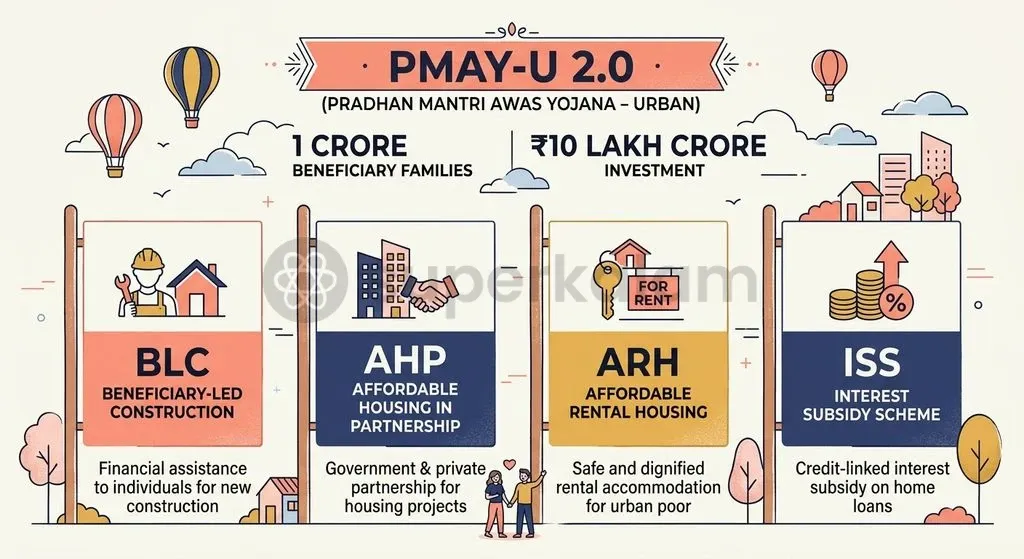
On August 9, 2024, the Union Cabinet approved Pradhan Mantri Awas Yojana - Urban 2.0 (PMAY-U 2.0) to address the housing requirements of 1 crore urban poor and middle-class families from 2024 to 2029. The scheme entails an investment of ₹10 lakh crore, supported by central assistance of ₹2.30 lakh crore, operating across four verticals: BLC, AHP, Affordable Rental Housing (ARH), and the Interest Subsidy Scheme (ISS).
To support circular migrants and industrial labour, MoHUA introduced the Affordable Rental Housing Complexes (ARHCs) sub-scheme in 2020. The scheme converts existing vacant government-funded housing and incentivises private and public entities to construct rental housing on unutilised land parcels.
Complementing programmatic funding, the Union Cabinet approved the Model Tenancy Act (MTA) on June 2, 2021. The model legislation proposes establishing a three-tier dispute resolution mechanism consisting of Rent Authorities, Rent Courts, and Rent Tribunals to balance tenant security with landlord property rights.
Core Structural Bottlenecks: Land Scarcity, Finance, and Tenurial Security
Urban housing delivery faces persistent structural constraints that slow the execution of public schemes across three key areas:
- High Land Costs and Peripheral Segregation: Prohibitive land prices inside municipal limits push affordable projects to distant peripheries, severing low-income workers from vital employment nodes.
- Tenurial Insecurity in Informal Settlements: Lack of registered titles or patta rights leaves slum dwellers vulnerable to summary demolition, suppressing private home investment and formal civic connections.
- Financial Exclusion in the Informal Sector: Workers without formal income documentation or credit histories face systemic reluctance from commercial banks extending home construction loans.
Comparing Models: What India Can Learn from Global Public Housing Successes
State-led housing initiatives demonstrate that securing land tenure and upgrading in-situ infrastructure produces sustainable urban regeneration. When governments combine statutory land rights with local community participation, public investments yield better socio-economic outcomes.
The state of Odisha demonstrated this shift through the Odisha Land Rights to Slum Dwellers Act, 2017 and the JAGA Mission. The initiative granted statutory land rights to urban slum dwellers and integrated infrastructure upgrades across informal settlements, winning the UN-Habitat Scroll of Honour Award in 2019.
Prioritising in-situ rehabilitation over forced peripheral relocation preserves informal social safety nets and ensures urban workers maintain direct access to livelihood corridors.
Discuss with Superkalam
Analyze the structural challenges that lead to a gap between pucca housing numbers and access to basic amenities like piped water in Indian cities.
Ask NowWay Forward: Designing Climate-Resilient and Inclusive Cities
Urban planning must shift from isolated housing construction to comprehensive spatial integration. Municipal corporations should integrate informal settlements into statutory City Master Plans, ensuring that housing projects connect directly to mass public transit and employment hubs.
Construction methods must also adapt to changing climate realities. Under the Global Housing Technology Challenge - India (GHTC-India), MoHUA constructed six Light House Projects of over 1,000 houses each across Indore, Rajkot, Chennai, Ranchi, Agartala, and Lucknow to mainstream 54 innovative, disaster-resilient building technologies.
- GHTC-India: Mainstreaming disaster-resilient precast concrete technologies.
- BEE Eco-Niwas Samhita: Enforcing energy conservation codes and thermal comfort standards.
- Model Tenancy Act: Formalising rental housing markets and tenant protection mechanisms.
- Slum Titling (JAGA Model): Securing land tenure and in-situ infrastructure upgrades.
Energy efficiency standards must be implemented at scale in low-cost housing. Enforcing the Eco-Niwas Samhita (Part I & II), formulated by the Bureau of Energy Efficiency under the Energy Conservation Act, 2001, ensures building envelope thermal comfort and cuts operational energy costs for low-income households.
State governments must expedite the adoption of the Model Tenancy Act, 2021, while expanding rental housing stock under PMAY-U 2.0. Balancing tenurial security, climate-resilient architecture, and basic service infrastructure will enable Indian cities to achieve the core mandate of World Habitat Day: adequate, safe, and dignified housing for all.
Key Takeaways
- World Habitat Day is observed annually on the first Monday of October pursuant to UN General Assembly Resolution 40/202 (1985), with the 2026 global event held in Muscat, Oman, on the theme 'Adequate Housing for All'.
- Adequate Housing Definition: Under CESCR General Comment No. 4 (1991), adequate housing encompasses seven pillars: tenure security, infrastructure/services, affordability, habitability, accessibility, location, and cultural adequacy.
- Constitutional Jurisprudence: The Supreme Court recognized the Right to Shelter as an integral facet of Article 21 and Article 19(1)(e) through landmark rulings including Olga Tellis (1985), Shantistar Builders (1990), and Chameli Singh (1996).
- Scale of Deficit: Census 2011 recorded 65.5 million people in slums (17.4% of urban households); NSS 76th Round data shows that while 96.0% have pucca structures, only 57.5% possess individual piped water connections.
- Policy Initiatives: PMAY-U 2.0 targets 1 crore families (2024–2029) with ₹10 lakh crore investment across four verticals, supported by the Model Tenancy Act (2021) and Light House Projects under GHTC-India.
Mains Question
"Adequate housing is not merely a matter of brick and mortar, but an indispensable foundation for human dignity and livelihood." In light of judicial interpretations under Article 21 and the seven CESCR benchmarks, elucidate the essential components of the right to shelter in India. (10 Marks)
Evaluate NowMains Question
Despite high rates of structural permanence in urban housing, multi-dimensional urban deprivation continues to plague Indian cities. Critically examine the efficacy of public housing interventions like PMAY-U in addressing the urban shelter deficit. (15 Marks)
Evaluate NowPractice MCQs
QUESTION 1
With reference to the right to adequate housing and international benchmarks, consider the following statements:
- The United Nations Committee on Economic, Social and Cultural Rights (CESCR) defined the criteria for adequate housing under General Comment No. 4.
- According to CESCR General Comment No. 7, forced evictions are prima facie incompatible with state obligations under international law.
- World Habitat Day is designated by the United Nations General Assembly to be observed annually on the first Monday of October. Which of the statements given above are correct?
QUESTION 2
Consider the following pairs of landmark Indian judicial rulings and the principles established regarding shelter:
- Olga Tellis v. BMC (1985) – Right to livelihood as an integral facet of Article 21
- Shantistar Builders v. N.K. Totame (1990) – Right to life encompasses reasonable accommodation and a decent environment
- Sudama Singh v. Govt. of NCT of Delhi (2010) – Mandatory rehabilitation surveys affirming the 'Right to the City' Which of the pairs given above is/are correctly matched?
QUESTION 3
Regarding the Pradhan Mantri Awas Yojana - Urban 2.0 (PMAY-U 2.0) approved in August 2024, consider the following statements:
- It targets addressing the housing requirements of 1 crore urban poor and middle-class families between 2024 and 2029.
- It entails a total investment of ₹10 lakh crore, which includes central assistance of ₹2.30 lakh crore.
- It operates through verticals that include Beneficiary-Led Construction, Affordable Housing in Partnership, Affordable Rental Housing, and the Interest Subsidy Scheme. Which of the statements given above are correct?
QUESTION 4
According to the National Sample Survey (NSS) 76th Round report (2018) cited in the context of urban housing in India:
QUESTION 5
Consider the following statements regarding international urban development frameworks:
- The New Urban Agenda was adopted at Habitat III in Quito in 2016.
- Sustainable Development Goal Target 11.1 aims to ensure access for all to adequate, safe, and affordable housing and basic services by 2030. Which of the statements given above is/are correct?