India-Japan Joint Crediting Mechanism: Meaning and Rules
India-Japan JCM supports low-carbon technology and carbon-credit cooperation under Article 6.2. Read its rules, project cycle and accounting safeguards.
Oct, 2026
•9 min read
Overview
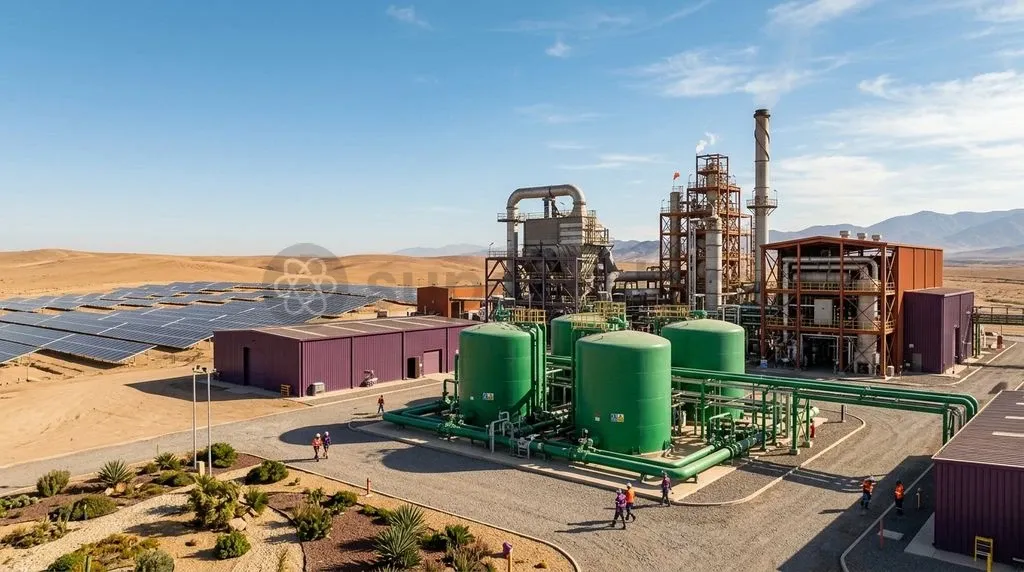
The India-Japan Joint Crediting Mechanism operationalises bilateral carbon trading under Article 6.2 of the Paris Agreement. It gives India access to advanced Japanese low-carbon technologies while generating high-integrity Internationally Transferred Mitigation Outcomes (ITMOs). This structure speeds up industrial decarbonisation without undermining national climate targets.
Both nations execute mitigation projects jointly. They split verified carbon credits according to their financial and technical contributions. Unlike legacy offset programmes, this bilateral route applies strict accounting safeguards that deduct transferred mitigation outcomes directly from the host nation's balance.
The framework unlocks vital co-financing for capital-heavy sectors like green hydrogen, carbon capture, and industrial retrofits. Bilateral climate finance ties directly into India's long-term emissions trajectory.
Why in the News? The Release of the 2026 JCM Operational Manual
The operationalisation of the India-Japan Joint Crediting Mechanism took a decisive step forward on June 8, 2026. On this date, both governments officially adopted the bilateral Rule of Implementation under Article 6.2.
As of June 2026, this bilateral framework sets clear procedures for registering projects, approving methodologies, and issuing carbon credits between both nations. The timeline developed through key milestones:
- August 7, 2025: The Ministry of Environment, Forest and Climate Change (MoEFCC) of India and the Government of Japan signed the foundational Memorandum of Cooperation.
- August 29, 2025: Both nations formally exchanged the memorandum during the India-Japan Summit.
- June 8, 2026: Both nations adopted the formal Rule of Implementation.
Bilateral market mechanisms under Article 6.2 provide a targeted route for decarbonisation finance and technology transfer. They move carbon markets away from cheap unilateral offsetting towards verified, shared mitigation outcomes.
What Is the Joint Crediting Mechanism (JCM)?
The Joint Crediting Mechanism is a bilateral project-based crediting system initiated by the Government of Japan. Its core aim is to diffuse leading low-carbon technologies across partner countries.
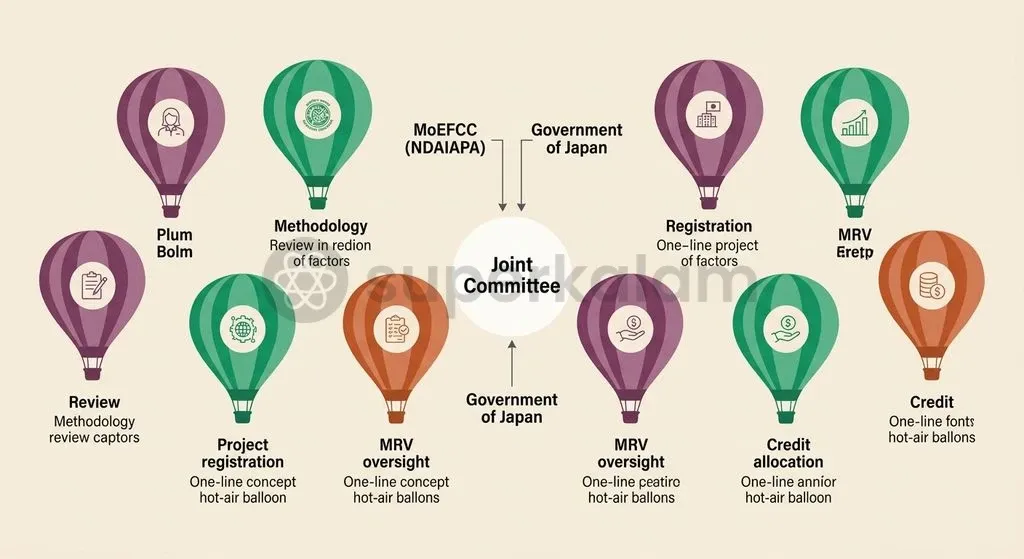
India became the 31st partner country globally to sign a bilateral JCM agreement with Japan. A bilateral Joint Committee governs the mechanism. Formed by designated representatives from both governments, it sets operating rules, approves baseline methodologies, and verifies credit allocations.
Under Section 3(a) of the bilateral Rule of Implementation, the India-Japan JCM covers seven major greenhouse gases:
- Carbon dioxide (CO2)
- Methane (CH4)
- Nitrous oxide (N2O)
- Hydrofluorocarbons (HFCs)
- Perfluorocarbons (PFCs)
- Sulphur hexafluoride (SF6)
- Nitrogen trifluoride (NF3)
Verified emission reductions from registered projects are split quantitatively between Indian and Japanese participants. These credit allocations reflect their respective financial, technical, and viability-gap contributions.
Discuss with Superkalam
Which seven greenhouse gases fall under the purview of the India-Japan Joint Crediting Mechanism Rule of Implementation?
Ask NowHow Article 6.2 of the Paris Agreement Governs Bilateral Carbon Trading
Article 6.2 of the Paris Agreement provides the international legal foundation for voluntary cooperative approaches. It allows countries to trade Internationally Transferred Mitigation Outcomes (ITMOs) across borders.
Unlike centralised multilateral markets governed by international executive boards, Article 6.2 relies on decentralised bilateral cooperation. It operates under international transparency standards set by Decision 2/CMA.3 of the Glasgow Rulebook. The framework grants participating nations sovereign flexibility:
- Bilateral Rulemaking: Governments design crediting structures tailored to shared industrial priorities.
- Sector Targeting: Host nations direct foreign investment to hard-to-abate sectors.
- Sovereign Authorisation: Host nations issue formal approvals before any credit leaves domestic registries.
In India, the National Designated Authority for the Implementation of the Paris Agreement (NDAIAPA), operating under the MoEFCC framework, serves as the apex regulatory body. The NDAIAPA evaluates project proposals and defines priority sectors. It issues formal bilateral authorisations before any mitigation outcome can be transferred abroad as an ITMO.
Step-by-Step: How a JCM Project Operates from Planning to Credit Issuance
The operational lifecycle of a JCM project requires structured project documentation, rigorous third-party auditing, and bilateral Joint Committee approvals before credits are issued.
| Stage | Core Action | Responsible Entity |
|---|---|---|
| 1. Methodology | Develops baseline and emission calculation formulas | Project Developer & Joint Committee |
| 2. PDD Preparation | Formulates project boundary and MRV plan | Project Developer |
| 3. Validation | Conducts independent assessment against standards | Accredited Third-Party Entity |
| 4. Registration | Grants formal bilateral project approval | Bilateral Joint Committee |
| 5. Monitoring | Implements on-site emissions data tracking | Project Operator |
| 6. Issuance | Allocates verified ITMO shares to registries | Joint Committee & Governments |
According to the Asian Development Bank's project handbook, every JCM initiative proceeds through six sequential stages:
- Methodology Development and Approval: Developers draft baseline methodologies demonstrating emissions reductions below business-as-usual levels, which the Joint Committee reviews and approves.
- Project Design Document (PDD) Preparation: Developers prepare a formal PDD detailing project boundaries, technology specifications, monitoring parameters, and emission calculation algorithms.
- Third-Party Validation: An accredited independent Third-Party Entity validates the PDD against JCM standards and baseline methodologies.
- Project Registration: Following successful validation, the bilateral Joint Committee formally registers the facility as an official JCM project.
- Monitoring, Reporting, and Verification (MRV): The project operator monitors emissions data according to the approved plan, producing a periodic monitoring report for independent verification.
- Credit Issuance and Allocation: The Joint Committee evaluates the verified report, determines final emission reductions, and requests both governments to issue the designated credit shares into their national registries.
Discuss with Superkalam
Explain how the application of a positive adjustment to a host nation's greenhouse gas inventory prevents the double counting of ITMOs.
Ask NowRules on Corresponding Adjustments to Prevent Double Counting
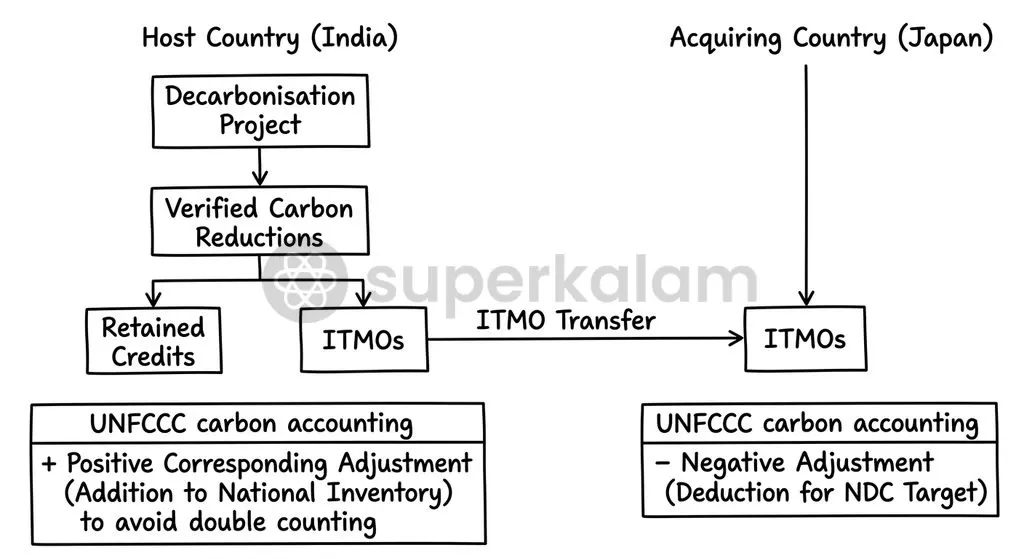
Corresponding Adjustments form the foundational accounting mechanism that prevents double counting when ITMOs are traded internationally.
Under United Nations Framework Convention on Climate Change guidelines, double counting occurs if both host and buyer nations count the same mitigation outcome toward their Nationally Determined Contributions (NDCs). Two core safeguards prevent this overlap:
- National Inventory Adjustment: When India transfers ITMOs to Japan, India must apply a positive adjustment to its national balance. This adds the exported emissions back to India's national greenhouse gas inventory.
- Registry Interoperability: Both countries track the lifecycle, issuance, holding, and transfer of ITMOs through connected electronic national registries.
These digital platforms ensure transactions comply with the UNFCCC Agreed Electronic Format (AEF) annual reporting standards. They guarantee that credits transferred abroad are not claimed under domestic decarbonisation mandates.
Comparison: How JCM Differs from the Clean Development Mechanism (CDM)
The bilateral architecture of Article 6.2 JCM resolves structural accounting deficiencies that characterised the Kyoto Protocol's Clean Development Mechanism.
Under the legacy CDM framework, developing nations faced no binding reduction targets and were not required to adjust their national accounts when selling Certified Emission Reductions (CERs). In contrast, the Paris Agreement binds all signatories to NDCs, making strict bilateral governance and accounting adjustments mandatory.
| Dimension | Kyoto Protocol: Clean Development Mechanism (CDM) | Paris Agreement: Joint Crediting Mechanism (Article 6.2) |
|---|---|---|
| Governance Structure | Centralised oversight under the UN CDM Executive Board | Decentralised oversight under a bilateral Joint Committee |
| National Target Scope | Only Annex I developed nations held binding targets | All signatory nations hold binding NDCs |
| Accounting Rules | No corresponding adjustments required for host nations | Mandatory Corresponding Adjustments to stop double counting |
| Credit Division | Unilateral credit export directly to international buyers | Quantitative credit sharing based on contribution |
| Financing Structure | Market-driven, post-issuance secondary credit sales | Upfront co-financing and viability gap grants |
| Technology Focus | Broad offset projects, often low-cost renewables | Advanced low-carbon tech in hard-to-abate sectors |
Discuss with Superkalam
How can Indian industrial project developers in capital-heavy sectors utilise JCM's upfront co-financing model to overcome technology adoption barriers?
Ask NowKey Benefits for India: Technology Transfer and Decarbonisation Finance
The India-Japan JCM provides financial support and technological access to accelerate the decarbonisation of India's capital-intensive industrial sectors.
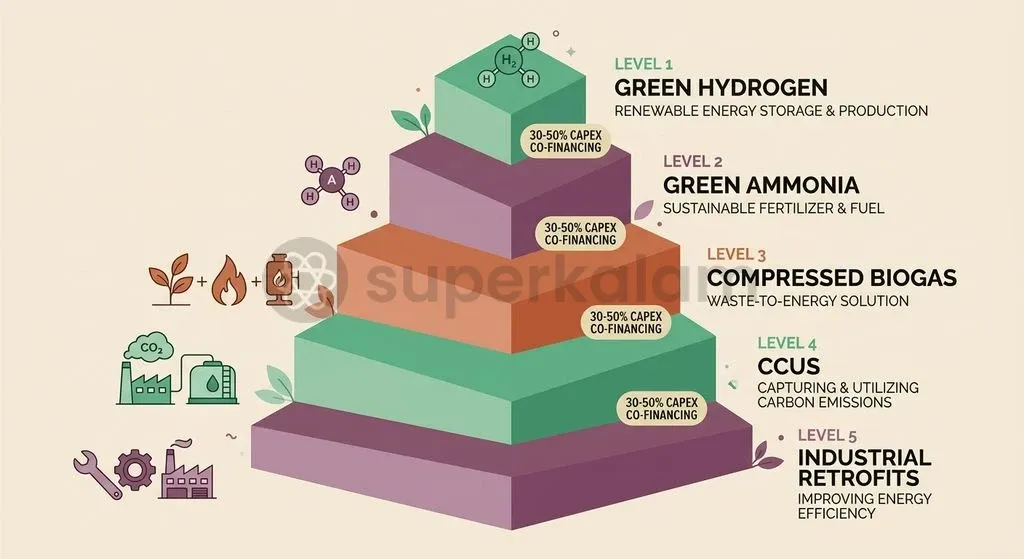
A central advantage of the mechanism is upfront capital subsidisation. The Japanese government structures JCM support to deliver co-financing of 30% to 50% of initial capital expenditures for eligible low-carbon technology deployments. This concessional viability funding lowers hurdle rates for Indian enterprises adopting expensive, cutting-edge systems.
The Ministry of Environment, Forest and Climate Change has prioritised several critical industrial sectors for Article 6.2 bilateral collaboration:
- Green hydrogen generation and distribution infrastructure
- Green ammonia production for fertiliser and maritime use
- Compressed biogas (CBG) processing plants
- Carbon capture utilisation and storage (CCUS) facilities
- High-efficiency industrial heating, smelting, and manufacturing retrofits
These priority areas ensure that international carbon finance directly strengthens industrial productivity rather than funding low-additionality offsets.
Key Challenges and Institutional Bottlenecks in Implementation
Deploying bilateral carbon trading under Article 6.2 requires navigating complex trade-offs between international credit exports and domestic NDC compliance.
Key structural and institutional hurdles include:
- NDC Compliance Risks: Corresponding Adjustments require India to add exported ITMOs back to its emissions total. Exporting high volumes of low-cost mitigation credits abroad could raise the domestic cost of achieving India's own NDC targets.
- Abatement Cost Traps: If India exports low-hanging abatement outcomes, domestic industries may later face higher marginal abatement costs to meet national decarbonisation goals.
- Registry Integration Hurdles: As reported by Carbon Pulse on September 28, 2026, Indian authorities have been developing a dedicated digital module within domestic carbon market infrastructure to handle Article 6.2 authorisations and manual tracking workflows.
- Cross-Border Interoperability: Real-time interoperability between Indian digital platforms and Japan's JCM registry remains essential to prevent tracking delays and administrative bottlenecks.
Discuss with Superkalam
Analyse the structural differences between the Kyoto Protocol's CDM Executive Board governance and Article 6.2's bilateral Joint Committee model.
Ask NowWay Forward: Maximising Carbon Market Integration for India's Net-Zero Goal
India can maximise the strategic value of the Joint Crediting Mechanism by establishing clear sector thresholds, protecting national mitigation reserves, and expanding institutional capacity.
First, the NDAIAPA should restrict ITMO exports exclusively to hard-to-abate sectors where domestic public capital is insufficient and foreign advanced technology is indispensable, such as CCUS and green hydrogen. High-volume, low-cost domestic mitigation activities should remain reserved for India's domestic carbon market to meet national NDC pledges affordably.
Second, regulatory bodies must fast-track the integration of national electronic registries with international UNFCCC tracking formats. Establishing clear domestic MRV protocols and training accredited third-party validation agencies will minimise administrative frictions, making India a global benchmark for high-integrity Article 6.2 bilateral partnerships.
Key Takeaways
- India and Japan operationalised their bilateral Joint Crediting Mechanism by adopting formal Rules of Implementation under Article 6.2 on June 8, 2026.
- The framework is governed by a bilateral Joint Committee, with India's NDAIAPA acting as the national authority to authorise projects and ITMO transfers.
- The JCM covers seven key greenhouse gases: CO2, CH4, N2O, HFCs, PFCs, SF6, and NF3.
- Mandatory Corresponding Adjustments require India to adjust its emissions balance upon exporting ITMOs, preventing double counting across NDCs.
- Japan provides 30% to 50% capital co-financing to deploy advanced low-carbon technologies in priority sectors such as CCUS, green hydrogen, and industrial efficiency.
Mains Question
"Unlike the legacy Clean Development Mechanism under the Kyoto Protocol, bilateral trading under Article 6.2 of the Paris Agreement balances decarbonisation financing with national emission targets." In this context, critically analyse the operational framework of the India-Japan Joint Crediting Mechanism (JCM). (15 Marks)
Evaluate NowMains Question
Elucidate the institutional role of the National Designated Authority for the Implementation of the Paris Agreement (NDAIAPA) and the bilateral Joint Committee in governing carbon credit transfers under the India-Japan Joint Crediting Mechanism. (10 Marks)
Evaluate NowPractice MCQs
QUESTION 1
Regarding the Joint Crediting Mechanism (JCM) agreed between India and Japan under Article 6.2 of the Paris Agreement, consider the following statements:
- India is the 31st partner country globally to enter into a bilateral JCM partnership with Japan.
- The mechanism is governed centrally by an international executive board under the direct oversight of the UNFCCC.
- The scope of the bilateral framework covers seven greenhouse gases, including Sulphur hexafluoride (SF6) and Nitrogen trifluoride (NF3). Which of the statements given above is/are correct?
QUESTION 2
With reference to 'Corresponding Adjustments' in international carbon trading under Article 6.2 of the Paris Agreement, consider the following statements:
- When a host country transfers Internationally Transferred Mitigation Outcomes (ITMOs), it must apply a positive adjustment by adding the exported emissions back to its national inventory.
- Mandatory corresponding adjustments were first introduced under the Kyoto Protocol's Clean Development Mechanism (CDM).
- Connected electronic national registries must adhere to the UNFCCC Agreed Electronic Format (AEF) reporting standards to prevent double counting. Which of the statements given above is/are correct?
QUESTION 3
Consider the following statements regarding the institutional architecture governing Article 6.2 cooperative approaches in India:
- The National Designated Authority for the Implementation of the Paris Agreement (NDAIAPA) operates under the Ministry of Environment, Forest and Climate Change (MoEFCC).
- Formal sovereign authorisation from NDAIAPA is mandatory before any mitigation outcome can be transferred abroad as an ITMO.
- International transparency standards for Article 6.2 cooperative approaches are guided by Decision 2/CMA.3 of the Glasgow Rulebook. Which of the statements given above is/are correct?
QUESTION 4
According to the operational handbook for Joint Crediting Mechanism (JCM) projects, which of the following represents the correct sequential order of project implementation stages?
QUESTION 5
In the context of international climate finance and market mechanisms, how does the Joint Crediting Mechanism (JCM) differ from the Clean Development Mechanism (CDM)?
- While CDM applied only to Annex I nations having binding targets, JCM operates in a regime where all signatories hold binding NDCs.
- JCM relies on quantitative credit sharing based on financial and technical contributions, whereas CDM involved unilateral credit exports.
- CDM offered upfront viability gap grants, whereas JCM relies exclusively on post-issuance secondary market sales. Which of the statements given above is/are correct?