Women-Led Development in India: Meaning, Constitutional Basis and the Asset Gap
Women-led development in India explained: its meaning, constitutional basis, property and land-title gaps, and why asset ownership decides real empowerment.
Oct, 2026
•9 min read
Context
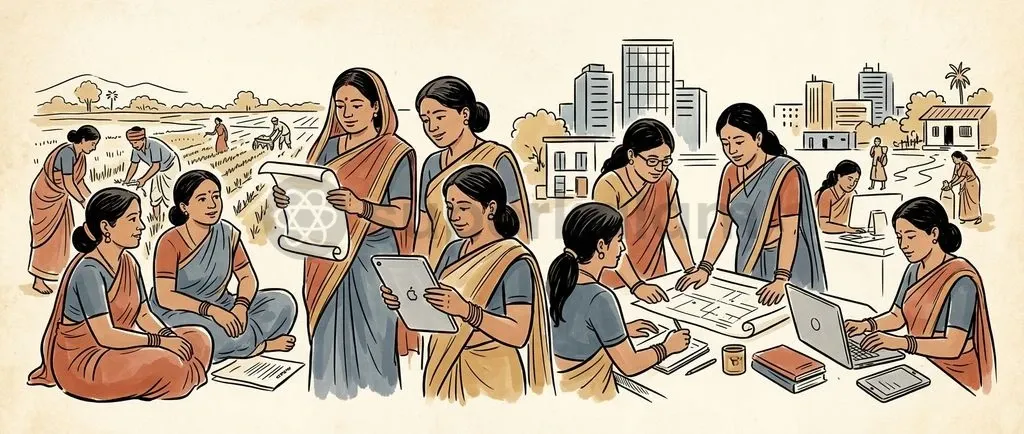
India’s structural transition toward women-led development faces a persistent asset deficit. Statutory inheritance rights consistently fail to translate into registered, marketable property ownership for female citizens.
Public policy now treats women as drivers of macroeconomic growth rather than passive welfare recipients. Yet legal titles to land and immovable property remain heavily concentrated among men. This gap in asset ownership chokes female enterprise, denies institutional credit to farming women, and weakens female financial agency. Resolving this asset gap is essential to convert formal statutory equality into real economic power.
Why in the News: The Shift to Women-Led Growth Meets the Asset Barrier
Paragraph 64 of the G20 New Delhi Leaders' Declaration (2023) committed member nations to women-led development. The declaration created a dedicated working group to treat women as economic drivers rather than welfare recipients. This multilateral priority aligns directly with national planning.
As announced in the Interim Union Budget 2024-25 Speech by the Ministry of Finance, the Union Government’s Viksit Bharat @ 2047 roadmap anchors inclusive transformation on four pillars termed 'GYAN'—Garib (poor), Yuva (youth), Annadata (farmers), and Nari (women).
This shift marks a decisive departure from the traditional beneficiary approach to an agency-centred framework. However, this macro-level ambition confronts an immovable bottleneck: the acute asset deficit among Indian women.
As of March 2026, despite progressive statutory changes and state-sponsored credit schemes, formal property and land ownership remain overwhelmingly skewed toward men. This persistent ownership divide limits women's autonomy across rural and urban economies alike.
Statutory Rights vs Ground Realities: Succession Laws and the Ownership Gap
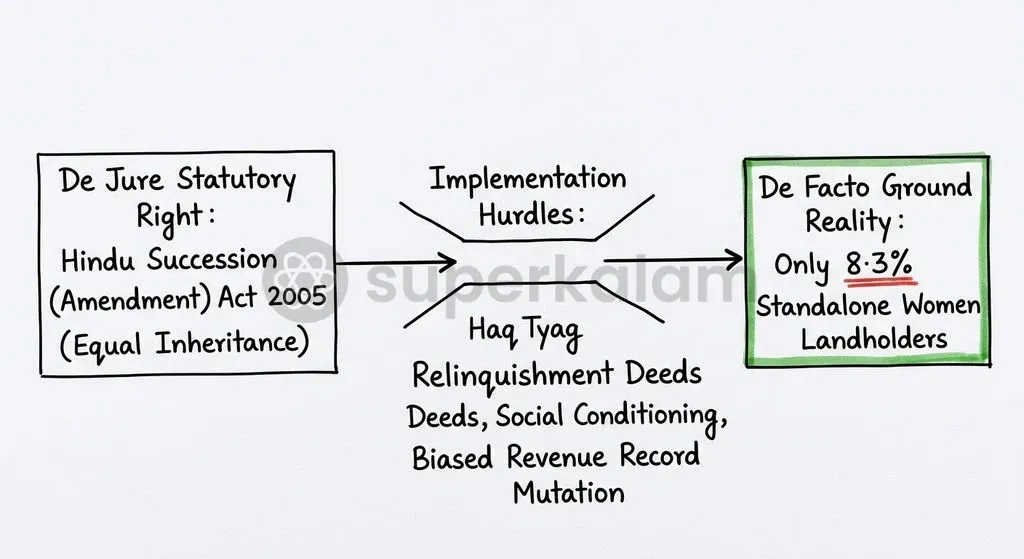
The Indian Parliament enacted the Hindu Succession (Amendment) Act, 2005 to remove gender discrimination regarding ancestral property. By substituting Section 6 of the Hindu Succession Act, 1956, the amendment granted daughters coparcenary rights by birth on equal terms with sons.
Any remaining judicial ambiguity surrounding whether the father had to be alive when the amendment took effect was resolved by the Supreme Court of India in Vineeta Sharma v. Rakesh Sharma & Ors. (2020). A three-judge bench held that daughters acquire coparcenary rights retroactively by birth as an unobstructed heritage, clarifying that the father coparcener did not need to be living on 9 September 2005.
Despite this settled statutory architecture, de facto property ownership remains severely restricted. According to the National Family Health Survey (NFHS-5) 2019-21, 43.3% of women aged 15–49 reported owning a house or land either alone or jointly. Yet standalone individual land ownership among women stood at just 8.3% nationally.
Multiple systemic barriers prevent statutory rights from translating into operational ownership:
- Customary disinheritance practices: In several northwestern states, customary practices such as Haq Tyag (voluntary relinquishment of inheritance rights) systematically pressure women to execute registered relinquishment deeds in favour of male siblings, as documented in the Economic & Political Weekly.
- Administrative friction: Revenue departments routinely demand male coparcener consent during mutation proceedings, delaying or obstructing female registrations.
- Social retaliation: Asserting succession rights often risks severing kinship safety nets, leaving women socially vulnerable in the event of marital distress.
| Parameter | De Jure Legal Position | Ground Reality (De Facto Status) |
|---|---|---|
| Succession Framework | Equal coparcenary rights by birth under Section 6 of the Hindu Succession Act, 1956 (amended 2005). | Informal disinheritance persists through customary practices like Haq Tyag. |
| Supreme Court Precedent | Unobstructed retroactive rights affirmed in Vineeta Sharma v. Rakesh Sharma (2020). | Administrative hurdles in land revenue mutation records delay legal transfers. |
| Land Ownership Rates | Equal legal entitlement to parental and marital property shares. | Standalone female land ownership stands at only 8.3% per NFHS-5 data. |
Discuss with Superkalam
Recall the legal precedent established by the Supreme Court in the Vineeta Sharma (2020) judgment regarding daughters' coparcenary rights.
Ask NowThe Missing Collateral: How Lack of Assets Chokes Credit and Enterprise
The Reserve Bank of India’s commercial lending guidelines generally require hypothecation of immovable property for business loans exceeding collateral-free ceilings. Because few women hold registered property deeds in their own names, female entrepreneurs face structural barriers when seeking commercial capital.
According to the joint report 'From Borrowers to Builders' by NITI Aayog, TransUnion CIBIL, and MicroSave Consulting, women account for 26% of total system credit in India. Overall credit penetration among women stands at 36%.
This structural ceiling is evident across key institutional lending channels:
- Micro-loan concentration: In the Pradhan Mantri MUDRA Yojana (PMMY), women entrepreneurs account for nearly 68% of total loan accounts sanctioned.
- The graduation barrier: Over 79% of women's Mudra loans remain concentrated in the entry-level 'Shishu' bracket (loans up to ₹50,000).
- Missing scale: Progression to the 'Tarun' category (₹5 lakh to ₹10 lakh) remains negligible because enterprises lack registered immovable property to pledge as collateral.
Discuss with Superkalam
Explain how the lack of registered land titles mechanically disconnects women cultivators from formal credit instruments like the Kisan Credit Card (KCC).
Ask NowThe Farm Deficit: Feminization of Agriculture Without Land Rights
The Periodic Labour Force Survey (PLFS) Annual Report 2023-24 shows a national female Labour Force Participation Rate of 41.7%, with rural female participation reaching 47.6%.
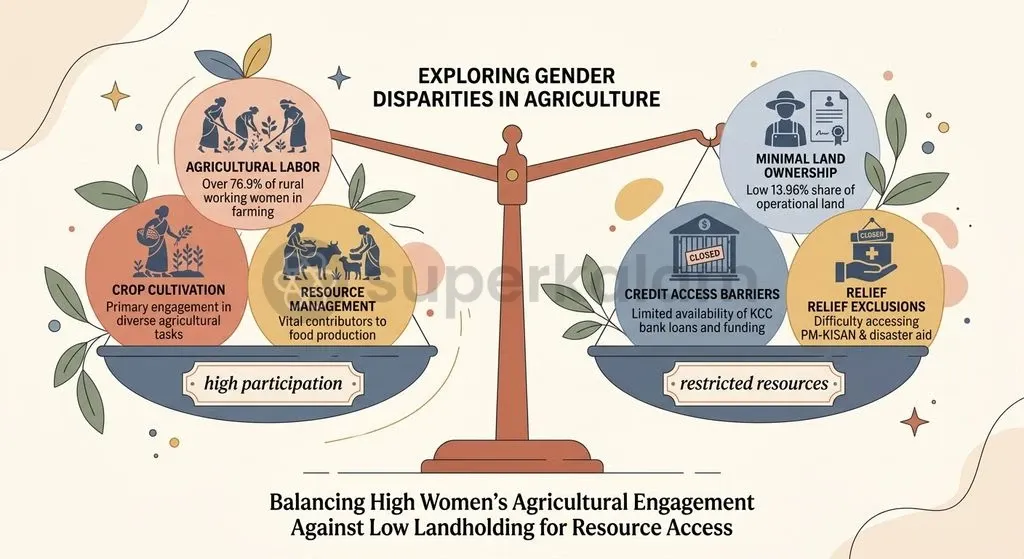
Data from the same survey shows that over 76.9% of rural working women are employed in agriculture. This highlights a structural paradox: rural agriculture is increasingly feminised, but land titles remain held by men.
The 10th Agriculture Census (2015-16) reported that women hold only 13.96% of operational agricultural landholdings, covering just 11.72% of the operated farming area in India.
This institutional disconnect between female labour and formal ownership limits women farmers in three major ways:
- Direct Benefit Transfers: Pradhan Mantri Kisan Samman Nidhi (PM-KISAN) guidelines condition the ₹6,000 annual direct benefit transfer strictly on legal cultivable land ownership recorded in State land revenue records, excluding non-titled women cultivators.
- Subsidised Credit: Priority Sector Lending guidelines from the Reserve Bank of India link Kisan Credit Card (KCC) issuance to verified Record of Rights, leaving non-titled women dependent on high-cost informal lenders.
- Disaster Relief: Disaster response norms under the State Disaster Response Fund (SDRF) and National Disaster Response Fund (NDRF) require verified revenue ownership for crop-loss compensation, leaving women cultivators without a safety net during climate shocks.
Discuss with Superkalam
If a state government introduces a 2% stamp duty waiver for female property buyers, what unintended behavioural side effects might emerge without accompanying managerial safeguards?
Ask NowEvaluating Current Interventions: From Stamp Duty Concessions to SVAMITVA
The Union and State governments have deployed targeted administrative and fiscal measures to improve female asset holding. These range from subsidised property registration charges to mandatory co-ownership rules in welfare schemes.
Several state governments provide a 1% to 2% concession on stamp duty when properties are registered in the name of a woman or jointly. While this measure has raised urban property registrations in women's names, it occasionally leads to nominal ownership, where female names are used solely for tax savings without granting genuine control.
Under the Pradhan Mantri Awas Yojana-Gramin (PMAY-G), public policy mandates female property inclusion. The Ministry of Rural Development reports that 74% of sanctioned houses are registered solely to women or jointly with their spouses. This rule establishes legal co-ownership across millions of rural households.
Similarly, the Ministry of Panchayati Raj maps rural inhabited land parcels using drone surveys under the SVAMITVA scheme. Several states, including Madhya Pradesh, Haryana, and Karnataka, expressly record female co-ownership on Property Cards. By generating clear digital property titles for rural homes, the scheme provides documented assets that can serve as formal loan collateral.
| Policy Intervention | Implementing Agency | Operational Mechanism | Impact on Female Ownership |
|---|---|---|---|
| PMAY-G Housing Deeds | Ministry of Rural Development | Mandates sole or joint female registration for sanctioned rural houses. | 74% of sanctioned houses registered in women's names solely or jointly. |
| State Stamp Duty Cuts | State Revenue Departments | Grants a 1% to 2% discount on property registration duties for female buyers. | Lowers registration costs; risks nominal ownership without managerial control. |
| SVAMITVA Property Cards | Ministry of Panchayati Raj | Uses drone surveys to issue property titles in Abadi areas, provisioning female co-ownership. | Provides formal credit collateral to rural women in participating states. |
Discuss with Superkalam
Weigh the effectiveness of state welfare-led co-titling (like PMAY-G) against statutory succession rights in achieving genuine economic autonomy for rural women.
Ask NowConstitutional Foundations and Distributive Justice
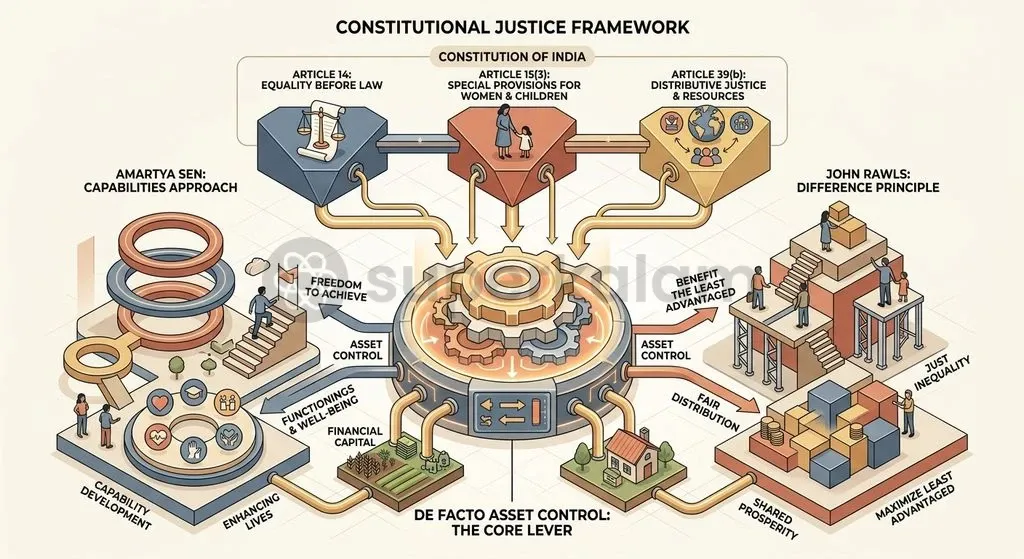
The constitutional basis for female property parity rests on fundamental guarantees and directive principles. Article 14 guarantees equality before the law, while Article 15(3) empowers the State to make special affirmative provisions for women.
Complementing these fundamental rights, Article 39(b) in Part IV directs state policy toward distributing material resources to serve the common good. Although Directive Principles of State Policy are non-justiciable under Article 37, they remain fundamental in the governance of the country.
From an ethical and policy perspective, this ownership imbalance reflects core dilemmas of distributive justice:
- Amartya Sen's Capabilities Approach: Formal legal entitlements remain ineffective without conversion factors like actual asset control. Tangible assets give women the practical capability to make independent economic choices.
- John Rawls's Difference Principle: In A Theory of Justice, Rawls argues that socio-economic systems must be arranged to provide the greatest benefit to the least-advantaged. Women facing asset poverty represent a primary group requiring corrective structural reform.
Closing the asset deficit moves policy beyond compensatory welfare, shifting the system toward genuine structural equity.
Way Forward: Building Real Economic Autonomy Through Asset Parity
Converting de jure statutory equality into genuine economic agency requires coordinated legal, administrative, and financial reforms:
- Digital Land Governance and Joint Titling: State revenue departments should mandate joint spousal titling on all agricultural land records during inheritance mutations, mirroring the PMAY-G framework.
- Expanding Collateral-Free Credit Ecosystems: Financial institutions should expand cash-flow lending models and adapt credit assessment tools, reducing the reliance on immovable property collateral for growing female-run enterprises.
- Decoupling Agricultural Support from Land Titles: Operational guidelines for schemes like PM-KISAN and KCC should recognize registered tenant farmers and women cultivators via Self-Help Group verification, ensuring access to credit and disaster relief.
- Administrative Oversight Against Coerced Relinquishment: Revenue authorities must require formal, independent checks before registering Haq Tyag deeds, preventing customary coercion and protecting inheritance rights.
Key Takeaways
- India's goal of women-led development under the Viksit Bharat @ 2047 roadmap requires dismantling structural asset barriers to ensure real female agency.
- The Supreme Court's ruling in Vineeta Sharma v. Rakesh Sharma (2020) confirmed that daughters hold retroactive coparcenary rights by birth under Section 6 of the Hindu Succession Act, 1956.
- A wide gap persists between law and practice: NFHS-5 data shows that standalone individual land ownership among women stands at just 8.3%.
- In rural India, 76.9% of working women engage in agriculture (PLFS 2023-24), yet women hold only 13.96% of operational landholdings (Agriculture Census 2015-16), excluding them from PM-KISAN, KCC, and disaster relief.
- Over 79% of women's Mudra loans remain confined to the entry-level Shishu tier (up to ₹50,000), held back by commercial banking requirements for immovable property collateral.
- Achieving asset parity requires administrative measures like mandatory joint titling, automated digital mutations, and decoupling farm subsidies from land title records.
Mains Question
"The feminization of agriculture in rural India coexists with an acute land ownership deficit, turning female cultivators into invisible workers." Examine. (10 Marks)
Evaluate NowMains Question
"Statutory reforms in inheritance law have established formal equality, yet female economic agency remains stunted by the 'collateral trap' in formal credit markets." Critically analyse. (15 Marks)
Evaluate NowPractice MCQs
QUESTION 1
With reference to succession rights in India, consider the following statements:
- The Hindu Succession (Amendment) Act, 2005 substituted Section 6 of the principal Act to confer coparcenary rights by birth to daughters.
- In Vineeta Sharma v. Rakesh Sharma (2020), the Supreme Court ruled that a daughter can claim coparcenary rights only if her father coparcener was alive on 9 September 2005.
- According to the National Family Health Survey (NFHS-5), standalone individual land ownership among Indian women exceeds 25%.
Which of the statements given above is/are correct?
QUESTION 2
Consider the following statements regarding the institutional challenges faced by women in India's agricultural and rural economy:
- As per the Periodic Labour Force Survey (PLFS) 2023-24, more than 75% of rural working women are engaged in agriculture.
- Under the 10th Agriculture Census (2015-16), women operate over 25% of the total operated agricultural land area in India.
- Access to benefits under PM-KISAN is conditional upon legal cultivable land ownership recorded in State land revenue records.
Which of the statements given above is/are correct?
QUESTION 3
Consider the following statements regarding female entrepreneurship and institutional credit in India:
- Under the Pradhan Mantri MUDRA Yojana (PMMY), women account for more than 60% of total loan accounts sanctioned.
- In PMMY, a vast majority of women's borrowing remains concentrated in the 'Shishu' loan category.
- RBI commercial lending guidelines allow micro and small enterprises to access unlimited credit without the hypothecation of immovable property.
Which of the statements given above is/are correct?
QUESTION 4
With reference to policy interventions promoting female asset ownership in India, consider the following statements:
- The Pradhan Mantri Awas Yojana-Gramin (PMAY-G) mandates that sanctioned houses be registered solely to women or jointly with their spouses.
- Under the SVAMITVA scheme, drone mapping of rural Abadi areas is utilised to issue property cards that can provision female co-ownership.
- Several state governments offer stamp duty concessions of 1% to 2% for property registered in the name of a woman or jointly.
Which of the statements given above is/are correct?
QUESTION 5
The customary practice termed 'Haq Tyag', reported in northwestern India, is best described as:
Related Blogs
Reservation After Religious Conversion: What the Supreme Court Has Ruled and the Article 341 Debate
Oct, 2026
•10 min read

Lancet Commission on Global Health Threats 2026: What It Is and the 17 Threats It Identifies
Oct, 2026
•8 min read
Special Summary Revision of Electoral Rolls 2026: Meaning, Process and SSR vs SIR
Oct, 2026
•9 min read


