Lancet Commission on Global Health Threats 2026: What It Is and the 17 Threats It Identifies
The Lancet Commission on Global Health Threats 2026 explained: what the commission is, the 17 threats it identifies, and why reactive biosecurity is no longer enough.
Oct, 2026
•8 min read

Overview
The Lancet Commission on 21st Century Global Threats to Health, published in October 2026, warns that conventional biosecurity cannot protect humanity from overlapping planetary, commercial, and technological crises. Border closures, national stockpiling, and post-outbreak medical countermeasures fail against systemic shocks.
Global health governance must transition from reactive pathogen containment to proactive risk mitigation across sectors. Evaluating catastrophic threats across 204 countries and territories, the Commission defines each as an amenable risk capable of generating at least one billion cumulative DALYs between 2025 and 2100 that policy action can avert.
Why in the News: The Lancet Commission's 2026 Warning
The Lancet Commission on 21st Century Global Threats to Health warned in October 2026 that global health architecture remains dangerously unprepared for multi-systemic 21st-century shocks.
Public health agencies worldwide remain trapped in reactive biosecurity postures. Rather than tackling the structural drivers of illness, authorities rely on late-stage measures:
- Post-Outbreak Interventions: Governments routinely prioritise emergency border controls and proprietary vaccine procurement while neglecting the root drivers of disease.
- Scale of Exposure: The report evaluates catastrophic threats across 204 countries and territories between 2025 and 2100.
- Amenable Threat Benchmark: The Commission defines an amenable catastrophic threat as any risk capable of causing at least one billion cumulative disability-adjusted life-years (DALYs) that public policy interventions can prevent.
- Metric of Burden: As defined by the World Health Organization and the Institute for Health Metrics and Evaluation, a DALY combines years of life lost to premature mortality with years lived with disability into a single metric representing one lost year of full health.
As of October 2026, multilateral consensus on collective defence remains fractured. While the United Nations General Assembly adopted a political declaration on pandemic preparedness in October 2026 by a vote of 153 to 3, opposition from the United States, Israel, and Argentina demonstrated the fragility of global consensus.
Discuss with Superkalam
Recall the exact threshold of cumulative DALYs used by the Lancet Commission to classify a risk as an amenable catastrophic threat.
Ask NowBeyond the List of 17: How Global Health Risks Have Changed
The Lancet Commission catalogued seventeen distinct threats capable of causing catastrophic health burdens between 2025 and 2100, spanning ecological, commercial, and technological domains.
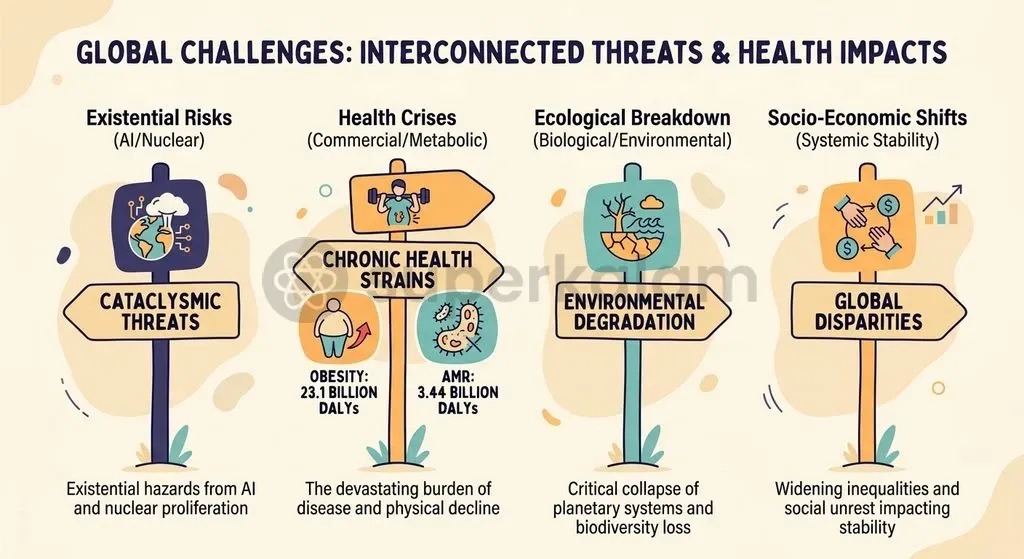
The seventeen identified threats encompass air pollution, antimicrobial resistance (AMR), childhood malnutrition, climate change, declining development assistance for health, conventional conflict, high alcohol use, high blood pressure, income inequality, low educational attainment, malicious artificial intelligence (AI) use, nuclear conflict, obesity, pandemics, poor mental health, smoking, and unhealthy ageing.
The Commission established an analytical hierarchy among these risks based on severity and preventability:
| Risk Domain | Specific Identified Threats | Projected Amenable Burden / Impact | Governance Character |
|---|---|---|---|
| Extinction-Level Risks | Malicious AI use (including bio-engineered pathogens), nuclear conflict | Potential human extinction by 2100 | High-consequence existential security risks requiring strict global non-proliferation treaties |
| Metabolic & Commercial Drivers | Obesity, high blood pressure, smoking, alcohol use | Obesity alone accounts for 23.1 billion avoidable DALYs | Driven by corporate marketing of ultra-processed foods and regulatory inaction |
| Ecological & Biological Threats | Climate change, air pollution, pandemics, antimicrobial resistance (AMR) | AMR accounts for 3.44 billion avoidable DALYs | Transboundary spillover events worsened by habitat destruction and antibiotic overuse |
| Socio-Economic Vulnerabilities | Declining health assistance, income inequality, low education, malnutrition | Sub-Saharan Africa bears ~70% of burden from health aid collapse | Structural financing gaps leaving low-income nations vulnerable to external shocks |
Only two of the seventeen threats carry human extinction potential by 2100: nuclear conflict triggering catastrophic nuclear famine, and the malicious deployment of advanced artificial intelligence, particularly AI-synthesised biological agents.
The Central Clash: Reactive Biosecurity versus Planetary Health
The World Health Organization faces a conceptual divide between traditional national biosecurity and the broader framework of planetary health governance.
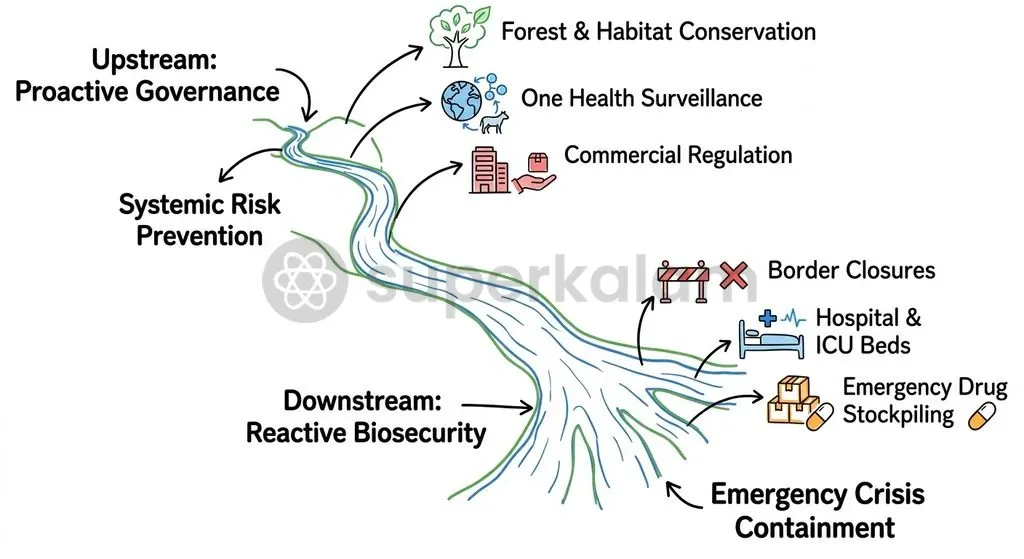
- Traditional Biosecurity: Treats health emergencies as acute, exogenous interruptions to normal social life. National defence strategies channel billions into border surveillance, pharmaceutical stockpiles, and quarantine facilities. This reactive posture fails because modern epidemiological vulnerabilities stem from continuous human disruptions of planetary systems.
- Planetary Health: Recognises that human health depends entirely on stable natural ecosystems. Aggressive industrial agriculture, deforestation, and fossil fuel consumption create ecological conditions that accelerate zoonotic spillovers and chronic illness.
- Commercial Drivers: Transnational corporations actively market ultra-processed foods, high-sugar beverages, alcohol, and tobacco across developing markets, fuelling non-communicable disease burdens that match infectious disease tolls. Limiting climate warming from 4.4°C down to 1.8°C would alone avert 1.89 billion amenable DALYs linked to severe thermal stress and respiratory illness by 2100.
Discuss with Superkalam
Explain how the 'planetary health' approach differs fundamentally from traditional national biosecurity paradigms.
Ask NowTough Governance Trade-offs: Economic Growth, Patents, and Sovereignty
The World Health Organization Pandemic Agreement negotiations reveal sharp geopolitical trade-offs between national sovereignty, patent monopolies, and global public health.
Multilateral treaty negotiations currently stall over Article 12 of the draft Pandemic Agreement, which governs the Pathogen Access and Benefit-Sharing System (PABS). Developing nations, organised under the Global South coalition, insist that countries sharing biological samples and pathogen genetic sequences must receive guaranteed, equitable access to resulting diagnostics, therapeutics, and vaccines.
Conversely, pharmaceutical-producing nations in the Global North resist binding transfer quotas, seeking to protect intellectual property rights under the World Trade Organization TRIPS framework.
- Sovereignty versus Binding Pacts: High-income nations frequently resist international compliance mechanisms that restrict unilateral trade bans or mandate domestic manufacturing concessions.
- Property Rights versus Universal Access: Defending patents protects private research incentives, but creates artificial scarcity during global health emergencies.
- Industrial Growth versus Ecological Regulation: Curbing pollution and intensive animal farming requires limits on commercial sectors that generate short-term revenue.
What the Findings Mean for India: One Health and Industrial Realities
India faces compounding epidemiological challenges due to its simultaneous exposure to all seventeen catastrophic threats identified by the Commission.
In an interview with The Indian Express (as reported, October 2026), Dr. Soumya Swaminathan noted that India encounters overlapping exposure across every threat category, spanning severe air pollution to surging non-communicable diseases. This convergence complicates healthcare planning under Article 21 of the Constitution, which the Supreme Court interprets as guaranteeing the right to health.
- Antimicrobial Resistance (AMR): High baseline antibiotic consumption across human healthcare and veterinary farming threatens clinical infrastructure. Staggering stewardship risks severe drug-resistant mortality, directly reflecting the 3.44 billion global amenable DALYs projected by the Commission.
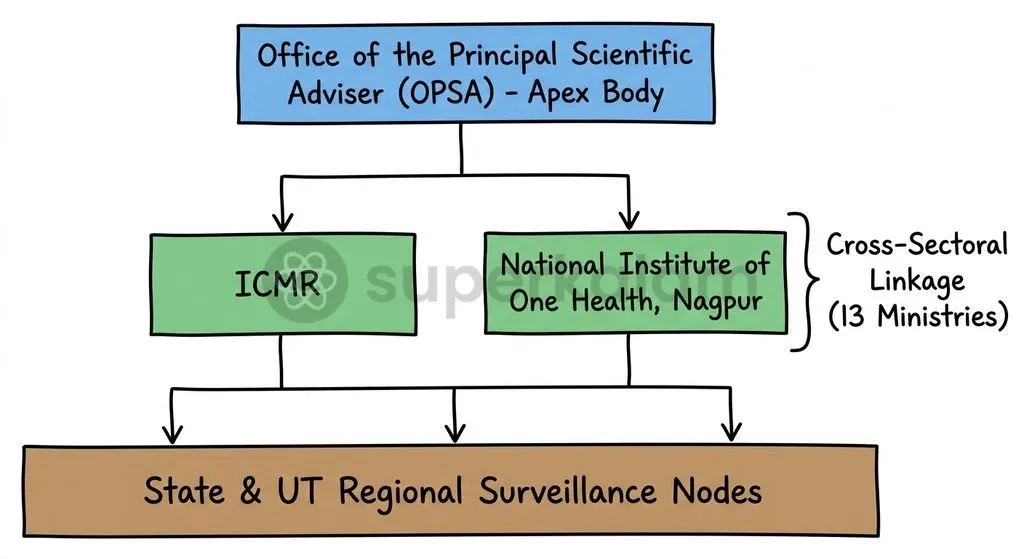
- Institutional Leadership: The Union Cabinet approved the creation of a Scientist 'H' level post for the National Institute of One Health in Nagpur to institutionalise cross-sector coordination.
- Multi-Ministerial Execution: India's National One Health Mission operates under a governance architecture steered by the Office of the Principal Scientific Adviser (OPSA), with the Indian Council of Medical Research (ICMR) leading technical execution across more than 13 central ministries.
- Sub-National Implementation: The first State and Union Territory engagement workshop convened in New Delhi on June 9, 2025, coordinating 27 regional administrations to standardise integrated disease surveillance.
Discuss with Superkalam
Apply the concept of commercial determinants of health to explain how corporate food marketing contributes to non-communicable disease burdens in developing countries.
Ask NowEthical Dilemmas: Fair Burden Sharing Between Rich and Poor Nations
Global health bioethics exposes profound moral imbalances between the historical polluters of the Global North and vulnerable populations across the Global South.
- Climate Injustice: Low- and middle-income countries contributed least to historical greenhouse gas emissions, yet suffer disproportionate spikes in heat-induced mortality, crop failures, and vector-borne diseases. The Commission highlights this structural climate injustice as an ethical breakdown requiring equitable international compensation.
- Financing Breakdown: Sub-Saharan Africa alone faces approximately 70% of the amenable health burden resulting from a breakdown in external development assistance for health. Slashing international assistance deprives poorer regions of basic funding for primary clinics and infant nutrition.
- Distributive Access: Global health justice requires treating essential countermeasures—such as mRNA vaccine platforms, broad-spectrum antivirals, and climate-resilient crop varieties—as global public goods rather than commercial assets.
The Way Forward: Rebuilding Global Health Architecture
The Lancet Commission sets out three strategic pillars to transition global institutions from reactive posturing to anticipatory governance.
Systemic reform demands a coordinated international agenda resting on institutional readiness, scientific research, and transparent surveillance:
- Financing Threat-Ready Health Systems: Multilateral development banks must channel long-term concessional capital into primary healthcare and local genomic surveillance networks, reducing reliance on emergency financial appeals.
- Investing in Breakthrough Innovations: Governments should fund open-science platforms for novel antimicrobial classes, universal coronavirus vaccines, and non-polluting agricultural techniques unencumbered by restrictive commercial patents.
- Establishing Independent Threat Monitoring: The international community requires an autonomous global monitoring council to audit national biosecurity capabilities, pathogen research facilities, and environmental health indicators without diplomatic interference.
For developing nations like India, operationalising the National One Health Mission across animal husbandry, forestry, and urban planning provides a viable domestic blueprint. Aligning municipal sanitation, agricultural antibiotic limits, and environmental regulations protects human populations before novel pathogens spill over into vulnerable communities.
Discuss with Superkalam
Analyse the structural trade-offs between WTO TRIPS intellectual property protections and the proposed Pathogen Access and Benefit-Sharing (PABS) system under Article 12.
Ask NowKey Takeaways
- The Lancet Commission's October 2026 report identifies seventeen catastrophic health threats, defining each as an amenable risk capable of inflicting at least one billion cumulative DALYs by 2100.
- Only two of the seventeen threats—malicious artificial intelligence use and nuclear conflict—carry human extinction potential by 2100.
- Obesity represents the largest single avoidable burden, accounting for 23.1 billion projected amenable DALYs through 2100.
- The draft WHO Pandemic Agreement remains stalled over Article 12, as developing nations demand equitable benefit-sharing in exchange for pathogen sequence data.
- India faces dual epidemiological burdens, responding through the OPSA-steered National One Health Mission and the National Institute of One Health in Nagpur.
- Sub-Saharan Africa faces roughly 70% of the projected health damage resulting from reductions in international health development assistance.
Mains Question
'Conventional biosecurity frameworks, reliant on border closures and late-stage medical countermeasures, are fundamentally inadequate against 21st-century systemic health shocks.' In light of the Lancet Commission's findings, critically analyse the necessity of transitioning towards a planetary health governance paradigm. (15 Marks)
Evaluate NowMains Question
Citing the structural challenges highlighted by the Lancet Commission, evaluate India's multi-ministerial 'One Health' approach in mitigating transboundary and systemic health threats. (10 Marks)
Evaluate NowPractice MCQs
QUESTION 1
With reference to the findings of the Lancet Commission on 21st Century Global Threats to Health (2026), consider the following statements:
- An 'amenable catastrophic threat' is defined as any risk capable of causing at least one billion cumulative disability-adjusted life-years (DALYs) between 2025 and 2100 that public policy interventions can prevent.
- Among the seventeen catalogued threats, only nuclear conflict and malicious use of artificial intelligence are identified as carrying human extinction potential by 2100.
- Antimicrobial resistance (AMR) alone accounts for over twenty billion avoidable DALYs within the evaluated projection period.
Which of the statements given above are correct?
QUESTION 2
Regarding the institutional mechanisms and governance architecture of India's National One Health Mission, consider the following statements:
- The mission's overall governance architecture is steered by the Office of the Principal Scientific Adviser (OPSA).
- Technical execution across central ministries is led by the Indian Council of Medical Research (ICMR).
- The Union Cabinet approved the establishment of a Scientist 'H' level post at the National Institute of One Health located in Nagpur.
Which of the statements given above are correct?
QUESTION 3
Consider the following statements regarding the World Health Organization Pandemic Agreement negotiations:
- Disagreements largely centre on Article 12, which governs the Pathogen Access and Benefit-Sharing System (PABS).
- Developing nations advocate that sharing biological samples and genetic sequences must guarantee equitable access to resulting diagnostics and therapeutics.
- Pharmaceutical-producing nations in the Global North support mandatory, binding technology transfer quotas under TRIPS flexibilities.
Which of the statements given above is/are correct?
QUESTION 4
According to the Lancet Commission on 21st Century Global Threats to Health, limiting global warming from 4.4°C down to 1.8°C would avert how many amenable disability-adjusted life-years (DALYs) by 2100?
QUESTION 5
In the context of the October 2026 United Nations General Assembly political declaration on pandemic preparedness, which group of nations voted against the declaration?