Special Summary Revision of Electoral Rolls 2026: Meaning, Process and SSR vs SIR
Special Summary Revision (SSR) of electoral rolls explained: the ECI process, how SSR differs from Special Intensive Revision (SIR), and what it means for voter list integrity.
Oct, 2026
•9 min read

Overview
Electoral roll integrity in India rests on a perpetual administrative trade-off between the rapid processing of citizen-initiated claims and the resource-heavy rigour of ground-up door-to-door enumeration. Under the Representation of the People Act, 1950, the Election Commission of India exercises plenary authority to determine whether constituencies undergo an incremental Special Summary Revision or an exhaustive, ground-up Special Intensive Revision.
This administrative choice dictates whether roll maintenance prioritises low-cost speed or baseline accuracy. In practice, it determines whether phantom electors linger on voter lists, or vulnerable citizens face disenfranchisement through procedural exclusion.
Discuss with Superkalam
Which specific constitutional articles vest the plenary power of electoral roll management in the Election Commission of India and mandate universal adult suffrage?
Ask NowWhy Electoral Rolls Are Under Scrutiny Today
As of October 2026, the Election Commission of India ordered the annual Special Summary Revision across 17 States and Union Territories with reference to January 1, 2027 as the qualifying date. Electoral registers face heightened scrutiny from political parties and civil society regarding roll fidelity.
Two structural distortions drive public concern:
- Unremoved deceased electors: Entries for dead voters persist across multiple electoral cycles.
- Arbitrary deletions: Living voters are struck off registers without adequate notice or verification.
Public confidence in electoral outcomes hinges on the purity of voter registers. The operational debate pits updating existing entries through routine administrative summaries against ordering comprehensive door-to-door ground verification.
The Constitutional and Legal Bedrock: Articles 324–326 and RPA 1950
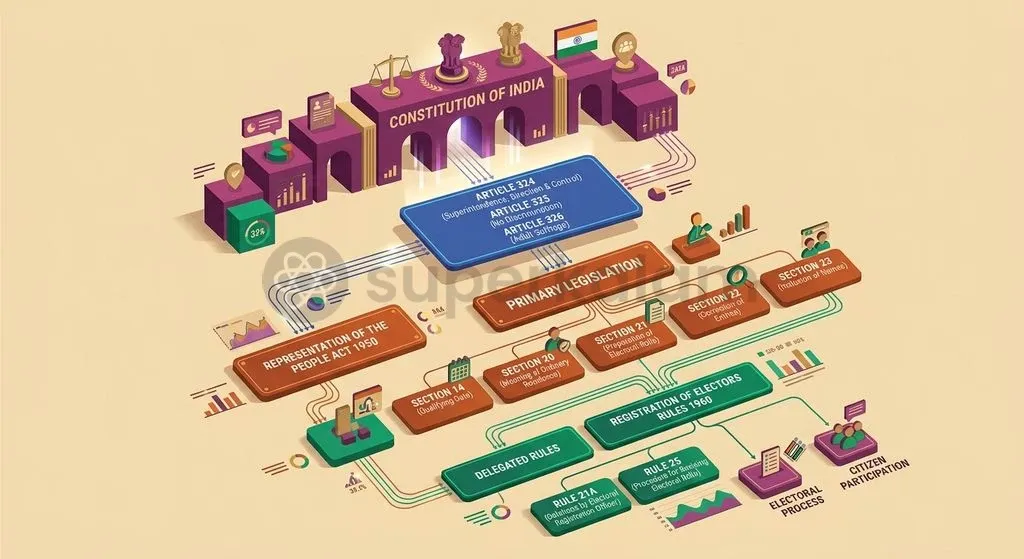
Article 324 of the Constitution vests the superintendence, direction, and plenary control of the preparation of electoral rolls in the Election Commission of India. This plenary power ensures that the compilation of registers remains insulated from executive interference.
Constitutional parameters for voter eligibility are anchored in Articles 325 and 326:
- Article 325: Mandates a single general electoral roll for every territorial constituency, prohibiting inclusion or exclusion on grounds only of religion, race, caste, or sex.
- Article 326: Establishes universal adult suffrage, conferring voting rights on every citizen aged 18 or above who is not disqualified by law on grounds of non-residence, unsoundness of mind, crime, or corrupt practices.
The primary statutory machinery governing the compilation and revision of rolls resides in the Representation of the People Act, 1950. Section 21 of the Act mandates the preparation and revision of electoral rolls by reference to a qualifying date prior to elections or in any year directed by the Commission. Section 21(3) further empowers the Election Commission of India to direct a special revision of any roll at any time across any constituency.
Complementing the parent statute, Rule 25(1) of the Registration of Electors Rules, 1960 specifies that the electoral roll for every constituency shall be revised under Section 21(2) either intensively, summarily, or partly intensively and partly summarily, as the Commission directs.
How They Work: Incremental Updating vs Ground-Up Verification
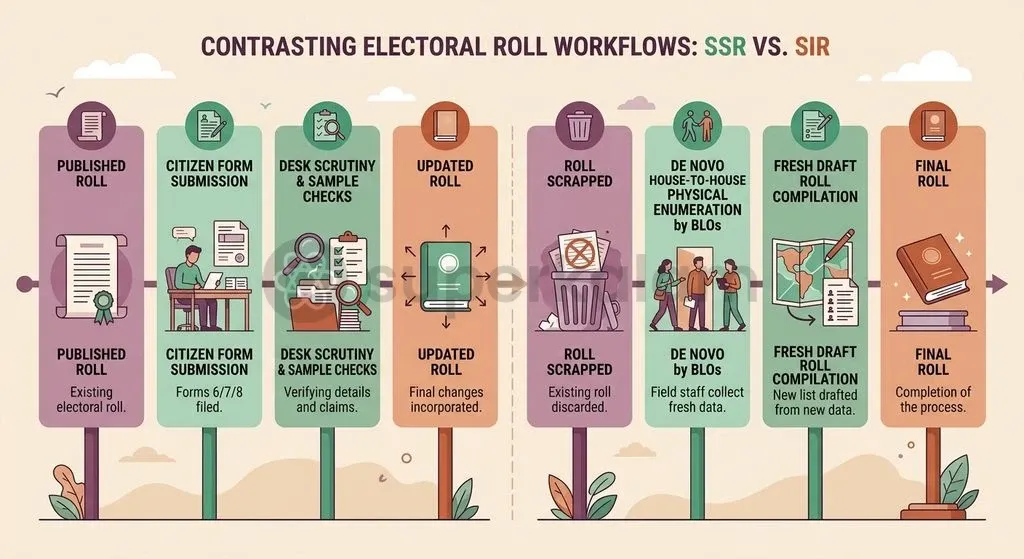
Special Summary Revision operates as an incremental process that treats the existing published roll as broadly valid, seeking only marginal corrections. Under Rule 25(3) of the Registration of Electors Rules, 1960, the Electoral Registration Officer prepares a draft list of amendments based on readily available data and publishes the existing roll alongside draft amendments for claims and objections.
Special Summary Revision relies on citizen-initiated voluntary paperwork:
- Form 6: Application for inclusion of name by a new voter.
- Form 7: Application for deletion of an existing entry or objection against an inclusion.
- Form 8: Application for correction of particulars, transposition, or updating residential addresses.
Booth Level Officers conduct targeted sample checks during a Summary Revision, but the administrative machinery does not visit every home.
In contrast, Special Intensive Revision discards the presumption that the existing register is complete. Under Rule 25(2) of the Registration of Electors Rules, 1960, an intensive revision requires the roll to be prepared afresh from scratch, applying rules 4 to 23 as if it were the initial preparation of an electoral roll.
Operationally, Booth Level Officers conduct compulsory, house-to-house enumeration across every dwelling in the constituency. The administration distributes enumeration forms directly to households, verifies residency in person, and compiles a completely new draft register based entirely on field verification.
Discuss with Superkalam
How does the operational methodology of a draft amendment list in SSR differ from the de novo baseline enumeration in SIR?
Ask NowDirect Comparison: Scope, Operational Triggers, and Verification Intensity
The choice between an intensive overhaul and an incremental update is dictated by statutory provisions, operational capacity, and roll distortions. The table below delineates the statutory and administrative differences between the two frameworks.
| Parameter | Special Summary Revision (SSR) | Special Intensive Revision (SIR) |
|---|---|---|
| Statutory Basis | Rule 25(3), Registration of Electors Rules, 1960 | Rule 25(2), Registration of Electors Rules, 1960 |
| Operational Methodology | Draft publication with self-reported additions, deletions, and corrections via Forms 6, 7, and 8 | Exhaustive de novo physical enumeration of every household by Booth Level Officers |
| Presumption of Register | Existing roll presumed valid; only incremental amendments are processed | Existing roll discarded; register prepared afresh from baseline data |
| Administrative Trigger | Routine annual updating cycle conducted prior to standard election cycles | Severe demographic distortions, post-delimitation overhauls, or massive suspected inaccuracies |
| Verification Depth | Desk scrutiny of submitted claims supplemented by targeted sample checks | Direct field verification of every resident across all polling stations |
| Qualifying Dates | Four rolling dates per year: January 1, April 1, July 1, October 1 | Single designated qualifying date fixed for the de novo enumeration cycle |
| Primary Systemic Risk | Retention of duplicate entries, unrecorded migrants, and deceased electors | Procedural exclusion of genuine voters, tenants, and migrant labourers |
The Core Administrative Dilemma: Speed and Cost vs Exclusion and Ghost Voters
The central administrative choice balances procedural speed and cost against absolute accuracy. Special Summary Revision provides an agile, low-cost mechanism that allows election officials to update massive electorates across hundreds of constituencies without deploying millions of field staff.
Yet each approach carries distinct systemic risks:
- Summary Revision vulnerabilities: Because the process depends heavily on voluntary reporting, it permits phantom voters to accumulate over time. Families rarely submit Form 7 to report a death, and migrant workers seldom formalise the cancellation of their rural enrolment upon relocating to urban centres.
- Intensive Revision vulnerabilities: Clearing unverified entries through house-to-house enumeration risks causing the mass disenfranchisement of vulnerable populations. Citizens working long hours, seasonal migrants, and informal tenants are frequently recorded as absent and subsequently struck off the draft roll.
Discuss with Superkalam
If a seasonal migrant worker is absent during a Booth Level Officer's field visit, how does Section 20(1A) of the RPA 1950 safeguard their electoral status?
Ask NowThe Disenfranchisement Threat: How Roll Cleanups Impact Marginalised Citizens
Mass roll cleanups present acute risks for citizens at the socioeconomic margins. Daily-wage earners and urban renters often lack fixed tenure or long-term address documentation, making them vulnerable to summary removal during field checks.
Statutory protections exist to shield mobile citizens from arbitrary deregistration:
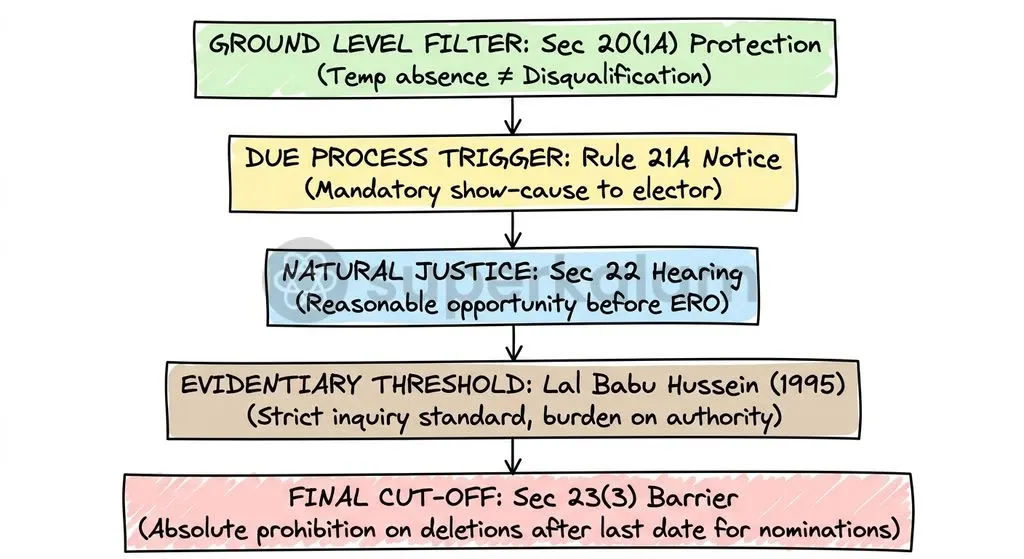
- Protection of Temporary Absence: Section 20(1A) of the Representation of the People Act, 1950 explicitly dictates that a person absenting themselves temporarily from their place of ordinary residence does not cease to be ordinarily resident in that location.
- Mandatory Due Process: The second proviso to Section 22 of the Representation of the People Act, 1950 mandates that no entry may be deleted without providing the affected person a reasonable opportunity of being heard, except when confirming the death of an elector.
- Statutory Show-Cause Requirement: Rule 21A of the Registration of Electors Rules, 1960 requires the Electoral Registration Officer to issue a formal show-cause notice and provide a hearing before removing entries alleged to have been erroneously entered.
The legal standard governing deletions was settled in Lal Babu Hussein v. Electoral Registration Officer (1995). A three-judge bench of the Supreme Court held that once a citizen's name appears on the electoral roll, the statutory procedure for removal must be strictly observed. The burden of proof rests on the state or the objecting party, not on the registered voter.
The human cost of procedural failures is exacerbated by Section 23(3) of the Representation of the People Act, 1950. This provision creates a hard statutory bar, prohibiting any amendment, transposition, or deletion of entries after the last date for making nominations until the election concludes. If an eligible elector is unlawfully deleted during a pre-election cleanup, Section 23(3) forecloses administrative restoration, resulting in irrevocable disenfranchisement on polling day.
Beyond Periodic Revisions: Continuous Updation and the Way Forward
Resolving the tension between administrative efficiency and register accuracy requires moving beyond sporadic periodic revisions toward automated, continuous roll maintenance.
Legislative reforms have incrementally broadened registration accessibility. The Election Laws (Amendment) Act, 2021 amended Section 14(b) of the Representation of the People Act, 1950, replacing the single January 1 eligibility cutoff with four qualifying dates annually: January 1, April 1, July 1, and October 1. This reform prevents young citizens who turn 18 after January from waiting up to a full year to register.
To systematically modernise roll administration, technical and governance reforms should focus on:
- Centralised Deduplication via ERONET: The Election Commission operates ERONET within its unified ECINET architecture, maintaining a database of over 95 crore electors. Expanding ERONET's algorithmic matching flags demographic and logical discrepancies across state lines, identifying duplicates without relying solely on door-to-door canvassing.
- Automated Civil Registration Linking: As recommended by the Law Commission of India in its 255th Report on Electoral Reforms, state Civil Registration System (CRS) death databases should link directly with ERONET via secure APIs. Automated death data integration would allow Electoral Registration Officers to generate pre-populated show-cause notices to families, eliminating deceased entries without shifting the reporting burden onto citizens.
- Enforcing Due Process Safeguards: Strict administrative enforcement of Section 22 hearings and Rule 21A show-cause notices must precede any proposed deletion. Electoral Registration Officers must publish preliminary deletion lists publicly at local tehsil offices and digitally before applying the Section 23(3) nomination cut-off.
Discuss with Superkalam
Compare the systemic risks of phantom voter accumulation in SSR against the procedural exclusion of genuine electors during an SIR drive.
Ask NowKey Takeaways
- Article 324 grants the Election Commission plenary control over roll preparation, while Section 21 of the Representation of the People Act, 1950 governs revision procedures under the constitutional parameters of Articles 325 and 326.
- Under Rule 25 of the Registration of Electors Rules, 1960, Special Summary Revision handles incremental citizen claims via Forms 6, 7, and 8, whereas Special Intensive Revision conducts a de novo house-to-house enumeration from scratch.
- The Election Laws (Amendment) Act, 2021 modernised Section 14(b) of the Representation of the People Act, 1950 by introducing four statutory qualifying dates: January 1, April 1, July 1, and October 1.
- Section 20(1A) protects temporary absentees from losing ordinary residence status, while the second proviso to Section 22 and Rule 21A mandate a reasonable opportunity of being heard prior to any deletion.
- In Lal Babu Hussein (1995), the Supreme Court established that the burden of proving voter ineligibility rests on the state or objector, while Section 23(3) of the 1950 Act bars any roll modifications after candidate nominations close.
Mains Question
'The statutory tension between rapid incremental revision and intensive verification of electoral rolls exposes vulnerable citizens to administrative disenfranchisement.' In light of the provisions of the Representation of the People Act, 1950, critically examine. (15 Marks)
Evaluate NowMains Question
The Supreme Court in Lal Babu Hussein v. Electoral Registration Officer (1995) established strict procedural hurdles against arbitrary deletion of electors. Elucidate the legal and operational protections available to voters facing removal from electoral registers. (10 Marks)
Evaluate NowPractice MCQs
QUESTION 1
With reference to the electoral framework in India, consider the following statements:
- Article 325 of the Constitution mandates separate electoral rolls based on religion, race, caste, or sex for designated constituencies.
- Article 324 vests the superintendence, direction, and plenary control of the preparation of electoral rolls in the Election Commission of India.
- Universal adult suffrage is established under Article 326 of the Constitution of India. Which of the statements given above are correct?
QUESTION 2
Regarding the revision of electoral rolls under the Registration of Electors Rules, 1960, consider the following statements:
- A Special Summary Revision operates under Rule 25(3) and presumes the existing electoral roll to be broadly valid.
- A Special Intensive Revision requires the roll to be prepared afresh from scratch under Rule 25(2) by conducting house-to-house enumeration.
- The Election Laws (Amendment) Act, 2021 restricted the qualifying dates for voter registration to a single annual cutoff on January 1. Which of the statements given above is/are correct?
QUESTION 3
Consider the following statements regarding statutory protections under the Representation of the People Act, 1950:
- Section 20(1A) specifies that temporary absence from a place of ordinary residence does not cause a person to cease being ordinarily resident there.
- Section 23(3) prohibits any amendment, transposition, or deletion of entries in an electoral roll after the last date for making nominations until election completion.
- The second proviso to Section 22 allows the deletion of an elector's entry without providing a reasonable opportunity of being heard even in cases not involving death. Which of the statements given above is/are correct?
QUESTION 4
In the context of the procedural safeguards for electoral roll deletion settled in Lal Babu Hussein v. Electoral Registration Officer (1995), who bears the burden of proof when an entry on the electoral roll is challenged?
QUESTION 5
Under the Registration of Electors Rules, 1960, which specific forms are prescribed for voter addition, deletion, and particulars correction during a Special Summary Revision?