Reservation After Religious Conversion: What the Supreme Court Has Ruled and the Article 341 Debate
Can Dalit converts claim SC status? Article 341, what the Supreme Court has ruled on reservation after religious conversion, and the constitutional debate explained.
Oct, 2026
•10 min read

Context
The legal exclusion of Dalit Christian and Muslim converts under the Constitution (Scheduled Castes) Order, 1950 rests on a theological assumption of castelessness. That assumption conflicts directly with documented sociological realities of persistent untouchability across India.
Affirmative action safeguards historical victims of caste oppression. Yet Paragraph 3 of the 1950 Order restricts Scheduled Caste classification exclusively to individuals professing Hinduism, Sikhism, or Buddhism.
This ceiling forces socio-economically marginalised citizens into a stark choice. They must pick between freedom of conscience and state-backed reparative justice. Bridging this enduring impasse requires definitive empirical substantiation of ongoing social stigma alongside legislative recalibration by Parliament under Article 341.
Why the SC Status Demand for Dalit Converts Is Back in the News
Two decisive rulings delivered by the Supreme Court of India in 2026 brought fresh judicial scrutiny to post-conversion caste rights:
- Chintada Anand v. State of Andhra Pradesh (24 March 2026): The Supreme Court held that an individual belonging to a Scheduled Caste forfeits Scheduled Caste status upon converting to Christianity.
- The Secretary to Government v. Sameer Ahamed N. and Ors. (15 October 2026): The Supreme Court ruled that a person converting from Hinduism to Islam cannot claim Backward Class (Muslim) reservation benefits based on antecedent social backwardness. The bench clarified that social disabilities suffered in a previous religious order cannot transpose a former caste identity into a distinct notified backward class.
As of October 2026, these judicial pronouncements coincide with the pending report of the Justice K.G. Balakrishnan Commission, keeping the constitutional validity of Paragraph 3 firmly in the national spotlight.
The 1950 Presidential Order: Why Scheduled Caste Status Was Tied to Religion
The Constitution (Scheduled Castes) Order, 1950 established the original statutory baseline for identifying communities eligible for protective affirmative action under Article 341(1).
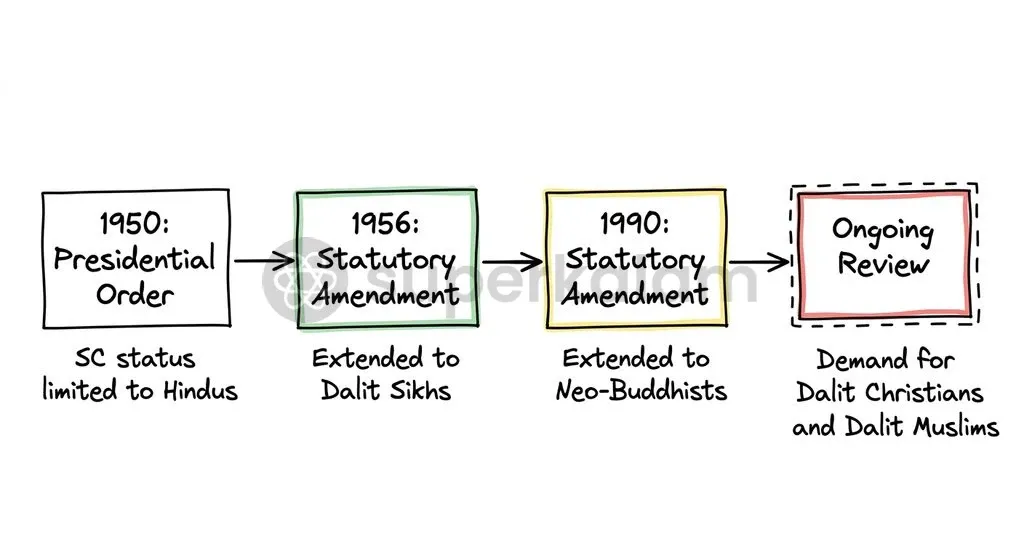
Promulgated by the President on 10 August 1950, the initial notification restricted Scheduled Caste recognition strictly to members of the Hindu faith. The executive rationale maintained that caste stratification and untouchability were unique historical features of the Hindu social order. It presumed that egalitarian religions inherently prevented such social discrimination.
Paragraph 3 of the 1950 Order operates as the statutory religion bar:
- The statutory prohibition: According to Paragraph 3 of the Constitution (Scheduled Castes) Order, 1950, no person who professes a religion different from Hinduism, Sikhism, or Buddhism shall be deemed a member of a Scheduled Caste.
- The underlying premise: This framework presumes that embracing religions lacking scriptural sanction for caste automatically liberates an individual from social degradation.
Discuss with Superkalam
Which two non-Hindu religions were added to the Scheduled Caste Order via parliamentary amendments in 1956 and 1990?
Ask NowHow Sikh and Buddhist Converts Won Scheduled Caste Recognition Over Time
Parliament has previously exercised its legislative prerogative under Article 341(2) to expand the religious boundaries of the 1950 Order on two historical occasions. The initial strictly Hindu requirement was first modified through statutory intervention following sustained advocacy from depressed-class leaders who demonstrated the persistence of caste hierarchies in non-Hindu indigenous traditions.
- The 1956 Amendment for Dalit Sikhs: Parliament enacted the Constitution (Scheduled Castes) Orders (Amendment) Act, 1956, formally including Dalit Sikh communities (such as Mazhabis and Ramdasias) within the Scheduled Caste umbrella.
- The 1990 Amendment for Dalit Buddhists: Following decades of mobilisation tracing back to Dr B.R. Ambedkar's 1956 conversion movement, Parliament passed Act No. 15 of 1990 to grant Scheduled Caste status to Navayana Buddhist converts.
Both statutory amendments recognised that egalitarian theological tenets do not automatically dissolve centuries of embedded social oppression in practical community life.
Differing Rules Across Categories: How Conversion Treats SC, ST, and OBC Communities
The Indian constitutional scheme treats religious conversion dissimilarly depending on whether affirmative action is anchored in caste-based untouchability, geographical isolation, or general educational and social backwardness.
| Category | Constitutional Basis | Governing Instrument | Is Reservation Religion-Neutral? | Impact of Religious Conversion |
|---|---|---|---|---|
| Scheduled Castes (SC) | Articles 341, 15(4), 16(4) | Constitution (Scheduled Castes) Order, 1950 | No (restricted to Hindu, Sikh, and Buddhist faiths) | SC status is completely forfeited upon conversion to Christianity or Islam. |
| Scheduled Tribes (ST) | Articles 342, 15(4), 16(4) | Constitution (Scheduled Tribes) Order, 1950 | Yes | ST status is fully retained regardless of conversion to Christianity, Islam, or other faiths. |
| Other Backward Classes (OBC) | Articles 15(4), 16(4), 340 | Central and State OBC Lists | Yes | Backward class status is preserved within notified groups, including converted Dalit Christians and Muslim communities. |
Scheduled Tribe identity relies on distinct cultural traits, primitive characteristics, and geographic isolation rather than religious dogma, insulating it from faith changes. Conversely, the Other Backward Classes framework, operationalised following the Mandal Commission, captures backwardness across multiple faiths without imposing a statutory religion test.
Discuss with Superkalam
Why does religious conversion lead to the loss of SC reservation while ST reservation remains protected regardless of faith?
Ask NowThe Sociological Dilemma: Does Untouchability Disappear After Change of Faith?
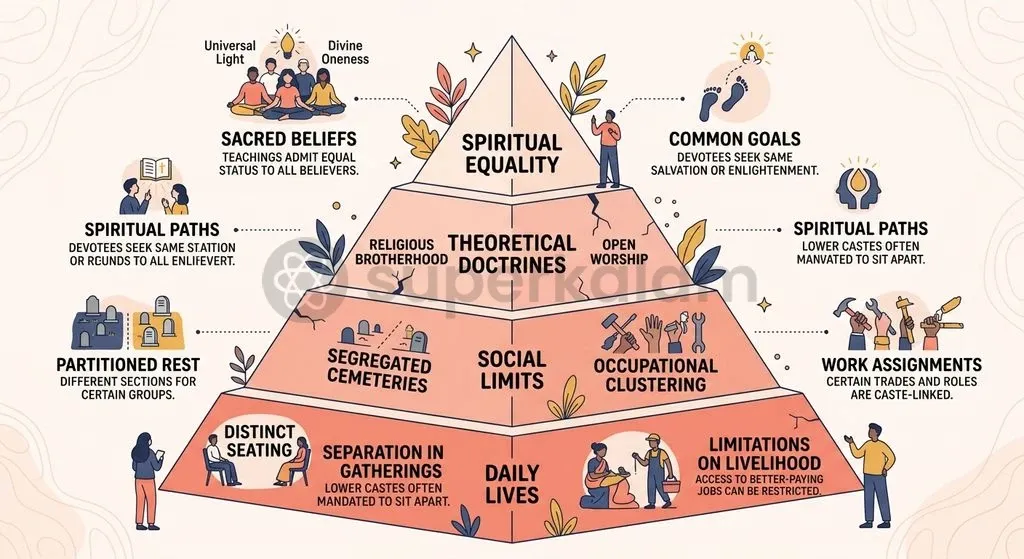
Sociological investigations consistently reveal that formal conversion to non-Indic faiths fails to insulate Dalit individuals from structural discrimination and caste-based exclusion. Despite scriptural egalitarianism in Christianity and Islam, Indian cultural practices routinely superimpose caste hierarchies onto minority religious communities.
Empirical inquiries highlight deep, ongoing stratification across minority faiths:
- Stratification among Muslims: The Sachar Committee Report (2006) documented deep social stratification among Indian Muslims, categorising the community into Ashraf, Ajlaf, and Arzal groups. The report highlighted that Arzal communities experience profound social marginalisation and occupational segregation comparable to Hindu Scheduled Castes.
- Discrimination among Christians: Surveys by the Anthropological Survey of India and the National Commission for Minorities confirm persistent discrimination among Christian converts across southern India. These findings document segregated burial grounds, separate seating enclosures within churches, and strict marital endogamy among converts.
Changing spiritual allegiance therefore rarely eradicates inherited social disabilities within village ecosystems.
Key Supreme Court Judgments on Conversion, Reconversion, and Caste Continuity
The Supreme Court of India has developed an extensive body of jurisprudence addressing the legal consequences of religious conversion and reconversion on caste identity.
The landmark ruling in Soosai v. Union of India (1985) established the evidentiary standard for expanding Paragraph 3 benefits. The court upheld the constitutional validity of the 1950 Order, ruling that extending Scheduled Caste recognition to Christian converts requires convincing empirical proof that converts suffer identical social and economic disabilities as their Hindu counterparts.
Judicial attitudes towards caste revival upon reconversion were established in C.M. Arumugam v. S. Rajgopal (1976). The bench held that while conversion out of Hinduism generally operates as an expulsion from caste, caste status can revive upon reconversion if the original community accepts the person back.
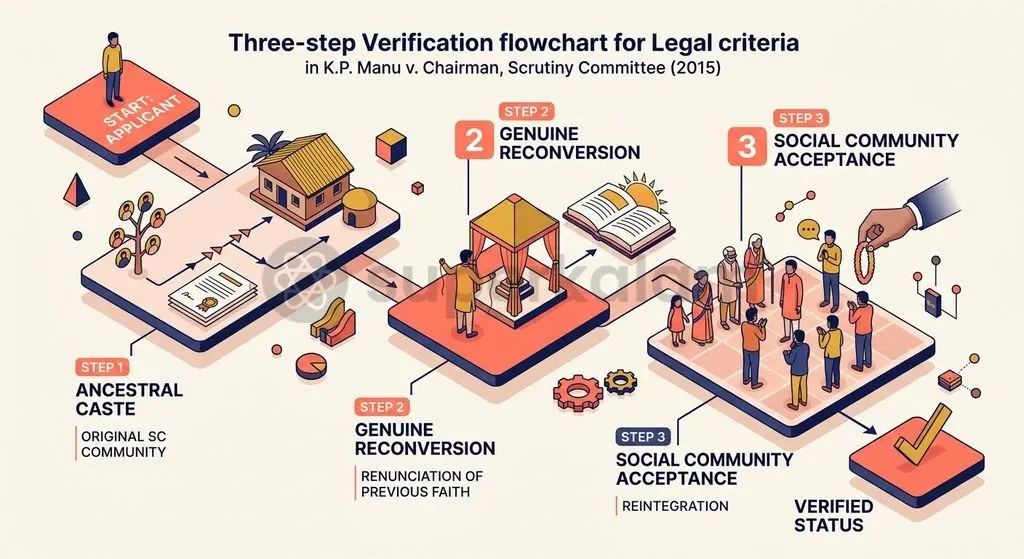
In K.P. Manu v. Chairman, Scrutiny Committee (2015), the court consolidated this principle into a clear three-pronged test:
- Definitive proof of the claimant's ancestor originally belonging to a recognised Scheduled Caste community.
- Verifiable evidence of the individual's genuine reconversion back to Hinduism.
- Clear proof of community acceptance by the original caste group without social ostracisation.
Discuss with Superkalam
How might the three-pronged test in K.P. Manu v. Chairman apply to a third-generation convert seeking to reclaim Scheduled Caste status?
Ask NowCompeting Official Inquiries: From Ranganath Misra to the K.G. Balakrishnan Commission
Executive commissions instituted by the Union Government have arrived at sharply contrasting conclusions regarding the religion bar in affirmative action policy:
- The Ranganath Misra Commission (2007): The National Commission for Religious and Linguistic Minorities, chaired by Justice Ranganath Misra, recommended in 2007 that Scheduled Caste status should be completely delinked from religion. The Misra Commission advocated making the classification entirely religion-neutral, bringing it into structural alignment with the Scheduled Tribe model.
- The K.G. Balakrishnan Commission (2022–present): In October 2022, the Union Government constituted a three-member Commission of Inquiry headed by former Chief Justice of India K.G. Balakrishnan. Appointed via Gazette Notification No. S.O. 4769(E), the commission was mandated to examine the empirical feasibility and social impact of extending Scheduled Caste status to Dalit converts to Christianity and Islam. As of late 2026, the commission's tenure has been periodically extended, with its final report still pending submission to the Ministry of Social Justice and Empowerment.
The Constitutional Clash: Freedom of Religion (Article 25) vs Presidential Discretion (Article 341)
The ongoing litigation before the Supreme Court of India presents a fundamental conflict between individual fundamental rights and sovereign classification powers. Petitioners in Writ Petition (Civil) No. 180 of 2004 contend that conditioning welfare benefits on religious identity infringes basic constitutional guarantees:
- Article 14 (Equality before Law): Petitioners argue that Paragraph 3 creates an irrational and discriminatory classification between converts to Indic faiths (Buddhism, Sikhism) and converts to semitic faiths (Christianity, Islam) facing comparable social marginalisation.
- Article 15(1) (Prohibition of Discrimination): The existing scheme penalises citizens solely on grounds of religious belief, denying state protection to otherwise deserving depressed classes.
- Article 25 (Freedom of Conscience): Tying statutory entitlements to religious profession is a state disincentive against exercising personal spiritual liberty.
The Union Government counters these arguments by anchoring its defence in Article 341(1). The government maintains that the President holds wide discretionary power to specify Scheduled Castes based on historical untouchability unique to the Hindu social structure, asserting that court-mandated expansion would distort the original intent of compensatory reservation.
Discuss with Superkalam
Compare the empirical findings of the Sachar Committee on Arzal Muslims with the evidentiary requirements established in Soosai v. Union of India.
Ask NowThe Way Forward: Balancing Empirical Field Data with Constitutional Safeguards
Resolving the impasse requires Parliament to balance rigorous empirical assessment with the transformative promises of the Indian Constitution. The pending findings of the Justice K.G. Balakrishnan Commission should provide an objective, data-driven foundation to evaluate whether untouchability endures post-conversion with the same debilitating intensity.
Two policy approaches offer constructive paths forward:
- Targeted legislative amendment under Article 341(2): If comprehensive field surveys verify persistent untouchability, Parliament could exercise its constitutional authority to enact targeted legislative adjustments.
- Sub-categorisation within OBC quotas: Expanding and sub-categorising existing Other Backward Classes quotas could channel specialised economic support to Dalit Christians and Muslims without destabilising the core Scheduled Caste framework.
Any durable policy outcome must reconcile the constitutional mandate of equality with the realities of ground-level social stratification.
Key Takeaways
- The 1950 Religion Bar: Paragraph 3 of the Constitution (Scheduled Castes) Order, 1950 restricts Scheduled Caste status strictly to persons professing Hinduism, Sikhism, or Buddhism.
- Historical Statutory Expansions: Parliament amended the 1950 Order under Article 341(2) in 1956 to include Dalit Sikhs and in 1990 to include Dalit Buddhists.
- Asymmetric Protection Frameworks: Scheduled Tribe status under Article 342 and Other Backward Classes quotas are completely religion-neutral, contrasting sharply with the faith-restricted Scheduled Caste criteria.
- Judicial High Bar: From Soosai v. Union of India (1985) to Chintada Anand (March 2026), the Supreme Court has consistently required definitive empirical proof of persistent disabilities before extending Scheduled Caste status post-conversion.
- Pending Commission Findings: While the 2007 Ranganath Misra Commission favoured delinking Scheduled Caste status from religion, the official policy direction remains tethered to the forthcoming report of the Justice K.G. Balakrishnan Commission.
Mains Question
"Paragraph 3 of the Constitution (Scheduled Castes) Order, 1950 presumes that theological egalitarianism automatically eradicates structural untouchability." In light of sociological findings and judicial pronouncements, critically examine this proposition. (15 Marks)
Evaluate NowMains Question
The constitutional mechanism governing affirmative action treats religious conversion differently across Scheduled Castes, Scheduled Tribes, and Other Backward Classes. Elucidate the differing legal rationales behind these distinctions. (10 Marks)
Evaluate NowPractice MCQs
QUESTION 1
With reference to the Constitution (Scheduled Castes) Order, 1950, consider the following statements:
- As originally promulgated in 1950, Scheduled Caste status was restricted exclusively to members professing the Hindu faith.
- Dalit Sikh communities were accorded Scheduled Caste status through an amendment enacted by Parliament in 1956.
- Navayana Buddhist converts were brought under the Scheduled Caste fold via statutory amendment in 1990. Which of the statements given above are correct?
QUESTION 2
Consider the following statements regarding the legal impact of religious conversion on reservation benefits across different categories in India:
- Scheduled Caste status is forfeited upon conversion to Christianity or Islam under the Constitution (Scheduled Castes) Order, 1950.
- Scheduled Tribe status is retained regardless of conversion to Christianity or Islam.
- Other Backward Classes (OBC) status is preserved within notified groups across multiple faiths without imposing a statutory religion test. Which of the statements given above is/are correct?
QUESTION 3
In K.P. Manu v. Chairman, Scrutiny Committee (2015), the Supreme Court laid down a three-pronged test regarding caste revival upon reconversion. Which of the following is NOT one of the prongs of that test?
QUESTION 4
Consider the following statements regarding judicial pronouncements on religious conversion and reservation benefits:
- In Soosai v. Union of India (1985), the Supreme Court held that extending Scheduled Caste recognition to Christian converts requires convincing empirical proof of identical social and economic disabilities.
- In The Secretary to Government v. Sameer Ahamed N. and Ors. (2026), the Supreme Court ruled that social disabilities suffered in a previous religious order cannot transpose a former caste identity into a distinct notified backward class upon conversion to Islam. Which of the statements given above is/are correct?
QUESTION 5
Which official commission recommended in 2007 that Scheduled Caste status should be completely delinked from religion and made entirely religion-neutral, structurally aligning it with the Scheduled Tribe model?
Related Blogs

Lancet Commission on Global Health Threats 2026: What It Is and the 17 Threats It Identifies
Oct, 2026
•8 min read
Special Summary Revision of Electoral Rolls 2026: Meaning, Process and SSR vs SIR
Oct, 2026
•9 min read

BHAVYA Scheme: Can Plug-and-Play Industrial Parks Transform Manufacturing?
Oct, 2026
•9 min read


