Why the EU AI Act Forces Indian IT to Pivot to High-Trust Auditing - UPSC Notes
Discover how Regulation (EU) 2024/1689 is compelling India's technology sector to transition toward high-trust algorithmic auditing and risk verification.
Aug, 2026
•10 min read
Context

Fig: India's $297 billion technology export sector faces a transformative shift as European Union AI regulations mandate high-trust compliance and auditing.
Regulation (EU) 2024/1689 enforces extraterritorial compliance mandates on third-country technology providers. This obliges India's 297 billion dollar IT services sector to shift from traditional cost-arbitrage code delivery toward high-trust algorithmic auditing and continuous risk verification.
This regulatory shift stems from strict extraterritorial provisions. They apply whenever an artificial intelligence system's output is used within the European single market.
Consequently, Indian technology vendors serving European enterprises must adapt. They face rigorous data lineage tracking, technical documentation, and continuous conformity assessments. This shift marks a structural evolution from low-margin offshore software development to high-value governance, risk, and compliance advisory services across global technology supply chains.
Why the EU AI Act Matters Now for Indian IT
The European Union's Regulation (EU) 2024/1689 reshapes global software exports. It extends strict regulatory oversight to non-European technology vendors serving EU clients. Published in the Official Journal of the European Union on 12 July 2024, the legislation introduces a risk-based framework for regulating artificial intelligence systems. As of August 2026, key provisions governing transparency disclosures and high-risk system obligations are becoming fully operational, making immediate alignment imperative for offshore technology providers.
Jurisdictional scope under Article 2(1)(c) explicitly encompasses providers and deployers established in third countries like India whenever the output produced by their artificial intelligence system is used within the EU. This extraterritorial jurisdiction directly impacts an estimated 1,200 Indian technology companies that supply software, predictive models, and cloud-hosted algorithmic solutions to European enterprise clients.
| Stage | Description | Legal Provision |
Non-EU AI Provider | Technology vendor established in third countries (e.g. India) | Article 2(1)(c) |
EU Usage Trigger | System output is used within the EU single market | Article 2(1)(c) |
Mandatory Compliance | Enterprise must meet full regulatory compliance obligations | Regulation (EU) 2024/1689 |
The economic stakes are substantial for India's technology ecosystem. NASSCOM data shows that India's technology industry generated $297 billion in revenue in FY25 and is projected to reach up to $315 billion in FY26. Because the European market constitutes a major share of these export earnings, Indian software vendors can no longer treat regulatory compliance as a secondary responsibility.
Understanding the EU AI Act Risk Tiers and Compliance Demands
Regulation (EU) 2024/1689 establishes a horizontal risk-based governance architecture that categorises artificial intelligence applications into four regulatory tiers. Each tier carries distinct technical, legal, and operational compliance mandates:
| Risk Tier | Compliance Demand | Primary Scope |
Unacceptable Risk | Banned outright | Article 5 |
High Risk | Mandatory conformity assessments | Article 43 |
Limited Risk | Transparency and watermarking | Article 50 |
Minimal Risk | Unrestricted / Voluntary codes | Standard software applications |
- Unacceptable Risk: Article 5 bans harmful practices outright, including social scoring systems and cognitive behavioural manipulation. Violations carry severe administrative fines under Article 99 of up to €35 million or 7% of global annual turnover, whichever is higher.
- High Risk: Encompasses systems deployed in critical infrastructure, healthcare, employment screening, biometrics, and credit scoring. Under Article 43, providers of high-risk systems must execute a formal conformity assessment verifying technical documentation, human oversight, and data governance prior to market placement.
- Limited Risk: Focuses primarily on interactive artificial intelligence, synthetic media, and deepfakes. Article 50 mandates explicit transparency obligations, requiring providers to ensure that artificial intelligence outputs are machine-readable and clearly marked as artificially generated, with full enforcement taking effect on 2 August 2026.
- Minimal Risk: Applies to standard software applications such as spam filters or AI-enabled video games, which remain largely unregulated and subject only to voluntary codes of conduct.
Compliance demands for high-risk systems extend far beyond initial software deployment. Article 3(23) dictates that any planned or unplanned substantial modification to an operational artificial intelligence system invalidates its original compliance status, immediately triggering a mandatory new conformity assessment.
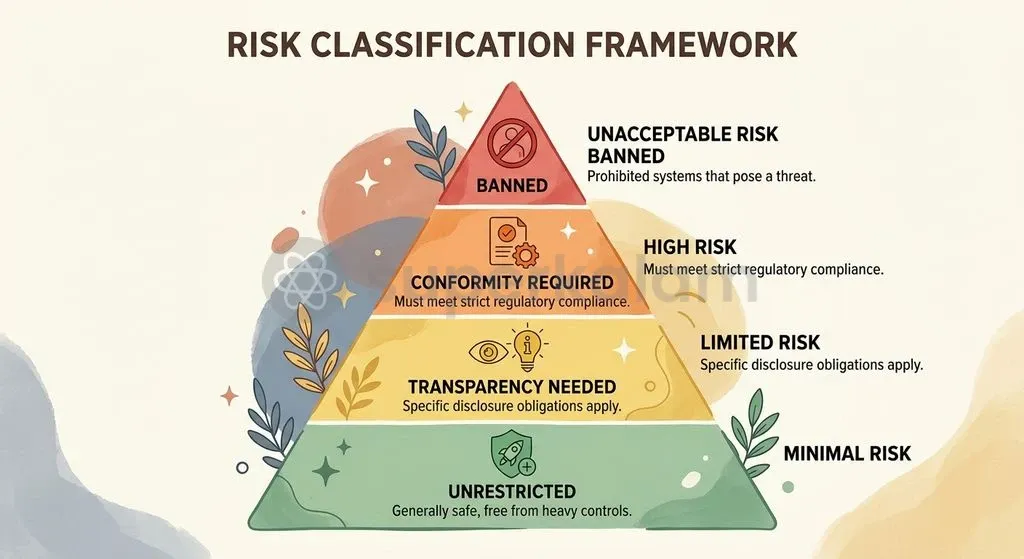
Fig: The EU AI Act classifies AI applications into four distinct risk tiers, imposing strict conformity requirements on high-risk systems.
Discuss with Superkalam
Can you recall the four regulatory risk tiers defined under the EU AI Act and the primary legal obligation associated with each tier?
Ask NowHow Indian IT Services Compare Before and After the EU AI Act
The European Union AI regulatory framework alters the operational core of Indian software exports across legal, technical, and commercial delivery dimensions. Historical outsourcing relied on time-and-materials or fixed-price contracts centered on bespoke code delivery. The new regime mandates continuous algorithmic verification and risk management.
| Comparison Dimension | Traditional Offshore IT Model | EU AI Act Compliant Delivery Model |
Core Value Proposition | Cost-arbitrage, labour scale, and rapid code deployment. | High-trust verification, algorithmic auditing, and liability mitigation. |
Contractual Structure | Time-and-materials or fixed-price project deliverables. | Continuous service-level agreements incorporating ongoing compliance monitoring. |
Documentation Standard | Standard software architecture diagrams and functional specifications. | Comprehensive audit dossiers, including data lineage diagrams and model cards. |
Regulatory Presence | Offshore delivery centres operating without European legal presence. | Mandatory appointment of an EU-based Authorized Representative under Articles 23 & 24. |
System Modification | Patch updates and bug fixes executed under standard release cycles. | Any substantial modification invalidates compliance and forces re-assessment under Article 3(23). |
This structural shift requires Indian vendors to supply comprehensive technical documentation alongside raw code. Deliverables must now incorporate complete data lineage diagrams, model cards detailing training parameters, and empirical algorithmic bias evaluations.
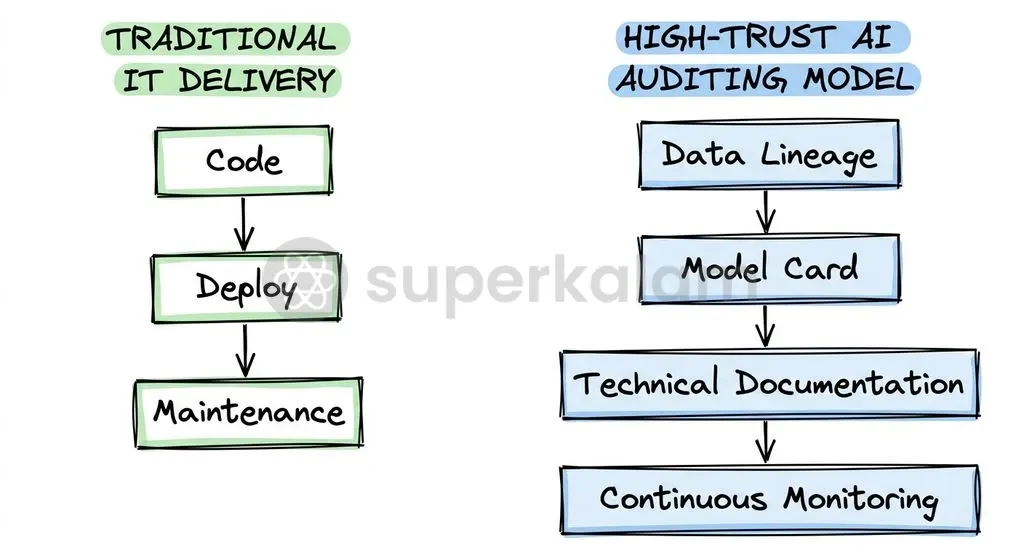
Fig: Transitioning from offshore coding to continuous compliance requires integrating model auditing, data lineage, and EU-based representation.
The Shift from Offshore Cost Arbitrage to High-Trust AI Auditing
Indian IT services enterprises, according to NASSCOM, are pivoting toward high-trust artificial intelligence assurance frameworks like ISO/IEC 42001 to secure global revenue. Moving up the value chain enables tech leaders to transition from low-margin software coding to high-margin GRC advisory services.
Standardisation anchors this strategic transformation. ISO/IEC 42001:2023, published in December 2023, serves as the international standard for Artificial Intelligence Management Systems (AIMS). By adopting ISO/IEC 42001 alongside the NIST AI Risk Management Framework, Indian technology exporters establish verifiable baseline governance structures that European clients require during vendor due diligence.
- ISO/IEC 42001:2023 Standard: Establishes formal Artificial Intelligence Management Systems (AIMS).
- NIST AI Risk Management Framework: Provides operational guidelines for model risk identification and risk mitigation.
- Unified AI Governance Dossier: Combines technical audit records to substantiate compliance for European enterprise clients.
- EU High-Risk Conformity Pass: Secures formal regulatory approval prior to deployment in the EU single market.
High-trust auditing converts regulatory friction into a commercial advantage. Indian firms that build dedicated compliance and algorithmic auditing practices can evaluate client models for bias, explainability, security vulnerabilities, and data provenance. This positions Indian IT not merely as offshore execution partners, but as primary custodians of global artificial intelligence safety.
Risks and Roadblocks for Indian Tech Firms in Meeting Compliance
Mid-sized Indian technology exporters face significant financial and operational hurdles under the compliance mandates enforced by the European Union. While large Tier-1 integrators possess the capital to absorb regulatory overheads, mid-tier firms risk margin compression or market exclusion.
| Compliance Hurdle | Cost / Overhead Scope | Key Impact |
EU Technical Consulting | ₹12 lakh to ₹40 lakh per high-risk system | High financial entry barrier for smaller exporters |
ISO 42001 Certification | ₹3 lakh to ₹15 lakh per organisation | Requires 90 to 180 working days to implement |
EU Authorized Representative | Permanent administrative overhead | Legal requirement under Articles 23 & 24 |
Auditor Talent Scarcity | Resource constraint | Shortage of cross-disciplinary AI ethics and legal auditors |
Financial burdens stem from mandatory legal and technical procedures:
- European compliance consulting services for technical documentation are estimated to cost between ₹12 lakh and ₹40 lakh per high-risk system, presenting a steep financial barrier for smaller exporters.
- Implementing organizational ISO/IEC 42001 certification in India is estimated to cost between ₹3 lakh and ₹15 lakh, requiring between 90 and 180 working days to complete.
- Non-EU technology providers must appoint an Authorized Representative established within the European Union pursuant to Articles 23 and 24, creating permanent administrative overheads.
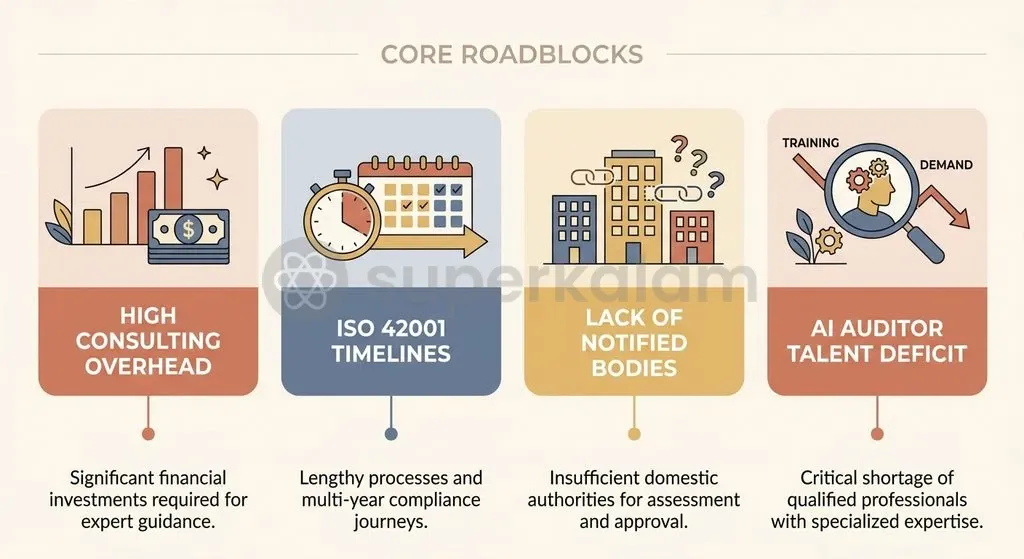
Fig: Financial and operational hurdles, such as high documentation costs and a shortage of certified AI auditors, affect mid-sized technology exporters.
Operational bottlenecks worsen these financial challenges. Industry analyses indicate that India currently lacks recognized domestic Notified Bodies accredited to conduct third-party conformity assessments under EU regulatory standards. Consequently, Indian exporters must engage European auditing firms, increasing evaluation timelines and operational expenses. Furthermore, a severe talent scarcity in specialized artificial intelligence auditors proficient across machine learning engineering, legal liability, and regulatory frameworks hinders rapid scaling.
Discuss with Superkalam
In your own words, explain how Article 2(1)(c) extends European regulatory jurisdiction to offshore technology developers based in India.
Ask NowWhat the Future Holds for India's AI Export Economy
The Ministry of Electronics and Information Technology is currently formulating national artificial intelligence governance frameworks to align domestic standards with international compliance mandates. Through the IndiaAI mission, MeitY is developing safety guidelines aligned with ISO/IEC 42001 and OECD principles to benchmark domestic technology exports against global baselines.
Trade negotiations under the proposed India-EU Free Trade Agreement provide a key strategic forum to resolve regulatory barriers. India's key policy objective centers on establishing mutual recognition agreements for conformity assessment bodies under World Trade Organization Technical Barriers to Trade mechanisms:
| MRA Dimension | Primary Impact | Regulatory Consequence |
Economic Benefit | Local domestic audits reduce cost and delay | Reduces conformity expense for Indian tech exporters |
Strategic Risk | Adopting EU rules reinforces "Brussels Effect" | Creates long-term regulatory dependency on foreign standards |
From a GS2 bilateral trade perspective, mutual recognition presents both strategic advantages and risks:
- Strategic Advantage: Achieving mutual recognition allows accredited Indian laboratories to certify compliance locally, drastically reducing conformity costs and regulatory friction for domestic technology exporters.
- Regulatory Dependency: Relying on European compliance benchmarks reinforces the "Brussels Effect", obligating Indian policy framework makers to adopt external regulatory norms without having equal voting power in setting those standards.
To avoid structural standard-setting dependency, India must balance global regulatory alignment with domestic technological autonomy. Active participation in multilateral standards forums—such as the Global Partnership on Artificial Intelligence (GPAI)—enables India to contribute to global safety frameworks that reflect the operational realities of emerging economy tech exports.
Key Takeaways
- Regulation (EU) 2024/1689 applies extraterritorially under Article 2(1)(c) to any third-country technology firm whose artificial intelligence outputs are utilized within the European single market.
- Indian technology exporters serving European enterprise clients are pivoting from traditional cost-arbitrage code delivery toward high-trust artificial intelligence auditing grounded in ISO/IEC 42001 standards.
- High-risk artificial intelligence systems require mandatory conformity assessments under Article 43, while Article 3(23) dictates that any substantial modification invalidates prior compliance.
- Compliance overheads—including estimated consulting fees of ₹12 lakh to ₹40 lakh per high-risk system—and a lack of domestic Notified Bodies create initial export hurdles for mid-sized Indian technology firms.
- India-EU Free Trade Agreement negotiations regarding mutual recognition of conformity assessment bodies are vital to reducing certification costs, though they require balancing global alignment against regulatory autonomy.
Mains Question
"The extraterritorial jurisdiction of Regulation (EU) 2024/1689 necessitates a structural shift in India's $297 billion IT sector from traditional cost-arbitrage code delivery to high-trust algorithmic auditing and continuous risk verification." Elucidate. (15 marks)
Evaluate NowMultiple Choice Questions
QUESTION 1
Q1. Consider the following statements regarding Regulation (EU) 2024/1689 (EU AI Act):
- Under Article 2(1)(c), its extraterritorial jurisdiction applies when an AI system's output is used within the European single market, even if the provider is established in a third country like India.
- The Act establishes a horizontal risk-based framework categorized into four regulatory tiers.
- High-risk AI systems under Article 5 are banned outright, attracting administrative fines up to €35 million or 7% of global annual turnover.
Which of the statements given above are correct?
QUESTION 2
Q2. With reference to compliance demands under the EU AI Act, consider the following statements:
- Systems deployed in employment screening, credit scoring, and critical infrastructure are categorized as High Risk.
- Limited-risk systems face mandatory transparency obligations under Article 50, requiring outputs to be machine-readable and marked as artificially generated.
- Under Article 3(23), standard patch updates and routine software bug fixes automatically invalidate an AI system's original compliance status.
Which of the statements given above is/are correct?
QUESTION 3
Q3. Consider the following statements regarding the regulatory compliance mandates for offshore IT vendors serving the EU market:
- Articles 23 and 24 mandate non-EU technology vendors to appoint an EU-based Authorized Representative.
- According to NASSCOM, India's technology sector revenue is projected to reach up to $315 billion in FY26.
- Implementing organizational ISO/IEC 42001 certification in India is estimated to require between 90 to 180 working days.
Which of the statements given above are correct?