Atal Vayo Abhyudaya Yojana: AVYAY Scheme Explained
Atal Vayo Abhyudaya Yojana supports senior citizens through care homes, helplines, assistive devices and active-ageing programmes.
Sep, 2026
•10 min read

Overview
The Atal Vayo Abhyudaya Yojana is an umbrella Central Sector Scheme formulated by the Ministry of Social Justice and Empowerment to institutionalise comprehensive eldercare across India. The scheme marks a decisive policy shift from fragmented destitution-based charity to an integrated, market-enabled care economy that secures physical, economic, and emotional well-being for senior citizens. By consolidating community care homes, assistive medical devices, and startup innovation under a unified framework, the scheme responds to unprecedented demographic ageing where India faces the challenge of growing old before it grows wealthy.
Why in the News? The Looming Grey Dividend Challenge
India is undergoing an accelerated demographic transition marked by a rapidly expanding elderly population. According to the Report of the Technical Group on Population Projections (2011–2036) released by the Ministry of Health and Family Welfare, India's senior citizen population will expand from 10.38 crore in 2011 to 22.7 crore by 2036, rising from 8.6% to 15% of the total population.
This demographic surge poses severe socioeconomic pressures. Findings from Wave 1 of the Longitudinal Ageing Study in India indicate that approximately 75% of senior citizens suffer from at least one chronic ailment, while 40% present multimorbidities or physical and mental disabilities. Furthermore, the study noted that 23.8% of individuals aged 60 and above suffer from limitations in Activities of Daily Living, which creates an urgent demand for structured long-term geriatric care.
Discuss with Superkalam
According to the MoHFW Technical Group report, what percentage of India's population will be senior citizens by 2036?
Ask NowBeyond Old-Age Homes: The Structural Re-Engineering of Elderly Care in India
The Ministry of Social Justice and Empowerment restructured legacy welfare interventions to establish an institutional continuum of eldercare. Effective from April 1, 2021, the central government revamped the erstwhile National Action Plan for Senior Citizens into the unified umbrella scheme named Atal Vayo Abhyudaya Yojana.
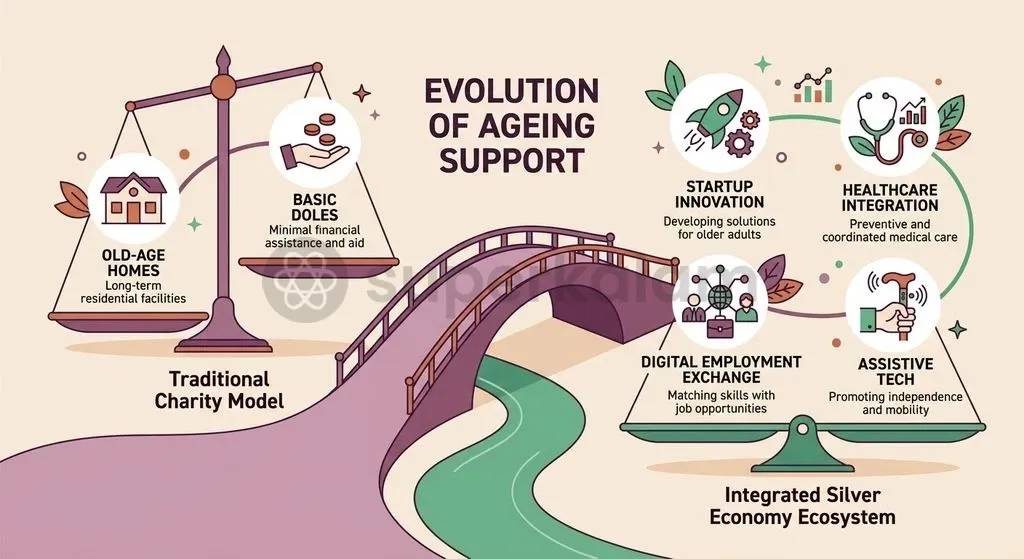
Historically, state intervention for the elderly operated on a residual charity paradigm. Earlier welfare initiatives focused primarily on running basic shelter homes for abandoned seniors, leaving active, middle-income, and semi-dependent elderly populations outside the institutional safety net.
AVYAY alters this focus by treating senior citizens as active participants in national development. The programme integrates assistive medical rehabilitation, market-based private innovation, dedicated crisis response helplines, and livelihood channels to build a sustainable silver economy, which NITI Aayog's 2024 position paper estimated at approximately ₹73,082 crore.
Architecture of AVYAY: How the Umbrella Framework Works
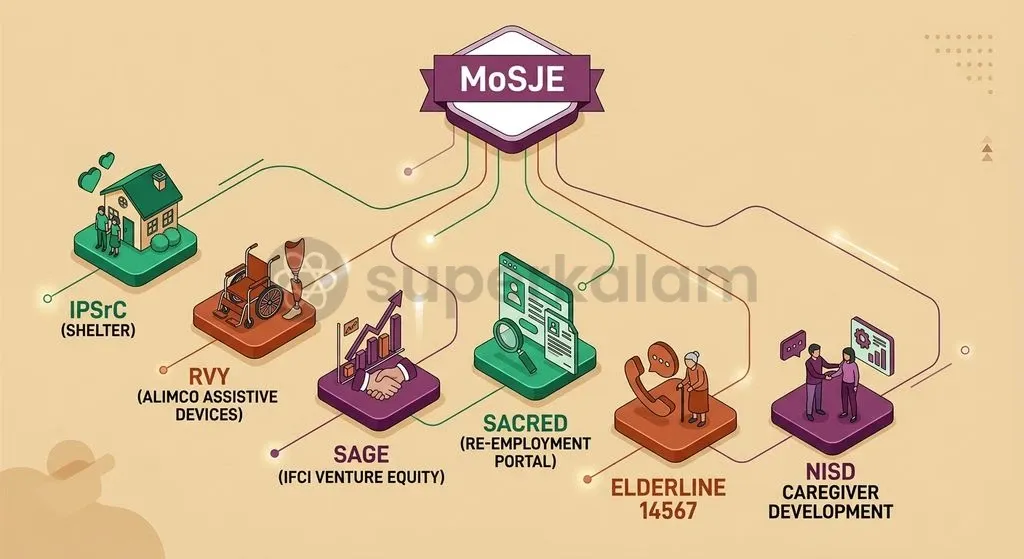
The Atal Vayo Abhyudaya Yojana operates as an umbrella 100% Central Sector Scheme implemented directly under the Department of Social Justice and Empowerment. Central funding flows through specialized institutional agencies, state departments, and accredited non-governmental organisations to execute targeted verticals.
| Implementing Vertical | Target Demographic | Primary Output |
|---|---|---|
| IPSrC | Indigent Seniors | Shelter, Nutrition, Healthcare Homes |
| Rashtriya Vayoshri Yojana (RVY) | BPL / Low Income (≤ ₹15,000/month) | Free Assisted Living Physical Devices |
| SAGE Portal | Eldercare Startups | Equity Funding up to ₹1 Crore via IFCI |
| SACRED Portal | Skilled Seniors (60+) | Private Re-employment Matching Platform |
| Elderline (14567) | Distressed Seniors | Rescue, Legal & Healthcare Advisory |
| State Action Plan (SAPSrC) | State-Specific Needs | Cataract Surgeries, Capacity Building |
Discuss with Superkalam
How does AVYAY mark a structural shift from traditional charity-based eldercare to an active 'silver economy' framework?
Ask NowCore Sub-Schemes and Implementation Verticals
The AVYAY umbrella structure integrates six specialized sub-programmes designed to address distinct vulnerabilities among the elderly:
- Integrated Programme for Senior Citizens: Under this component, the central government provides grant-in-aid to voluntary organisations to establish and maintain Senior Citizen Homes, Continuous Care Homes for bedridden residents, Mobile Medicare Units, and Physiotherapy Clinics.
- Rashtriya Vayoshri Yojana: This vertical provides free physical aids and assisted living devices through the Artificial Limbs Manufacturing Corporation of India. Eligible beneficiaries include senior citizens belonging to Below Poverty Line households or those earning a monthly income up to ₹15,000.
- Elderline National Toll-Free Helpline: Operational across India on toll-free number 14567 from 8:00 AM to 8:00 PM daily, Elderline delivers emotional counselling, on-ground rescue, healthcare advisory, and legal dispute guidance to seniors in distress.
- State Action Plan for Senior Citizens: The central government extends flexible grant funding to State and Union Territory administrations. This financing supports local initiatives such as mobile cataract surgeries, community awareness drives, and geriatric capacity building.
- Caregiver Capacity Building via NISD: The Department of Social Justice and Empowerment rolled out the PM-SPECIAL initiative and the SHATAYU dashboard under the National Institute of Social Defence to standardize training and create a national registry of certified geriatric caregivers.
Funding Mechanism: Central Sector Outlay and the Senior Citizens Welfare Fund
The Atal Vayo Abhyudaya Yojana receives statutory financing support from the dedicated Senior Citizens' Welfare Fund alongside direct budgetary outlays. The central government established this fund under Chapter VII, Section 122 of the Finance Act, 2015 to secure sustainable, non-lapsable financing for elderly welfare programmes.
The Senior Citizens' Welfare Fund mobilises capital by transferring unclaimed balances from institutional accounts:
- Unclaimed Deposits: Balances lying dormant for more than seven years in Public Provident Fund accounts, Employees' Provident Fund accounts, and Post Office small savings schemes are transferred to the fund.
- Insurance Policies: Unclaimed proceeds from matured life and general insurance policies held with public and private insurance entities are directed to this corpus.
- Dedicated Utilisation: Accrued funds directly finance the procurement of assistive devices under the Rashtriya Vayoshri Yojana and long-term care infrastructure under the Integrated Programme for Senior Citizens.
Discuss with Superkalam
Analyze how leveraging unclaimed balances in PPF and EPF accounts addresses the challenge of financing long-term social welfare schemes in India.
Ask NowFrom Charity to Market Ecosystem: The SAGE and SACRED Innovations
The Ministry of Social Justice and Empowerment launched two flagship digital portals to transition elderly care into an entrepreneurship-backed market ecosystem. These initiatives break away from passive welfare by leveraging the skills of senior citizens and encouraging private sector investment in eldercare products.
| Feature | SAGE Portal | SACRED Portal |
|---|---|---|
| Primary Objective | Eldercare Startup Incubation & Financing | Senior Re-Employment & Livelihood Facilitation |
| Implementing Body | MoSJE with IFCI Venture Capital Funds | MoSJE Digital Interface |
| Financial Vehicle | Equity funding up to ₹1 crore per enterprise | No direct financing; virtual matching service |
| Equity Cap | Maximum 49% government equity holding | Not applicable |
| Key Beneficiary | Eldercare innovators, tech product creators | Senior citizens aged 60+ with professional skills |
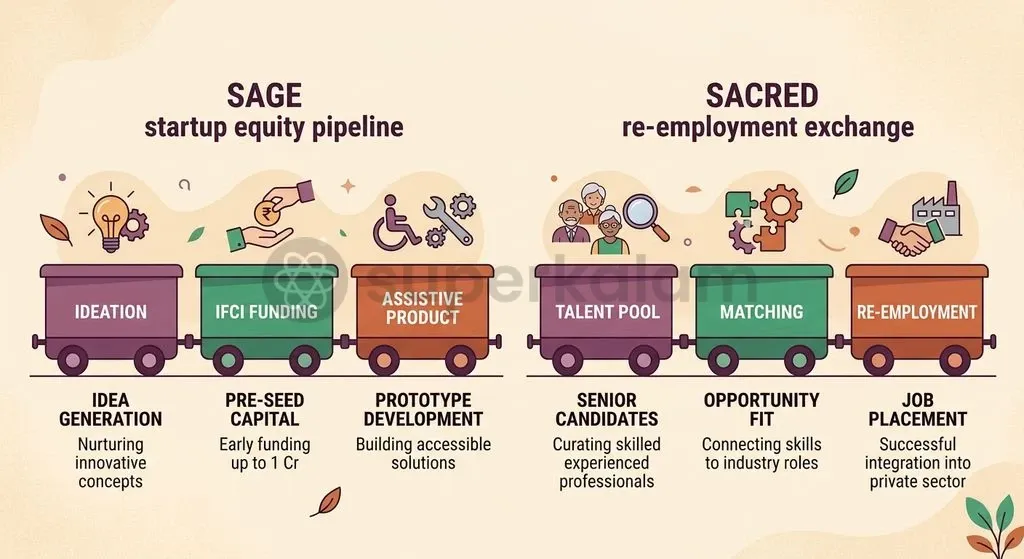
Under the Seniorcare Ageing Growth Engine initiative, the central government provides equity financing of up to ₹1 crore per project through IFCI to selected eldercare startups, subject to a maximum 49% government equity cap. This fund supports enterprise-grade products in remote health monitoring, assistive mobility, dementia care, and home-care services.
Simultaneously, the Senior Able Citizens for Re-Employment in Dignity portal serves as an employment exchange. The platform matches experienced citizens aged 60 and above with private enterprises seeking specialized, part-time, or advisory talent, thereby harnessing India's vast pool of senior human capital.
Key Operational Bottlenecks: Regional Disparities and Geriatric Infrastructure Deficits
The implementation of AVYAY faces substantial spatial and administrative bottlenecks across Indian states. Implementation assessments highlighted by NITI Aayog reveal an acute geographic skew, with NGO-run Senior Citizen Homes heavily concentrated in southern and western states like Andhra Pradesh, Tamil Nadu, and Maharashtra. Conversely, heavily populated northern and eastern states face severe infrastructural deficits despite growing ageing burdens.
| Structural Dimension | Documented Operational Friction |
|---|---|
| Geographic Distribution | Heavy clustering of NGO homes in AP, TN, MH; severe deficit in North and East India |
| Fund Absorption Deficits | Delayed Utilization Certificates (UCs) cause multi-month grant disbursement backlogs |
| Healthcare Integration | Inadequate linkage with district-level geriatric units established under NPHCE |
| Caregiver Shortage | Acute scarcity of formally certified, standardized geriatric care workers |
Administrative friction dampens scheme delivery. Parliamentary standing committee reviews show persistent fund absorption bottlenecks, largely caused by delayed submission of Utilization Certificates by state nodal agencies and lengthy verification cycles for voluntary organisations.
Furthermore, while the Ministry of Health and Family Welfare operates the National Programme for Health Care of the Elderly to build 10-bedded geriatric wards in district hospitals, AVYAY shelter homes remain poorly integrated with these specialized health centres.
Ethical and Constitutional Anchors: Article 41 and the Care Economy Imperative
The Indian Constitution embeds the welfare of the elderly within the non-justiciable principles of state policy. Article 41 of the Constitution explicitly directs the State to make effective provision for securing public assistance in cases of old age, sickness, and disablement within the limits of its economic capacity and development.
Statutory protections reinforce these constitutional directives. The Maintenance and Welfare of Parents and Senior Citizens Act, 2007 establishes statutory Maintenance Tribunals where neglected parents can seek monthly maintenance allowances from legal heirs.
To deter domestic abandonment, Section 24 of the Maintenance and Welfare of Parents and Senior Citizens Act, 2007 prescribes a penal sentence of up to three months of imprisonment, a fine up to ₹5,000, or both for anyone intentionally deserting a dependent senior citizen.
Discuss with Superkalam
Weigh the trade-offs of using equity participation (up to 49%) through SAGE versus direct grant subsidies to foster innovation in the eldercare market.
Ask NowWay Forward: Building a Rights-Based Continuum of Care
Policy planners must transition India's eldercare ecosystem into an institutionalized, universal continuum of care. The October 2024 expansion of Ayushman Bharat PM-JAY, which approved distinct health insurance coverage of ₹5 lakh annually for all senior citizens aged 70 and above irrespective of household income, provides a solid universal base for geriatric health security.
To maximise the impact of AVYAY, policy execution should focus on four priorities:
- Equitable Infrastructure Allocation: The Ministry of Social Justice and Empowerment must replace the NGO-application-driven model with state-wise spatial gap analyses, directing capital to build Senior Citizen Homes in underserved districts across central, northern, and eastern India.
- Inter-Ministerial Convergence: Operational linkages between AVYAY homes, the National Programme for Health Care of the Elderly, and Ayushman Bharat Health and Wellness Centres will streamline chronic disease management and institutional palliative care.
- Expansion of SAGE Equity Corpus: Scaling the SAGE venture funding mechanism will unlock private venture capital for assistive robotics, affordable tele-health, and modular retirement housing.
- Professional Caregiver Accreditation: Rapid scaling of training curricula through the National Institute of Social Defence and the SHATAYU dashboard will formalise eldercare as an organised employment sector.
Key Takeaways
- Umbrella Structure: Atal Vayo Abhyudaya Yojana is an umbrella Central Sector Scheme under the Ministry of Social Justice and Empowerment, operational since April 1, 2021.
- Sub-Scheme Integration: The scheme integrates key components including the Integrated Programme for Senior Citizens, Rashtriya Vayoshri Yojana, SAGE portal, SACRED platform, and Elderline (14567).
- Innovative Market Levers: SAGE provides equity support of up to ₹1 crore (maximum 49% equity) to eldercare startups, while SACRED provides re-employment opportunities to citizens aged 60 and above.
- Dedicated Financing: The scheme draws long-term financing from the Senior Citizens' Welfare Fund, established under the Finance Act, 2015 from unclaimed deposits in PPF, EPF, and small savings.
- Constitutional and Legal Base: Grounded in the Directive Principles of State Policy under Article 41 and statutory enforcement under the Maintenance and Welfare of Parents and Senior Citizens Act, 2007.
Mains Question
The transition of elderly welfare from 'residual destitution relief' to a 'market-enabled silver economy' reflects a paradigm shift in Indian social policy. In the light of the Atal Vayo Abhyudaya Yojana (AVYAY), evaluate the effectiveness of initiatives like SAGE and SACRED in harnessing the grey dividend. (15 Marks)
Evaluate NowMains Question
'Securing non-lapsable and institutionalized financing is central to sustaining social security for vulnerable groups.' Elucidate the role of the Senior Citizens' Welfare Fund established under the Finance Act, 2015 in financing senior citizen welfare schemes under AVYAY. (10 Marks)
Evaluate NowPractice MCQs
QUESTION 1
With reference to the Atal Vayo Abhyudaya Yojana (AVYAY), consider the following statements:
- It is a Centrally Sponsored Scheme implemented on a cost-sharing basis between the Centre and States.
- It restructured and replaced the erstwhile National Action Plan for Senior Citizens.
- The scheme marks a transition from a charity-based model to an integrated, market-enabled care economy.
Which of the statements given above is/are correct?
QUESTION 2
Consider the following statements regarding the Seniorcare Ageing Growth Engine (SAGE) and Senior Able Citizens for Re-Employment in Dignity (SACRED) initiatives:
- SAGE provides equity financing of up to ₹1 crore per project through IFCI Venture Capital Funds, subject to a 49% government equity cap.
- SACRED operates as an employment matching platform connecting experienced citizens aged 60 and above with private enterprises.
- Both SAGE and SACRED provide direct financial grants to individual senior citizens to meet their daily medical expenses.
Which of the statements given above is/are correct?
QUESTION 3
Regarding the Senior Citizens' Welfare Fund, consider the following statements:
- It was established under Chapter VII, Section 122 of the Finance Act, 2015.
- It is financed by transferring unclaimed balances lying dormant for more than seven years in accounts such as PPF, EPF, and Post Office savings schemes.
- Proceeds accrued in the fund are utilized to support programmes such as the Rashtriya Vayoshri Yojana and the Integrated Programme for Senior Citizens.
Which of the statements given above are correct?
QUESTION 4
Under the Rashtriya Vayoshri Yojana (RVY) component of AVYAY, who among the following is eligible to receive free physical aids and assisted living devices?
QUESTION 5
Consider the following statements regarding demographic ageing and geriatric care infrastructure in India:
- According to the Technical Group on Population Projections, India's senior citizen population is projected to reach 15% of the total population by 2036.
- Findings from LASI Wave 1 indicate that approximately 75% of senior citizens in India suffer from at least one chronic ailment.
- The SHATAYU dashboard and PM-SPECIAL initiative were rolled out under the National Institute of Social Defence to create a registry and standardize training for geriatric caregivers.
Which of the statements given above are correct?