HAL Handover: Tejas FOC Trainer, HTT-40 and Dhruv NG
HAL handed over the Tejas FOC trainer, HTT-40 basic trainer and Dhruv NG helicopter, highlighting India’s defence and civil aviation manufacturing push.
Sep, 2026
•7 min read
Overview
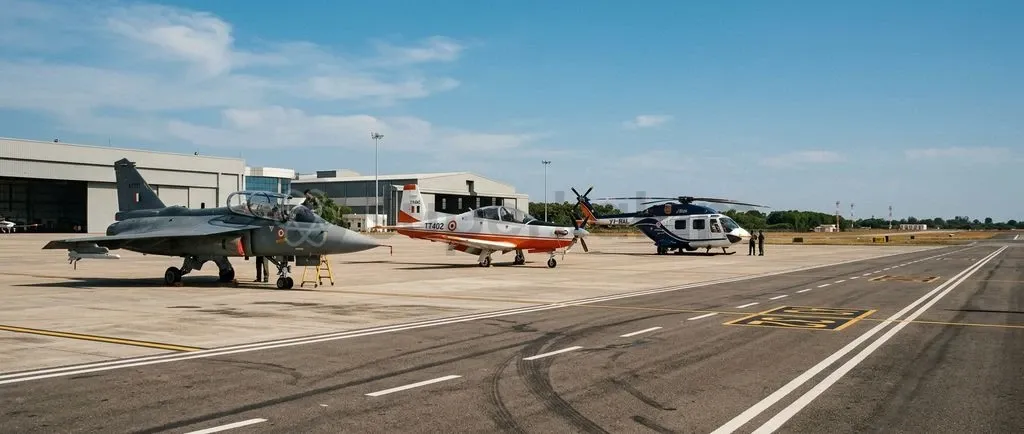
Hindustan Aeronautics Limited completed a strategic triple platform handover in Bengaluru. The state-run manufacturer delivered two LCA Tejas twin-seater trainers and the indigenous HTT-40 basic trainer to the Indian Air Force. It also handed over four Dhruv NG helicopters to Pawan Hans Limited.
According to the Ministry of Defence, the milestone expands domestic pilot training pipelines, modernises offshore transport, and reinforces aerospace manufacturing self-reliance. While local sub-system integration has expanded steadily across airframes, critical dependencies on foreign propulsion cores highlight the need for deeper domestic supply chain ecosystems.
Why in the News: The Triple Handover Milestone
The Ministry of Defence announced on 18 September 2026 that Hindustan Aeronautics Limited conducted a simultaneous triple platform delivery in Bengaluru. As of September 2026, the delivery transferred two Light Combat Aircraft Tejas Final Operational Clearance twin-seater trainers and the first indigenous HTT-40 basic trainer to the Indian Air Force, while supplying four civil-certified Dhruv Next Generation helicopters to Pawan Hans Limited.
The handover fulfilled major contractual commitments across three distinct programmes:
- LCA Tejas FOC Trainers: The twin-seater units, designated SPT7 and SPT8, fulfilled the Indian Air Force's 2010 procurement order for 20 aircraft (16 single-seat fighters and four twin-seat operational trainers).
- HTT-40 Basic Trainer: The aircraft entered service under a ₹6,828.36 crore contract covering 70 aircraft to establish a domestic baseline for primary flight instruction.
- Dhruv NG Helicopters: Pawan Hans Limited received its first four units out of a 10-helicopter order valued at over ₹1,800 crore.
Understanding the Three Platforms: Tejas Trainer, HTT-40, and Dhruv NG
Hindustan Aeronautics Limited engineered these three platforms to cover distinct tiers spanning basic pilot training, advanced fighter conversion, and multi-role rotary operations.
Each platform serves a defined operational profile:
- LCA Tejas FOC Trainer: Functions as a lead-in fighter trainer to prepare pilots for supersonic combat. It retains the full weapons suite and sensor capabilities of the single-seat combat variant.
- HTT-40 Basic Trainer Aircraft ('Ankur'): A tandem-seat turboprop platform built for ab-initio flight instruction. It provides foundational capabilities in aerobatics, instrument flying, night navigation, and close-formation manoeuvres. The airframe incorporates an indigenous content of 56% at initial production, with domestic material integration projected to exceed 60% as sub-system manufacturing scales.
- Dhruv Next Generation (NG): A 5.5-tonne multi-role helicopter certified by the Directorate General of Civil Aviation. Configured for offshore transport, disaster response, emergency medical services, and regional passenger connectivity under the Regional Connectivity Scheme (UDAN).
Discuss with Superkalam
Which specific foreign engines power the Tejas Trainer and HTT-40 platforms respectively?
Ask Now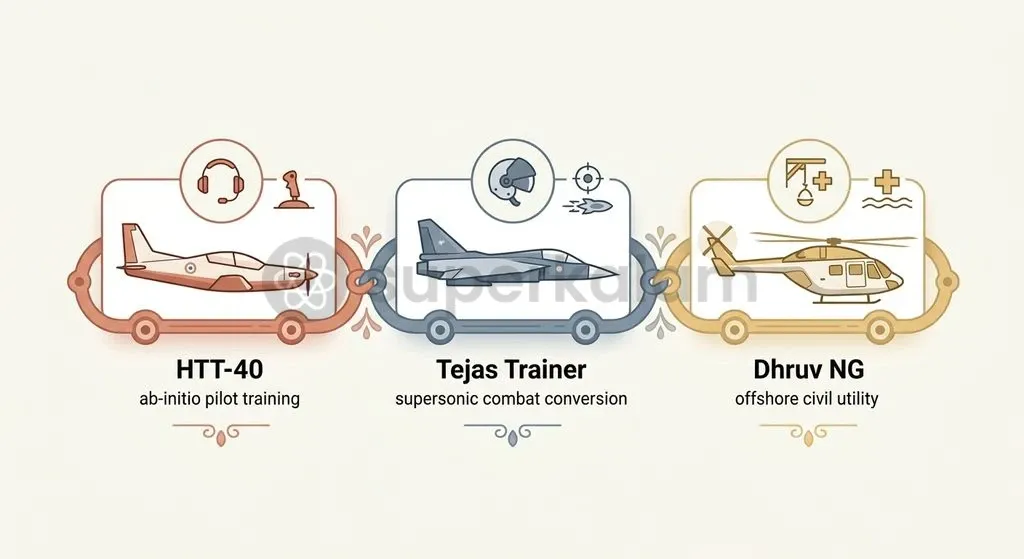
Side-by-Side Comparison: Specifications, Role, and Strategic Purpose
A structured technical comparison highlights how each platform addresses specific operational gaps across defence and civil aviation sectors.
| Parameter | LCA Tejas FOC Trainer | HTT-40 ('Ankur') | ALH Dhruv NG |
|---|---|---|---|
| Primary Category | Supersonic Lead-In Fighter Trainer (LIFT) | Basic Trainer Aircraft (BTA) | Multi-Role Civil Helicopter |
| Primary Operator | Indian Air Force | Indian Air Force | Pawan Hans Limited / Civil PSUs |
| Core Operational Role | Operational conversion and full combat operations | Stage-1 foundational and ab-initio flight training | Offshore logistics, disaster relief, and EMS |
| Propulsion System | GE Aerospace F404-IN20 turbofan | Honeywell TPE331-12B turboprop | Shakti turboshaft (HAL-Safran) |
| Key Equipment Features | Glass cockpit, advanced avionics, and full weapons hardpoints | Modern digital avionics, zero-zero ejection seats, and aerobatic handling | DGCA-certified cabin layout, flotation gear, and cargo hook |
| Indigenisation Status | Final delivery of 2010 contract batch | 56% baseline indigenous content, scaling past 60% | First four units delivered under 10-aircraft order |
How This Handover Boosts India's Pilot Training and Offshore Logistics Pipeline
The Indian Air Force pilot training architecture relies on a structured, multi-stage curriculum that transitions ab-initio cadets into supersonic fighter pilots:
- Stage-1: Basic Flying Training – Conducted on the HTT-40 'Ankur' for ab-initio foundation.
- Stage-2: Intermediate Jet Training – Builds core jet handling and navigation techniques.
- Stage-3: Advanced / Lead-In Fighter Training – Flown on the Tejas FOC Trainer for operational conversion.
- Frontline Operational Squadrons – Deployment to operational units (Su-30MKI, Rafale, Tejas Mk1A).
Cadets commence their instruction in Stage-1 basic flying training, where the HTT-40 replaces aging assets and supplements the imported Swiss Pilatus PC-7 Mk II fleet. Mastering stall recovery, low-level navigation, and formation flight on an indigenous platform protects the training pipeline from foreign supply disruptions and high maintenance outlays.
Following intermediate stages, fighter-stream pilots transition to operational conversion units. The Tejas FOC Trainer allows trainee pilots to experience delta-wing high-angle-of-attack handling and digital fly-by-wire controls before flying single-seat front-line fighters. Because the trainer variant retains radar, electronic warfare, and weapons deployment capabilities, the Indian Air Force maintains full combat availability during operational contingencies.
On the civil aviation front, the induction of four Dhruv NG helicopters modernises the operations of Pawan Hans Limited. The platform provides logistics support to offshore oil-rig installations operated by public sector energy enterprises. It also strengthens remote connectivity across hilly terrain and island territories while enhancing national capacity for airborne medical evacuation.
Discuss with Superkalam
How does the multi-stage training pipeline (Stage-1 on HTT-40 to Stage-3 on Tejas Trainer) transition an ab-initio cadet to a frontline combat pilot?
Ask Now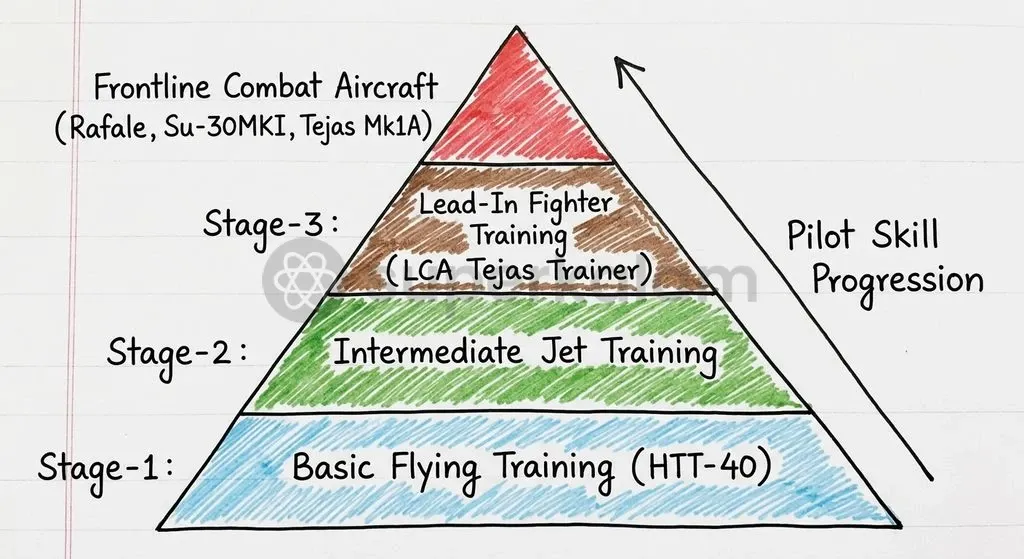
Strategic Significance for Defence Indigenisation and Aatmanirbhar Bharat
The Department of Defence Production has utilised structured policy mandates and domestic procurement quotas to build a self-sustaining aerospace manufacturing ecosystem. Both basic trainer aircraft and light combat aircraft variants were incorporated into early import-embargo lists under the Department of Military Affairs' First and Second Positive Indigenisation Lists in 2020 and 2021. These statutory restrictions prevented off-the-shelf foreign imports and accelerated capital sanction for domestic designs.
Policy measures supporting this ecosystem include:
- Capital Budget Earmarking: India has allocated 75% of defence capital procurement specifically for domestic industry, ensuring capital retention within local manufacturing supply chains.
- Component Indigenisation: The Ministry of Defence notified its 6th Positive Indigenisation List in August 2026, designating 405 Line Replaceable Units, sub-systems, and components with an estimated domestic business potential of ₹3,070 crore.
- MSME Supplier Integration: Through the SRIJAN defence indigenisation portal launched in August 2020, over 33,000 items have been offered for domestic development, resulting in more than 15,700 indigenised sub-assemblies produced by private vendors and MSMEs.
Discuss with Superkalam
Why do delivery delays in foreign propulsion cores like the GE F404 create a cascading bottleneck across domestic fighter assembly lines?
Ask NowPersistent Bottlenecks: Aero-Engine Dependence, Supply Chains, and Production Delays
India's indigenous aerospace programme faces strategic vulnerabilities due to continued reliance on foreign original equipment manufacturers for advanced propulsion systems. All three platforms handed over in Bengaluru rely on imported propulsion cores or foreign technology partnerships.
The propulsion dependencies comprise:
- Tejas Trainer: Powered by the GE Aerospace F404-IN20 turbofan, originating from the United States.
- HTT-40: Driven by the Honeywell TPE331-12B turboprop engine, imported from the United States.
- Dhruv NG: Powered by the Shakti turboshaft engine, co-developed through a joint partnership with Safran of France.
Aero-engine supply constraints, particularly delivery delays of GE F404 powerplants, have created production bottlenecks for the frontline Tejas Mk1A delivery schedule. These delays cascade across airframe assembly lines, illustrating how structural gaps in metallurgy, single-crystal blade manufacturing, and core engine design limit operational readiness.
Discuss with Superkalam
How can India structure future joint ventures like SAFHAL to ensure full intellectual property transfer in critical high-temperature metallurgy?
Ask Now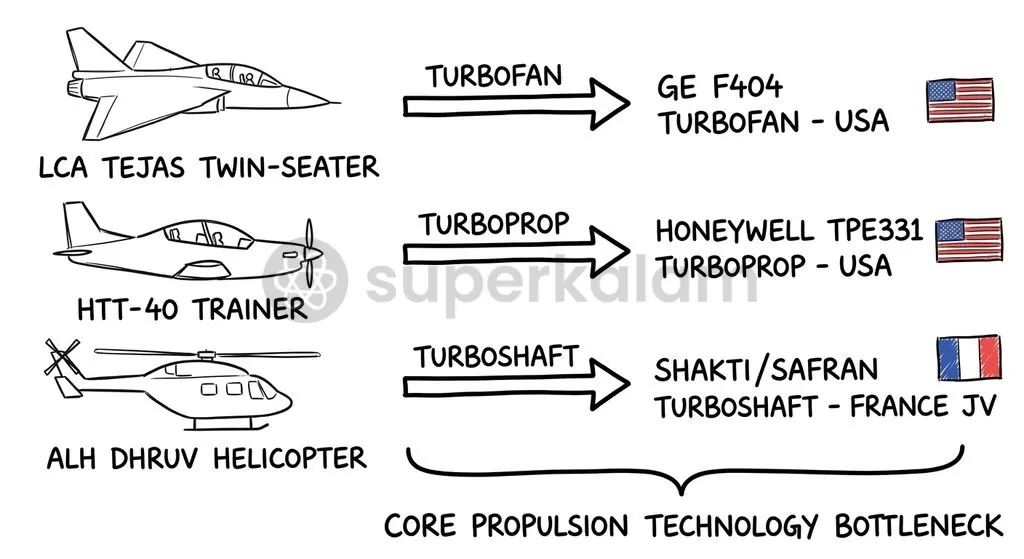
Way Forward: Accelerating Indigenous Design, Testing, and Private Sector Integration
Policy reforms under the Defence Acquisition Procedure must prioritise deep technology co-development and domestic testing infrastructure.
To overcome engine vulnerabilities in the rotary-wing domain, Hindustan Aeronautics Limited and Safran Helicopter Engines established the SAFHAL Helicopter Engines joint venture. This initiative aims to design, develop, and produce engines locally for the upcoming Indian Multi-Role Helicopter, creating a blueprint for high-thrust jet propulsion partnerships.
Strategic measures for long-term self-reliance include:
- Private Sector Tier-1 Integration: Expanding the role of private aerospace firms from component suppliers to major sub-assembly integrators to scale annual airframe production rates.
- R&D in High-Temperature Metallurgy: Channeling domestic research capital into core aero-engine technologies, including thermal barrier coatings and single-crystal turbine blades.
- Dedicated Flight-Testing Infrastructure: Scaling automated testing benches and climatic simulation facilities to shorten certification cycles for new airframe variants.
Key Takeaways
- The simultaneous delivery of two LCA Tejas FOC trainers, the HTT-40 'Ankur', and four Dhruv NG helicopters reinforces military flight training and civil logistics capacity.
- The HTT-40 platform anchors Stage-1 ab-initio pilot instruction, while the Tejas twin-seater fulfills lead-in fighter training and operational conversion requirements.
- Dhruv NG deliveries to Pawan Hans Limited support civil offshore energy logistics, disaster relief, and remote connectivity initiatives.
- All three platforms continue to rely on foreign propulsion cores, including GE F404, Honeywell TPE331, and Safran-derived Shakti engines.
- Government procurement reforms have earmarked 75% of the defence capital budget for domestic industry to strengthen local manufacturing depth.
Mains Question
"While progressive indigenisation of airframes and sub-systems reflects domestic manufacturing maturity, persistent dependence on foreign propulsion cores exposes structural vulnerabilities in India's aerospace sector." Critically analyse. (15 Marks)
Evaluate NowMains Question
Examine the role of statutory Positive Indigenisation Lists, capital procurement earmarking, and the SRIJAN portal in building a self-reliant defence aerospace ecosystem in India. (10 Marks)
Evaluate NowPractice MCQs
QUESTION 1
With reference to the Indian Air Force's pilot training architecture and aircraft inductions, consider the following statements:
- The indigenous HTT-40 'Ankur' is designated for Stage-1 basic and ab-initio flying training.
- The LCA Tejas FOC twin-seater trainer serves as a Lead-In Fighter Trainer for Stage-3 operational conversion.
- The HTT-40 basic trainer airframe features an initial indigenous content of 56%, projected to exceed 60%.
Which of the statements given above are correct?
QUESTION 2
Consider the following pairs regarding indigenous aerospace platforms and their respective propulsion systems:
- LCA Tejas FOC Trainer : GE Aerospace F404-IN20 turbofan
- HTT-40 Basic Trainer : Honeywell TPE331-12B turboprop
- ALH Dhruv NG : Shakti turboshaft engine
How many of the pairs given above are correctly matched?
QUESTION 3
Consider the following statements regarding policy initiatives promoting defence indigenisation in India:
- Basic trainer aircraft and light combat aircraft variants were included in early Positive Indigenisation Lists to prohibit off-the-shelf imports.
- The Ministry of Defence has earmarked 75% of defence capital procurement specifically for domestic industry.
- The SRIJAN defence indigenisation portal was launched to facilitate private vendor and MSME partnership for sub-assembly indigenisation.
Which of the statements given above is/are correct?
QUESTION 4
Regarding the Dhruv Next Generation (NG) helicopter delivered by Hindustan Aeronautics Limited, consider the following statements:
- It is a 5.5-tonne multi-role helicopter civil-certified by the Directorate General of Civil Aviation (DGCA).
- The initial batch of four units was handed over to Pawan Hans Limited under a 10-helicopter contract.
Which of the statements given above is/are correct?
QUESTION 5
The 'SAFHAL Helicopter Engines' joint venture between Hindustan Aeronautics Limited and Safran Helicopter Engines has been established primarily to: