Section 299 BNS vs Section 295A IPC: Key Differences Explained
Section 299 of the BNS replaces Section 295A of the IPC on outraging religious feelings, with changes to mens rea, electronic speech, and procedure under the BNSS.
Sep, 2026
•8 min read

Context
Section 299 of the Bharatiya Nyaya Sanhita, 2023 replaces Section 295A of the Indian Penal Code. It penalises deliberate and malicious acts intended to outrage religious feelings. Crucially, the provision modernises statutory reach by expressly covering offences committed through electronic means.
This transition preserves core sentencing thresholds and procedural safeguards. At the same time, it adapts criminal jurisprudence to digital communication channels. As administration shifts under the new codes, enforcing a strict evidentiary threshold for mens rea remains vital to protecting free expression while maintaining public peace.
Why Section 299 BNS Is in the News
The transition from the Indian Penal Code, 1860 to the Bharatiya Nyaya Sanhita, 2023 has brought religious offence laws under renewed scrutiny. As of May 2024, High Courts across the country—including the Allahabad High Court in Priyanka Bharti v. State of U.P.—have reaffirmed that criminal liability requires strict proof of malicious intent.
Legal practitioners and scholars are assessing how updated statutory phrasing affects online discourse and police discretion. Furthermore, the operationalisation of the Bharatiya Nagarik Suraksha Sanhita, 2023 introduces a revised procedural framework. This governs how complaints are registered, investigated, and sanctioned for speech-related prosecutions.
Understanding the Legal Transition: From IPC to BNS
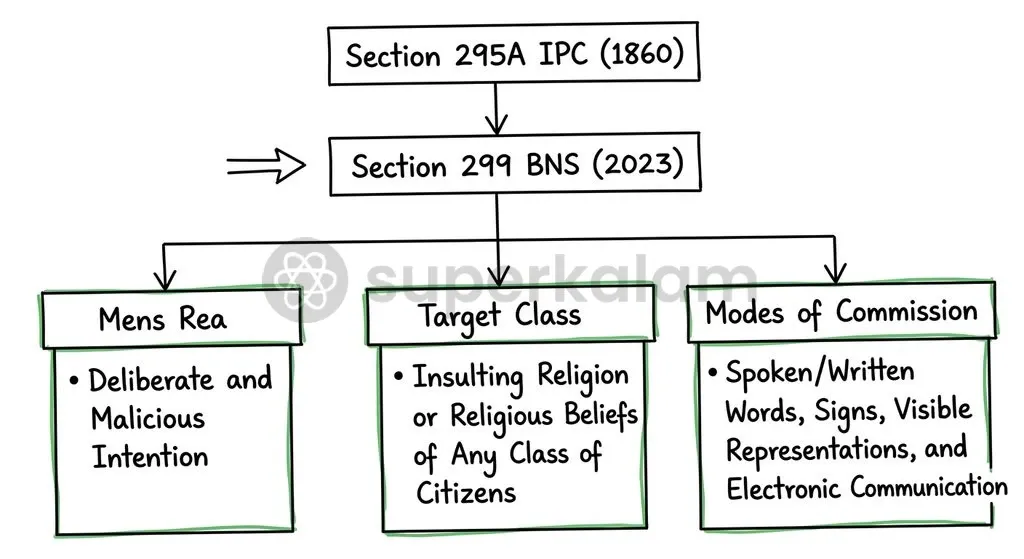
Parliament enacted the Bharatiya Nyaya Sanhita, 2023 to replace the colonial-era Indian Penal Code of 1860. The reform consolidated and renumbered offences against public tranquillity and religion. Under this legislative overhaul, the historic Section 295A of the IPC was repealed and reconstituted as Section 299 of the BNS.
This statutory transition preserves nearly a century of settled judicial doctrine. Rather than lowering the bar for criminal speech, the legislature retained the foundational test of deliberate and malicious intent. It updated the law primarily to address 21st-century digital communication.
Discuss with Superkalam
What specific phrase was added to Section 299 BNS that was not explicitly present in the text of Section 295A IPC?
Ask NowText and Key Ingredients of Section 299 BNS
Section 299 of the Bharatiya Nyaya Sanhita, 2023 defines and penalises acts calculated to insult religious beliefs. Under Section 299 of the BNS, whoever, with deliberate and malicious intention of outraging the religious feelings of any class of citizens of India, by words, either spoken or written, or by signs, or by visible representations, or through electronic means or otherwise, insults or attempts to insult the religion or the religious beliefs of that class, commits an offence.
To establish guilt under Section 299 BNS, the prosecution must satisfy three cumulative statutory ingredients:
- Target Class: The act must target a distinct class of citizens of India and insult or attempt to insult its religion or religious beliefs.
- Specified Medium: The insult must be conveyed through spoken or written words, signs, visible representations, electronic means, or analogous methods.
- Aggravated Mens Rea: The accused must act with deliberate and malicious intention specifically directed at outraging the religious feelings of that class.
The absence of an aggravated mental state precludes criminal liability. This requirement ensures that unintended slights, careless remarks, or academic critiques do not fall within the penal net.
Discuss with Superkalam
Explain why the requirement of 'deliberate and malicious intention' is critical to protecting academic discourse and satire under Section 299 BNS.
Ask NowComparing Section 299 BNS with IPC Section 295A
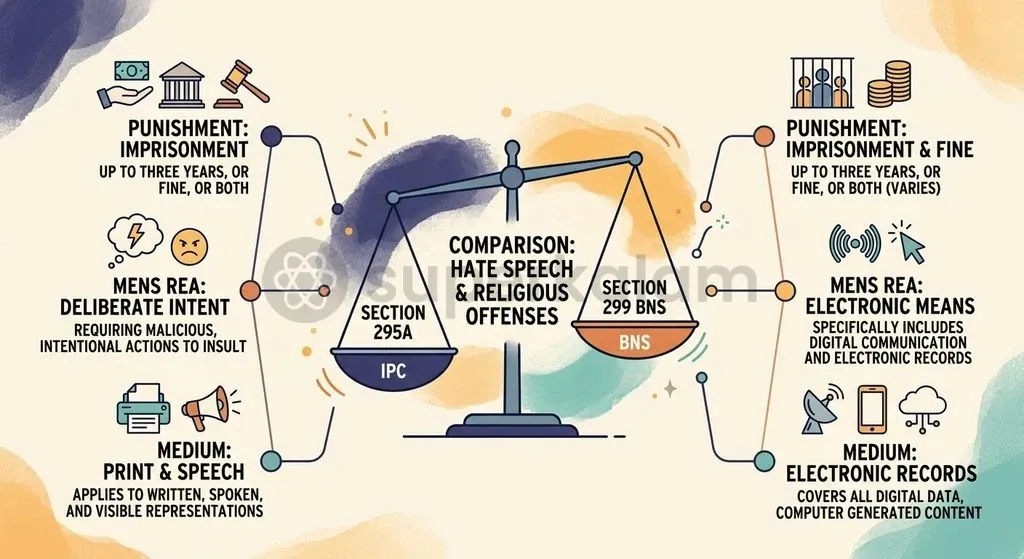
The Bharatiya Nyaya Sanhita retains the substantive structure of Section 295A IPC while introducing an explicit recognition of modern technological channels. Under the erstwhile Indian Penal Code, courts had to interpret electronic speech through general statutory clauses, whereas Section 299 BNS directly incorporates digital dissemination.
| Dimension | Section 295A IPC (Old Framework) | Section 299 BNS (New Framework) |
|---|---|---|
| Statutory Enactment | Indian Penal Code, 1860 | Bharatiya Nyaya Sanhita, 2023 |
| Prescribed Maximum Sentence | Imprisonment up to 3 years, or fine, or both | Imprisonment up to 3 years, or fine, or both |
| Recognised Media of Expression | Words (spoken/written), signs, visible representations | Words, signs, visible representations, or through electronic means |
| Required Mens Rea | Deliberate and malicious intention | Deliberate and malicious intention |
| Target of Offence | Any class of citizens of India | Any class of citizens of India |
Discuss with Superkalam
If a citizen posts an unwitting, careless comment on social media regarding a religious practice, how should law enforcement apply the rulings in Mahendra Singh Dhoni and Priyanka Bharti?
Ask NowProcedural Aspects: Cognizability, Bail, and Punishment
The procedural administration of Section 299 BNS is governed by the Bharatiya Nagarik Suraksha Sanhita, 2023. Under the First Schedule of the BNSS, an offence under Section 299 BNS is classified as a cognizable and non-bailable offence, triable by a Magistrate of the First Class.
| Procedural Parameter | Statutory Rule under BNSS, 2023 |
|---|---|
| Classification | Cognizable and Non-Bailable |
| Trial Court | Magistrate of the First Class |
| Compoundability | Non-compoundable (BNSS Section 359) |
| Mandatory Pre-condition | Prior Government Sanction (BNSS Chapter XIV) |
Three procedural conditions define how cases under Section 299 BNS progress through the criminal justice system:
- Non-Compoundable Nature: Under Section 359 of the BNSS, offences under Section 299 BNS are non-compoundable. Private parties cannot settle or withdraw charges out of court without judicial authority.
- Mandatory Government Sanction: Under Chapter XIV of the BNSS, no court can take cognizance of an offence under Section 299 BNS without the prior sanction of the Central Government or the State Government.
- Arrest Protections: To prevent automatic arrests, the Supreme Court in Arnesh Kumar v. State of Bihar and Lalita Kumari v. Govt. of U.P. held that offences punishable by up to seven years require strict justification and preliminary inquiry prior to custodial arrest.
Discuss with Superkalam
Compare how the 'proximate nexus' test of Ram Manohar Lohia interacts with the concept of the 'heckler's veto' described by the Law Commission.
Ask NowConstitutional Balance: Freedom of Speech vs Public Order
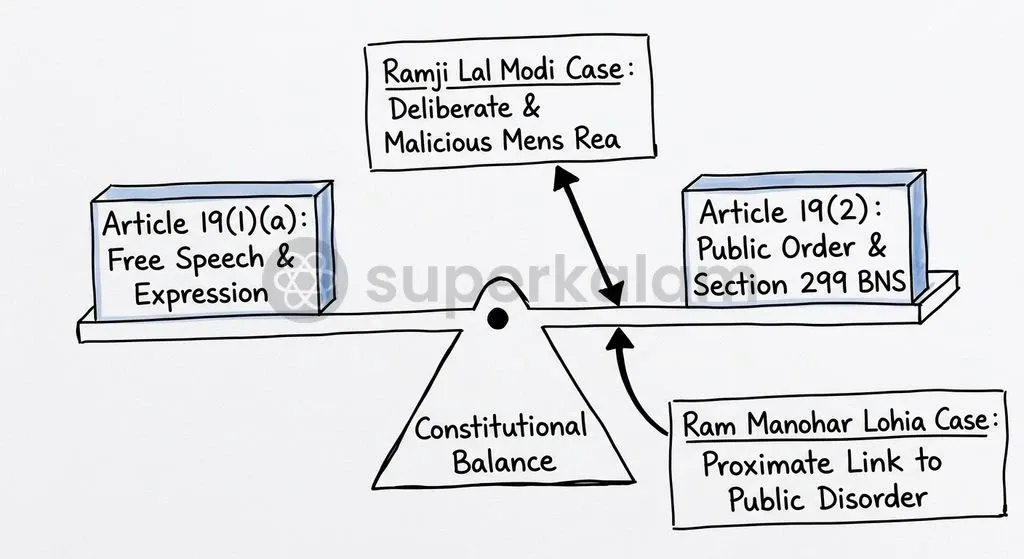
The constitutional validity of Section 299 BNS hinges on the interplay between individual liberty and state regulatory power.
Key constitutional touchpoints define this legal framework:
- Article 19(1)(a): Guarantees all citizens the fundamental right to freedom of speech and expression.
- Article 19(2): Permits the State to impose reasonable restrictions in the interests of public order or morality.
- Article 25: Protects freedom of conscience alongside the right to profess, practise, and propagate religion.
In Superintendent, Central Prison, Fatehgarh v. Ram Manohar Lohia, the Supreme Court established a strict test for state intervention. Any restriction on free speech must maintain a proximate and direct nexus to preserving public order, ruling out remote or speculative apprehensions.
Key Supreme Court Precedents on Outraging Religious Feelings
The Supreme Court of India has established authoritative jurisprudence interpreting the boundaries of religious insult laws. In the landmark Constitution Bench verdict in Ramji Lal Modi v. State of U.P. (1957), a five-judge bench upheld the constitutional validity of Section 295A IPC under Article 19(2).
The Court emphasised that the statute does not penalise every casual or thoughtless insult to religion. Instead, it penalises only aggravated forms of insult committed with deliberate and malicious intention to disrupt public peace.
Subsequent rulings have reinforced this high evidentiary standard:
- Absence of Malice: In Mahendra Singh Dhoni v. Yerraguntla Shyamsundar (2017), the Supreme Court quashed criminal proceedings where the alleged insult occurred without deliberate and malicious intent, reiterating that careless or unwitting acts do not satisfy statutory thresholds.
- Dissent versus Hate Speech: In Amish Devgan v. Union of India (2021), the Supreme Court distinguished between bona fide critique, satire, or historical inquiry and criminal hate speech aimed at inciting hostility.
- Strict Judicial Review: In Priyanka Bharti v. State of U.P., the Allahabad High Court reaffirmed that criminal complaints lacking evidence of specific intent to outrage religious feelings cannot be sustained under the penal law.
Ethical and Governance Implications for Law Enforcement
Enforcing speech-related criminal laws creates significant administrative dilemmas for police officers and magistrates. The primary ethical challenge is avoiding the heckler's veto, wherein intolerant factions weaponise the criminal law to silence legitimate artistic, journalistic, or academic expression by threatening public disorder.
When law enforcement agencies register First Information Reports (FIRs) mechanically without assessing intent, the process itself becomes a punishment, producing a chilling effect on democratic discourse. The Law Commission of India in its 267th Report on Hate Speech observed that criminal laws targeting speech require precise institutional criteria to ensure that executive discretion is not exercised arbitrarily against lawful debate.
Way Forward: Preventing Misuse While Protecting Communal Harmony
Balancing communal harmony with free expression under the Bharatiya Nyaya Sanhita requires institutional reforms and clear operational protocols. Because Section 299 BNS encompasses electronic communication, the potential for rapid multi-jurisdictional filings has increased, necessitating targeted regulatory guidance.
To maintain constitutional integrity in criminal administration, police departments and executive authorities should implement targeted measures:
- Mandatory Preliminary Inquiry: Law enforcement agencies must enforce the guidelines established in Lalita Kumari v. Govt. of U.P., conducting a preliminary factual assessment to establish the existence of deliberate malice before registering an FIR for speech-based offences.
- Stringent Sanction Screening: State and Central home departments must subject prosecution requests under Chapter XIV of the BNSS to rigorous legal scrutiny, ensuring that sanctions are not granted for academic criticism, humour, or bona fide religious debate.
- Training on Mens Rea Standards: Training academies for police officers and judicial magistrates should emphasise landmark rulings like Ramji Lal Modi and Mahendra Singh Dhoni, equipping field officers to differentiate between genuine hate speech and non-malicious commentary.
- Implementing Law Commission Recommendations: Adopting the statutory clarity recommended in the Law Commission's 267th Report will help insulate executive decision-making from partisan pressures and reduce speculative litigation.
Key Takeaways
- Section 299 of the Bharatiya Nyaya Sanhita, 2023 replaces Section 295A of the Indian Penal Code, criminalising deliberate and malicious acts intended to outrage religious feelings.
- The principal statutory enhancement in Section 299 BNS is the explicit inclusion of offences committed through electronic means, reflecting modern digital communication.
- The statutory penalty remains identical to the IPC framework, providing for imprisonment up to three years, a fine, or both.
- Under the Bharatiya Nagarik Suraksha Sanhita, 2023, Section 299 is classified as cognizable, non-bailable, non-compoundable, and requires prior government sanction before judicial cognizance.
- The Supreme Court in Ramji Lal Modi (1957) and Mahendra Singh Dhoni (2017) established that only aggravated insults backed by deliberate and malicious intent fall within the ambit of the law.
Mains Question
"Section 299 of the Bharatiya Nyaya Sanhita, 2023 retains the substantive core of Section 295A IPC while modernising its reach for the digital era." Elucidate the statutory ingredients of Section 299 BNS and examine the judicial safeguards established to prevent the curtailment of legitimate free speech. (10 Marks)
Evaluate NowMains Question
"The enforcement of criminal provisions against religious insults often confronts the administrative dilemma of the 'heckler's veto', threatening the constitutional balance under Articles 19 and 25." Critically analyse the ethical and governance challenges faced by law enforcement agencies under Section 299 BNS and the Bharatiya Nagarik Suraksha Sanhita, 2023. (15 Marks)
Evaluate NowPractice MCQs
QUESTION 1
With reference to Section 299 of the Bharatiya Nyaya Sanhita (BNS), 2023, consider the following statements:
- It penalises deliberate and malicious acts intended to outrage religious feelings of any class of citizens.
- Unlike the erstwhile Section 295A of the Indian Penal Code, it explicitly incorporates offences committed through electronic means.
- The prescribed maximum punishment has been increased from three years under the IPC to five years under the BNS.
Which of the statements given above are correct?
QUESTION 2
Regarding the procedural framework governing Section 299 of the Bharatiya Nyaya Sanhita under the Bharatiya Nagarik Suraksha Sanhita (BNSS), 2023, consider the following statements:
- An offence under Section 299 BNS is classified as cognizable and bailable.
- The offence is non-compoundable under Section 359 of the BNSS.
- Prior sanction of the Central Government or State Government is mandatory before a court can take cognizance of the offence.
Which of the statements given above is/are correct?
QUESTION 3
Consider the following statements regarding judicial interpretations of laws penalising the outraging of religious feelings in India:
- In Ramji Lal Modi v. State of U.P. (1957), the Supreme Court held that only aggravated forms of insult committed with deliberate and malicious intention are penalised under the law.
- In Superintendent, Central Prison, Fatehgarh v. Ram Manohar Lohia, the Supreme Court ruled that any restriction on free speech under Article 19(2) must maintain a proximate and direct nexus to public order.
- In Mahendra Singh Dhoni v. Yerraguntla Shyamsundar (2017), the Supreme Court ruled that careless or unwitting remarks without malicious intent satisfy the statutory threshold for prosecution.
Which of the statements given above is/are correct?
QUESTION 4
Under the Bharatiya Nagarik Suraksha Sanhita (BNSS), 2023, which court is designated to try an offence under Section 299 of the Bharatiya Nyaya Sanhita (BNS)?
QUESTION 5
With reference to freedom of speech and speech-related offences in India, consider the following statements:
- Article 19(2) of the Constitution permits reasonable restrictions on freedom of speech and expression in the interests of public order.
- The Law Commission of India's 267th Report highlighted the risk of the 'heckler's veto' silencing lawful debate when speech laws lack precise criteria.
- The Supreme Court in Amish Devgan v. Union of India maintained that bona fide critique, satire, and historical inquiry are legally equivalent to criminal hate speech.
Which of the statements given above is/are correct?