Why the Cauvery Water Sharing Formula Fails During Droughts - UPSC Mains Notes
Discover why static volumetric quotas and pro-rata distress sharing collapse during simultaneous reservoir deficits in the Cauvery basin.
Aug, 2026
•10 min read
Overview
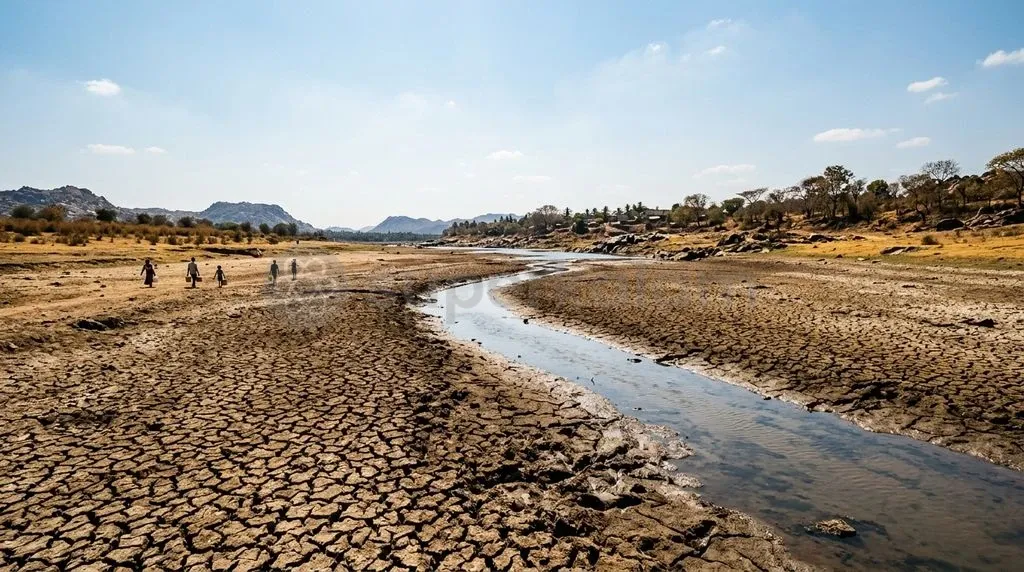
Fig: Monsoon deficits regularly strain the Cauvery water-sharing framework between riparian states.
The Cauvery water dispute re-emerges during low-rainfall years. This occurs because the Supreme Court of India established fixed volumetric water allocations based on a normal yield of 726 TMC. However, the court did not codify an operational, daily distress-sharing rule for simultaneous reservoir deficits across Karnataka and Tamil Nadu.
This structural deficiency leaves the statutory Cauvery Water Management Authority relying on voluntary compliance and pro-rata reductions during droughts. Meanwhile, expanding cultivation of water-intensive crops like paddy and sugarcane in the upper and lower basin aggravates storage deficits. Effective inter-state water governance requires shifting from static quotas toward real-time telemetry, cropping reform, and active river basin management.
Why in the News?
Monsoon deficiencies continue to trigger reduced inflows into major basin reservoirs. Consequently, the statutory Cauvery Water Management Authority must navigate ongoing dispute resolutions between Karnataka and Tamil Nadu. As of March 2026, rainfall deficits across upper catchment areas have re-exposed the operational limitations of existing water-sharing mandates during drought seasons.
Under Article 262 of the Constitution, Parliament holds the power to enact legislation for adjudicating inter-state river water disputes, excluding Supreme Court jurisdiction over such adjudications. The statutory framework operating under this constitutional provision faces recurring strain during deficit rainfall years.
Mechanics of the Cauvery Water Sharing Formula
The Supreme Court of India defined the legal mechanics of Cauvery water allocation in its final judgment delivered on 16 February 2018. In Civil Appeal No. 2453 of 2007, the court determined the total dependable yield of the Cauvery basin at 726 TMC. Out of this yield, the Supreme Court allocated 404.25 TMC to Tamil Nadu, 284.75 TMC to Karnataka, 30 TMC to Kerala, and 7 TMC to Puducherry.
Under this judgment, Karnataka must ensure an annual release of 177.25 TMC to Tamil Nadu at the Biligundlu border point during a normal water year. The Supreme Court reduced Tamil Nadu's allocation by 14.75 TMC compared to the 2007 Cauvery Water Disputes Tribunal award. The court reallocated 4.75 TMC to Karnataka for Bengaluru's drinking water needs and accounted for 10 TMC of groundwater availability in Tamil Nadu's delta area.
To enforce these allocations, the Central Government notified the Cauvery Water Management Scheme, 2018 on 1 June 2018 under Section 6A of the Inter-State River Water Disputes Act, 1956. The scheme constituted the statutory Cauvery Water Management Authority and the Cauvery Water Regulation Committee under the Ministry of Jal Shakti.
| Operational Parameter | Supreme Court Award (2018 Metrics) | Functional Significance |
Total Dependable Basin Yield | 726 TMC | Baseline annual water volume assessed for the entire Cauvery basin |
Tamil Nadu Allocation | 404.25 TMC | Primary downstream share for irrigation and domestic use |
Karnataka Allocation | 284.75 TMC | Upstream share including drinking water for Bengaluru |
Biligundlu Release Target | 177.25 TMC | Mandatory annual delivery from Karnataka to Tamil Nadu in a normal year |
Where the Existing Formula Fails During Monsoon Deficits
Standard water allocation formulas collapse during monsoon deficits due to hydrologic variations, fixed operational limits, and institutional constraints.
- Seasonal Hydrology Mismatch: Upper catchments in Karnataka rely on the Southwest Monsoon from June to September, whereas lower delta areas in Tamil Nadu receive water from both the Southwest and Northeast Monsoons.
- Absence of Distress Rules: Neither the 2007 tribunal award nor the 2018 Supreme Court judgment codified a detailed operational formula for day-to-day distress sharing, leaving states to follow general pro-rata principles.
- Simultaneous Storage Deficits: Deficits occurring at once across Karnataka's four reservoirs—Krishna Raja Sagara, Kabini, Hemavathi, and Harangi—and Tamil Nadu's downstream Mettur Dam remove the buffer required to absorb supply shocks.
- Non-Linear Conveyance Losses: When overall basin inflow drops by 50%, a simple pro-rata rule mandates cutting downstream releases by 50%. However, dry riverbeds cause severe conveyance losses between upper reservoirs and Biligundlu, forcing Karnataka to release a higher share of its remaining live storage. Consequently, pro-rata rationing fails during simultaneous deficits.
- Lack of Enforcement Power: The statutory Cauvery Water Management Authority lacks an independent enforcement force to mandate physical releases, relying on voluntary compliance or Supreme Court orders.
The Mekedatu Dam Controversy and Competing State Demands
The proposed Mekedatu balancing reservoir project in Karnataka represents a central flashpoint in contemporary Cauvery river basin politics.
| Aspect | Karnataka's Project Plan | Tamil Nadu's Objections |
Infrastructure & Cost | Construct a 67.16 TMC balancing reservoir and 400 MW hydroelectric facility at Mekedatu in Ramanagara district, costing ₹9,000 crore | Asserts additional upstream storage grants Karnataka operational control over river regulation during distress years |
Primary Objective | Store excess monsoon flows and supply drinking water to Bengaluru | Expresses concern that upstream storage will diminish flow arrivals at Biligundlu during lean periods |
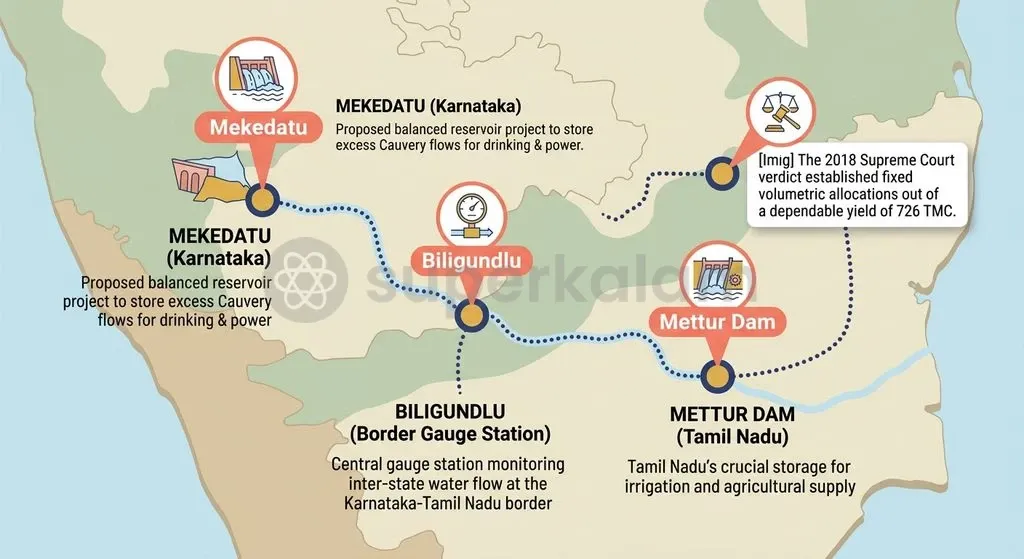
Fig: The proposed Mekedatu project remains a core conflict point regarding upstream flow control during dry years.
Current Regulatory Status: Addressing this impasse, the Ministry of Jal Shakti returned the Detailed Project Report to Karnataka, requesting a revised DPR compliant with CWC guidelines and tribunal mandates.
Discuss with Superkalam
Do balancing reservoirs like Mekedatu improve urban water security or increase downstream vulnerability?
Ask NowHow Climate Change and Shifting Cropping Patterns Worsen the Crisis
Agricultural water demand in the Cauvery basin consistently exceeds natural yield due to the extensive cultivation of water-intensive crops.
- Upper Basin Demand (Karnataka): In Mandya and Mysuru districts, sugarcane and paddy dominate command areas. Paddy alone consumes over 20% of Karnataka's Cauvery water share.
- Water Intensity Metrics: Agronomic estimates show that producing 1 kg of paddy requires 3,000 to 5,000 litres of water, while 1 kg of sugar requires 1,500 to 2,500 litres.
- Lower Basin Demand (Tamil Nadu): In the Cauvery Delta Zone, over 1.2 million hectares rely on canal releases from Mettur Dam.
- Groundwater Strain: Surface water shortages during deficit monsoons force delta farmers to operate over 1.8 lakh agricultural borewells, accelerating rapid groundwater depletion across lower basin aquifers.
Discuss with Superkalam
Which constitutional provision governs inter-state river water disputes in India?
Ask NowThe Way Forward: Rethinking Interstate Water Management
Resolving the Cauvery dispute permanently requires shifting from ad-hoc crisis response to institutional river basin governance. Managing inter-state basins requires technological precision, cropping alignment, and statutory enforcement.
- Automated Telemetry Networks: Water management authorities advocate installing automated real-time telemetry gauge networks across all major reservoirs and tributary junction points. Real-time data sharing eliminates inter-state disputes regarding actual inflows and storage figures.
- Integrated River Basin Frameworks: Section 3 of the River Boards Act, 1956 provides a statutory mechanism to establish Inter-State River Boards for integrated river basin management. Although no river board has been constituted under this Act to date, activating this framework can enable basin-wide planning.
- Cropping Pattern Realignment: Shift agricultural incentives from water-intensive paddy and sugarcane toward climate-resilient millets and pulses in both upper and lower command areas.
- Strengthening Executive Authority: Enhance the functional powers of the Cauvery Water Management Authority under the Ministry of Jal Shakti to enforce operational release rules during monsoon deficits.
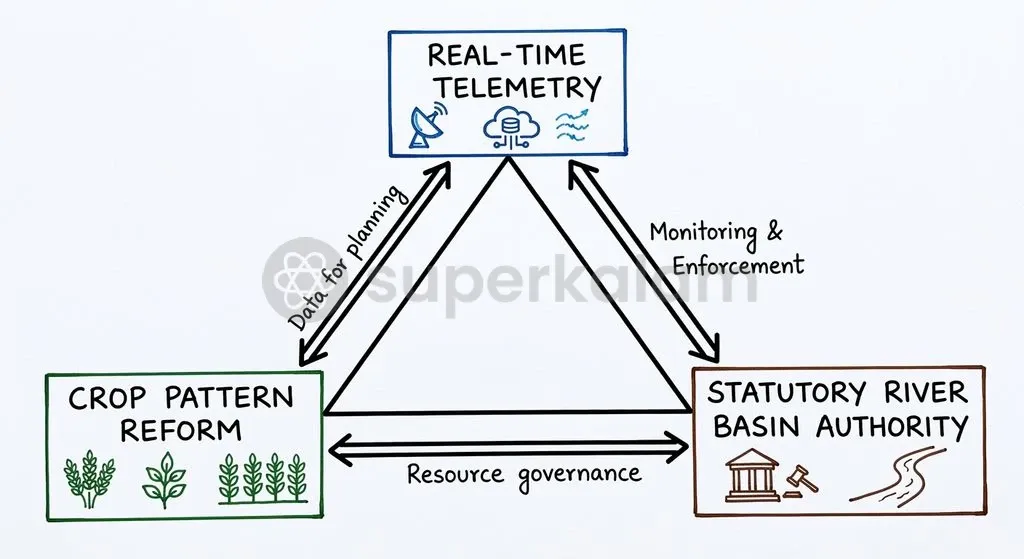
Fig: Integrated river basin management requires combining automated telemetry with crop diversification and statutory enforcement.
Key Takeaways
Key findings highlight structural defects in the Cauvery water sharing framework during drought years.
- The Supreme Court allocated 404.25 TMC to Tamil Nadu and 284.75 TMC to Karnataka out of a total yield of 726 TMC in its 2018 final judgment.
- Karnataka must ensure an annual release of 177.25 TMC to Tamil Nadu at Biligundlu during normal water years.
- Proportional distress sharing collapses during droughts due to simultaneous reservoir deficits and unmodeled conveyance losses along dry riverbeds.
- The Cauvery Water Management Authority lacks an independent enforcement arm, depending on voluntary state compliance or judicial interventions.
- The River Boards Act, 1956 provides an unutilised statutory framework to establish inter-state boards for integrated basin management.
Mains Question
"Unregulated cropping choices and high agronomic water demand exacerbate surface and groundwater deficits during drought years in river basins." Discuss this proposition with reference to the Cauvery river basin and suggest measures for sustainable inter-state water management.
Evaluate NowMultiple Choice Questions
QUESTION 1
Q1. Consider the following statements regarding the Cauvery water allocation established by the Supreme Court of India in its 2018 final judgment:
- The total dependable annual yield of the Cauvery basin was assessed at 726 TMC.
- Tamil Nadu was allocated 404.25 TMC, while Karnataka was allocated 284.75 TMC.
- Karnataka is required to ensure an annual delivery of 177.25 TMC to Tamil Nadu at the Biligundlu border point during a normal water year.
Which of the statements given above are correct?
QUESTION 2
Q2. The proposed Mekedatu balancing reservoir project in Karnataka comprises which of the following infrastructure specifications?
QUESTION 3
Q3. With reference to inter-state water governance and the legal framework operating in the Cauvery basin, consider the following statements:
- Article 262 of the Constitution empowers Parliament to enact legislation for adjudicating inter-state river water disputes, excluding Supreme Court jurisdiction over such adjudications.
- The Cauvery Water Management Authority was constituted under Section 6A of the Inter-State River Water Disputes Act, 1956.
- Multiple active Inter-State River Boards have been constituted under Section 3 of the River Boards Act, 1956 to govern the Cauvery river basin.
Which of the statements given above is/are correct?