What Are JOSH Teams? Joint Squad for Health and TB Outreach
Read how JOSH teams bring MY Bharat and NCC volunteers together for tuberculosis awareness, community outreach and India's TB-elimination efforts.
Oct, 2026
•10 min read
Overview
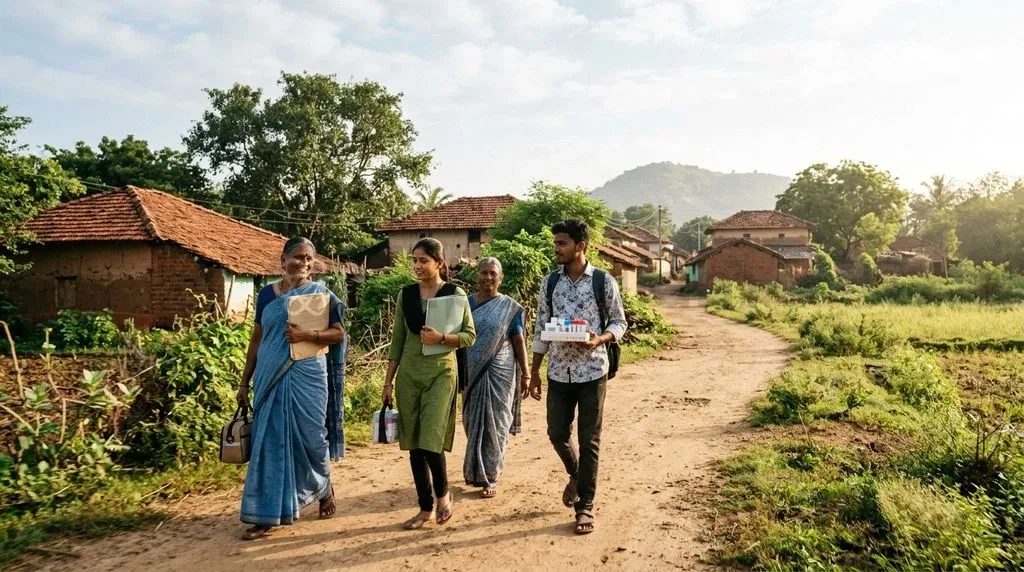
The deployment of Joint Squad for Health (JOSH) Teams marks a major grassroots shift toward youth-led Active Case Finding under the National Tuberculosis Elimination Programme. Door-to-door outreach alone cannot bridge the elimination gap without resolving deep deficits in rapid molecular diagnostics, undernutrition, and private-sector under-reporting. Launched by the Ministry of Health and Family Welfare across 55 initial districts, these tripartite squads unite administrative leadership with community volunteers to trace presumptive patients directly at their doorsteps.
Frontline detection is only the initial link in a demanding clinical cascade. It requires reliable bacteriological confirmation, immediate treatment initiation, and sustained nutritional support to halt community transmission.
Why in the News: The Push for Ground-Level Detection Under NTEP
Union Minister for Health and Family Welfare J.P. Nadda launched the JOSH (Joint Squad for Health) Teams initiative on 8 October 2026 at Bharat Mandapam, New Delhi, to accelerate youth-led community mobilisation for tuberculosis elimination. As of October 2026, the intervention targets stubborn transmission reservoirs that standard clinical consultations fail to capture. The initiative operates under the aegis of the Pradhan Mantri TB Mukt Bharat Abhiyaan (PMTBMBA), reinforcing the operational machinery of the National Tuberculosis Elimination Programme (NTEP).
The rollout also announced digital tools for field reporting. The announcement does not establish that E-Sangini is integrated directly inside the TB Mukt App or that JOSH reports automatically feed into Ni-kshay.
India's 2025 TB Elimination Target: The Scale of the Unmet Burden
India's National Strategic Plan (NSP) for Tuberculosis Elimination 2017–2025 set an ambitious target to reduce annual tuberculosis incidence to 44 per 100,000 population and mortality to 3 per 100,000 population by 2025. This domestic goal advanced the United Nations Sustainable Development Goal (SDG 3.3) deadline of 2030 by a full five years, establishing a demanding operational timeline for public health machinery.
| Indicator | Target Level | Actual Trajectory |
|---|---|---|
| 2015 Baseline Incidence | Baseline benchmark | 237 per 100,000 |
| 2024 Achieved Incidence | Interim progress | 187 per 100,000 (21% reduction) |
| 2025 NSP Goal | Target milestone | 44 per 100,000 |
Epidemiological outcomes highlight an enduring implementation gap. India achieved a 21% reduction in incidence, declining from 237 per 100,000 population in 2015 to 187 per 100,000 in 2024, yet fell substantially short of the 44 per 100,000 benchmark. India still bears 27% of the global burden of tuberculosis and roughly one-fourth of all multidrug-resistant or rifampicin-resistant (MDR/RR-TB) infections.
Programmatic interventions delivered demonstrable treatment gains despite missed incidence targets. The Ministry of Health and Family Welfare confirmed that India achieved a 92% treatment coverage rate in 2024, far outpacing the global average of 78%. Furthermore, institutional decentralisation through the TB Mukt Panchayat initiative led to 67,933 Gram Panchayats across 697 districts being verified and certified as free from tuberculosis transmission.
Discuss with Superkalam
Recall the three central ministries collaborating to form and operate the JOSH Teams.
Ask NowWhat Are JOSH Teams? Structure, Mandate, and Community Mechanics
The JOSH Teams represent a tripartite collaborative model established between the Union Ministry of Health and Family Welfare, the Ministry of Youth Affairs and Sports, and the Ministry of Defence. In its initial rollout, public health authorities deployed these units across 55 districts located in 11 States and Union Territories before undertaking nationwide expansion.
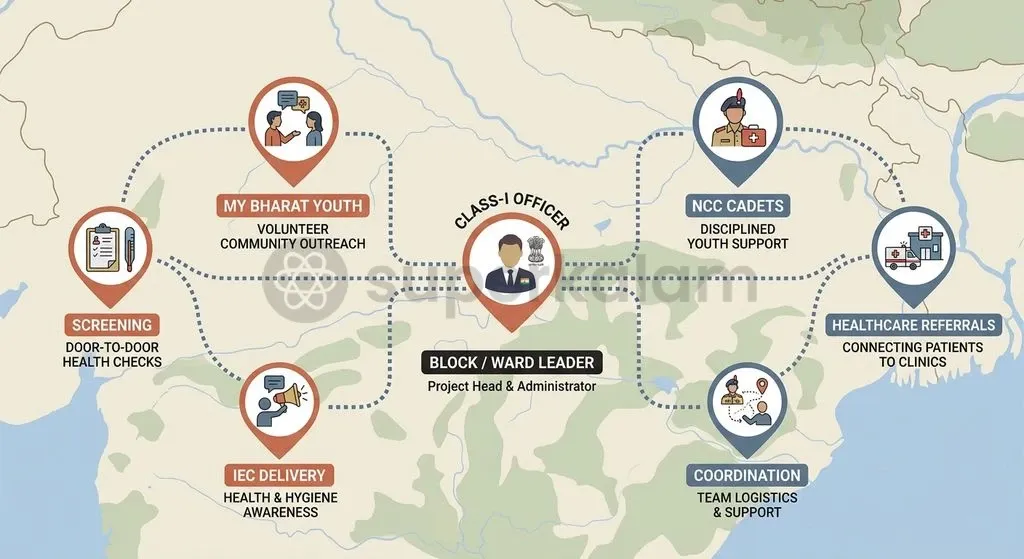
Each squad operates under strict administrative oversight to maintain accountability:
- A designated Class-I officer leads each unit at the block or municipal ward level.
- Five MY Bharat volunteers contribute youth-led grassroots mobilisation capacity.
- Five National Cadet Corps cadets provide disciplined field coverage and community liaison support.
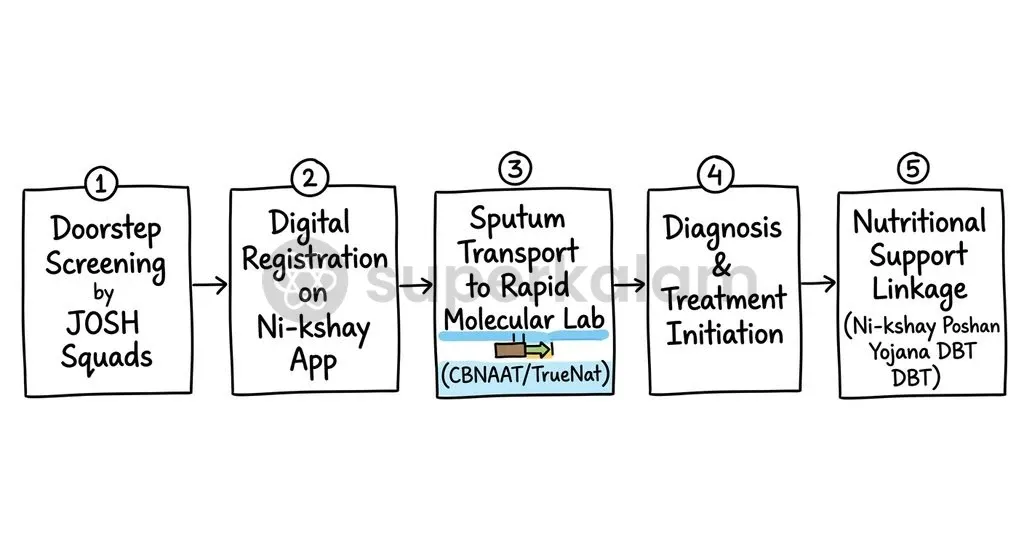
The operational mandate of JOSH Teams spans systematic house-to-house screening, spreading Information, Education, and Communication (IEC) materials, and dispelling deep-rooted community stigma. Squad members map symptoms, identify individuals displaying persistent coughs or low-grade fever, and facilitate primary transit to public diagnostic centres.
From Doorstep to Diagnosis: How Active Case Finding Links to Ni-kshay
Active Case Finding (ACF) marks an institutional departure from conventional hospital surveillance by proactively searching for undiagnosed tuberculosis in vulnerable, congregate settings such as slums, migrant settlements, and tribal hamlets. Rather than waiting for symptomatic patients to reach primary health centres, field squads evaluate individuals directly within their living environments.
Data captured during doorstep interactions flows directly into the Ni-kshay digital portal, the central web-based architecture of the NTEP. The platform provides comprehensive tracking infrastructure:
- Generating a unique longitudinal profile for every presumptive individual identified during outreach.
- Tracking sample movement and laboratory results following referral to diagnostic units.
- Facilitating Direct Benefit Transfers (DBT) under government welfare schemes once clinical diagnosis occurs.
- Monitoring patient adherence through treatment completion via frontline health workers.
Financial and social protection mechanisms tie directly into this digital network. In October 2024, the Central Government enhanced monthly support under the Ni-kshay Poshan Yojana from ₹500 to ₹1,000 per month per patient for the entire treatment duration, committing an additional outlay of ₹1,040 crore. Complementing this fiscal support, the community-driven Ni-kshay Mitra initiative under PMTBMBA expanded to supply monthly nutritional food baskets to household contacts as well as the patients themselves.
Comparing Approaches: Passive Hospital Screening vs. JOSH Outreach
Passive clinical screening depends exclusively on self-motivated health-seeking behaviour, whereas Active Case Finding deployed through JOSH Teams actively dismantles geographic and behavioural access barriers.
| Dimension | Passive Hospital Screening | JOSH Active Outreach |
|---|---|---|
| Detection Trigger | Symptomatic patient visits a primary health centre or hospital | Frontline squad conducts proactive, house-to-house screening |
| Operational Reach | Restricted to patients with physical and financial healthcare access | Penetrates rural settlements, urban slums, and tribal hamlets |
| Stigma Mitigation | Low; care-seeking delayed by fear of community discrimination | Direct engagement and counselling at the doorstep |
| Digital Integration | Case logged into Ni-kshay only after clinical presentation | Real-time logging of presumptive cases via dedicated mobile app |
| Personnel Deployed | Static medical officers and institutional nursing staff | Tripartite squads led by Class-I officers with NCC and MY Bharat youth |
Discuss with Superkalam
Explain why Active Case Finding (ACF) is critical in congregate settings compared to traditional hospital-based passive screening.
Ask NowStructural Headwinds: Why Door-to-Door Visits Cannot Fix Every Bottleneck
Frontline screening squads cannot independently eliminate disease transmission if secondary clinical infrastructure and social determinants remain unresolved. Active identification exposes underlying systemic bottlenecks across the testing network, clinical engagement pipelines, and community nutrition baselines.
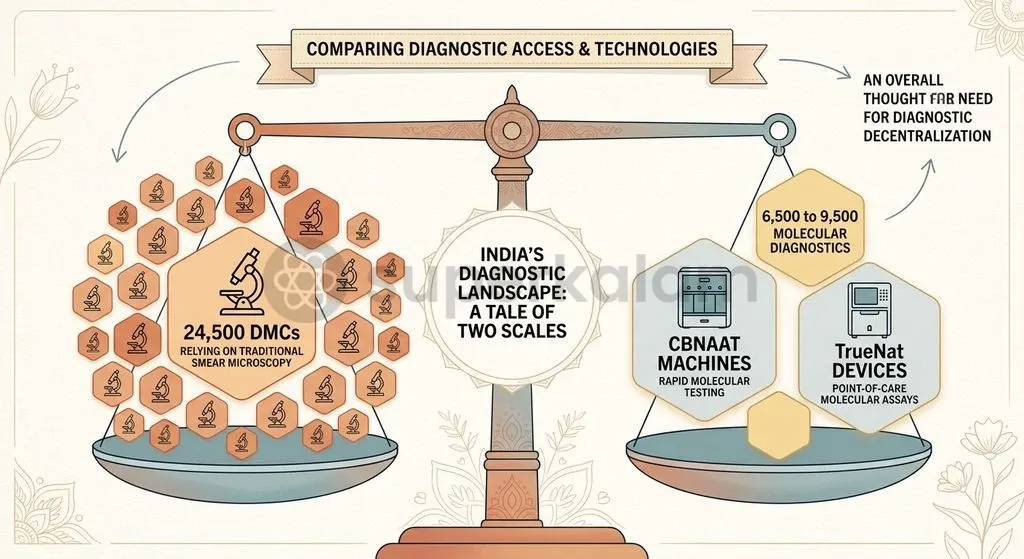
First, diagnostic infrastructure remains severely skewed toward obsolete technology. National programmatic guidelines explicitly mandate upfront rapid molecular testing using Nucleic Acid Amplification Tests (such as CBNAAT and TrueNat) for all presumptive cases to secure bacteriological confirmation and identify rifampicin resistance immediately. However, between 74% and 79% of testing across India continues to depend on conventional sputum smear microscopy. The public health system operates over 24,500 Designated Microscopy Centres but maintains only 6,500 to 9,500 molecular machines, forcing peripheral health workers to fall back on less sensitive tests.
| Facility Type | Available Count | Operational Reality |
|---|---|---|
| Designated Microscopy Centres | 24,500+ centres | Handle 74% to 79% of all tests using century-old microscopy |
| Molecular Testing Machines | 6,500 to 9,500 machines | TrueNat and CBNAAT capacity remains limited at peripheral centres |
Second, private healthcare providers remain an under-monitored corridor. Private clinics and hospitals accounted for 33% of notifications in 2023, representing 8.4 lakh out of 25.5 lakh registered cases. Despite mandatory reporting rules, informal rural practitioners and unorganised private clinics regularly treat patients without logging cases into the Ni-kshay platform, increasing diagnostic delays and the risk of untreated drug-resistant strains.
Third, structural vulnerability driven by poverty undercuts medical outreach. Nutritional deprivation is the single largest risk factor for tuberculosis in India, driving over 35% of annual incident cases. The landmark ICMR-NIRT RATIONS trial demonstrated that providing nutritional food baskets to household contacts in Jharkhand reduced disease incidence by 39% to 48%. Finding presumptive cases door-to-door produces incomplete outcomes if patients return to food-insecure households lacking basic macro- and micro-nutrients.
Discuss with Superkalam
Analyse the ethical and social risks of door-to-door tuberculosis screening regarding patient privacy and community stigma.
Ask NowThe Ethics of Public Health Surveillance: Stigma, Privacy, and Consent
Aggressive door-to-door medical surveillance introduces acute ethical trade-offs regarding individual dignity and constitutional protections. Field teams visiting homes in tight-knit rural villages risk inadvertently exposing presumptive patients to intense social discrimination.
Visible visits by uniformed NCC cadets and designated officers can turn a screening encounter into an inadvertent public disclosure. In close-knit communities, the presence of an active health squad outside a private home sparks immediate local speculation.
Public health teams must navigate three distinct ethical and constitutional safeguards:
- Mitigating Social Ostracisation: Screening visits must avoid triggering community gossip, tenancy evictions, or workplace discrimination against vulnerable families.
- Constitutional Right to Privacy: In Justice K.S. Puttaswamy (Retd.) v. Union of India (2017), the Supreme Court affirmed that informational privacy and confidentiality form an inseparable component of the right to privacy under Article 21].
- Voluntary Informed Consent: Field applications must ensure end-to-end data security, and screening protocols must secure explicit voluntary consent rather than relying on administrative coercion.
Discuss with Superkalam
Evaluate whether expanding volunteer-led youth squads is sufficient to achieve tuberculosis elimination in the absence of rapid molecular diagnostics.
Ask NowWay Forward: Merging Outreach with Nutrition, Diagnostics, and Private Sector Care
Transforming the JOSH initiative into a sustainable public health success requires linking community screening directly to advanced clinical infrastructure and social security systems. Active identification represents merely the first step. Completing the elimination loop demands concrete institutional actions across three functional priorities:
- Decentralising Rapid Diagnostics: State health departments must transition from sputum smear microscopy to universal molecular testing by installing TrueNat platforms at the primary health centre and block levels. Presumptive samples identified by JOSH Teams must bypass microscopy centres entirely and proceed directly to Nucleic Acid Amplification Tests to enable early resistance profiling.
- Treating Undernutrition as Clinical Therapy: Building upon the RATIONS trial findings, state administrations should pair JOSH case detection with immediate distribution of food rations under the expanded Ni-kshay Mitra framework. Ensuring that the enhanced ₹1,000 monthly allowance under the Ni-kshay Poshan Yojana reaches bank accounts without administrative friction directly protects vulnerable contacts from clinical disease progression.
- Tightening Private Sector Accountability: District health authorities must enforce real-time case notification on the Ni-kshay portal among private practitioners and pharmacies. Pairing active outreach with diagnostic equity and targeted nutritional intervention ensures that JOSH Teams help convert temporary screening gains into permanent disease elimination.
Key Takeaways
- Union Health Minister J.P. Nadda launched the JOSH Teams initiative on 8 October 2026, establishing a tripartite collaboration between the Health, Sports, and Defence ministries across 55 initial districts.
- Each JOSH squad operates under the leadership of a Class-I officer, deploying five MY Bharat volunteers and five NCC cadets for active community screening.
- India achieved a 21% reduction in incidence between 2015 and 2024, falling short of the National Strategic Plan 2025 target of 44 cases per 100,000.
- Sputum smear microscopy continues to account for 74% to 79% of testing, highlighting a significant bottleneck in rural rapid molecular diagnostics.
- Undernutrition drives over 35% of annual incidence, underscoring the clinical value of the enhanced ₹1,000 monthly Ni-kshay Poshan Yojana transfer.
- Public health door-to-door visits must safeguard patient confidentiality under Article 21, as affirmed in the Puttaswamy (2017) ruling].
Mains Question
"Frontline detection is only the initial link in a demanding clinical cascade." In light of the deployment of JOSH Teams under the National Tuberculosis Elimination Programme, evaluate the role of youth-led Active Case Finding in closing the last-mile gap in tuberculosis control. (10 Marks)
Evaluate NowMains Question
India's National Strategic Plan set an ambitious target of reducing tuberculosis incidence to 44 per 100,000 by 2025, yet actual trajectories reveal persistent epidemiological gaps. Critically examine the systemic challenges in achieving TB elimination, with particular reference to the integration of digital platforms and community outreach mechanisms. (15 Marks)
Evaluate NowPractice MCQs
QUESTION 1
With reference to the Joint Squad for Health (JOSH) Teams launched under the National Tuberculosis Elimination Programme (NTEP), consider the following statements:
- The initiative represents a tripartite collaboration involving the Ministry of Health and Family Welfare, the Ministry of Youth Affairs and Sports, and the Ministry of Defence.
- Each team is led at the block or municipal ward level by a designated Class-I officer and includes volunteers from MY Bharat and National Cadet Corps cadets.
- The squad focuses exclusively on clinical treatment administration rather than active house-to-house screening. Which of the statements given above is/are correct?
QUESTION 2
Consider the following statements regarding India's tuberculosis targets and performance under the National Strategic Plan (NSP):
- The National Strategic Plan 2017–2025 aimed to reduce annual TB incidence to 44 per 100,000 population by 2025, five years ahead of SDG 3.3.
- Between 2015 and 2024, India achieved a 21% reduction in incidence, bringing it down to 187 per 100,000 population.
- In 2024, India's reported treatment coverage rate was below the global average. Which of the statements given above are correct?
QUESTION 3
Which of the following digital tools or modules launched alongside the JOSH Teams is specifically integrated within the TB Mukt App to support ground-level operational reporting?
QUESTION 4
Consider the following statements regarding nutritional and social support initiatives under the Pradhan Mantri TB Mukt Bharat Abhiyaan (PMTBMBA):
- In October 2024, monthly financial support under the Ni-kshay Poshan Yojana was enhanced to ₹1,000 per month per patient for the entire treatment duration.
- The Ni-kshay Mitra initiative provides monthly food baskets exclusively to hospitalized patients.
- The Ni-kshay digital portal facilitates Direct Benefit Transfers (DBT) and monitors patient treatment adherence. Which of the statements given above is/are correct?
QUESTION 5
In the context of the National Tuberculosis Elimination Programme, how does Active Case Finding (ACF) differ from Passive Hospital Screening?