Edible Oil Prices in India: Import Dependence and Biofuels
Read why India's edible oil prices depend on imports, global palm and soybean oil supplies, biofuel policies, tariffs and domestic oilseed production.
Oct, 2026
•11 min read
Overview
India faces persistent edible oil inflation. More than half of its cooking oil comes from external suppliers. That heavy exposure leaves household kitchen budgets at the mercy of foreign trade policies, overseas biofuel mandates, and shipping bottlenecks.
Domestic crushing fulfils only 40% to 44% of national demand, according to a joint assessment by the Press Information Bureau and NITI Aayog. This structural deficit forces the country to import between 56% and 60% of its edible oil requirements every year.
Tariff adjustments remain the central government's standard shock absorber. Officials frequently adjust customs levies to protect urban consumers while attempting to incentivise domestic growers. Yet true self-reliance demands addressing structural hurdles in cropping patterns, seed yields, and procurement systems rather than relying on reactive trade policies.
Why in the News: The Recent Spike in Domestic Cooking Oil Prices
FAO's Vegetable Oil Price Index averaged 198.6 points in September 2026, up 0.9% from August and 18.3% from a year earlier. Higher palm oil prices drove the increase, reflecting import demand and concern about dry weather in Southeast Asia.
Sunflower oil quotations fell as markets expected ample Black Sea supplies, though transport constraints limited the decline. Soy oil prices remained supported by biofuel demand. India's reliance on imported edible oils makes these global movements relevant to domestic prices.
The September 2024 tariff increase was an earlier policy episode, not the current news trigger. Tariffs, global supplies, weather and food-to-fuel demand all affect prices. Source: FAO.
Discuss with Superkalam
Which three edible oils form the bulk of India's import basket, and which regions are their primary suppliers?
Ask NowWhere India Gets Its Oil: Mapping the Country's Heavy Import Basket
India is the world's largest importer of vegetable oils. The Department of Food and Public Distribution records that India consumes roughly 25 to 26 million tonnes of edible oil every year.
These massive shipments place sustained pressure on external accounts. Edible oils represent India's third-largest import commodity by value after crude petroleum and gold, according to findings from a study published in the National Academy Science Letters. These imports account for nearly 40% of the national agricultural import bill and close to 3% of India's total merchandise imports. This continuous outflow creates a persistent drain on foreign exchange reserves.
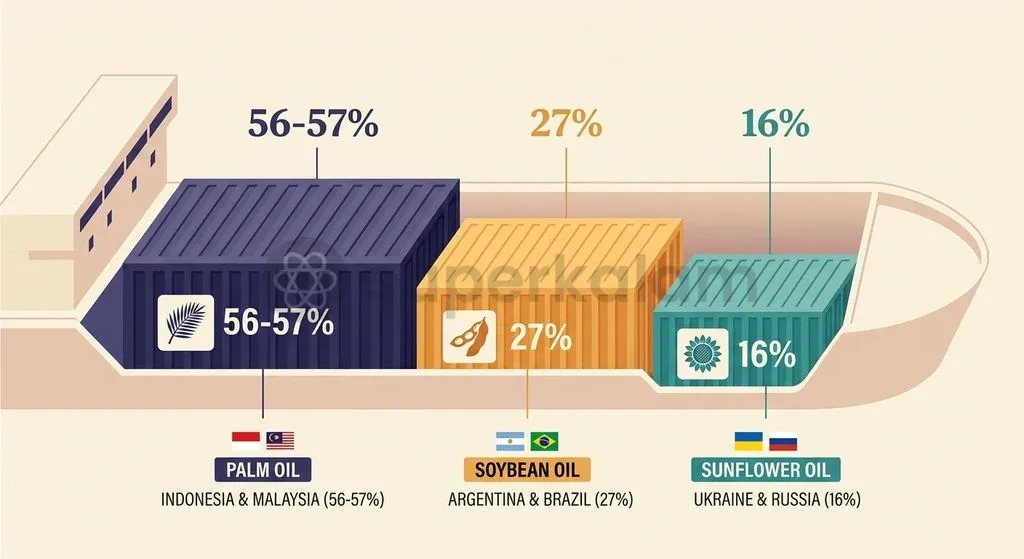
India's external supply basket is heavily concentrated across three primary vegetable oil varieties and a handful of exporting regions:
- Palm Oil (56% to 57% of total imports): Sourced primarily from Indonesia and Malaysia, crude and refined palm oil forms the bedrock of institutional consumption, commercial food processing, and budget household cooking.
- Soybean Oil (approximately 27% of total imports): Imported predominantly from Argentina and Brazil, fulfilling substantial urban household demand.
- Sunflower Oil (approximately 16% of total imports): Sourced almost entirely from the Black Sea basin, notably the Russian Federation and Ukraine.
| Edible Oil Variety | Share of Total Imports | Primary Sourcing Countries | Primary Domestic End-Use |
|---|---|---|---|
| Crude & Refined Palm Oil | 56% – 57% | Indonesia, Malaysia | Commercial catering, food processing, institutional kitchens |
| Degummed Soybean Oil | ~27% | Argentina, Brazil | Household cooking, consumer retail packs, blended oils |
| Crude Sunflower Oil | ~16% | Russian Federation, Ukraine | Urban household cooking, premium consumer culinary use |
Dietary habits have intensified this external dependency. A report by NITI Aayog on edible oil self-reliance notes that Indian per capita consumption expanded from 15.8 kg per annum in 2012–13 to 19.7 kg per annum. This intake substantially exceeds dietary benchmarks set by the Indian Council of Medical Research–National Institute of Nutrition (ICMR-NIN). Rapid expansion of food delivery platforms, processed foods, and commercial dining continues to widen this gap.
Global Supply Shocks: From Geopolitics to Erratic Weather
External disruptions trigger immediate price spikes across domestic retail markets, as documented by the Food and Agriculture Organization. Relying heavily on foreign crushers exposes domestic consumers directly to three recurring friction points:
- Black Sea Geopolitical Conflict: In March 2022, the FAO Vegetable Oil Price Index reached an all-time high of 251.8 points following military conflict across the Black Sea, which halted bulk cargo shipments from Ukrainian ports. Although global commodity prices moderated from those peaks, the index later climbed past 198 points due to export controls and production constraints.
- El Niño Weather Shocks: Severe climate anomalies suppress agricultural output. Southeast Asian oil palm plantations experienced diminished fruit yields during recent El Niño weather cycles, suppressing seasonal output across Sumatra and peninsular Malaysia.
- Protectionist Trade Policies: Exporter governments routinely prioritise domestic price caps over international trade commitments. When major exporter governments impose unexpected export levies or domestic market obligations to protect their own consumers, Indian refiners face prompt supply contractions and increased landed costs.
Discuss with Superkalam
How does the disparity between assured cereal procurement and fluctuating oilseed market prices influence farmer cropping choices in India?
Ask NowFood versus Fuel: How the Global Biofuel Push Drives Up Food Costs
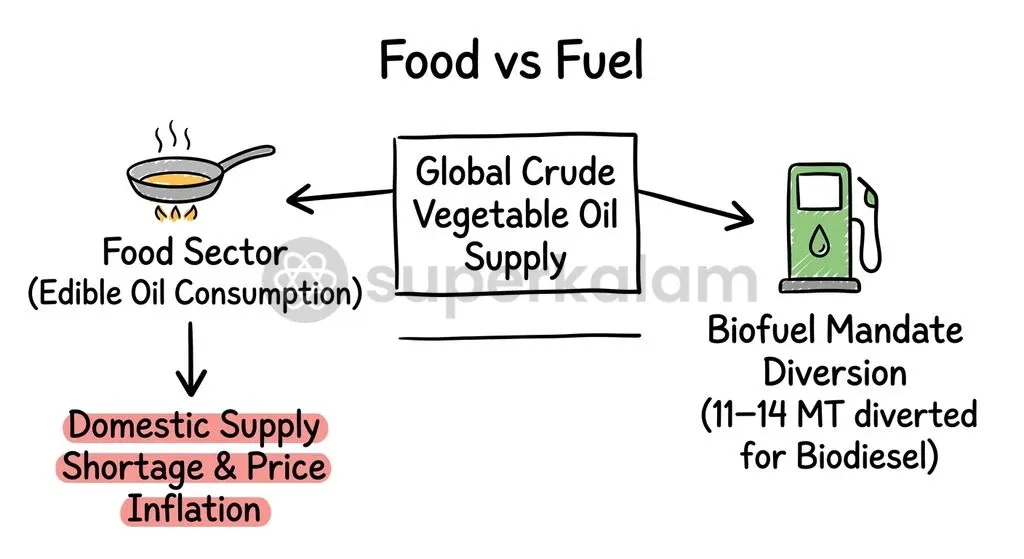
Energy mandates in producing countries have fundamentally altered global cooking oil markets. The Ministry of Energy and Mineral Resources of the Republic of Indonesia accelerated national biofuel mandates, pulling vast volumes of vegetable oil away from dining tables. Indonesia enforced a mandatory B35 biodiesel blending mandate in 2023, requiring automotive diesel to contain 35% palm oil-derived methyl ester, while preparing an expansion to B40. S&P Global Commodity Insights reported that this domestic green-fuel push diverts between 11 and 14 million tonnes of crude palm oil annually away from international export markets.
Biofuel policies across the Americas compound this strain. Substantial volumes of soybean oil now feed renewable diesel refineries instead of food supply chains. This direct competition between energy security and global nutrition creates an artificial price floor across international vegetable oil markets:
- Diverted Export Volumes: Millions of tonnes of agricultural produce that once supplied food markets now feed industrial fuel bioreactors.
- Price Transmission to Retail Consumers: Because energy mandates establish guaranteed domestic purchase volumes in exporter economies, international export premiums rise, directly lifting the cost of refined oils imported by Indian firms.
- Reduced Buffer Stocks: Global stockpiles of palm and soy oils remain structurally thin, leaving international markets vulnerable to brief weather disruptions.
Domestic Bottlenecks: Why Indian Farmers Underproduce Oilseeds
India's domestic cultivation fails to keep pace with consumption due to entrenched agronomic and economic disincentives, as highlighted by the Commission for Agricultural Costs and Prices. More than 70% of Indian oilseed farming takes place on entirely rainfed acreage, according to technical data from ICAR and NITI Aayog. Lacking reliable canal irrigation or tube-well networks, smallholder oilseed growers remain vulnerable to late monsoon arrivals and mid-season dry spells.
Yield gaps remain severe across primary growing regions. Department of Agriculture and Farmers Welfare assessments show that India's average national oilseed productivity is approximately 1,294 kg per hectare. This yield is less than half the productivity achieved in leading agricultural economies like Brazil and the United States, where average yields regularly exceed 3,000 kg per hectare.
Market procurement structures reinforce this chronic deficit:
- Cereal-Centric Procurement Distortion: Heavy public procurement of wheat and paddy at assured Minimum Support Price (MSP) under the National Food Security Act guarantees a risk-free return for farmers in Punjab, Haryana, and western Uttar Pradesh.
- Uncertain Farmgate Realisations: Although the central government regularly announces increases in MSP for mustard, groundnut, and soybean, physical state procurement for oilseeds remains irregular, leaving farmers dependent on volatile private wholesale prices.
- Fragmented Processing Infrastructure: Traditional village expellers suffer from low oil recovery rates and lack integration with modern solvent extraction infrastructure.
Discuss with Superkalam
Weigh the trade-offs of using import tariff hikes to protect domestic farmers versus the resulting inflationary pressure on household budgets.
Ask NowPolicy Measures: Balancing Tariff Adjustments with the Edible Oil Mission
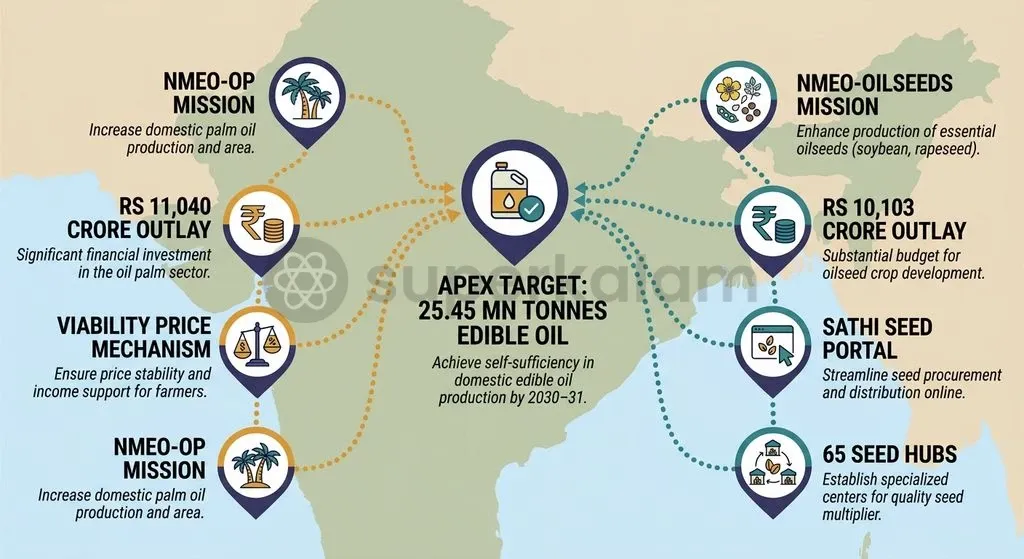
The Union Cabinet has sanctioned two major supply-side missions to break dependence on foreign crushing mills. In August 2021, the Cabinet approved the National Mission on Edible Oils – Oil Palm (NMEO-OP) with a dedicated financial outlay of Rs 11,040 crore. Operational guidelines from the Department of Agriculture indicate that NMEO-OP targets expanding domestic oil palm coverage to 10 lakh hectares to produce 11.20 lakh tonnes of crude palm oil by 2025–26, increasing to 28 lakh tonnes by 2029–30.
Price volatility poses a major deterrent for potential cultivators. To shield growers from steep downturns in international markets, NMEO-OP established a Viability Price (VP) mechanism for Fresh Fruit Bunches. The operational guidelines set the Viability Price at 14.3% of the five-year trailing average of crude palm oil prices, adjusted annually against the Wholesale Price Index. If market wholesale prices fall below this guaranteed floor, the central government reimburses farmers directly through direct benefit transfers.
On 3 October 2024, the Union Cabinet approved the National Mission on Edible Oils – Oilseeds (NMEO-Oilseeds) with an outlay of Rs 10,103 crore covering the period from 2024–25 to 2030–31. According to official Press Information Bureau releases, this initiative seeks to expand primary oilseed production from 39 million tonnes to 69.7 million tonnes. Working together, NMEO-OP and NMEO-Oilseeds aim to elevate domestic edible oil production to 25.45 million tonnes by 2030–31, fulfilling roughly 72% of India's projected domestic consumption.
The mission framework modernises certified seed chains through several institutional steps:
- SATHI Portal Management: Utilising the Seed Authentication, Traceability & Holistic Inventory digital platform to administer a transparent five-year rolling seed plan.
- Specialised Infrastructure: Constructing 65 dedicated seed hubs and 50 certified seed storage units to make high-yielding varieties accessible to farmers.
- Scale-Up of Secondary Oils: Modernising solvent processing to harness unexploited secondary streams, particularly rice bran and cottonseed oils.
The Way Forward: Achieving Oilseed Self-Reliance Without Ecological Strain
Aggressive plantation targets carry serious ecological hazards in biodiversity-sensitive zones, as cautioned by the Indian Council of Forestry Research and Education. While the National Mission on Edible Oils – Oil Palm prioritises the North Eastern states and the Andaman and Nicobar Islands, these landscapes host fragile tropical ecosystems. In Writ Petition (Civil) No. 202/1995 (T.N. Godavarman Thirumulpad v. Union of India), the Supreme Court of India prohibited commercial oil palm monoculture on forest land across the Andaman and Nicobar Islands in 2002, following recommendations from the Shekhar Singh Committee.
Hydrological constraints are equally formidable. Agronomic assessments by the ICAR-Indian Institute of Oil Palm Research document that a single mature oil palm consumes between 200 and 250 litres of water daily. Planting vast contiguous blocks of oil palm in rainfed zones risks depleting local water tables. The practice also risks fragmenting community forests and displacing biodiverse Jhum fallow systems.
Achieving sustainable self-reliance requires a balanced roadmap across several policy areas:
- Agro-Climatic Zoning for Oil Palm: Restrict oil palm cultivation strictly to cleared, irrigated agricultural lands in states with suitable groundwater, such as Andhra Pradesh and Telangana, while enforcing conservation bans across tropical forest frontiers.
- Productivity Missions for Mustard and Soybean: Deploy high-yielding hybrid seeds and micro-irrigation systems across traditional oilseed belts in Rajasthan, Madhya Pradesh, Gujarat, and Maharashtra.
- Tapping Secondary Vegetable Oils: Joint research from NITI Aayog and the Solvent Extractors' Association of India reveals that modernising rice bran and cottonseed solvent extraction can yield between 2.5 and 3 million tonnes of cooking oil annually without requiring additional agricultural land.
- Procurement Parity: Operationalise regular market intervention schemes for oilseeds under PM-AASHA, ensuring farmers receive reliable price support comparable to wheat and rice procurement.
Discuss with Superkalam
Propose an institutional strategy to help India reach its target of 72% edible oil self-reliance by 2030–31 without compromising water resources or food security.
Ask NowKey Takeaways
- Heavy Import Dependency: India imports 56% to 60% of its edible oil consumption (consuming 25 to 26 million tonnes annually), making cooking oil the nation's third-largest import expenditure after crude petroleum and gold.
- Concentrated Foreign Sourcing: The import basket is dominated by palm oil from Indonesia and Malaysia (56%–57%), soybean oil from Argentina and Brazil (
27%), and sunflower oil from the Black Sea region (16%). - The Food-versus-Fuel Divergence: International blending rules like Indonesia's B35 mandate divert between 11 and 14 million tonnes of palm oil annually into biofuel, tightening export availability and lifting baseline prices.
- Domestic Productivity Gaps: More than 70% of Indian oilseed farms are rainfed, yielding an average of 1,294 kg per hectare compared to over 3,000 kg per hectare achieved in Brazil and the United States.
- Twin National Missions: The Union Cabinet approved NMEO-OP (Rs 11,040 crore) and NMEO-Oilseeds (Rs 10,103 crore) to expand domestic edible oil production to 25.45 million tonnes by 2030–31, targeting 72% self-sufficiency.
- Ecological and Hydrological Boundaries: Oil palms consume 200 to 250 litres of water per tree per day, requiring careful agro-climatic planning to avoid repeating the ecological degradation prohibited by the Supreme Court in the Andaman Islands.
Mains Question
"Despite frequent Minimum Support Price enhancements, entrenched cereal-centric procurement and rainfed farming continue to hinder India's edible oil self-sufficiency." In this context, critically analyse the domestic bottlenecks in oilseed production and evaluate the potential of the National Mission on Edible Oils – Oilseeds (NMEO-Oilseeds) to bridge the yield gap. (15 Marks)
Evaluate NowMains Question
"The transition towards bio-based fuels in major exporting nations combined with geopolitical disruptions has created an artificial floor under international vegetable oil prices." Elucidate the mechanisms through which overseas mandates transmit price shocks to Indian household consumers. (10 Marks)
Evaluate NowPractice MCQs
QUESTION 1
With reference to India's edible oil consumption and import profile, consider the following statements:
- Domestic crushing accounts for less than half of the national edible oil demand.
- Edible oil is India's largest import commodity by value, exceeding crude petroleum.
- Palm oil constitutes more than half of India's total vegetable oil import basket. Which of the statements given above are correct?
QUESTION 2
Regarding the National Mission on Edible Oils – Oil Palm (NMEO-OP), consider the following statements:
- It targets expanding domestic oil palm coverage to 10 lakh hectares.
- The Viability Price for Fresh Fruit Bunches is fixed at 14.3% of the five-year trailing average of crude palm oil prices, adjusted annually against the Wholesale Price Index.
- Deficits between market wholesale prices and the Viability Price are compensated via direct benefit transfers to farmers. Which of the statements given above is/are correct?
QUESTION 3
Consider the following statements regarding domestic oilseed cultivation in India:
- More than 70% of Indian oilseed acreage is entirely rainfed.
- India's average oilseed productivity is less than half of that recorded in the United States and Brazil.
- The National Mission on Edible Oils – Oilseeds (NMEO-Oilseeds) targets raising primary oilseed output to nearly 70 million tonnes by 2030–31. Which of the statements given above are correct?
QUESTION 4
Consider the following statements regarding the impact of global biofuel mandates on edible oil markets:
- Indonesia's mandatory B35 biodiesel blending mandate requires diesel to contain 35% palm oil-derived methyl ester.
- Indonesia's domestic biodiesel mandate diverts over 10 million tonnes of crude palm oil annually away from international export markets. Which of the statements given above is/are correct?
QUESTION 5
Following the customs tariff revision under Notification No. 48/2024-Customs in September 2024, what is the effective import duty on crude edible oils (including the Agriculture Infrastructure and Development Cess) in India?