NPPA Cancer Drug Pricing: The 30% Trade Margin Cap Explained
Understand NPPA's trade-margin approach to cancer-medicine pricing, the 30% cap, price-to-stockist calculations and the challenges in regulating drug prices.
Oct, 2026
•8 min read

Overview
The National Pharmaceutical Pricing Authority approved an in-principle thirty percent cap on trade margins for non-scheduled anti-cancer drugs under Paragraph 19 of the DPCO 2013. The intervention reins in retail markups. Historically, these markups escalate up to seven hundred percent.
This statutory formula caps the commercial spread between the manufacturer's Price to Stockist and the Maximum Retail Price. Yet downstream limits solve only half the problem. Without base-cost audits and curbs on captive hospital dispensing networks, pharmaceutical manufacturers can evade limits by artificially inflating wholesale transfer prices.
Why in the News: The Move to Cap Cancer Drug Margins at 30%
As of October 2026, the National Pharmaceutical Pricing Authority approved an in-principle thirty percent trade margin cap on non-scheduled anti-cancer medicines under Paragraph 19 of the DPCO 2013. The decision emerged from the 151st Authority meeting convened by the drug pricing regulator.
Two core administrative steps underpin this emergency intervention:
- Statutory trigger: The Central Government acted under Paragraph 19 of the Drugs (Prices Control) Order, 2013. This power allows price revisions under extraordinary circumstances in public interest, bypassing routine regulatory schedules.
- Expert review: An expert panel under the Directorate General of Health Services received a mandate to submit its formal report by October 14, 2026. The committee was tasked with selecting more non-scheduled oncology formulations for the 30% ceiling.
From Pronab Sen to 2019: The Road to Trade Margin Rationalisation
The Pronab Sen Task Force on Price Control of Drugs first conceptualised Trade Margin Rationalisation (TMR) in 2005 as a market-friendly alternative to statutory price caps. The committee recommended capping intermediary spreads across wholesale and retail tiers rather than fixing uniform production prices.
In February 2019, the Department of Pharmaceuticals operationalised this approach through Gazette Notification S.O. 1041(E). The pilot generated measurable consumer relief across outpatient oncology channels:
- Wide brand coverage: Capped margins at 30% across 42 non-scheduled oncology formulations spanning 526 distinct commercial brands.
- Steep price cuts: Retail prices dropped by up to ninety-one percent, recording an average price reduction of roughly fifty percent.
- Household savings: Delivered recurring annual consumer savings of ₹984 crore across covered therapies.
- Supply preservation: Regulators invoked Paragraph 21(2) of the DPCO 2013, compelling manufacturers to maintain existing production levels and prevent artificial shortages.
Discuss with Superkalam
Recall the regulatory provision of the DPCO 2013 that empowers the Central Government to intervene in drug pricing under extraordinary circumstances.
Ask NowHow the 30% Rule Works: The Math Behind Price to Stockist and MRP
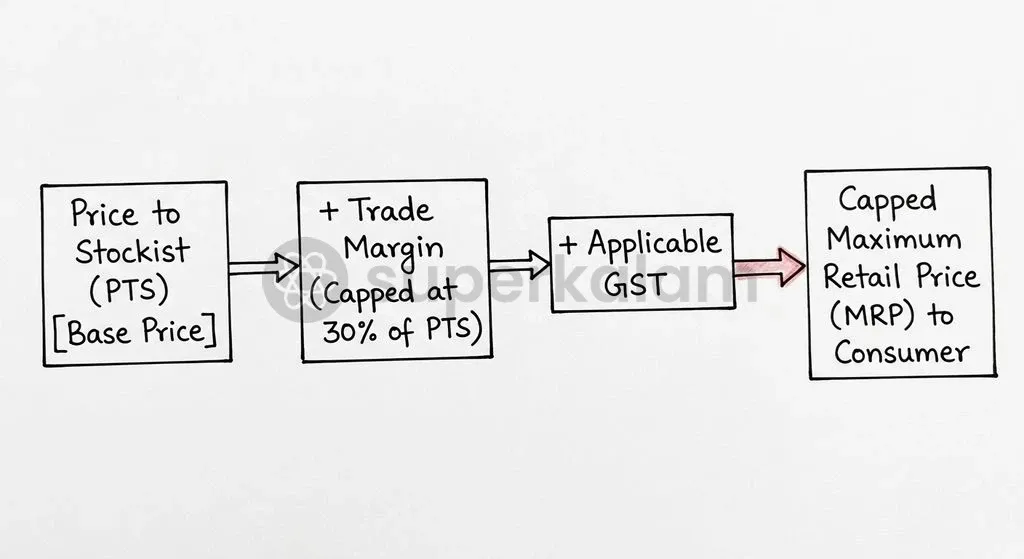
The National Pharmaceutical Pricing Authority calculates permissible retail prices using the formula notified in Gazette Notification S.O. 1041(E). The regulatory formula determines the Maximum Retail Price directly from the Price to Stockist (PTS):
Permissible Retail Price = Price to Stockist × (1 + (Trade Margin / (100 - Trade Margin)))
Under this statutory formula, Trade Margin is strictly capped at thirty percent of the final consumer price. Setting the trade margin at thirty percent creates an allowable mathematical multiplier of roughly 1.428 over the base PTS.
Department of Pharmaceuticals briefings revealed that non-scheduled cancer medicines historically carried average markups of 170%, with severe instances escalating past seven hundred percent. Commercial distributors and hospital pharmacies exploited this gap to capture wide margins.
| Pricing Tier Component | Unregulated Market Practice | Regulated TMR Framework (30% Cap) |
|---|---|---|
| Wholesale Base (PTS) | Baseline manufacturer selling price | Baseline manufacturer selling price |
| Intermediary Trade Markup | Ranging from 170% to over 700% | Mathematically capped at 42.8% on PTS |
| Final Retail Price (MRP) | Uncontrolled multi-fold price escalation | Strictly capped at PTS ÷ 0.70 |
| Supply Mandate | Voluntary company production | Mandatory output under DPCO Para 21(2) |
The Loopholes: Why Drugmakers Can Simply Inflate the Base Price
The Parliamentary Standing Committee on Chemicals and Fertilizers warned in August 2026 that pharmaceutical firms can defeat trade margin caps by manipulating base wholesale figures. Because the mechanism restricts only the commercial percentage spread, drugmakers retain the incentive to artificially raise baseline PTS.
This pricing vulnerability stems from clear regulatory loopholes:
- Transfer price gaming: A firm facing a compressed thirty percent distribution markup can increase its wholesale billing price to stockists. This accounting manoeuvre protects revenue for both the manufacturer and favoured hospital distributors.
- Unregulated entry rates: Under Paragraph 20 of DPCO 2013, non-scheduled formulations face an annual ten percent ceiling on price hikes. However, their initial launch prices remain completely unregulated without Paragraph 19 intervention.
- Lack of cost oversight: The Parliamentary Standing Committee urged the Department of Pharmaceuticals to institute backward cost audits. Such audits verify actual production and import expenses to prevent inflated wholesale baselines.
Discuss with Superkalam
Explain how setting a 30% trade margin cap on the Maximum Retail Price results in a 42.8% allowable markup over the Price to Stockist.
Ask NowThe Hospital Pharmacy Monopoly: Where Trade Margins Truly Explode
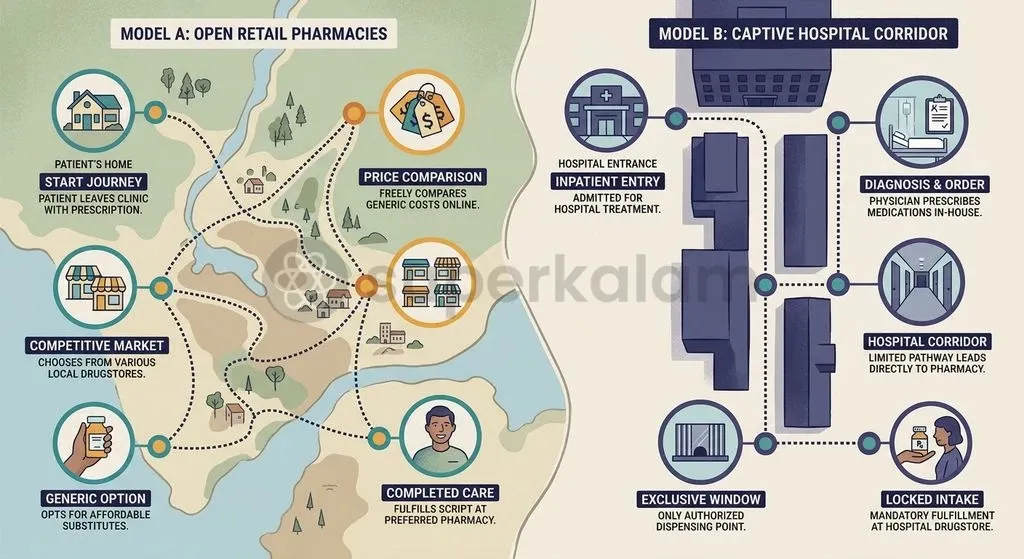
The Competition Commission of India observed that private hospitals operate captive dispensing networks insulated from standard market competition. Inpatient hospital environments spur brand competition over price competition, prompting healthcare providers to stock high-margin formulations.
Distortions within private hospital distribution centre on three main practices:
- Tied clinical services: Hospitals bundle oncology treatments with exclusive internal pharmacy dispensing, barring patients from buying cheaper alternatives outside.
- Inelastic demand: Patients undergoing intensive chemotherapy cannot negotiate prescription costs or challenge administrative restrictions.
- Prescription controls: The National Medical Commission introduced rules requiring practitioners to prescribe generic pharmacological names instead of commercial brands, enabling retail substitution.
Discuss with Superkalam
How can a state-run procurement agency apply the Pronab Sen Committee's trade margin model to reduce tertiary cancer care costs in public hospitals?
Ask NowCeiling Price vs Margin Cap: Comparing the Two Control Models
The Drugs (Prices Control) Order, 2013 establishes two distinct regulatory techniques to curb runaway pharmaceutical expenditure across domestic healthcare markets. Routine price regulation governs scheduled essential drugs, while Trade Margin Rationalisation provides a flexible tool for non-scheduled therapies.
The standard framework covers medicines listed under the National List of Essential Medicines (NLEM). Under Paragraph 4 of DPCO 2013, the pricing authority calculates a uniform national ceiling price based on the simple average market price of all brands holding at least one percent market share. In contrast, Trade Margin Rationalisation establishes enterprise-specific maximum prices anchored directly to each company's reported Price to Stockist.
| Structural Feature | NLEM Ceiling Pricing (DPCO Para 4) | Trade Margin Rationalisation (DPCO Para 19) |
|---|---|---|
| Statutory Coverage | Scheduled essential medicines on the NLEM | Non-scheduled formulations and specialty drugs |
| Pricing Benchmark | Simple average of brands with ≥1% market share | Enterprise-specific Price to Stockist (PTS) |
| Rupee Regularity | Single uniform rupee ceiling nationwide | Variable brand-specific retail price ceilings |
| Regulatory Trigger | Regular biennial update of NLEM schedules | Executive orders under extraordinary circumstances |
| Corporate Loophole | Gaming simple market averages | Artificially inflating baseline wholesale PTS |
Ethics and Access: Balancing Innovation with the Right to Health
In Paschim Banga Khet Mazdoor Samity (1996), the Supreme Court of India ruled that the duty to protect life under Article 21 requires accessible medical care. The bench affirmed that the constitutional obligation of the State includes providing timely treatment, making financial affordability an integral component of the right to health.
Two contrasting priorities define this ongoing debate:
- Household vulnerability: National Health Accounts Estimates for 2020-21 show that Out-of-Pocket Expenditure (OOPE) represents 39.4% of Total Health Expenditure in India. Retail purchases of medicines remain the primary driver of catastrophic debt.
- Commercial claims vs intermediary capture: Drugmakers argue that high margins fund research and development. However, excessive retail markups captured by hospital pharmacies reward intermediaries rather than clinical innovation.
Discuss with Superkalam
Analyse the structural differences between NLEM ceiling price regulation under Paragraph 4 and enterprise-specific margin caps under Paragraph 19.
Ask Now
Way Forward: Closing the Base Price Loophole and Buying in Bulk
The Parliamentary Standing Committee on Chemicals and Fertilizers recommended that the Department of Pharmaceuticals incorporate permanent enabling statutory provisions for Trade Margin Rationalisation directly into the DPCO 2013. Amending the statutory order provides predictable regulatory oversight, replacing periodic invocations of Paragraph 19.
Public health procurement agencies provide a proven mechanism to bypass exploitative distribution chains. Transparent state bodies like the Tamil Nadu Medical Services Corporation and Rajasthan Medical Services Corporation secure sixty to ninety percent price cuts on oncology molecules relative to commercial retail prices. Adopting pooled procurement at the national level provides strong bargaining leverage against international pharmaceutical monopolies.
Sustained administrative coordination must reinforce these procurement mechanisms:
- Conduct mandatory backward cost audits on baseline Price to Stockist submissions to prevent artificial wholesale price padding.
- Enforce National Medical Commission directives requiring generic prescribing to break captive hospital dispensing monopolies.
- Direct the Competition Commission of India to penalise hospital chains that condition clinical treatment on buying from in-house dispensaries.
- Mandate public disclosures of wholesale transfer prices across commercial oncology distributors to ensure market transparency.
Key Takeaways
- The National Pharmaceutical Pricing Authority approved an in-principle thirty percent trade margin cap on non-scheduled oncology drugs under Paragraph 19 of the DPCO 2013.
- Trade Margin Rationalisation traces its policy origin to the 2005 Pronab Sen Committee, offering a market-pegged alternative to rigid administrative price ceilings.
- The 2019 pilot across 42 cancer medicines proved effective, generating annual consumer savings of ₹984 crore with average price drops of fifty percent.
- Manufacturers can evade retail margin controls by artificially inflating baseline PTS, demanding statutory backward cost audits to preserve consumer relief.
- The Competition Commission of India identified captive hospital pharmacies as major market bottlenecks, urging open procurement and generic substitution.
Mains Question
"Trade Margin Rationalisation (TMR) addresses only intermediary markups, leaving baseline wholesale prices vulnerable to corporate gaming." In light of the Parliamentary Standing Committee's observations, critically examine the efficacy of capping trade margins under DPCO Paragraph 19 in ensuring affordable oncology care. (15 Marks)
Evaluate NowMains Question
Highlighting the Supreme Court's ruling in Paschim Banga Khet Mazdoor Samity (1996), discuss how regulatory interventions in cancer drug pricing contribute to realizing the constitutional right to health under Article 21. (10 Marks)
Evaluate NowPractice MCQs
QUESTION 1
With reference to the regulation of drug prices in India under the Drugs (Prices Control) Order (DPCO), 2013, consider the following statements:
- Ceiling prices for scheduled formulations under the National List of Essential Medicines (NLEM) are determined based on the simple average market price of brands holding at least one percent market share.
- Trade Margin Rationalisation (TMR) under Paragraph 19 of DPCO 2013 fixes a single uniform rupee ceiling across all brands nationwide.
- The statutory formula under Gazette Notification S.O. 1041(E) caps the trade margin at thirty percent directly calculated on the Price to Stockist (PTS). Which of the statements given above is/are correct?
QUESTION 2
Consider the following statements regarding the regulatory framework and institutional history of pharmaceutical pricing in India:
- The concept of Trade Margin Rationalisation (TMR) was first proposed by the Pronab Sen Task Force in 2005 as an alternative to uniform statutory price caps.
- Under Paragraph 19 of the DPCO 2013, the Central Government can revise drug prices under extraordinary circumstances in public interest.
- Paragraph 21(2) of the DPCO 2013 empowers regulators to mandate that manufacturers maintain existing production levels to prevent artificial shortages. Which of the statements given above are correct?
QUESTION 3
Consider the following statements regarding price regulation of non-scheduled formulations under the DPCO 2013:
- Non-scheduled formulations are subject to an annual price hike ceiling of ten percent under Paragraph 20 of DPCO 2013.
- The initial launch prices of non-scheduled drugs are automatically capped based on backward cost audits of production expenses.
- In Paschim Banga Khet Mazdoor Samity (1996), the Supreme Court held that timely and accessible medical treatment is a constitutional obligation under Article 21. Which of the statements given above is/are correct?
QUESTION 4
Which of the following bodies or legal provisions is specifically empowered to compel pharmaceutical companies to maintain production levels and prevent artificial market shortages following price interventions?
QUESTION 5
According to findings of the Competition Commission of India (CCI) cited in the context of hospital pharmacies, which factor primarily drives the explosion of trade margins in private healthcare institutions?