Why Mumbai-Ahmedabad Bullet Train Cost Doubled to ₹2 Lakh Crore
As project delays and tied financing double bullet train outlays, evaluating infrastructure debt tradeoffs becomes essential for critical railway governance.
Oct, 2026
•10 min read
Context
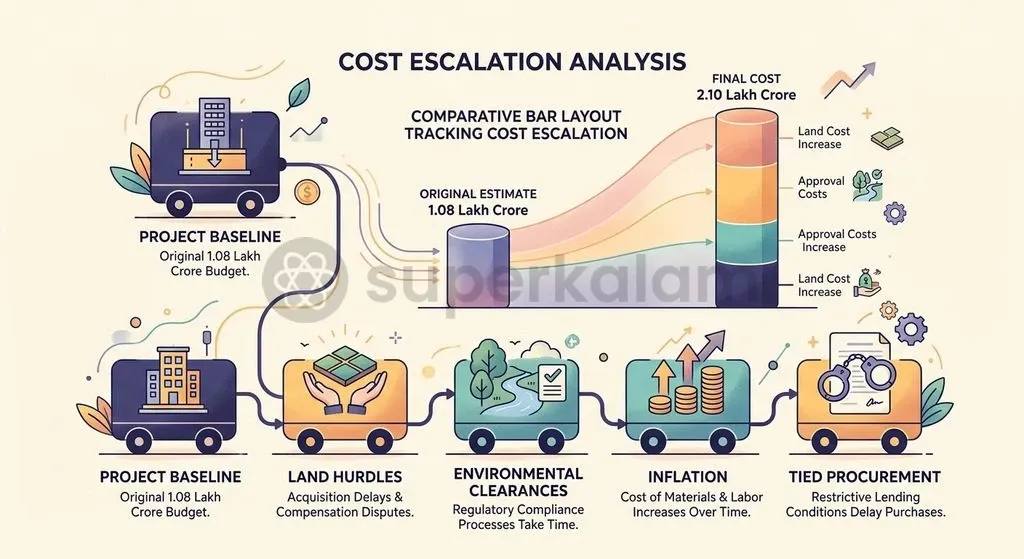
The Mumbai-Ahmedabad High-Speed Rail corridor faces a sharp cost escalation. Its budget has jumped from an original 2015 estimate of ₹1,08,000 crore to upwards of ₹2 lakh crore.
As reported by the Ministry of Railways in press briefings, revised project estimates submitted to the Union Cabinet now place total capital expenditure between ₹1.98 lakh crore and ₹2.10 lakh crore. The surge stems from three compounding pressures:
- Prolonged land acquisition deadlocks across Maharashtra.
- Post-pandemic material inflation on key civil packages.
- Tied procurement rules governing Japanese bilateral financing.
Concessional loans offer nominal interest rates of just 0.1%. Yet restrictive procurement rules and currency swings shift substantial fiscal burdens onto sovereign balance sheets. Evaluating this corridor provides an empirical case study on balancing bullet trains with wider railway modernisation.
Why in the News? The ₹2 Lakh Crore Cost Revision Explained
The Ministry of Railways submitted revised estimates to the Union Cabinet projecting total completion costs between ₹1.98 lakh crore and ₹2.10 lakh crore. According to Lok Sabha disclosures by the Ministry of Railways, the Union Government originally sanctioned the corridor in December 2015 with an estimated completion budget of ₹1,08,000 crore. Nearly a decade later, the venture confronts an estimated cost doubling driven by compounding civil delays, tender cancellations, and global price shifts.
As of July 2025, official statements from the Press Information Bureau confirm that the operational schedule has slipped:
- The original 2015 joint feasibility study targeted complete corridor commissioning by 2023.
- The National High Speed Rail Corporation Limited now targets commissioning the 50-kilometre trial section between Surat and Bilimora by August 2027.
- Full corridor operations are deferred to 2029–2030.
Under the initial framework, the Japan International Cooperation Agency agreed to fund 81% of the project via an Official Development Assistance loan of ₹88,000 crore. That support has limits.
According to project monitoring reports from the Ministry of Statistics and Programme Implementation, Japanese concessional assistance remains capped at its original baseline. This ceiling leaves an incremental escalation of nearly ₹1 lakh crore to be absorbed directly by the Union Government through budgetary support.
Internal Bottlenecks vs External Shocks: What Drove the Price Doubling?
Land acquisition in Maharashtra proved especially difficult under the Right to Fair Compensation and Transparency in Land Acquisition, Rehabilitation and Resettlement Act, 2013. Parliamentary records show that acquiring 1,389.5 hectares required protracted negotiations. Maharashtra had secured under 30% of its required land as late as 2021 before finally reaching 100% in 2024.
Statutory rules, local protests, and centre-state political misalignment stalled civil contracting along the northern terminal segment for years.
Judicial challenges and environmental clearances added further delays across coastal ecosystems. In Godrej & Boyce Manufacturing Company Limited v. State of Maharashtra (2023), the Bombay High Court dismissed challenges to the compulsory acquisition of 9.69 acres at Vikhroli. It ruled that public interest in infrastructure overrides private commercial ownership.
Simultaneously, mandatory Coastal Regulation Zone permissions and petitions over felling 20,000 mangroves across Thane Creek delayed underground civil packages. In Gujarat, the project authority faces an estimated liability risk of nearly ₹40,000 crore following enhanced compensation awards issued by the Land Acquisition, Rehabilitation and Resettlement Authority.
| Project Factor | Original 2015 Feasibility Framework | Revised Implementation Reality |
|---|---|---|
| Total Estimated Cost | ₹1,08,000 crore | ₹1.98 lakh crore to ₹2.10 lakh crore |
| Target Commissioning | Full corridor by 2023 | Surat–Bilimora trial in 2027; full corridor by 2029–2030 |
| External Financing | ₹88,000 crore (81% of baseline via JICA) | Capped at baseline; cost overruns borne domestically |
| Land Clearances | Rapid acquisition anticipated along rail right-of-way | Full acquisition delayed until 2024; litigation over urban parcels |
External economic shocks compounded these structural slippages. According to the Ministry of Statistics and Programme Implementation, five years of delay pushed major tenders straight into post-2020 inflation. Escalating unit prices for structural steel, specialised cement, and imported tunnel-boring equipment turned operational pauses into compounding budgetary expansions.
Discuss with Superkalam
Recall the original completion deadline and the revised operational schedule for the Mumbai-Ahmedabad High-Speed Rail corridor.
Ask NowThe Cost of Tied Aid: Japanese Financing and Procurement Monopolies
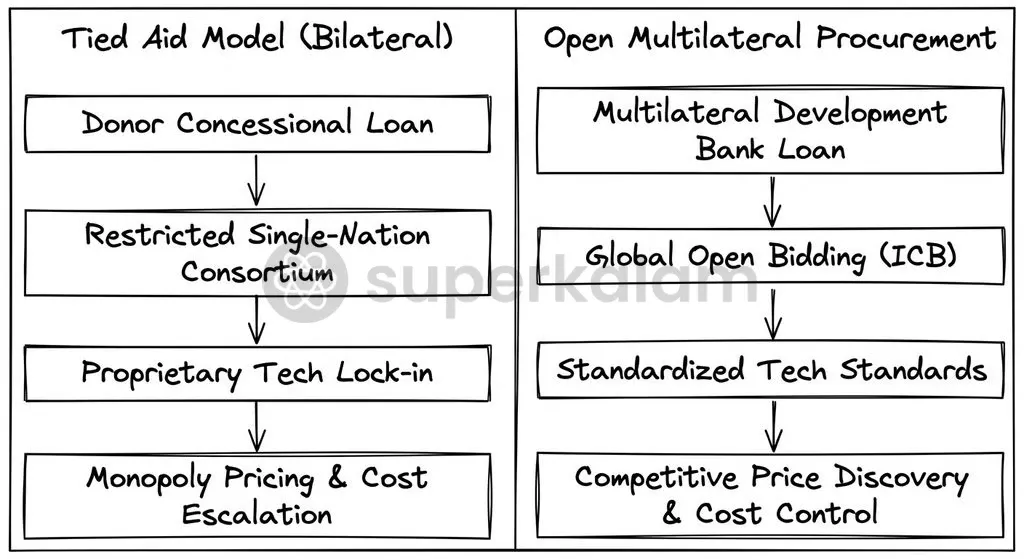
The Japan International Cooperation Agency structured its ₹88,000 crore Official Development Assistance loan under Special Terms for Economic Partnership conditions. These statutory tied-aid rules mandate that prime contractors for rolling stock, track safety systems, and signalling mechanisms must be Japanese industrial firms. While the financing carries a 50-year tenure and a nominal interest rate of 0.1%, it eliminates open global price discovery across major technical packages.
Tied conditions triggered severe contractual deadlocks during rolling stock talks for the Shinkansen E5 Series trainsets:
- Investigative industry reports indicated bidding stalled after the Japanese consortium of Kawasaki Heavy Industries and Hitachi quoted prices estimated at nearly double the project authority's benchmark.
- Bilateral lending covenants prohibited onboarding alternative international vendors.
- The executing agency remained caught between non-negotiable foreign specifications and runaway procurement costs.
To bypass these inflated foreign bids, the Ministry of Railways adjusted its domestic industrial strategy. Regulatory filings reveal that state-owned enterprise BEML Limited was awarded contracts to design and manufacture indigenous 280-kmph bullet train prototypes, designated the B28 series. Developing domestic alternatives offers a long-term hedge against tied foreign monopolies, though retrofitting domestic rolling stock onto proprietary foreign track layouts introduces complex engineering challenges.
The Currency Trap: How Rupee Depreciation Erodes Concessional Loans
The Reserve Bank of India has frequently warned that unhedged long-term foreign currency borrowings expose infrastructure projects to steep exchange rate risks. Although the nominal interest rate stands at an ultra-low 0.1% with a 15-year moratorium, the facility must be repaid in Japanese Yen. Over a 50-year horizon, structural depreciation of the Indian Rupee against the Yen risks wiping out the favourable interest margin.
Exchange rate volatility does not stay confined to the project authority's balance sheet:
- Sovereign counter-guarantees: Union Budget guarantee disclosures confirm that external bilateral borrowing by public sector entities carries unconditional sovereign counter-guarantees from the Ministry of Finance.
- Direct sovereign liabilities: If tariff collections fall short or macroeconomic shocks weaken the rupee, the resulting debt servicing deficits transform into direct sovereign liabilities funded by Indian taxpayers.
Discuss with Superkalam
Explain how repayment of long-term concessional loans in Japanese Yen poses a currency risk for the Indian government despite a nominal 0.1% interest rate.
Ask NowFare-Box Math: Can Ticket Sales Ever Pay Off the Project Debt?
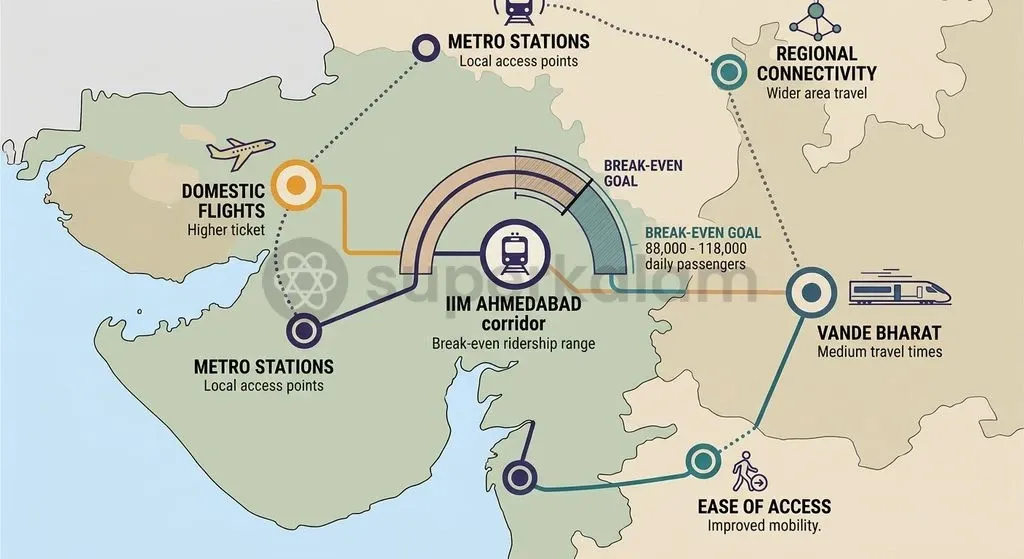
A landmark research study from the Indian Institute of Management Ahmedabad calculated that the corridor must transport between 88,000 and 1,18,000 daily passengers to remain commercially viable. This break-even threshold assumes an average ticket price of ₹1,500 across roughly 100 daily trips simply to cover operations and service underlying debt liabilities. With capital expenditure doubling toward ₹2 lakh crore, the revenue required to avert chronic operational deficits rises significantly.
Commercial pricing power faces rigid constraints along the Mumbai–Ahmedabad route due to two parallel transit alternatives:
- Low-cost domestic flights: Passenger data from the Directorate General of Civil Aviation indicates airlines run high-frequency, price-competitive services between both commercial hubs.
- Semi-high-speed rail: Indian Railways operates Vande Bharat Express services alongside premium air-conditioned conventional coaches on parallel tracks.
Bullet train operators cannot aggressively raise tariffs without losing price-sensitive business travellers to substitute transport modes.
Balancing the Ledger: Debt Risks for Indian Railways and States
Cost escalation on the bullet train corridor places direct financial pressure on both state budgets and the national rail network. The National High Speed Rail Corporation Limited operates as a joint venture Special Purpose Vehicle financed through shared equity.
Corporate filings show that ownership is divided across three public stakeholders:
- Ministry of Railways: 50% equity stake
- Government of Gujarat: 25% equity stake
- Government of Maharashtra: 25% equity stake
When capital costs double, each partner faces demands to inject additional budgetary resources to bridge ongoing funding shortfalls.
Absorbing an unexpected expenditure burden of nearly ₹1 lakh crore exerts severe fiscal strain on Indian Railways. Independent audit evaluations from the Comptroller and Auditor General of India on train derailments demonstrate that capital investments in high-profile ventures often compete directly with core network maintenance:
- Routine track renewals and ultrasonic flaw detection
- Critical bridge rehabilitation across aging sections
- Widespread rollout of modern train collision avoidance systems
Allocating massive budgetary support to a single regional corridor limits the capital available for system-wide railway safety.
Discuss with Superkalam
How can the legal precedent set in Godrej & Boyce v. State of Maharashtra be applied to resolve future urban land acquisition deadlocks in linear infrastructure projects?
Ask NowWhat Rail Reform Committees Tell Us About Megaproject Financing
The Bibek Debroy Committee on railway restructuring emphasised that Indian Railways must overhaul its financial accounting mechanisms to accurately assess project returns. Submitted in June 2015, the committee's final report urged an immediate transition from traditional cash accounting to accrual-based commercial accounting systems. Without commercial balance sheets, public rail agencies fail to quantify true life-cycle liabilities, accumulated depreciation, and escalating interest obligations embedded within megaprojects.
The committee outlined specific institutional reforms to insulate railway infrastructure planning from non-commercial distortions:
- Establishment of an Independent Economic Regulator: The Debroy report recommended creating a statutory Rail Development Authority empowered to establish cost-reflective tariffs, protect passenger interests, and enforce neutral track access rules across public and private train operators.
- Prioritisation of High-Yield Network Debottlenecking: Committee findings cautioned against sinking disproportionate capital reserves into high-profile passenger initiatives while core freight corridors, high-density line doubling, and basic safety systems remain underfunded.
- Transparent Public Service Obligation Accounting: The committee advised separating commercial freight and passenger operations from social welfare mandates, ensuring that passenger subsidies are explicitly funded via transparent budgetary transfers rather than opaque internal cross-subsidies.
Way Forward: De-risking Future High-Speed Rail Corridors
The National High Speed Rail Corporation Limited must establish rigorous pre-construction clearance benchmarks before breaking ground on subsequent high-speed corridors. Statutory planning frameworks should mandate achieving at least 80% encumbrance-free land acquisition along with complete environmental approvals. Finalised geotechnical surveys must also precede mega civil contracts. This sequencing prevents idle contractor claims and compound inflationary overheads that derailed the Mumbai-Ahmedabad project budget.
Future infrastructure financing agreements should integrate key procurement reforms:
- Shift away from tied aid: Transition toward competitive multilateral bidding to avoid single-country vendor monopolies.
- Early domestic integration: Involve domestic manufacturers like BEML early in the design cycle to develop indigenous capabilities.
- Sovereign risk hedging: Implement structured foreign exchange hedging instruments and independent tariff oversight under the Rail Development Authority.
These measures ensure future bullet train networks drive economic expansion without jeopardising national fiscal sustainability.
Discuss with Superkalam
Analyse the trade-off between allocating central budgetary support to high-speed rail megaprojects versus funding safety upgrades like collision avoidance systems across conventional railway tracks.
Ask NowKey Takeaways
- The Mumbai-Ahmedabad High-Speed Rail corridor's projected cost has doubled from ₹1,08,000 crore to between ₹1.98 lakh crore and ₹2.10 lakh crore, driven by procedural delays and material inflation.
- Maharashtra experienced severe land acquisition delays under the Right to Fair Compensation and Transparency in Land Acquisition, Rehabilitation and Resettlement Act, 2013, lagging below 30% acquisition as late as 2021 before completing in 2024.
- Japan International Cooperation Agency's tied loan under Special Terms for Economic Partnership restricted rolling stock procurement to Japanese suppliers, triggering contract deadlocks over elevated trainset prices.
- Concessional bilateral borrowing at a 0.1% nominal interest rate exposes the Union Government to severe unhedged currency depreciation risks against the Japanese Yen over a 50-year horizon.
- Benchmark research from IIM Ahmedabad highlights that break-even operations require 88,000 to 1,18,000 daily passengers, a threshold pressured by intense competition from airlines and Vande Bharat services.
- The Bibek Debroy Committee (2015) urged Indian Railways to transition to commercial accrual accounting, establish a statutory Rail Development Authority, and prioritise freight decongestion over capital-intensive prestige projects.
Mains Question
"Concessional bilateral financing with low nominal interest rates can mask substantial sovereign fiscal burdens under tied-aid procurement and exchange rate volatility." In the context of the Mumbai-Ahmedabad High-Speed Rail project, critically analyse this statement. (15 Marks)
Evaluate NowMains Question
Highlighting the recommendations of the Bibek Debroy Committee on railway restructuring, examine the fiscal trade-offs between funding high-speed rail megaprojects and maintaining conventional network safety. (10 Marks)
Evaluate NowPractice MCQs
QUESTION 1
With reference to the financing structure of the Mumbai-Ahmedabad High-Speed Rail (MAHSR) project, consider the following statements:
- The Japan International Cooperation Agency (JICA) initially agreed to fund 81% of the project via an Official Development Assistance loan.
- Japanese concessional assistance automatically expands to absorb subsequent project cost escalations proportionately.
- The external bilateral borrowing incurred by the project executing entity carries unconditional sovereign counter-guarantees from the Ministry of Finance.
Which of the statements given above are correct?
QUESTION 2
Consider the following statements regarding the institutional and equity structure of the National High Speed Rail Corporation Limited (NHSRCL):
- It is a statutory corporation established under an Act of Parliament with 100% equity held by the Ministry of Railways.
- The Government of Gujarat and the Government of Maharashtra each hold an equity stake of 25% in the entity.
Which of the statements given above is/are correct?
QUESTION 3
Regarding the procurement framework and technical contracts for the Mumbai-Ahmedabad High-Speed Rail corridor, consider the following statements:
- The JICA Official Development Assistance loan was structured under Special Terms for Economic Partnership (STEP) conditions.
- STEP conditions permit open international competitive bidding for rolling stock and track safety systems.
- To reduce reliance on tied foreign bids, contracts were awarded to BEML Limited to develop indigenous 280-kmph prototypes.
Which of the statements given above are correct?
QUESTION 4
In the context of the Mumbai-Ahmedabad High-Speed Rail project, the 2023 ruling of the Bombay High Court in Godrej & Boyce Manufacturing Company Limited v. State of Maharashtra established that:
QUESTION 5
According to the Indian Institute of Management Ahmedabad research study cited in the context of the Mumbai-Ahmedabad High-Speed Rail project, what daily ridership threshold was estimated for commercial break-even at an average fare of ₹1,500?