Why Judicial Orders Alone Cannot Stop Election Black Money in India
Explore why judicial orders cannot stop election black money in India. Analyze statutory loopholes, RPA 1951, Section 77 limits, and party funding.
Aug, 2026
•12 min read

Judicial directives enforce election rules, but statutory amendments by Parliament remain vital to close funding loopholes.
Context
Judicial orders alone cannot eliminate black money from Indian elections. Supreme Court rulings address procedural enforcement mechanisms. However, statutory carve-outs in the Representation of the People Act, 1951 and Income Tax Act, 1961 permit unrestricted political party expenditure and non-transparent cash donations.
Recent judicial directives from the Supreme Court of India have tightened seizure reporting timelines, struck down anonymous funding tools, and restricted prosecution withdrawals. Yet statutory loopholes still separate candidate spending caps from unlimited party budgets. Until Parliament acts, judicial oversight remains a temporary palliative rather than a structural cure.
Why Election Funding Reform Is Back in the Spotlight
The Supreme Court of India recently tightened procedures for handling seized assets during elections to curb illicit financial flows. In State of Karnataka v. Prathik Parasrampuria (2026 INSC 868), the Supreme Court issued strict procedural directions to prevent political interference during polls as reported in August 2026.
The Court's key directions establish tight operational boundaries:
- 24-hour reporting window: Authorities seizing cash or assets linked to electoral offences must report to a District Magistrate or competent court within 24 hours with written reasons establishing a prima facie nexus.
- Time-bound trials: The bench imposed a mandatory one-year deadline to complete investigations into electoral offences and asked High Courts to set up special courts.
- Restriction on withdrawals: State governments cannot unilaterally withdraw criminal prosecutions against candidates during elections without prior High Court approval.
While these directives strengthen investigative integrity under Article 324, the Court emphasised that its residuary authority operates only where statutory law is silent. It cannot override express legislative enactments.
Discuss with Superkalam
What time limit did the Supreme Court set for investigating electoral offences in State of Karnataka v. Prathik Parasrampuria (2026)?
Ask Now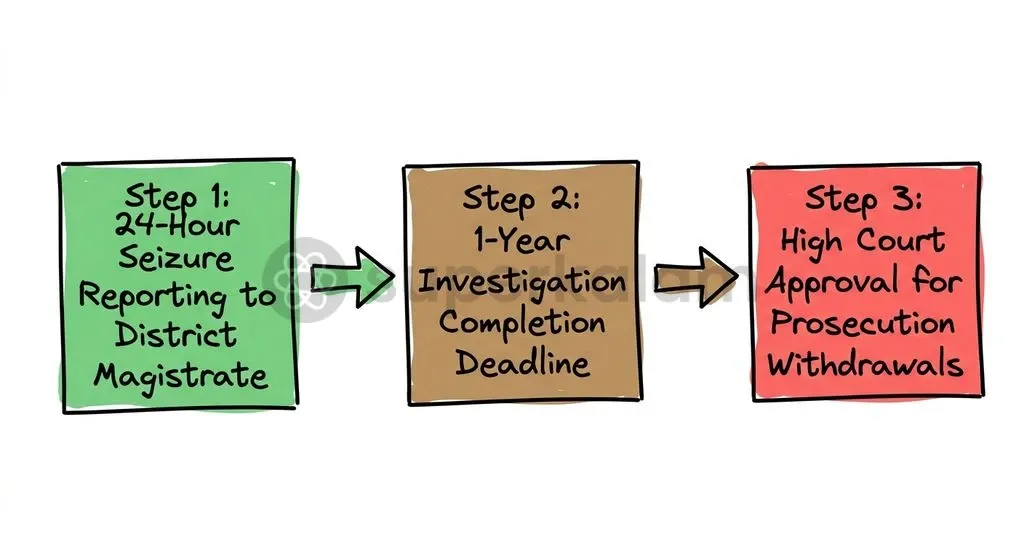
What the Supreme Court Has Tried to Fix
The Supreme Court of India has consistently deployed constitutional remedies to enforce transparency in political party operations. Judicial interventions seek to protect the voter's fundamental right to information under Article 19(1)(a).
Key rulings demonstrate this constitutional approach:
- Accountability and Audits: In Common Cause v. Union of India (1996), the Court held that Election Commission powers under Article 324 include auditing party accounts and demanding financial disclosures.
- Striking Anonymous Funding: In Association for Democratic Reforms v. Union of India (2024 INSC 113), the Supreme Court struck down the Electoral Bond Scheme, 2018 as unconstitutional. The Court ruled that anonymous political contributions violated the voter's right to know donor identities.
Despite these landmark verdicts, judicial orders face sharp institutional limitations. Courts cannot rewrite statutory codes or establish new spending caps from the bench.
Discuss with Superkalam
How does Explanation 1 of Section 77 create a gap between candidate and party spending limits?
Ask NowThe Legal Loophole That Keeps Black Money Alive
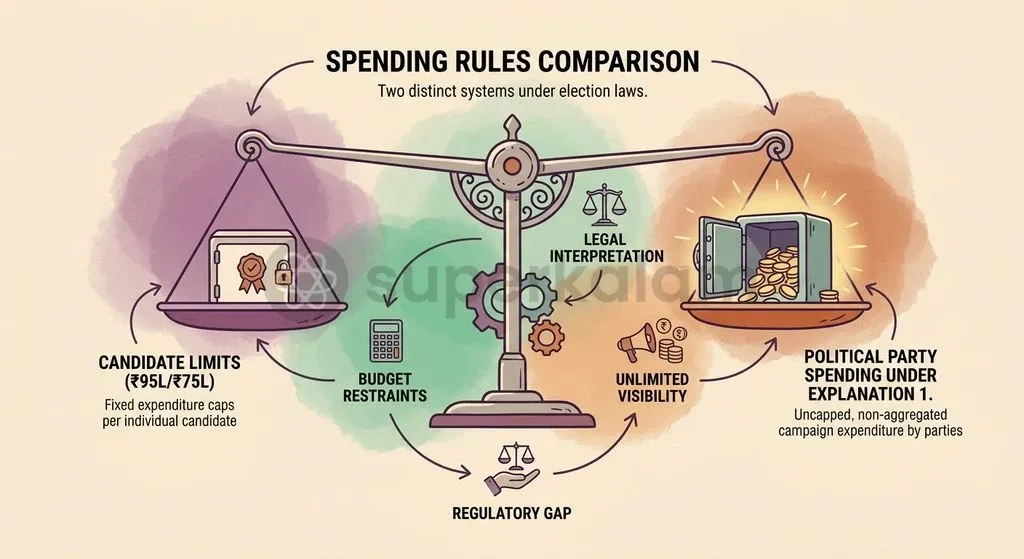
The Representation of the People Act, 1951 creates a stark contrast between candidate expenditure limits and party spending. Under Rule 90 of the Conduct of Elections Rules, 1961, statutory ceilings cap individual candidate spending at ₹95 lakh for Lok Sabha constituencies in larger states and ₹75 lakh in smaller states. Yet political party expenditure remains entirely uncapped by statute.
This gap originates in Section 77(1) of the Representation of the People Act, 1951. While candidates must record all personal election expenses, Explanation 1 excludes party spending on star campaigners and general propaganda from candidate accounts.
In Kanwar Lal Gupta v. Amar Nath Chawla (1975), the Supreme Court ruled that party spending benefiting a specific candidate must count towards that candidate's cap. Parliament later amended Section 77 to nullify this ruling, which the Court upheld in P. Nalla Thampy Terah v. Union of India (1985). Separately, under Section 123(1) of the RPA, 1951, bribery is a corrupt practice, but invalidating an election requires proving direct consent from the candidate or their agent.
| Dimension | Individual Candidate Limits | Political Party Spending |
|---|---|---|
| Statutory Ceiling | Capped at ₹95 lakh (larger states) or ₹75 lakh (smaller states) under Conduct of Elections Rules, 1961. | Uncapped under statutory law. |
| Star Campaigner Expenses | Included only if directly paid by candidate; excluded under Section 77 Explanation 1. | Fully excluded from candidate accounts under Section 77 of the RPA, 1951. |
| Legal Status of Exceeding Limit | Disqualifying corrupt practice if proven under Section 123 of the RPA, 1951. | Permissible under existing legislative provisions without financial caps. |
What Past Committees Warned Us About Party Finances
Government-appointed committees have long warned that unregulated private capital distorts political equality.
Key reform proposals highlight distinct strategies to address off-the-books wealth:
- In-Kind State Funding: The Indrajit Gupta Committee (1998) recommended partial state funding strictly in-kind—supplying fuel, paper, and broadcast airtime—to recognised national and state parties while excluding independent candidates.
- Prerequisites and Disclosure Timelines: The 255th Law Commission Report (2015) deemed total state funding unviable under present fiscal conditions. It argued that state aid requires mandatory inner-party democracy, decriminalisation of politics, and strict disclosures. The report recommended inserting Section 29F into the RPA, 1951, forcing parties to submit audited statements within 75 days for assembly polls and 90 days for general elections.
Why Financial Reporting and Tax Exemptions Fail
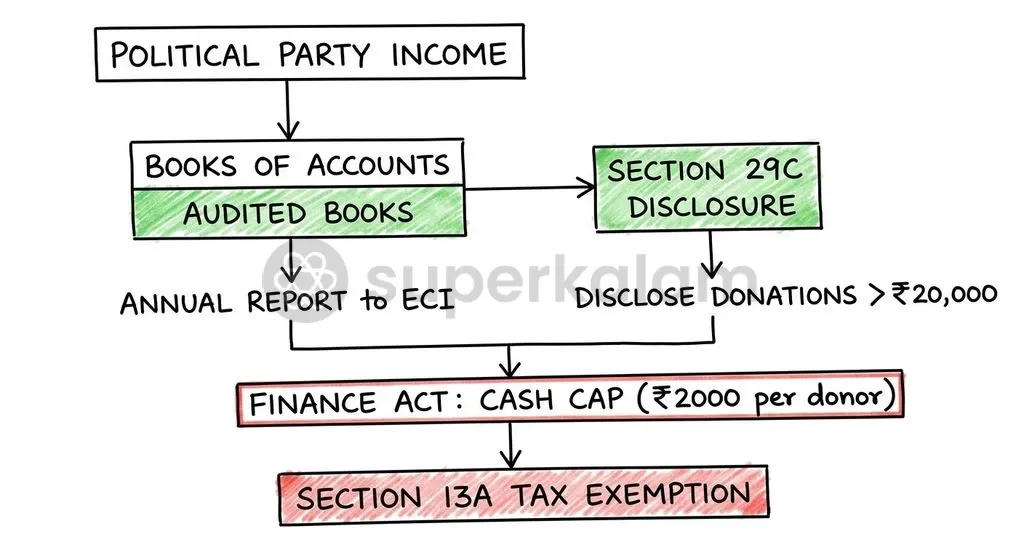
The Income Tax Act, 1961 grants political parties broad exemptions that complicate tracking untaxed wealth.
Two primary statutory mechanics govern these tax benefits:
- Section 13A Tax Exemptions: Registered parties receive 100% tax exemption on house property, capital gains, and voluntary contributions. Parties maintain this tax-free status by submitting audited accounts and disclosing voluntary donations over ₹20,000 under Section 29C of the RPA, 1951.
- Cash Donation Thresholds: The Finance Act, 2017 amended Section 13A to cap cash donations at ₹2,000 per donor. However, enforcement remains weak because parties can aggregate unrecorded micro-donations below the threshold without revealing donor identities.
Discuss with Superkalam
How can proposed Section 29F ensure audit compliance without burdening smaller regional parties?
Ask NowHow to Fix Electoral Funding: The Way Forward
Eradicating election black money requires holistic legislative action rather than relying on ad-hoc judicial directions. Parliament can reform electoral finance through targeted statutory amendments:
- Revising Candidate Expense Rules: Re-evaluate Explanation 1 of Section 77 of the RPA, 1951 to count party spending on behalf of candidates against candidate expenditure caps, restoring the principle in Kanwar Lal Gupta (1975).
- Enforcing Audit Timelines: Insert Section 29F into the RPA, 1951 as proposed by the 255th Law Commission Report to give strict ECI disclosure deadlines binding statutory power.
- Tightening Tax Exemptions: Condition Section 13A tax exemptions under the Income Tax Act, 1961 on full digital auditability and lower contribution reporting thresholds.
- Introducing State Support: Adopt in-kind state funding under the Indrajit Gupta Committee model to reduce cash reliance while preserving a level playing field for recognised parties.
Key Takeaways
The Election Commission of India requires comprehensive legislative backing to effectively regulate political party finances and eliminate electoral black money.
- Judicial Boundaries: Supreme Court rulings, including 2026 INSC 868, strengthen investigative timelines under Article 324 but cannot override explicit legislative statutes or statutory carve-outs.
- Expenditure Asymmetry: Section 77 of the RPA, 1951 caps candidate spending at ₹95 lakh/₹75 lakh while leaving political party election expenditure completely uncapped under Explanation 1.
- Tax Exemptions: Section 13A of the Income Tax Act, 1961 offers 100% tax exemptions to parties, while cash donation limits of ₹2,000 under the Finance Act, 2017 are easily circumvented through fragmented cash reporting.
- State Funding Principles: The Indrajit Gupta Committee (1998) advocated partial in-kind state funding for recognised parties, while the 255th Law Commission Report deemed absolute state funding unviable without inner-party democracy and mandatory disclosures.
- Statutory Reform Needed: Effective regulation requires inserting proposed Section 29F into the RPA, 1951 to enforce mandatory 75-day and 90-day expenditure disclosure timelines.
Mains Question
"Explanation 1 of Section 77 of the Representation of the People Act, 1951 creates a stark structural asymmetry by capping candidate expenditure while leaving political party election budgets uncapped." Critically analyse how this statutory carve-out undermines electoral equity, and suggest necessary statutory reforms. (15 Marks)
Evaluate NowMains Question
"Judicial orders from the Supreme Court enforce procedural integrity under Article 324, but operate merely as temporary palliatives in the absence of comprehensive statutory reform." Elucidate with reference to recent judicial directives and the financial exemption framework under the Income Tax Act, 1961. (10 Marks)
Evaluate NowPractice MCQs
QUESTION 1
Consider the following statements regarding the directions issued by the Supreme Court of India in State of Karnataka v. Prathik Parasrampuria (2026):
- Authorities seizing assets during elections must report to a District Magistrate or competent court within 24 hours with written reasons establishing a prima facie nexus.
- State governments can unilaterally withdraw criminal prosecutions against candidate accused during elections provided approval is granted by the District Magistrate.
- High Courts were requested to set up special courts to enforce a mandatory one-year deadline for investigating electoral offences.
Which of the statements given above are correct?
QUESTION 2
With reference to candidate expenditure limits and party spending under the Representation of the People Act (RPA), 1951, consider the following statements:
- Under Explanation 1 of Section 77, expenditure incurred by political parties on star campaigners is excluded from the individual candidate's expense ceiling.
- In Kanwar Lal Gupta v. Amar Nath Chawla (1975), the Supreme Court ruled that party spending benefiting a specific candidate must count towards that candidate's cap.
- Proving bribery under Section 123(1) of the RPA, 1951 invalidates an election automatically without needing to show candidate or election agent consent.
Which of the statements given above is/are correct?
QUESTION 3
Consider the following statements regarding committee recommendations on political finance reforms in India:
- The Indrajit Gupta Committee (1998) recommended total monetary state funding for both recognised political parties and independent candidates.
- The 255th Law Commission Report (2015) deemed total state funding unviable under present fiscal conditions. 3. The 255th Law Commission Report proposed inserting Section 29F into the RPA, 1951 to mandate audited statement submissions within 75 days for assembly polls and 90 days for general elections.
Which of the statements given above are correct?
QUESTION 4
With reference to political party tax exemptions under Section 13A of the Income Tax Act, 1961, consider the following statements:
- Registered political parties receive 100% tax exemption on house property, capital gains, and voluntary contributions.
- The Finance Act, 2017 capped cash donations to political parties at ₹2,000 per donor. 3. Parties maintain Section 13A tax exemption by disclosing individual donor identities for all voluntary contributions exceeding ₹2,000 under Section 29C of the RPA, 1951.
Which of the statements given above is/are correct?
QUESTION 5
Under Rule 90 of the Conduct of Elections Rules, 1961, what is the statutory expenditure limit set for an individual candidate contesting Lok Sabha elections in larger states?