FCRA Amendments 2026: Securitisation, Asset Custody & Civil Society Accountability - UPSC Notes
Analyzing the 2026 FCRA amendments, state asset custody over non-profits, and the constitutional tension between internal security and civil society rights.
Sep, 2026
•10 min read
Overview

Fig: The FCRA 2026 amendments balance state oversight with civil society autonomy under Article 19.
Introduced in the Lok Sabha on March 25, 2026, the Foreign Contribution (Regulation) Amendment Bill, 2026 shifts oversight from transactional tracking to administrative state custody over physical and capital assets. At the same time, it lowers maximum imprisonment penalties from five years to one year, balancing security needs with associational rights under Article 19(1)(c).
Proposed Chapter IIIA and Section 16A create a statutory Designated Authority to manage, supervise, and dispose of foreign-funded assets. These powers trigger whenever an organisation's registration expires, is surrendered, or faces cancellation. Overall, this expansion tightens state control over foreign capital while sharpening constitutional debates around civil society autonomy.
Why the FCRA 2026 Amendments Matter Today
The Foreign Contribution (Regulation) Amendment Bill, 2026, introduced in Lok Sabha on March 25, 2026, marks a structural policy shift in civil society oversight. Parliament is moving beyond banking audit trails toward direct administrative control over physical and capital assets owned by non-governmental organisations (NGOs).
The administrative scale of this shift is already clear:
- Cancelled Registrations: 22,496 FCRA registrations have been cancelled since 2015.
- Active Associations: Only about 14,466 associations remain eligible to receive foreign contributions as of September 2026.
- Geographical Limits: On June 22, 2026, the MHA notified the Foreign Contribution (Regulation) Amendment Rules, 2026, requiring registration certificates to specify approved purposes and geographic operational boundaries.
This expansion highlights a central trend: the 2026 amendments drive the securitisation of civil society by shifting the state role from monitoring transactions to taking administrative custody over physical assets.
Understanding the Foreign Contribution Regulation Act and Its Evolution
Parliament enacted the Foreign Contribution (Regulation) Act in 1976 during the Emergency to shield national political processes from foreign influence. The original statutory goal was specific: prevent foreign powers from altering domestic political outcomes, electoral integrity, or legislative debates through monetary inducements.
In 2010, lawmakers re-enacted the law to link foreign funding restrictions directly to internal security objectives. This expanded executive oversight beyond political figures to cover all voluntary organisations, research institutions, and socio-economic development groups in India.
Major statutory changes followed in 2020, imposing strict banking controls and expenditure caps. Section 7 introduced a complete ban on sub-granting foreign contributions to other entities. At the same time, allowable administrative expenses dropped from 50% to 20% of foreign funds. Sections 12(1A) and 17(1) also mandated that every recipient must open an 'FCRA Account' at the State Bank of India main branch on Sansad Marg, New Delhi.
| Legislative Milestone | Primary Regulatory Focus | Key Compliance & Operational Restrictions |
FCRA, 1976 | Political integrity during Emergency | Restricted foreign contributions to political parties, candidates, and parliamentarians. |
FCRA, 2010 | Internal security & financial integrity | Extended registration oversight to non-political NGOs and socio-economic institutions. |
FCRA Amendments, 2020 | Direct banking control & sub-grant bans | Imposed a complete ban on sub-granting (Section 7), reduced admin expense cap to 20%, and mandated SBI New Delhi account (Section 17(1)). |
FCRA Amendments, 2026 | Asset custody & executive control | Introduces Chapter IIIA and Section 16A to create a Designated Authority over assets upon registration expiry or cancellation. |
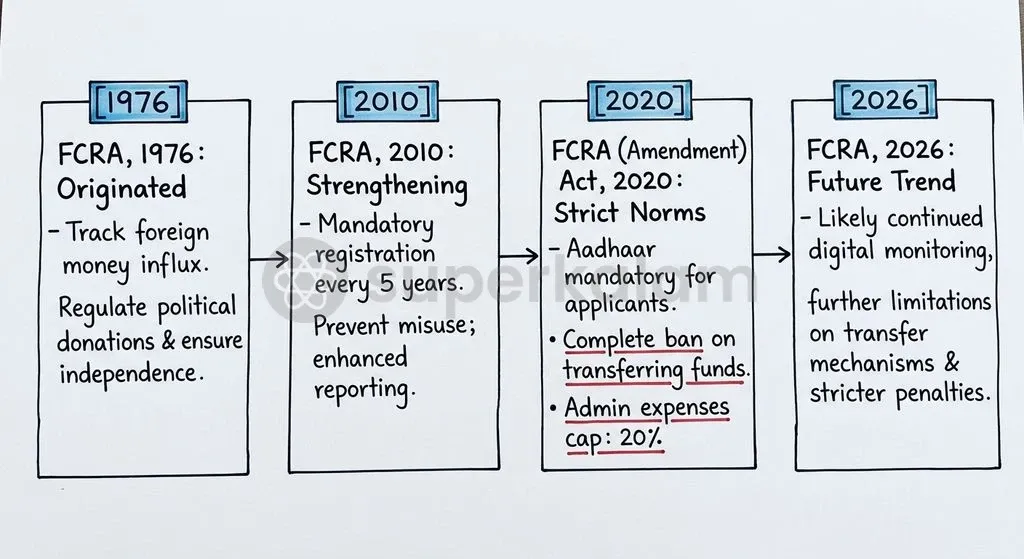 Fig: Evolution of FCRA from emergency-era political protection (1976) to asset-level state custody (2026).
Discuss with Superkalam
What primary legislative objective led to the enactment of the original Foreign Contribution (Regulation) Act in 1976 during the Emergency?
Ask NowThe Shift Toward Securitisation: Key Changes in the 2026 Bill
The Foreign Contribution (Regulation) Amendment Bill, 2026 creates Chapter IIIA and Section 16A to vest foreign-funded assets in a state-appointed Designated Authority. This mechanism grants executive authorities administrative custody over unspent funds and physical property whenever an organisation's registration is cancelled, surrendered, or expires.
Key provisions of the 2026 Bill set clear operational rules:
- Automatic Registration Cessation: An FCRA registration automatically ceases if an NGO misses the renewal deadline, if renewal is denied, or if expiry occurs before a renewal decision.
- Asset Custody via Designated Authority: Chapter IIIA empowers the Designated Authority to manage, supervise, and dispose of foreign funds and assets vested in it after registration ceases.
- Protection of Places of Worship: If vested assets include a place of worship, the authority must explicitly preserve its religious character.
- Expanded Scope of Key Functionaries: The definition of 'Key Functionary' now covers trustees, governing body members, partners, and anyone exercising executive control.
- Modification of Penalties: Maximum imprisonment for FCRA violations drops from five years to one year, easing criminal liability while keeping administrative asset controls intact.
- Recovery Window and Final Disposal: Vesting in the Designated Authority is temporary. An NGO can recover its assets if its registration is restored within a prescribed period; otherwise the assets can be sold and the proceeds go to the Consolidated Fund of India.
- Stated Grounds for the Bill: The government cites opaque foreign funding, its potential use in politically charged campaigns, and religious conversions as the concerns behind the tighter rules.
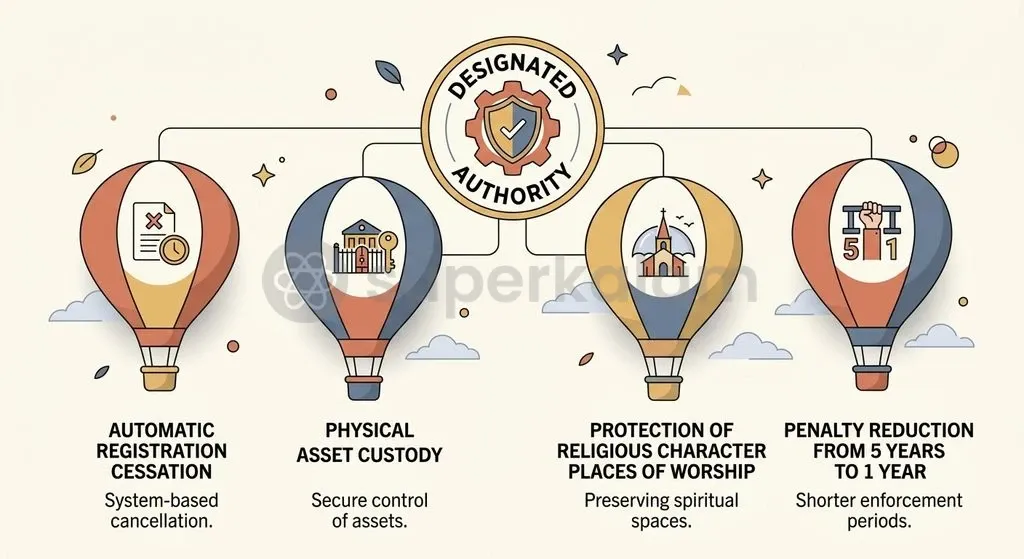
Fig: Key statutory provisions introduced under Chapter IIIA of the FCRA Amendment Bill 2026.
Operational Bottlenecks and Compliance Burdens on NGOs
Section 17(1) mandates that every NGO receive primary foreign funds through a single State Bank of India branch. Located on Sansad Marg in New Delhi, this main branch is the required gateway before funds move to secondary operational accounts.
Grassroots organisations face three main practical challenges:
- Centralised Gateway Delays: Routing all incoming foreign contributions through one branch creates administrative backlogs during initial fund clearance.
- Impact of Sub-Granting Bans: Section 7 prevents larger non-profits from passing foreign funds to local implementation partners, stalling rural projects.
- Administrative Cap Squeeze: Capping administrative spending at 20% of foreign contributions limits capacity to hire professional auditors and maintain operating staff.
Recent administrative rules add further regional constraints. The June 22, 2026 notification requires certificates to state explicit approved purpose codes and operational boundaries, limiting emergency response flexibility.
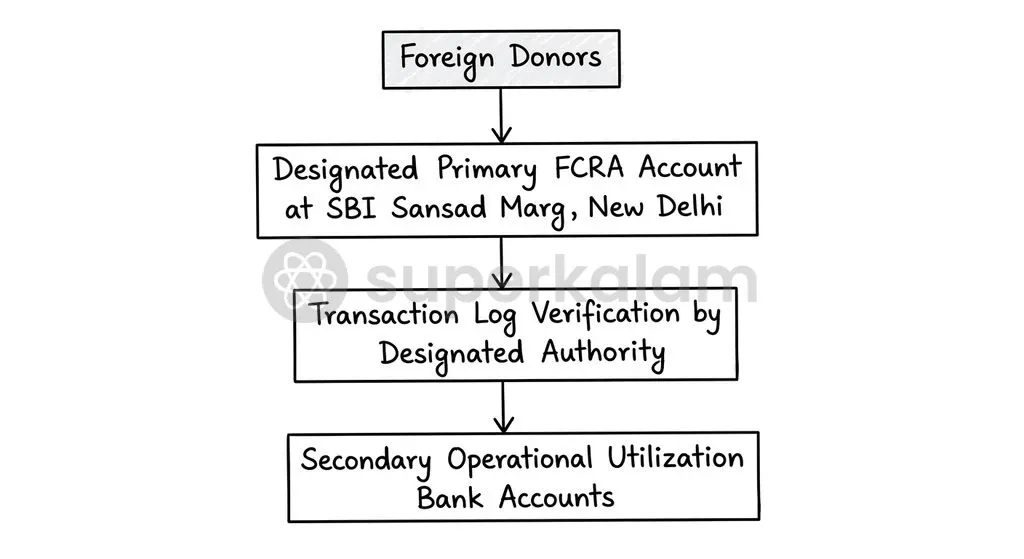
Fig: Mandatory foreign fund routing under Section 17(1) of the Foreign Contribution (Regulation) Act.
Discuss with Superkalam
Do the 2026 asset custody provisions strike a balance between financial transparency and operational autonomy?
Ask NowFinancial Transparency Versus Operational Autonomy
The Ministry of Home Affairs balances internal security against non-governmental organisations' operational rights guaranteed under Article 19(1)(c) of the Constitution.
| Regulatory Dimension | State Perspective | Civil Society Concerns |
Core Objective | Prevent money laundering, tax evasion, and foreign influence. | Preserve associational rights under Article 19(1)(c) and procedural fairness. |
Procedural Mechanisms | Asset custody under Designated Authority upon registration expiry. | Absence of explicit statutory appeal or pre-denial right to be heard. |
Global benchmarks provide additional context. The Financial Action Task Force (FATF) 2024 Mutual Evaluation of India praised the country's anti-money laundering efforts, but recommended targeted, risk-based regulation for non-profits rather than blanket restrictions.
The Funding Crossroads: Domestic Philanthropy and Donor Retreat
The debate around the 2026 Bill sits against a shifting funding landscape:
- Rise of Domestic Giving: Private philanthropy in India is projected to reach Rs 1.43 lakh crore (about $16 billion) in FY 2025, with Corporate Social Responsibility (CSR) spending growing alongside it.
- Donor Retreat: Some international donors are reducing contributions to India because of their own economic difficulties and India's growing economy.
- Why Foreign Funds Still Matter: Foreign contributions are a small share of overall development funding, but NGOs value them for their flexibility and fewer restrictions compared to government grants.
- Historical Role: Foreign aid has been credited with bringing new ideas, technologies, and organisational improvements to India's voluntary sector.
Civil society groups, particularly Christian organisations, fear the legislation may not be religion-neutral and could hurt the beneficiaries of their social services.
The Way Forward: Balancing National Security with Civil Society Freedom
Recommendations from the FATF 2024 Mutual Evaluation urge India to adopt a risk-based approach that safeguards non-profit operations without compromising national security. Building a balanced regulatory system requires clear administrative processes:
- Establishing Statutory Due Process: Parliament could add explicit appeal rights and mandatory pre-denial hearings to guarantee procedural fairness before registration ceases.
- Adopting Risk-Based Monitoring: Scrutiny should align with FATF Recommendation 8, focusing oversight on high-risk sectors while simplifying compliance for routine operations.
- Improving Banking Operations: Adding SBI processing nodes beyond the Sansad Marg branch would reduce clearance delays for field projects.
- Setting Clear Asset Disposal Rules: Guidelines under proposed Chapter IIIA should ensure the Designated Authority prioritises public interest utility when managing or returning vested assets.
Core Provisions at a Glance
- March 25, 2026 Introduction: The Foreign Contribution (Regulation) Amendment Bill, 2026 was introduced in Lok Sabha, creating Chapter IIIA and Section 16A to establish a Designated Authority over foreign-funded assets upon registration expiry or cancellation.
- Shift to Asset Custody: The 2026 Bill transitions regulation from financial tracking to state custody over physical and capital assets, while reducing the maximum imprisonment penalty from five years to one year.
- Noel Harper (2022) Precedent: The Supreme Court ruled that receiving foreign contributions is not a fundamental or absolute right, upholding Section 17(1) routing through the SBI main branch in New Delhi.
- Operational Restrictions: The FCRA framework bans sub-granting under Section 7, caps administrative expenses at 20%, and mandates specified geographic boundaries under the June 2026 rules.
- Absence of Statutory Appeal: The 2026 Bill lacks an explicit statutory appeal mechanism or a mandatory pre-denial right to be heard when renewal applications are rejected.
Mains Question
The Foreign Contribution (Regulation) Amendment Bill, 2026 shifts executive oversight from transactional tracking to administrative custody over foreign-funded capital assets. Critically examine the structural and constitutional implications of this shift for civil society autonomy in India. (15 Marks)
Evaluate NowMultiple Choice Questions
QUESTION 1
Q1. With reference to the Foreign Contribution (Regulation) Act (FCRA) and its legislative evolution, consider the following statements:
- The original FCRA was enacted in 1976 during the Emergency to shield domestic political processes from foreign monetary influence.
- The 2020 FCRA amendments reduced the maximum permissible cap on administrative expenses from 50% to 20% of foreign contributions.
- Under Section 7 of the FCRA as amended in 2020, sub-granting foreign contributions to secondary implementation partners is permitted if both entities hold valid FCRA registrations.
Which of the statements given above are correct?
QUESTION 2
Q2. Under the Foreign Contribution (Regulation) Amendment Bill, 2026, the expanded definition of 'Key Functionary' explicitly includes which of the following categories?
QUESTION 3
Q3. Regarding statutory procedures and regulatory notifications outlined in the FCRA 2026 framework, consider the following statements:
- The Foreign Contribution (Regulation) Amendment Rules, 2026 require registration certificates to specify approved purposes and geographic operational boundaries.
- Under Chapter IIIA of the 2026 Bill, if vested assets include a place of worship, the Designated Authority is required to explicitly preserve its religious character.
Which of the statements given above are correct?