Why Gold Prices Are Falling in India: Domestic & Global Drivers Explained
A sharp tariff cut and shifting global monetary policy explain why domestic bullion is cooling, carrying broad consequences for India's trade deficit.
Nov, 2026
•11 min read

Overview
Domestic gold prices in India fluctuate through a multi-layered mechanism linking international commodity exchanges, sovereign tariffs, and currency movements to local jewellery counters. While global benchmarks set the floor on platforms like the London Bullion Market Association (LBMA), domestic landing costs depend directly on foreign exchange rates and customs duties.
A dip in international spot prices paired with tariff rationalisation triggers tangible price drops on the Multi Commodity Exchange (MCX). Tracking this downward trajectory clarifies shifts in India's external trade balance, household asset allocation, and the fiscal liabilities tied to sovereign bullion instruments.
Why in the News: The Recent Drop in Domestic Gold Rates
The Multi Commodity Exchange witnessed significant downward corrections in domestic gold futures, driven by international macroeconomic softening and domestic policy interventions. As of July 2024, the Government of India executed a major fiscal rationalisation by slashing the total effective customs duty on gold bars from 15% to 6% in the Union Budget 2024-25.
Notified by the Ministry of Finance under Notification No. 30/2024-Customs, this executive tariff reduction prompted an immediate price contraction across wholesale and retail markets. The decline highlights that Indian gold rates do not mirror international benchmarks in isolation. Instead, they reflect the combined pull of monetary, trade, and fiscal decisions.
How Gold Prices Are Determined in India: The Basic Formula
The Central Board of Indirect Taxes and Customs sets tariff valuation rules translating dollar spot rates into Indian Rupee landed prices. Wholesale transactions start with the international benchmark quoted per troy ounce, where one troy ounce equals exactly 31.1035 grams. Importers convert this dollar price using the prevailing USD/INR exchange rate before adding statutory duties.
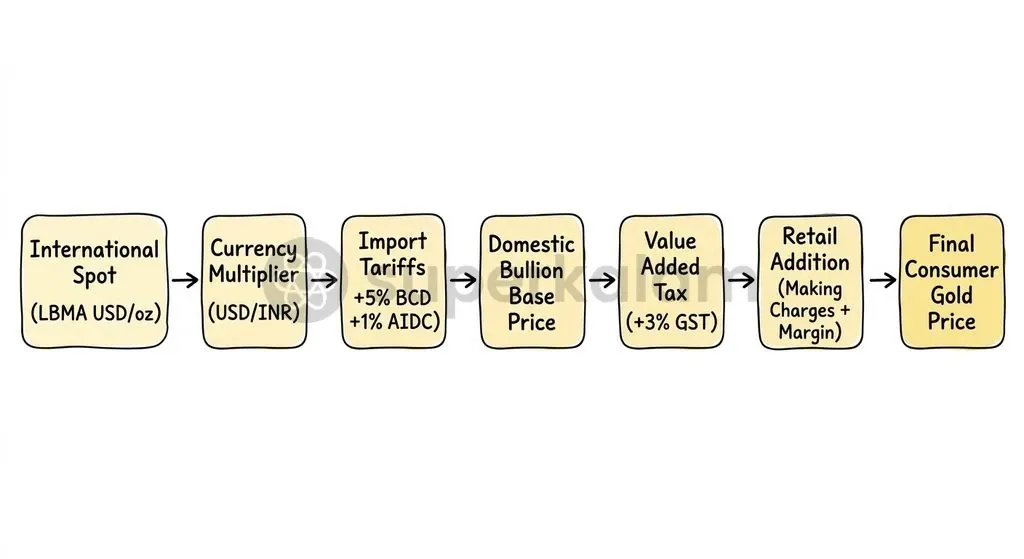
Domestic pricing follows a defined sequence across import, commodity exchange, and retail tiers:
- International Benchmark Conversion: The LBMA or COMEX dollar spot price per troy ounce is converted to Rupees per 10 grams using the prevailing USD/INR exchange rate.
- Basic Customs Duty (BCD): A statutory import duty levied under the Customs Tariff Act, currently set at 5% for gold bars.
- Agriculture Infrastructure and Development Cess (AIDC): An additional duty earmarked for agricultural logistics, fixed at 1% for gold bars.
- Integrated Goods and Services Tax (IGST): A mandatory 3% GST levy applied to the cumulative landed value including duties.
- Domestic Exchange Discovery: Contracts on the Multi Commodity Exchange incorporate local port clearance costs and bank handling charges.
| Pricing Stage | Component / Charge | Statutory or Market Basis | Impact on Consumer Price |
|---|---|---|---|
| :--- | :--- | :--- | :--- |
| Wholesale Landed Cost | International Spot + USD/INR | LBMA / COMEX benchmark via foreign exchange rate | Establishes the baseline cost of raw bullion |
| Border Tariffs | BCD (5%) + AIDC (1%) | Union Budget 2024-25 notifications under Customs Act | Adds a statutory 6% tax wedge to imported bars |
| Domestic Commodity Rate | MCX Spot / Futures Contract | Multi Commodity Exchange trading parity | Adds local liquidity premia or discounts |
| Retail Metal Value | Raw bullion rate + 3% GST | Central Goods and Services Tax framework | Forms the base price for 24-karat and 22-karat bars |
| Finished Jewellery | Making charges (8% to 25%) + 5% GST | India Bullion and Jewellers Association guidelines | Accounts for craftsmanship, design, and retail margins |
Global Triggers Behind the Fall: US Fed Stance, Dollar Strength, and Yields
The US Federal Reserve steers international bullion prices through its monetary policy stance and interest rate path. Because gold is a non-yielding asset, it provides neither coupon payments nor dividends during the holding period.
Two distinct market transmission channels drive this downward pressure:
- Rising Opportunity Cost: When sovereign paper offers elevated yields, institutional capital shifts away from precious metals. According to the Reserve Bank of India, rising benchmark interest rates and elevated US Treasury yields increase the opportunity cost of holding non-yielding bullion, which exerts persistent downward pressure on global bullion valuations.
- Dollar Denomination Drag: As documented by the World Gold Council, international bullion contracts are denominated in US dollars, meaning a strengthening dollar makes gold costlier for foreign buyers, dampening demand across non-dollar economies. When the US Dollar Index climbs, foreign buyers must commit more local currency, an affordability barrier that curbs global physical demand.
Discuss with Superkalam
Recall the exact statutory components and percentage rates that constitute the total effective customs duty on gold bars under Union Budget 2024-25.
Ask NowThe Currency Dynamic: How the Rupee-Dollar Rate Buffers Price Drops
The Reserve Bank of India monitors foreign exchange movements closely because the USD/INR currency pair is a structural shock absorber for domestic commodity pricing. When international gold prices slide in dollar terms, Rupee depreciation increases the landed rupee cost of each imported ounce. According to the Reserve Bank of India, Indian Rupee depreciation acts as a domestic price shock absorber, offsetting and dampening the pass-through of falling international gold prices into domestic retail counters.
This currency buffer creates a clear wedge between international and domestic percentage price drops:
- International Dollar Deflation: Global spot rates on COMEX may slide by 5% during an intense dollar rally.
- Domestic Currency Depreciation: The Indian Rupee depreciates against the US Dollar over the same window, raising import conversion costs.
- Net Domestic Transmission: Domestic wholesale rates on the Multi Commodity Exchange fall by only 2% to 3%, absorbing part of the global decline.
- Domestic Currency Appreciation Scenario: If the Rupee strengthens against the Dollar while international spot prices drop, domestic prices experience an amplified downward correction.
Discuss with Superkalam
Explain why gold's characteristic as a non-yielding asset makes international spot prices highly sensitive to changes in US Federal Reserve interest rates and Treasury yields.
Ask NowTariffs and Taxes: The Impact of Import Duty and Cess on Bullion
The Ministry of Finance exercises executive authority under Section 25 of the Customs Act, 1962 to modify tariff rates on precious metals in response to macroeconomic pressures. Prior to the Union Budget 2024-25, gold bars faced a combined tariff burden of 15%, comprising 10% Basic Customs Duty and 5% Agriculture Infrastructure and Development Cess. The Union Budget 2024-25 restructured these rates, lowering the Basic Customs Duty to 5% and the AIDC to 1%, establishing a total effective duty of 6%.
Tariff calibration directly reshapes formal and parallel bullion channels:
- Curtailing Grey Market Arbitrage: Reports from the Central Board of Indirect Taxes and Customs demonstrate that high tariff spreads generate pricing arbitrage that fuels unauthorized grey market smuggling networks.
- Lower Landed Wholesale Costs: Slashing statutory duties reduces landing costs directly, supporting transparent domestic price discovery.
- Encouraging Formal Inflows: Narrowing the tax spread shrinks illicit trading margins, incentivising official banking routes over cash-based parallel transactions.

From London Spot to Local Jewellers: How Retail Transmission Works
The India Bullion and Jewellers Association coordinates domestic spot pricing conventions, yet showroom price tags do not adjust instantaneously to wholesale commodity declines. Wholesale contracts on the Multi Commodity Exchange adjust to import parity within seconds, but retail jewellery showrooms face operational stickiness. The retail consumer price diverges from wholesale bullion due to the application of making charges ranging between 8% and 25%, alongside a 3% GST on the raw metal and a 5% GST on craftsmanship services.
The retail pass-through flows through four distinct pricing stages:
- International Benchmarking: Wholesale spot contracts trade on the LBMA or COMEX in US dollars per troy ounce.
- Import Parity Valuation: Dollar quotes convert at prevailing USD/INR rates, incurring 5% Basic Customs Duty and 1% AIDC.
- Domestic Wholesale Discovery: Multi Commodity Exchange futures incorporate port handling, clearance, and local liquidity spreads.
- Retail Jewellery Pricing: Showroom tags reflect showroom inventory lags, making charges (8% to 25%), 3% GST on metal, and 5% GST on craftsmanship.
(Structural transmission pipeline from global trading desks to domestic jewellery retail counters.)
A noticeable transmission lag separates wholesale price drops from consumer price tags. The World Gold Council notes that retail jewellers hold physical inventory purchased at prior price points, relying on forward price hedges and operating margins that delay immediate consumer-facing discounts. Showrooms lower retail sticker prices gradually to protect inventory margins, unless fierce local competition forces an immediate write-down.
Discuss with Superkalam
Analyse how a sharp depreciation of the Indian Rupee would alter the price pass-through if international gold prices were simultaneously falling on the COMEX exchange.
Ask NowMacroeconomic Fallout: Current Account Deficit, Household Wealth, and SGBs
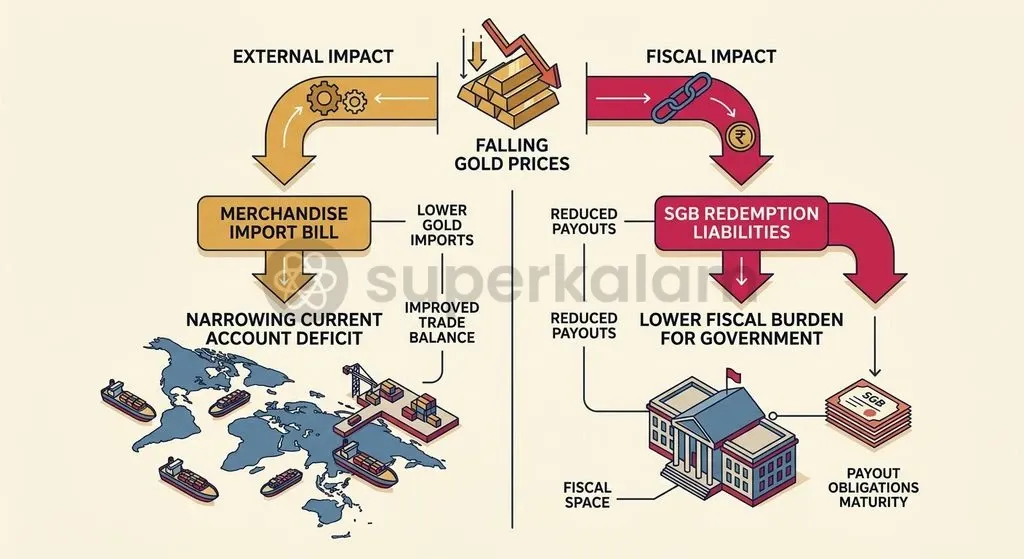
The Ministry of Commerce and Industry categorises gold as India's second largest merchandise import expense after crude petroleum, directly affecting the trade balance and Current Account Deficit. India relies on foreign shipments to meet nearly all domestic bullion consumption. According to the Reserve Bank of India, a sustained drop in landed gold prices reduces merchandise import expenditure, easing foreign currency outflows and containing the Current Account Deficit as a proportion of Gross Domestic Product.
| Macroeconomic Channel | Operational Transmission | Policy & Economic Outcome |
|---|---|---|
| :--- | :--- | :--- |
| External Trade Balance | Lower dollar outlays on physical bullion shipments | Narrows merchandise trade deficit and curbs CAD pressure |
| Fiscal Liabilities (SGBs) | Lower IBJA benchmark averages at scheduled redemption windows | Reduces government budgetary outlay on maturing sovereign tranches |
| Household Balance Sheets | Reduced nominal collateral valuations on private gold holdings | Moderates speculative hoarding and redirects marginal savings into financial assets |
(Macroeconomic feedback channels of softening bullion prices across external and domestic accounts.)
Domestic balance sheets experience parallel adjustments across household savings portfolios and public finance liabilities:
- Household Wealth Effect: World Gold Council research estimates that Indian households and religious trusts hold a cumulative private stock of approximately 25,000 tonnes of physical gold. Falling domestic prices moderate the nominal value of this collateral, altering household borrowing capacity against pledged gold ornaments.
- Financialisation of Savings: Declines in physical gold prices can spur seasonal festive purchases while dampening speculative hoarding. According to the Reserve Bank of India, sustained price corrections moderate real estate and gold wealth perceptions, encouraging households to direct marginal savings toward bank deposits, mutual funds, and equities.
- Fiscal Relief on Sovereign Gold Bonds: The Government of India benefits structurally during SGB redemption cycles when domestic prices drop. Under the Sovereign Gold Bond Scheme, the Reserve Bank of India determines the redemption price using the simple average of closing prices for 999 purity gold published by the India Bullion and Jewellers Association over the preceding three business days. Lower domestic gold benchmarks reduce the Department of Economic Affairs' budgetary outlay on maturing bonds and early exit windows.
Discuss with Superkalam
Evaluate the macroeconomic trade-off between reducing customs duty to curb parallel grey-market smuggling and the potential risk of worsening India's Current Account Deficit.
Ask NowThe Road Ahead: Managing Bullion Demand and Financial Stability
The Reserve Bank of India and the Ministry of Finance face the ongoing task of harmonising external account stability with domestic consumer appetite. Sustained price corrections grant immediate balance-of-payments relief by curbing aggregate import bills. Even so, policymakers must ensure that lower prices do not ignite a volume-driven import surge that neutralises foreign exchange gains.
Sustaining economic stability while managing bullion flows requires targeted policy coordination:
- Suppressing Illicit Smuggling: Maintaining competitive tariff structures under the Customs Act is essential to suppressing illicit smuggling rings and channelling physical demand through regulated channels.
- Expanding Paper Alternatives: Financial regulators must promote paper-based gold alternatives to decouple Indian wealth accumulation from physical imports.
- Recalibrating Public Liabilities: While the Sovereign Gold Bond Scheme exposed public accounts to international price rallies, lower price environments offer an opportunity to recalibrate domestic gold financialisation frameworks.
- Deepening Capital Formation: Channelling household capital into dematerialised bullion instruments, mutual funds, and bank deposits strengthens domestic capital formation without straining the national trade balance.
Key Takeaways
- Global Monetary Drivers: Rising US Treasury yields and high Federal Reserve policy rates elevate the opportunity cost of holding non-yielding bullion, while a strong US Dollar Index dampens global demand.
- Domestic Tariff Interventions: The Union Budget 2024-25 reduced effective customs duties on gold bars from 15% to 6% (5% Basic Customs Duty and 1% AIDC), which lowered domestic wholesale prices and curtailed illicit smuggling.
- Currency Pass-Through: Depreciation of the Indian Rupee against the US Dollar acts as a structural shock absorber, dampening the domestic retail impact of international dollar price declines.
- Retail Pricing Divergence: Retail jewellery prices differ from wholesale bullion due to making charges (8% to 25%), 3% GST on precious metals, 5% GST on craftsmanship, and showroom inventory holding lags.
- Macroeconomic and Fiscal Repercussions: Softening gold prices reduce India's merchandise import bill, narrow the Current Account Deficit, and lower the Union Government's redemption liabilities under the Sovereign Gold Bond Scheme.
Mains Question
"According to the Reserve Bank of India, Indian Rupee depreciation acts as a domestic price shock absorber, offsetting and dampening the pass-through of falling international gold prices into domestic retail counters." Elucidate. (10 Marks)
Evaluate NowMains Question
The Ministry of Finance, under Notification No. 30/2024-Customs, rationalised the effective customs duty on gold bars from 15% to 6%. Critically analyse the implications of this executive tariff reduction on India's external trade balance, illicit parallel markets, and sovereign liabilities. (15 Marks)
Evaluate NowPractice MCQs
QUESTION 1
With reference to the statutory tariff structure on imported gold bars following the Union Budget 2024-25, consider the following statements:
- The Basic Customs Duty (BCD) on gold bars is levied at 5%.
- The Agriculture Infrastructure and Development Cess (AIDC) on gold bars is fixed at 1%.
- The Integrated Goods and Services Tax (IGST) is levied at 5% on the cumulative landed value. Which of the statements given above is/are correct?
QUESTION 2
Consider the following statements regarding the influence of foreign exchange rates on domestic gold prices in India:
- Indian Rupee depreciation against the US Dollar dampens the domestic pass-through of falling international spot prices.
- When the Indian Rupee appreciates against the US Dollar alongside a drop in international spot prices, the domestic price decline is amplified.
- Domestic wholesale prices on the Multi Commodity Exchange automatically decline at double the percentage drop of international spot prices during rupee depreciation. Which of the statements given above are correct?
QUESTION 3
Regarding the global determinants of bullion valuations, consider the following statements:
- As gold is a non-yielding asset, elevated benchmark interest rates and rising US Treasury yields increase the opportunity cost of holding it.
- Because international bullion contracts are dollar-denominated, a stronger US Dollar Index dampens physical demand across non-dollar economies.
- In international benchmark trading, one standard troy ounce is precisely equal to 31.1035 grams. Which of the statements given above are correct?
QUESTION 4
With reference to the executive reduction of customs duties on gold notified under Section 25 of the Customs Act, 1962, consider the following statements:
- The total effective customs duty on gold bars was reduced from 15% to 6% under Notification No. 30/2024-Customs.
- Narrowing the import tariff spread eliminates domestic grey market price arbitrage and incentivises formal banking channels.
- The tariff reduction automatically mandates local jewellers to waive all retail making charges. Which of the statements given above is/are correct?
QUESTION 5
According to the Ministry of Commerce and Industry as cited in the article, what is the position of gold in India's merchandise import expenditure?