WHO Pandemic Agreement: PABS, Provisions and India
The WHO Pandemic Agreement was adopted in May 2025. Read its provisions, the PABS system, ratification requirements and India's position.
Oct, 2026
•10 min read
Overview
The World Health Organization adopted the landmark Pandemic Agreement in May 2025 under Article 19 of the WHO Constitution. The goal is simple: stop a repeat of the stark inequities of COVID-19.
The pact creates multilateral systems for pathogen surveillance, medical logistics, and global supply chains.
Yet its core promise remains vulnerable. Dismantling vaccine apartheid depends heavily on non-binding technology transfer rather than compulsory licensing. Real success will hinge on equitable benefit-sharing that stops wealthy states from cornering life-saving supplies in future crises.
Why in the News: The Push to Finalize the WHO Pandemic Agreement
On 20 May 2025, the World Health Assembly passed the WHO Pandemic Agreement under Resolution WHA78.1.
Member states negotiated the text under Article 19 of the WHO Constitution, which empowers the assembly to craft legally binding conventions. It is only the second binding treaty under Article 19 in WHO history, following the 2003 Framework Convention on Tobacco Control.
Adoption, however, does not mean immediate execution. Two procedural conditions under Article 31 govern the rollout:
- Negotiating the annex: signatures cannot commence until delegates negotiate and adopt the formal Pathogen Access and Benefit-Sharing Annex.
- Ratification threshold: As of May 2025, the treaty enters into force thirty days after the deposit of the sixtieth instrument of ratification pursuant to Article 33.
Discuss with Superkalam
Which provision of the WHO Constitution empowers the World Health Assembly to adopt binding conventions, and what was the first treaty created under it?
Ask NowRoots of the Treaty: COVID-19 Inequities and the Push for Reform
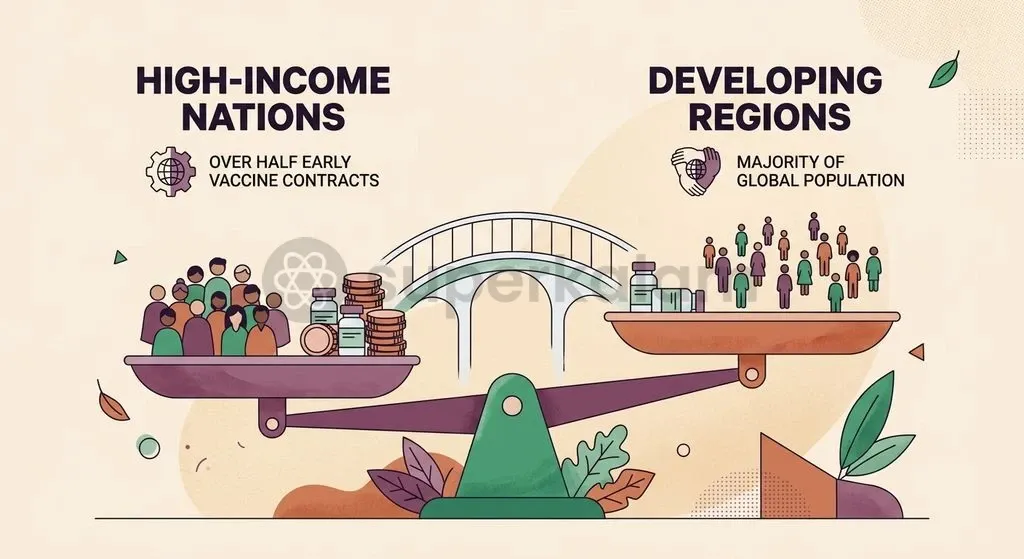
The COVID-19 pandemic split the globe along income lines. Wealthy capitals quickly secured bilateral advance deals for diagnostic kits, therapies, and vaccines, leaving poorer populations stranded outside the queue.
The emergency exposed two deep structural imbalances:
- Advance purchase agreements: high-income countries representing just 14% of the global population cornered over 53% of early vaccine production contracts. WHO Director-General Dr Tedros Adhanom Ghebreyesus condemned this disparity as vaccine apartheid and warned that market-driven hoarding represented a catastrophic moral failure.
- Voluntary funding bottlenecks: the COVAX Facility attempted to pool global procurement but failed to guarantee timely access for low- and middle-income nations. Because the mechanism depended on voluntary donations and charitable financing rather than binding allocation rights, manufacturers prioritised lucrative bilateral contracts with wealthy governments.
To repair these fractures, the World Health Assembly convened a Special Session in December 2021. Delegates adopted Decision SSA2(5) to create the Intergovernmental Negotiating Body charged with drafting a binding global treaty.
Key Provisions: What the Draft Pandemic Agreement Actually Proposes
The WHO Pandemic Agreement lays out a formal architecture to manage future health emergencies across the human, animal, and environmental interfaces.
The framework anchors cooperation across four central pillars:
- One Health Surveillance (Article 5): Member states commit to integrating surveillance across human, animal, and environmental health sectors to detect emerging zoonotic threats before spillover occurs.
- Pathogen Access and Benefit-Sharing System (Article 12): Countries agree to share biological samples and genetic sequence data on pathogens with pandemic potential in exchange for guaranteed, real-time access to vaccines and treatments.
- Global Supply Chain Network (Article 13): The agreement creates the WHO Global Supply Chain and Logistics Network to coordinate international stockpiles, streamline logistics, and discourage national export restrictions during emergencies.
- Coordinating Financial Mechanism (Article 20): A dedicated financial structure pools resources to help developing countries build laboratory capacity, workforce readiness, and genomic sequencing infrastructure.
Alongside the treaty, the Seventy-seventh World Health Assembly adopted targeted revisions to the International Health Regulations (2005) in June 2024 through Resolution WHA77.17. These amendments added a formal alert category called a Pandemic Emergency to spur early international mobilisation.
| Dimension | International Health Regulations (2005, amended 2024) | WHO Pandemic Agreement (Resolution WHA78.1) |
|---|---|---|
| Legal Basis | Article 21 of WHO Constitution (Regulations) | Article 19 of WHO Constitution (Convention/Treaty) |
| Primary Focus | Surveillance, border health measures, and emergency declaration | Structural equity, supply chains, financing, and manufacturing capacity |
| Key Trigger | Public Health Emergency of International Concern / Pandemic Emergency | Operationalised through intergovernmental mechanisms and the PABS system |
| Intellectual Property | Silent on patent waivers and technology transfers | Promotes voluntary licensing and reaffirms TRIPS flexibilities |
Discuss with Superkalam
How does the proposed 'pathogens in, products out' framework under Article 12 seek to correct past inequities in global health emergencies?
Ask NowThe PABS Mechanism: Will Sharing Virus Samples Guarantee Fair Vaccine Access?
Article 12 introduces the Pathogen Access and Benefit-Sharing System to connect biological surveillance with medical countermeasures.
Developing countries have long shared viral data freely through open repositories. Yet Western pharmaceutical firms routinely patented the resulting formulations, pricing out the very states that supplied the source material. Seeking parity, the Group for Equity, which includes India, pushed for an operational compact built on pathogens in, products out.
This wariness stems from recent crises:
- Avian influenza (H5N1) in 2007: Indonesia halted the sharing of avian influenza (H5N1) samples after commercial firms patented foreign vaccines from Indonesian strains without providing affordable supplies.
- Omicron variant in 2021: when South African scientists identified and reported the Omicron variant of SARS-CoV-2, high-income nations imposed punitive travel restrictions on southern African states instead of delivering proportional vaccine allocations.
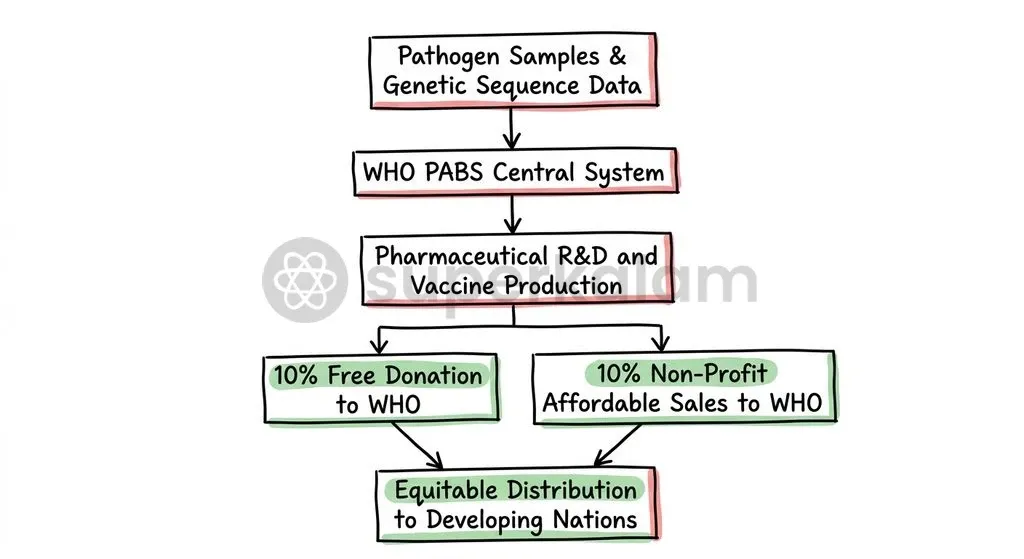
To bridge this divide, the draft PABS system establishes a fixed production quota. Manufacturers using the PABS repository must reserve 20% of real-time production of pandemic countermeasures for the WHO:
- 10% as free donations for vulnerable populations.
- 10% at affordable, non-profit prices for distribution to developing nations.
Global North vs Global South: The Battle Over Intellectual Property and Funding
Talks within the Intergovernmental Negotiating Body revealed deep ideological rifts between industrialised economies and the Global South.
The dispute centred on two conflicting models:
- The Global North position: the European Union, the United States, and Switzerland vigorously defended private intellectual property protections, arguing that mandatory patent sharing would undermine commercial investment in medical research.
- The Global South stance: developing nations countered that treating life-saving countermeasures as speculative market commodities guarantees artificial scarcity during global health emergencies.
The resulting text in Article 11 reflects a diplomatic compromise. Instead of requiring mandatory technology transfers, the agreement merely encourages patent holders to grant non-exclusive voluntary licences on mutually agreed terms. It retains, however, essential domestic public health safeguards under Article 11(4), reaffirming the TRIPS Agreement and Doha Declaration.
Geopolitical rifts widened the gap. The United States served formal notice to withdraw from the World Health Organization and dissociated from final negotiation rounds in early 2025, leaving future funding and global enforcement uncertain.
Discuss with Superkalam
If a developing country shares genomic data on a newly emerging pathogen today, how would the PABS quota ensure it receives medical countermeasures?
Ask NowIndia's Stand: Defending Affordable Generic Drugs and Sovereign Policy Space
India shaped its negotiating stance through the Ministry of Health and Family Welfare, protecting domestic generic manufacturers while championing international equity.
As the world's leading supplier of affordable generic drugs, India insisted that sharing pathogen samples must require reciprocal countermeasure access. India prioritised three main demands:
- Common But Differentiated Responsibilities: India advocated applying the Principle of Common But Differentiated Responsibilities to international health governance, warning that developing nations must not shoulder costly surveillance burdens without matching technical assistance.
- Guaranteed reciprocal access: speaking at the United Nations High-Level Meeting on Pandemic Prevention, Preparedness, and Response in September 2026, India's delegation stressed that the accord requires guaranteed reciprocal access for nations providing genomic information. Indian representatives rejected unconditional data transfers that generate commercial profits abroad while domestic populations face shortages.
- Decentralised manufacturing and TRIPS flexibilities: Indian policy advocates establishing regional manufacturing hubs across developing states rather than relying on concentrated foreign supply chains. By preserving compulsory licensing rights under the Doha Declaration on Public Health, India safeguarded its sovereign capacity to manufacture essential diagnostics and treatments during emergency declarations.
Paper Shield or Real Enforcement? The Flaw of Non-Binding Commitments
Legal scholars question whether the Pandemic Agreement can compel pharmaceutical conglomerates during an acute global crisis.
Two structural shortcomings weaken the accord's legal teeth:
- Hortatory phrasing over statutory mandates: the treaty relies primarily on aspirational phrasing rather than enforceable statutory mandates. When provisions instruct governments only to promote voluntary measures on mutually agreed terms, sovereign states retain discretion to prioritise domestic stockpiles over international allocations.
- Absence of punitive sanctions: the text lacks punitive sanctions for governments that break supply chain commitments or corner pharmaceutical supply contracts. The COVAX initiative demonstrated that voluntary pledges collapse whenever domestic political pressures prompt wealthy nations to sign exclusive procurement deals. Without independent oversight bodies or mandatory dispute panels, the treaty risks becoming an aspirational compact that falters when market pressures mount.
The Ethical Dimension: Global Public Goods Versus Commercial Monopolies
The debate over pandemic supplies reflects competing philosophical visions of distributive justice and basic human welfare.
Two core ethical principles define this divide:
- Rawlsian distributive justice: philosopher John Rawls articulated the difference principle, which asserts that institutional systems are just only if they improve the condition of the least advantaged members of society. Applying this standard to health governance requires treating vaccines as Global Public Goods rather than speculative commodities subject to commercial bidding.
- Public funding versus commercial monopolies: taxpayers across multiple nations funded basic research for COVID-19 vaccines, yet commercial manufacturers retained exclusive patents that restricted low-cost production in Africa, Asia, and Latin America. Denying developing nations the legal right to manufacture life-saving treatments compromises the universal right to health and institutionalises systemic vulnerability across borders.
Way Forward: Building an Enforceable and Fair Global Health Compact
Turning the WHO Pandemic Agreement into an effective treaty requires bridging the gap between aspirational language and operational delivery.
Three concrete reforms can turn promises into practice:
- Binding PABS terms: member states must define concrete rules within the Pathogen Access and Benefit-Sharing Annex to ensure that data sharing leads directly to guaranteed production shares. Low- and middle-income nations must insist that pathogen registries transfer samples only to commercial entities that sign binding benefit-sharing contracts.
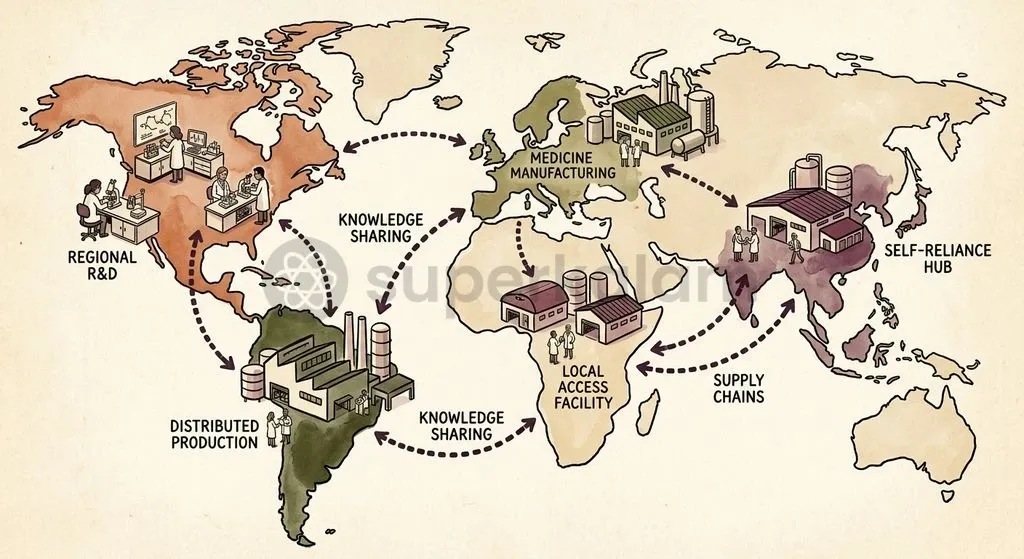
- Regional industrial diversification: global health governance must diversify industrial capacity by establishing regional manufacturing hubs across Latin America, Africa, and Southeast Asia. Relying exclusively on centralised European or North American facilities leaves supply networks vulnerable to national export controls during emergencies. Multilateral institutions must deploy the Coordinating Financial Mechanism established under Article 20 to fund regional research centres and technology transfers.
- Asserting sovereign IP safeguards: governments must use domestic patent safeguards under the TRIPS Agreement and Doha Declaration whenever private developers refuse voluntary licences during emergencies. Establishing pre-negotiated patent pools and open-science platforms will protect developing economies from the monopolistic bottlenecks that prolonged the COVID-19 pandemic.
Discuss with Superkalam
What are the key structural and legal differences between the amended International Health Regulations (2005) and the WHO Pandemic Agreement?
Ask NowKey Takeaways
- The Seventy-eighth World Health Assembly adopted the WHO Pandemic Agreement on 20 May 2025 through Resolution WHA78.1, making it the second legally binding convention formulated under Article 19 of the WHO Constitution following the 2003 Framework Convention on Tobacco Control.
- Signatures remain paused under Article 31 until member states finalise the Pathogen Access and Benefit-Sharing Annex, with entry into force requiring sixty state ratifications under Article 33.
- Article 12 establishes the PABS mechanism, which requires manufacturers using public pathogen registries to allocate 20% of real-time production to the WHO (10% as free donations and 10% at affordable non-profit rates).
- Article 11 reflects ongoing North-South friction by using non-binding terms that encourage voluntary licensing, though Article 11(4) explicitly reaffirms the use of TRIPS flexibilities and the 2001 Doha Declaration.
- India's negotiating position, reaffirmed at the UN in September 2026, emphasises Common But Differentiated Responsibilities, reciprocal countermeasure access, and protection for domestic generic pharmaceutical capacity.
Mains Question
'The Pathogen Access and Benefit-Sharing (PABS) System seeks to replace voluntary charity with an institutional compact of "pathogens in, products out".' In this context, evaluate the efficacy of the benefit-sharing mechanisms proposed under the WHO Pandemic Agreement. (10 Marks)
Evaluate NowMains Question
"Dismantling global 'vaccine apartheid' requires reconciling intellectual property rights with the principle of Common But Differentiated Responsibilities." Critically analyse India's negotiating stance and the structural challenges within the WHO Pandemic Agreement. (15 Marks)
Evaluate NowPractice MCQs
QUESTION 1
Regarding the WHO Pandemic Agreement adopted under Resolution WHA78.1, consider the following statements:
- It was adopted under Article 19 of the WHO Constitution as a legally binding convention.
- It represents the first legally binding treaty ever adopted under Article 19 in WHO history.
- The treaty enters into force thirty days following the deposit of the sixtieth instrument of ratification. Which of the statements given above is/are correct?
QUESTION 2
Consider the following statements regarding the Pathogen Access and Benefit-Sharing (PABS) System under Article 12 of the WHO Pandemic Agreement:
- It requires manufacturers utilizing the PABS repository to reserve 20% of real-time production of pandemic countermeasures for the WHO.
- Half of the reserved production quota is earmarked as free donations for vulnerable populations.
- The remaining half of the quota is allocated at affordable, non-profit prices for distribution to developing nations. Which of the statements given above are correct?
QUESTION 3
With reference to global health governance instruments, consider the following statements:
- The International Health Regulations (2005) derive legal authority from Article 21 of the WHO Constitution, whereas the Pandemic Agreement derives authority from Article 19.
- The 2024 amendments to the International Health Regulations introduced a formal alert category termed 'Pandemic Emergency'.
- The International Health Regulations mandate compulsory patent waivers and compulsory technology transfers during health crises. Which of the statements given above is/are correct?
QUESTION 4
Consider the following statements regarding the negotiating positions and provisions on Intellectual Property (IP) in the WHO Pandemic Agreement:
- Article 11 mandates compulsory technology transfers and automatic patent waivers for pandemic countermeasures.
- Article 11(4) reaffirms domestic public health safeguards under the TRIPS Agreement and the Doha Declaration.
- The European Union, the United States, and Switzerland argued that mandatory patent sharing would undermine commercial investment in medical research. Which of the statements given above is/are correct?
QUESTION 5
Which of the following bodies was established by the World Health Assembly under Decision SSA2(5) in December 2021 to draft the WHO Pandemic Agreement?