What is VRRR? Variable Rate Reverse Repo and RBI Liquidity Explained
Variable Rate Reverse Repo (VRRR) lets the RBI absorb surplus bank liquidity at an auction-set rate. How it works within the LAF, with the latest Rs 71,971 crore auction.
Sep, 2026
•8 min read

Overview
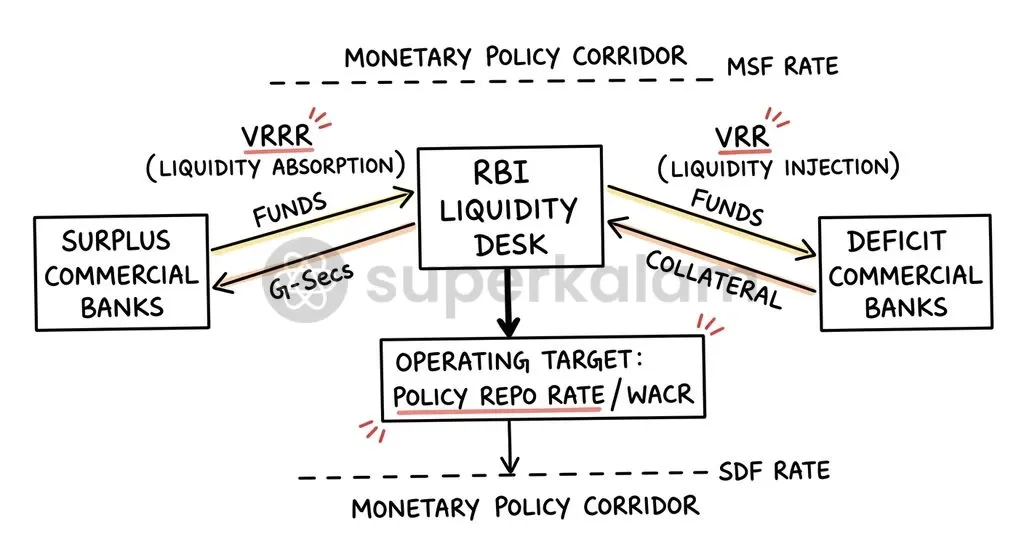
The Variable Rate Reverse Repo is the market-determined liquidity absorption mechanism of the Reserve Bank of India. It draws temporary surplus funds from commercial banks through competitive auctions against government securities to align interbank lending rates with the policy repo rate.
According to the Revised Liquidity Management Framework released by the Reserve Bank of India, the central bank uses these auctions to steer the overnight Weighted Average Call Rate, the operating target of monetary policy. Operating within a symmetric 50 basis point corridor, fine-tuning reverse repo operations absorb frictional liquidity generated by government expenditure or foreign exchange interventions.
This operational agility prevents money market rates from collapsing towards the Standing Deposit Facility floor. Consequently, the stance of monetary policy transmits cleanly into broader borrowing costs and economic demand.
Why in the News? The Recent Overnight VRRR Auction
The Reserve Bank of India conducted an overnight Variable Rate Reverse Repo auction on 23 September 2026 to absorb emerging surplus liquidity from the domestic banking system. As of September 2026, the central bank offered a notified amount of ₹75,000 crore, drawing substantial interest with commercial banks submitting total offers worth ₹87,993 crore.
Temporary liquidity expansions often stem from lumpy central government spending, treasury bill redemptions, and institutional deposit accumulations. Conducting this 1-day auction allowed the monetary authority to mop up excess cash before it depressed short-term money market rates below the intended policy trajectory.
What Is Variable Rate Reverse Repo (VRRR)?
A Variable Rate Reverse Repo is an auction-based liquidity absorption tool operated under the Reserve Bank of India's Liquidity Adjustment Facility. Commercial banks park their surplus funds with the central bank for designated tenors in exchange for eligible government securities as collateral, as outlined in the Reserve Bank of India's Revised Liquidity Management Framework. Unlike fixed-rate windows, interest rates in a VRRR are discovered competitively through an auction process.
| Policy Corridor Level | Operating Facility | Spread Relative to Repo Rate |
|---|---|---|
| Ceiling | Marginal Standing Facility (MSF) | +25 bps |
| Centre Target | Policy Repo Rate | Benchmark anchor |
| Floor | Standing Deposit Facility (SDF) | -25 bps |
The monetary policy architecture relies on a symmetric 50 basis point corridor to maintain price stability and orderly market conditions. The policy repo rate sits at the exact centre of this framework. The Standing Deposit Facility operates at 25 bps below the repo rate to provide the non-collateralised absorption floor, while the Marginal Standing Facility sits at 25 bps above the repo rate as the borrowing ceiling.
Discuss with Superkalam
What are the three structural levels defining the RBI's symmetric 50 basis point policy corridor?
Ask NowHow the VRRR Auction Mechanism Works
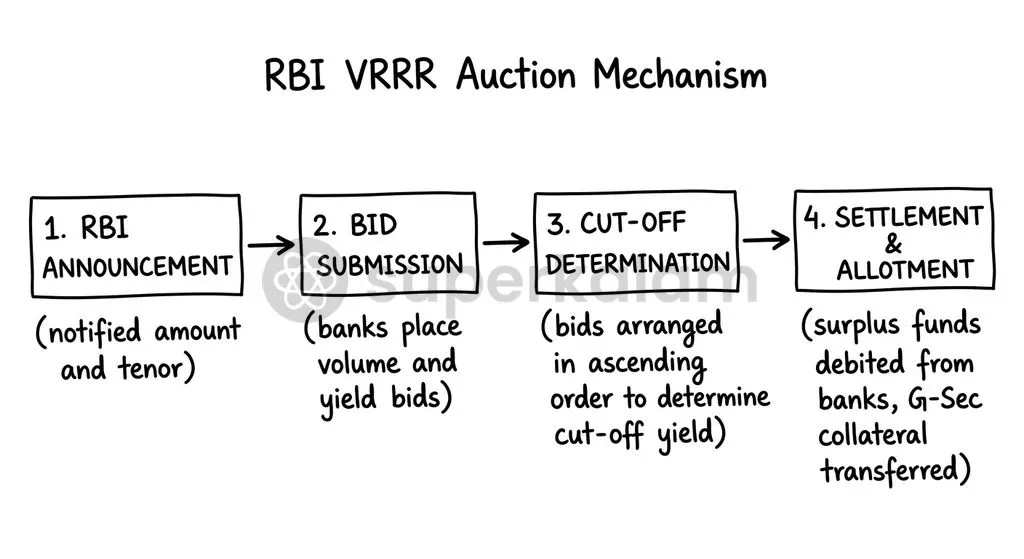
The Reserve Bank of India conducts Variable Rate Reverse Repo auctions through a competitive bidding process where scheduled commercial banks submit targeted volume and interest rate bids. The auction mechanism follows a sequential operational workflow:
- Advance Announcement: Barring exceptional intraday developments, the central bank provides at least one day of advance notice before conducting discretionary repo or reverse repo auctions.
- Bid Submission: Scheduled commercial banks submit electronic bids specifying the quantum of funds they wish to park and their acceptable return rates.
- Cut-off Determination: Central bank managers arrange bids in ascending order of interest rates, establishing a market-clearing cut-off rate up to the pre-notified absorption ceiling.
- Allotment and Settlement: Bids submitted at or below the cut-off rate receive allotments, after which the Reserve Bank of India transfers sovereign securities as collateral into the participating banks' accounts.
Comparing Liquidity Tools: VRRR vs Fixed Reverse Repo vs SDF
The Liquidity Adjustment Facility contains distinct absorption instruments including the Variable Rate Reverse Repo, Fixed Rate Reverse Repo, and the Standing Deposit Facility. Understanding the structural differences among these facilities is essential for analysing how liquidity operations interact with interbank markets.
| Operational Feature | Variable Rate Reverse Repo (VRRR) | Fixed Rate Reverse Repo | Standing Deposit Facility (SDF) |
|---|---|---|---|
| Collateral Backing | Fully collateralised with eligible government securities | Fully collateralised with eligible government securities | Uncollateralised absorption requiring no sovereign securities |
| Rate Determination | Market-discovered via competitive auction bidding | Fixed administrative rate linked to the policy corridor | Fixed administrative rate set at 25 bps below repo rate |
| Discretion & Access | Central bank discretion regarding timing and volume | Central bank discretion under legacy operations | Bank-driven standing facility accessible on demand |
| Primary Role | Dynamic fine-tuning and term liquidity absorption | Legacy absorption framework | Automatic, continuous absorption floor for the system |
| Tenor Range | Overnight up to 14 days | Fixed overnight window | Overnight standing facility |
Discuss with Superkalam
How does absorbing surplus cash through overnight VRRR auctions prevent the Weighted Average Call Rate from drifting towards the Standing Deposit Facility floor?
Ask NowWhy RBI Uses Overnight and Fine-Tuning VRRRs
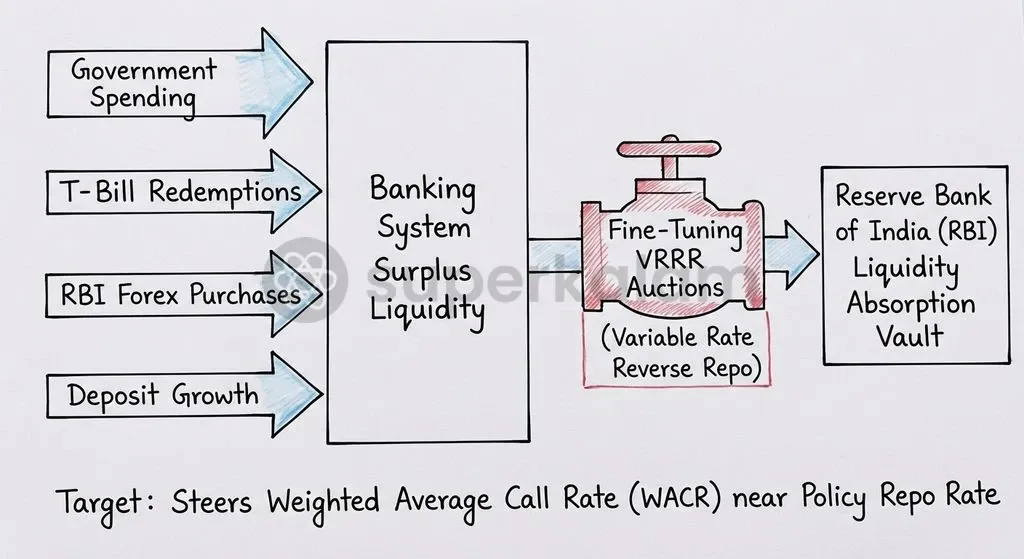
Central bank liquidity managers use fine-tuning Variable Rate Reverse Repo auctions to swiftly neutralise sudden, transient liquidity imbalances in the interbank market. Systemic cash reserves fluctuate frequently due to distinct seasonal and fiscal drivers documented in the Reserve Bank of India Bulletin:
- Government Expenditure Surges: Large releases of state and central budgetary outlays deposit sudden cash flows into commercial bank balances.
- Treasury Redemptions: Maturing government bonds and treasury bills inject immediate liquidity into institutional balance sheets.
- Foreign Exchange Interventions: Central bank purchases of foreign currency inject domestic rupee reserves into the banking network.
- Seasonal Deposit Accretions: Periodic surges in household and corporate savings expand commercial bank deposit bases.
The Revised Liquidity Management Framework finalised on 30 September 2025 reshaped this operating architecture. The central bank discontinued the mandatory 14-day VRR and VRRR operations as the primary anchor tools. Instead, it manages transient liquidity primarily through 7-day operations and flexible fine-tuning auctions ranging from overnight to 14 days.
How VRRR Affects Bank Lending, Call Rates, and Inflation
The Weighted Average Call Rate is the operating target of monetary policy, guiding broader credit costs and inflation dynamics across the Indian economy. When surplus liquidity accumulates unchecked, interbank lending rates plunge toward the Standing Deposit Facility floor. This rate drift weakens the transmission of the Monetary Policy Committee's policy rate decisions.
The transmission sequence moves through clearly defined stages:
- Surplus Absorption: Overnight VRRR auctions pull unallocated cash balances out of commercial banks.
- Call Rate Hardening: Removing excess reserves creates competitive upward pressure, anchoring the call rate close to repo.
- Benchmark Transmission: A firm overnight rate transmits predictably into Treasury bill yields, commercial paper pricing, and external benchmark lending rates.
- Macroeconomic Stability: By preventing unanchored short-term lending, the central bank maintains financial conditions aligned with inflation and growth targets.
Discuss with Superkalam
Compare why a commercial bank treasury desk might choose the Standing Deposit Facility window over participating aggressively in a competitive VRRR auction.
Ask NowKey Hurdles in Liquidity Management and Rate Transmission
Commercial banks often exhibit uneven participation in Variable Rate Reverse Repo auctions due to structural and frictional market imbalances. Even when systemic liquidity appears broadly in surplus, the distribution of surplus cash across lenders is rarely uniform.
Liquidity management confronts three main operational frictions:
- Asymmetric Liquidity Distribution: Public sector banks frequently hold the bulk of government deposits, while private lenders face structural cash deficits.
- Settlement and Clearing Caution: Treasury desks hold precautionary cash buffers to meet unexpected evening payment obligations or intraday tax settlements.
- Convenience of the SDF Window: Banks often prefer parking surplus cash in the on-demand uncollateralised SDF window rather than bidding aggressively in competitive VRRR auctions.
To manage these frictions, the central bank regularly conducts simultaneous fine-tuning injections and absorptions. It deploys variable repo and reverse repo auctions in the same period to balance interbank cash disparities.
The Way Forward for Monetary Policy Operations
The Reserve Bank of India requires continuous refinement of auction predictability and interbank distribution mechanisms to strengthen monetary transmission across varying liquidity cycles. Strengthening the efficacy of fine-tuning operations depends on clear policy sequencing:
- Maintaining Advance Communication: Providing at least one day of advance notice for discretionary auctions minimises uncertainty and enables treasury managers to budget liquidity efficiently.
- Calibrating Tenor Flexibility: Balancing standard 7-day operations with overnight and multi-day fine-tuning tenors ensures rapid responsiveness to unpredictable fiscal flows.
- Refining Coordinated Operations: Deploying simultaneous injection and absorption auctions resolves structural distribution asymmetries without distorting headline liquidity signals.
Discuss with Superkalam
Propose operational measures the central bank can undertake to resolve liquidity distribution asymmetries between public and private sector banks.
Ask NowKey Takeaways
- The Variable Rate Reverse Repo is a market-driven, collateralised liquidity absorption tool operated under the Reserve Bank of India's Liquidity Adjustment Facility.
- The operating target of monetary policy is the overnight Weighted Average Call Rate, which the central bank steers within a symmetric 50 basis point corridor.
- On 30 September 2025, the Revised Liquidity Management Framework discontinued the 14-day operation as the primary anchor, relying on 7-day operations alongside flexible overnight to 14-day fine-tuning auctions.
- On 23 September 2026, the central bank absorbed short-term liquidity through an overnight VRRR auction with a notified amount of ₹75,000 crore, receiving ₹87,993 crore in bank offers.
- Unlike the Standing Deposit Facility which absorbs funds without collateral on demand, VRRR requires eligible government securities as collateral through competitive rate bidding.
Mains Question
"Fine-tuning operations under the Liquidity Adjustment Facility are critical to aligning the operating target of monetary policy with the policy repo rate." In light of the Reserve Bank of India's Revised Liquidity Management Framework, elucidate. (10 Marks)
Evaluate NowMains Question
"Asymmetric liquidity distribution and operational frictions among commercial banks pose significant challenges to the transmission of monetary policy." Critically analyse how the Reserve Bank of India balances liquidity absorption and injection tools to address these impediments. (15 Marks)
Evaluate NowPractice MCQs
QUESTION 1
Regarding the monetary policy corridor and liquidity management operations of the Reserve Bank of India (RBI), consider the following statements:
- The policy repo rate serves as the central anchor within a symmetric 50 basis point policy corridor.
- The Standing Deposit Facility (SDF) forms the floor of the corridor and requires sovereign securities as collateral.
- The Marginal Standing Facility (MSF) is set at 25 basis points above the policy repo rate.
Which of the statements given above are correct?
QUESTION 2
Consider the following statements regarding the Variable Rate Reverse Repo (VRRR) auction mechanism:
- VRRR operations are auction-based and market-determined liquidity absorption tools backed by government securities.
- In a VRRR auction, the RBI arranges bids in ascending order of interest rates to determine a market-clearing cut-off rate.
- Under the Revised Liquidity Management Framework, mandatory 14-day operations remain the primary anchor tool for managing liquidity.
Which of the statements given above is/are correct?
QUESTION 3
Which of the following factors can lead to temporary surplus liquidity expansions in the domestic banking system?
- Surges in central and state government expenditures
- Treasury bill and government bond redemptions
- Foreign currency purchases by the Reserve Bank of India
Select the correct answer using the code given below:
QUESTION 4
Consider the following statements comparing the Standing Deposit Facility (SDF) and the Variable Rate Reverse Repo (VRRR):
- While the SDF is a bank-driven standing facility accessible on demand, VRRR operations are conducted at the discretion of the RBI regarding timing and volume.
- The interest rate under SDF is dynamically discovered through competitive bidding, whereas VRRR carries a fixed administrative rate.
Which of the statements given above is/are correct?
QUESTION 5
Under the Reserve Bank of India's liquidity framework, what is the operating target of monetary policy that VRRR operations aim to steer?