Ayushman Bharat PM-JAY at 8 Years: Eligibility, Coverage and Gaps
PM-JAY at 8 years: Rs 5 lakh cashless cover per family a year, SECC-based eligibility, the 70+ expansion, 60:40 Centre-State funding and the outpatient-cost gap.
Sep, 2026
•9 min read
Overview
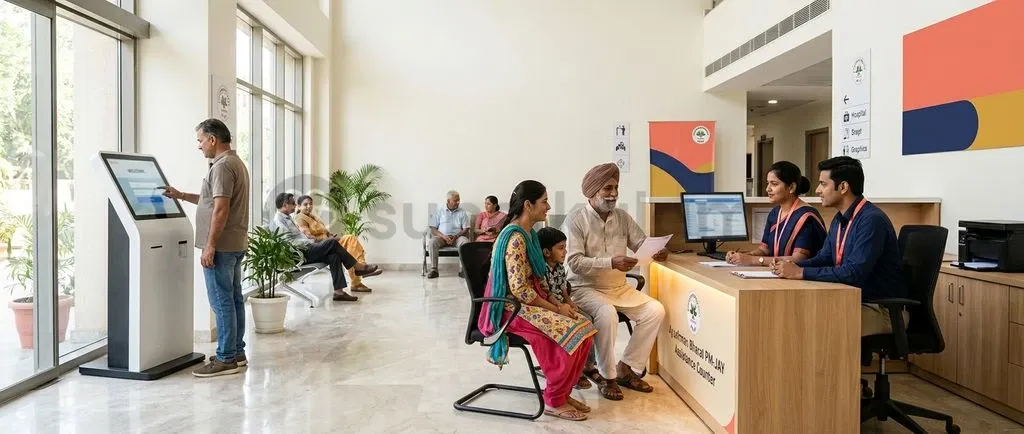
Ayushman Bharat Pradhan Mantri Jan Arogya Yojana (AB PM-JAY) provides an annual health assurance cover of Rs 5 lakh per family for secondary and tertiary hospitalisation. It functions on a fully cashless, paperless basis across empanelled healthcare providers nationwide. The Union Government launched the scheme in September 2018, transitioning public policy from fragmented supply-side funding to demand-side financial protection.
The programme has authorised over 12.69 crore hospital admissions worth Rs 1.92 lakh crore. Even so, structural hurdles limit its reach. Eliminating catastrophic household medical debt requires three key actions: raising package reimbursement rates, fixing inter-state hospital deficits, and funding outpatient treatments alongside inpatient care.
Why is Ayushman Bharat PM-JAY in the News?
Ayushman Bharat Pradhan Mantri Jan Arogya Yojana completes eight years of national implementation in September 2026. The Union Government launched the scheme on 23 September 2018 in Ranchi, Jharkhand, to protect vulnerable households from medical bankruptcy.
Key milestones highlight the scheme's expanding footprint:
- Scale of Utilization: As of June 2026, AB PM-JAY has authorized 12.69 crore cashless hospital admissions valued at Rs 1.92 lakh crore across a network of 37,413 empanelled public and private hospitals.
- Universal Senior Citizen Coverage: In October 2024, the Union Government expanded the safety net to cover all citizens aged 70 years and above under the Ayushman Vay Vandana Card, regardless of income.
- Constitutional Scrutiny: The milestone prompts a comprehensive review of the scheme's fiscal model, regional bottlenecks, and alignment with Article 21 and Article 47.
What is PM-JAY and How Does the Health Cover Function?
Pradhan Mantri Jan Arogya Yojana is the world's largest government-funded health assurance scheme. It provides a floater assurance cover of Rs 5 lakh per eligible family each year for secondary and tertiary care. The benefit applies without restrictions on family size, age, or gender.
Care is delivered on a cashless and paperless basis at the point of service. Beneficiaries can access secondary procedures like general surgery, alongside tertiary procedures like cardiology, across empanelled hospitals nationally.
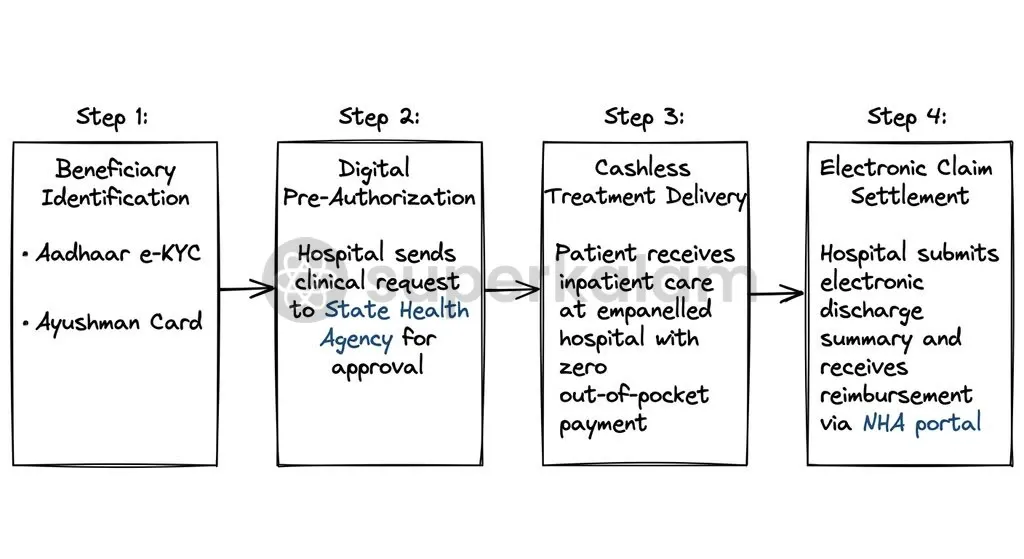
The operational architecture follows four clear stages:
- Beneficiary Identification: Hospital helpdesks verify patient identity via biometric authentication using Aadhaar or the Ayushman Card.
- Pre-Authorisation: Empanelled hospitals submit an online pre-authorisation request to the State Health Agency for the designated clinical package.
- Cashless Treatment: Following approval, the hospital delivers required diagnostics, surgeries, therapies, and post-discharge medications.
- Electronic Claim Settlement: The hospital uploads digital case files and invoices to the National Health Authority (NHA) portal for prompt reimbursement.
| Dimension | Inpatient Hospitalisation (PM-JAY) | Outpatient Primary Care (General System) |
|---|---|---|
| Service Scope | Secondary and tertiary hospital admissions | Consultations, routine diagnostics, and daily pharmacy |
| Coverage Mechanism | Cashless assurance up to Rs 5 lakh per family/year | Delivered via primary centres or out-of-pocket spending |
| Facility Network | 37,413 empanelled public and private hospitals | Ayushman Arogya Mandirs and primary health clinics |
| Financial Burden Share | Addresses catastrophic inpatient episodes | Accounts for over 60% of household out-of-pocket costs |
Discuss with Superkalam
What baseline survey was initially utilized by the Ministry of Health to identify beneficiary deprivation criteria under PM-JAY?
Ask NowEligibility Norms and the Recent Expansion to Senior Citizens
The Ministry of Health and Family Welfare initially linked beneficiary identification to deprivation criteria in the Socio-Economic and Caste Census (SECC) 2011. This baseline covered roughly 10.74 crore poor families, comprising 8.03 crore rural households and 2.71 crore urban occupational groups.
The entitlement base has grown steadily over eight years:
- Baseline Expansion: Target enrolment expanded to 12.37 crore families, protecting almost 55 crore individuals.
- Frontline Worker Inclusion: In March 2024, the Union Government enrolled 37 lakh families of ASHA workers and Anganwadi staff.
- Universal Senior Citizen Expansion: In October 2024, the Union Cabinet sanctioned health coverage for all senior citizens aged 70 years and above, irrespective of economic status.
Seniors aged 70 and above receive a dedicated Ayushman Vay Vandana Card. This card grants an exclusive top-up cover of Rs 5 lakh per year on a family basis, kept distinct from younger family members' shared balance.
Discuss with Superkalam
How does PM-JAY's demand-side health assurance model differ from traditional supply-side public healthcare financing?
Ask NowFunding Architecture: Center-State Cost Sharing and Budgetary Trends
PM-JAY is structured as a Centrally Sponsored Scheme funded through a defined Union-state contribution formula. The financing model preserves national assurance standards while balancing fiscal commitments across participating states.
The statutory funding ratios are divided across three tiers:
- General States with Legislatures: Financed on a 60:40 ratio between the Centre and the state government.
- North Eastern and Himalayan States: Financed on a 90:10 ratio to accommodate regional fiscal constraints.
- Union Territories without Legislatures: Fully financed through 100% central funding.
Administrative responsibilities flow across three distinct governance tiers:
- National Health Authority (NHA): Formulates apex policy, manages IT architecture, and standardises clinical package pricing.
- State Health Agencies (SHAs): Oversee hospital empanelment, process pre-authorisations, and settle hospital claims via Trust, Insurance, or Mixed models.
- Empanelled Healthcare Providers: Deliver cashless secondary and tertiary medical treatments to verified beneficiaries.
The National Health Authority (NHA) operates as an attached office under the Ministry of Health and Family Welfare. At the regional level, State Health Agencies (SHAs) execute the programme, administer hospital networks, and process local grievance redressals.
Discuss with Superkalam
If a low-income household spends heavily on outpatient consultations and chronic diabetes medication rather than inpatient care, how effectively does PM-JAY shield them from impoverishment?
Ask NowWhat Eight Years of Outcomes Show: Utilization and Out-of-Pocket Costs
National Health Accounts data indicates that PM-JAY has sped up the decline of out-of-pocket medical spending in India. Higher public allocations and structured inpatient protection have shielded millions of vulnerable citizens from acute poverty.
Out-of-Pocket Expenditure (OOPE) as a share of Total Health Expenditure fell from 62.6% in 2014-15 to 43.4% in 2022-23 (and touched 39.4% in 2021-22). The expansion of PM-JAY, paired with rising public health outlays, helped cushion families against high surgical and intensive care bills.
However, major financial gaps persist in non-hospitalised care:
- Exclusion of Outpatient Care: PM-JAY funds inpatient hospitalisation but excludes regular outpatient department (OPD) consultations.
- Pharmacy Expenditures: Routine diagnostic workups and daily retail pharmacy bills fall outside the reimbursement framework.
- Household Spending Realities: Outpatient visits, regular diagnostic tests, and medicines comprise over 60% of total OOPE across households.
Because outpatient treatment remains unhedged, families managing chronic conditions like diabetes or hypertension still carry heavy out-of-pocket costs.
Discuss with Superkalam
Weigh the trade-offs of setting Health Benefit Package rates using marginal costing principles against actual market-determined private healthcare costs.
Ask NowKey Operational Bottlenecks: Package Rates, Fraud, and Regional Imbalance
The Parliamentary Standing Committee on Health has identified structural friction points that hamper PM-JAY's full operational execution. Correcting these bottlenecks is necessary to retain private hospital participation and ensure uniform access.
The most pressing operational hurdles include:
- Unviable Package Reimbursement Rates: Health Benefit Package rates rely on marginal costing principles, setting reimbursement up to 70% below private market costs. As a result, leading tertiary hospitals often decline empanelment.
- Severe Regional Disparities: Empanelled private beds remain heavily concentrated in southern and western states. Meanwhile, northern and eastern states face underdeveloped private sectors and public hospital shortages.
- Claim Settlement Delays: Pre-authorisation backlogs, lengthy audits, and slow fund releases by State Health Agencies trigger liquidity stress for hospitals.
- Systemic Fraud Risks: Gaps in digital identity checks have allowed occasional phantom hospital admissions and unbundled surgical claims by errant providers.
Ethical Dimensions: Universal Health Coverage and Commercialized Healthcare
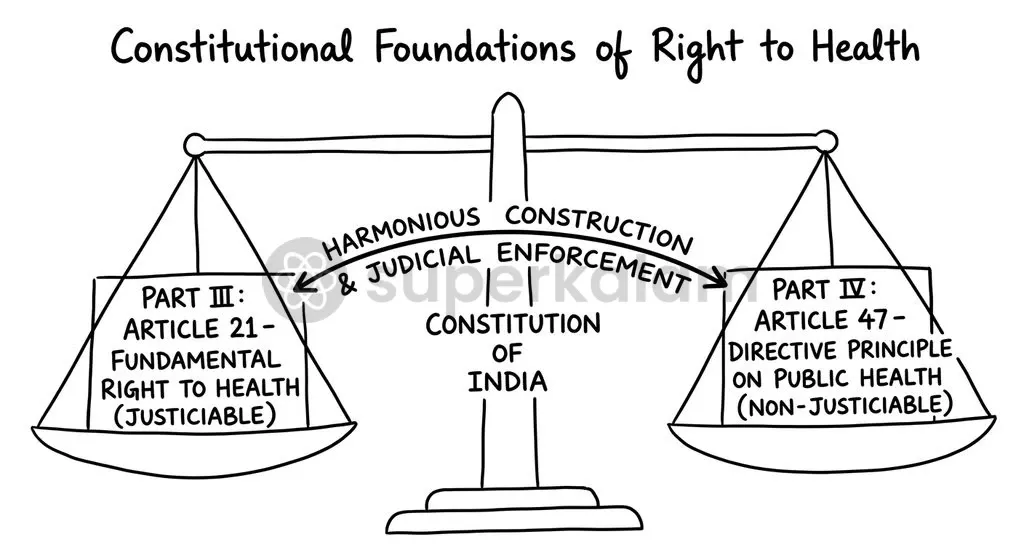
The Supreme Court of India recognises the right to health as an integral aspect of the right to life under Article 21. In Paschim Banga Khet Mazdoor Samity v. State of West Bengal (1996), the Court affirmed the State's constitutional duty to deliver timely emergency medical care to safeguard human life.
In addition, Article 47 sets out a non-justiciable Directive Principle of State Policy. It directs the State to regard public health improvement and higher nutrition standards as fundamental governance duties.
- Article 21 (Part III, Justiciable): Guarantees the right to health as a core component of the Right to Life.
- Article 47 (Part IV, Non-Justiciable DPSP): Directs the State to improve public health and raise living standards.
Channeling public funds into commercial insurance raises systemic trade-offs. NITI Aayog notes that demand-side commercial reimbursement can introduce distinct operational distortions:
- Supplier-Induced Demand: Fee-for-service structures may induce private clinics to prescribe unnecessary surgical procedures and diagnostic tests.
- Procedure Cherry-Picking: Private hospitals frequently prioritise high-margin tertiary interventions over low-margin medical admissions and preventive care.
- Under-Investment in Public Infrastructure: Excessive reliance on private empanelment risks turning public healthcare budgets into commercial subsidies rather than strengthening state-run hospitals.
Discuss with Superkalam
Design a policy framework to integrate outpatient primary care (such as Ayushman Arogya Mandirs) into the PM-JAY cashless reimbursement mechanism.
Ask NowWay Forward: Integrating Primary Care and Upgrading Reimbursement Systems
Strengthening Ayushman Bharat requires linking secondary hospitalisation under PM-JAY with primary care at Ayushman Arogya Mandirs. Developing this continuum of care is essential to build an equitable, sustainable public healthcare system.
Strategic reform priorities include:
- Rationalising Package Pricing: Recalibrating Health Benefit Package rates using scientific costing models. Adjusting reimbursement rates to match real operating costs will attract quality tertiary hospitals without compromising patient safety.
- Strengthening Gatekeeping and Primary Links: Integrating PM-JAY with Ayushman Arogya Mandirs. Requiring mandatory primary referrals for elective admissions will curb induced demand and avoid unnecessary secondary admissions.
- Expanding Outpatient and Pharmacy Coverage: Piloting outpatient diagnostic and medicine coverage for high-burden chronic diseases. Managing primary consultations early prevents illness progression and cuts tertiary hospital spending.
- Remedying Regional Supply Asymmetries: Offering viability gap funding, tax incentives, and land concessions to build accredited hospital beds in underserved northern and eastern districts.
- Deploying Advanced Anti-Fraud Analytics: Using machine learning and real-time clinical audit trails in NHA systems to detect and penalise fraudulent claims swiftly.
Key Takeaways
Ayushman Bharat PM-JAY marks a major transition in India's health policy, moving from fragmented welfare grants to entitlement-based assurance.
- Core Assurance Scale: PM-JAY provides Rs 5 lakh per family per year for cashless inpatient care, with over 12.69 crore admissions valued at Rs 1.92 lakh crore authorized by June 2026.
- Broadened Demographic Scope: Coverage expanded from the SECC 2011 baseline of 10.74 crore families to 12.37 crore families, alongside universal coverage for all citizens aged 70 years and above under the Ayushman Vay Vandana Card.
- Fiscal Structure: Functions as a Centrally Sponsored Scheme with a 60:40 split for general states, 90:10 for North Eastern and Himalayan states, and 100% central funding for Union Territories without legislatures.
- Macro Impact on Expenditure: Supported the reduction of household Out-of-Pocket Expenditure from 62.6% (2014-15) to 43.4% (2022-23), although unhedged outpatient care (>60% of OOPE) limits full financial relief.
- Constitutional Foundation: Grounded in the justiciable Right to Health under Article 21 (Paschim Banga ruling) and guided by the non-justiciable directive under Article 47.
Mains Question
"While Ayushman Bharat PM-JAY has significantly expanded demand-side protection for catastrophic inpatient hospitalisation, the exclusion of outpatient care constrains its potential to eliminate household medical impoverishment." Critically analyse. (15 Marks)
Evaluate NowMains Question
Evaluating the Center-State fiscal architecture and administrative execution of PM-JAY, discuss the operational challenges identified by the Parliamentary Standing Committee in achieving equitable tertiary healthcare delivery. (10 Marks)
Evaluate NowPractice MCQs
QUESTION 1
With reference to the Pradhan Mantri Jan Arogya Yojana (AB PM-JAY), consider the following statements: 1. The scheme provides an annual health assurance cover of Rs 5 lakh per family for both secondary and tertiary hospitalisation without restrictions on family size. 2. Under the Ayushman Vay Vandana Card, all senior citizens aged 70 years and above receive health coverage irrespective of their economic status. 3. Outpatient consultations (OPD) and daily retail pharmacy expenses are fully reimbursed on a cashless basis under the scheme. Which of the statements given above are correct?
QUESTION 2
Consider the following statements regarding the institutional and funding architecture of PM-JAY: 1. For general states with legislatures, the funding is shared between the Centre and the State in a 60:40 ratio. 2. Union Territories without legislatures are funded entirely through 100% central funding. 3. The National Health Authority (NHA) operates as an attached office under the Ministry of Health and Family Welfare. Which of the statements given above is/are correct?
QUESTION 3
With reference to healthcare spending and utilization patterns under AB PM-JAY, consider the following statements: 1. Out-of-Pocket Expenditure (OOPE) as a share of Total Health Expenditure in India decreased from 62.6% in 2014-15 to 43.4% in 2022-23. 2. Outpatient care, routine diagnostics, and pharmacy expenditures account for over 60% of total household out-of-pocket spending. Which of the statements given above is/are correct?
QUESTION 4
Regarding the operational bottlenecks highlighted by the Parliamentary Standing Committee on Health concerning PM-JAY, consider the following statements: 1. Health Benefit Package rates set on marginal costing principles can be up to 70% lower than private market costs. 2. Empanelled private hospital beds under PM-JAY are disproportionately concentrated in southern and western states compared to northern and eastern states. Which of the statements given above is/are correct?
QUESTION 5
Which of the following occupational and frontline groups was specifically incorporated into the AB PM-JAY entitlement base in March 2024?