I-STEM Portal Explained: Key Features, ₹20 Lakh Rule, and R&D Impact
By opening publicly funded labs to state colleges and startups, I-STEM tackles severe capital concentration across India's scientific research ecosystem.
Sep, 2026
•6 min read
Overview
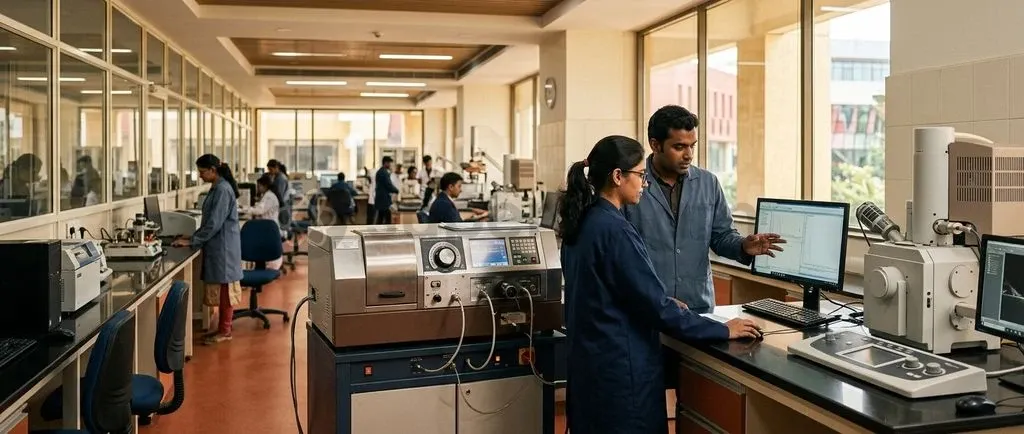
The Indian Science, Technology, and Engineering facilities Map (I-STEM) is a national web portal developed under the Prime Minister's Science, Technology, and Innovation Advisory Council (PM-STIAC). It establishes a transparent, searchable inventory of publicly funded laboratory equipment. This shared access prevents duplicate procurement and democratises scientific infrastructure across India.
Managed by the Centre for Nano Science and Engineering at the Indian Institute of Science, Bengaluru, the platform mandates that institutions register all government-funded equipment valued above ₹20 lakh for shared academic and industrial usage.
By offering digital slot booking, cloud-based simulation software suites, and targeted regional outreach programmes, I-STEM addresses structural asymmetries. Historically, capital research grants have concentrated within a few premier central institutions.
Discuss with Superkalam
Which centre at IISc Bengaluru hosts and manages the technical architecture of the I-STEM portal?
Ask NowWhat is the I-STEM Portal and Who Runs It?
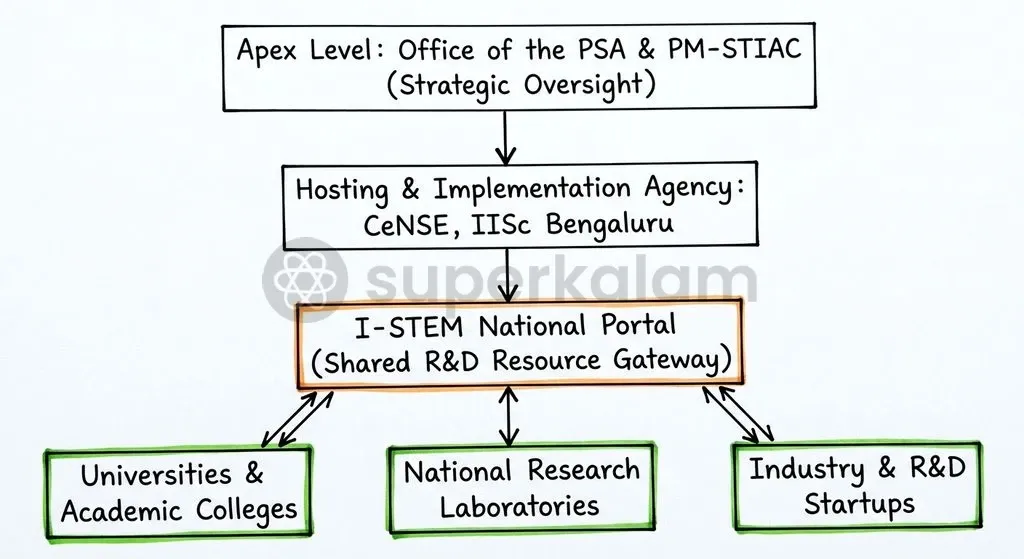
The I-STEM initiative operates directly under the Office of the Principal Scientific Adviser (PSA) to the Government of India as a PM-STIAC mission. Conceived under the PM-STIAC framework, the portal is a dynamic digital repository linking researchers with advanced laboratory resources across the country.
Database management, technical architecture, and operational hosting are run by the Centre for Nano Science and Engineering (CeNSE) located at the Indian Institute of Science (IISc), Bengaluru. The platform establishes a transparent mechanism where universities, national laboratories, and research centres list their physical assets, operational statuses, and booking availability.
| Dimension | Institutional Specification |
|---|---|
| Nodal Authority | Office of the Principal Scientific Adviser (PSA) |
| Policy Framework | PM-STIAC Mission |
| Hosting & Technical Agency | CeNSE, Indian Institute of Science (IISc), Bengaluru |
| Core Mandate | Establishing a searchable national inventory to prevent duplicate procurement and idle capacities |
Understanding the ₹20 Lakh Rule for Equipment Procurement
The Department of Science and Technology mandates that any scientific instrument exceeding ₹20 lakh in capital value procured with public funds must be listed on I-STEM. Public procurement guidelines establish this financial threshold to ensure that taxpayer-funded instrumentation does not remain restricted to single investigator teams.
Grants under schemes like the DST-FIST programme explicitly require beneficiary institutions to upload instrument specifications, custodial department details, and operational calendars to the central database. The compliance framework serves multiple regulatory objectives:
- Curbing Duplicate Grants: Funding agencies inspect the national repository to verify whether similar analytical instruments already exist in nearby regional clusters before approving new capital grants.
- Maximising Instrument Utilisation: Laboratories must declare operational uptime, allowing external academic users and industrial researchers to reserve unused operational windows.
- Fiscal Transparency: The policy enforces public accountability on institutional equipment procurement, ensuring expensive hardware yields broader societal and scientific returns.
Discuss with Superkalam
How does the ₹20 lakh listing rule prevent redundant capital expenditure across public research institutions?
Ask NowKey Features: From Slot Booking to Affordable Research Software
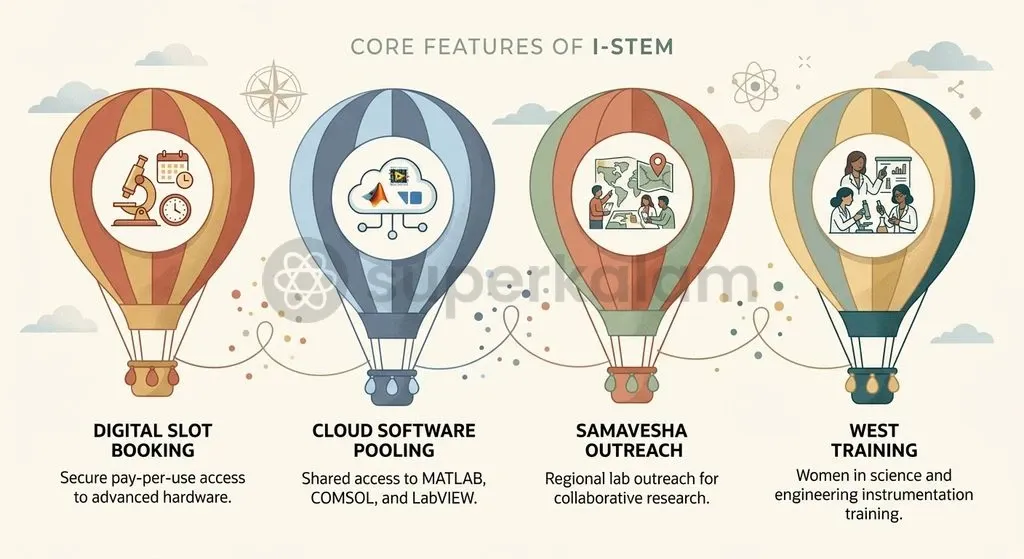
The I-STEM platform integrates digital slot booking, centralised software pooling, and specialised inclusion programmes into a unified national scientific interface. External researchers and early-stage entrepreneurs can locate instruments, inspect user charges, and reserve operational sessions via a digital slot-booking gateway.
This pay-per-use architecture provides transparent scheduling while generating operational revenue for host laboratories to support basic consumables and machine maintenance. Beyond physical hardware, the portal addresses expensive computational licensing hurdles through national cloud arrangements. Academic scholars and deep-tech startups obtain zero-cost access to standard engineering platforms, including MATLAB, COMSOL Multiphysics, and LabVIEW.
The ecosystem also incorporates targeted capacity-building schemes:
- The Samavesha Initiative: Designed as a regional outreach programme, Samavesha connects faculty and researchers from state universities with cutting-edge facilities housed in nearby central institutions.
- The WEST Programme: Launched in September 2022, the Women in Engineering, Science, and Technology (WEST) initiative trains women researchers in operating, maintaining, and fabricating scientific equipment.
Why I-STEM Matters for Indian R&D, Startups, and Tier-2/3 Colleges
Data from NITI Aayog shows that roughly 90% of central government R&D capital grants have historically flowed to a small group of premier central institutions like the IITs and IISc. In contrast, state public universities enrol approximately 95% of higher education students.
This skewed distribution created deep regional bottlenecks in scientific research. I-STEM bridges this institutional divide across three key dimensions:
- Equitable Hardware Access: Researchers from Tier-2 and Tier-3 colleges can now access advanced tools like electron microscopes and spectrometers without requiring direct capital grants.
- Startup Cost Reduction: Deep-tech startups and MSMEs can validate prototypes and conduct materials characterisation without prohibitive upfront equipment expenditure.
- Decentralised Research Capability: Shared infrastructure lets faculty at regional and state universities conduct competitive experimental research locally.
Discuss with Superkalam
How can an early-stage deep-tech startup leverage I-STEM to validate hardware prototypes without heavy upfront capital?
Ask NowKey Operational Bottlenecks in Research Resource Sharing
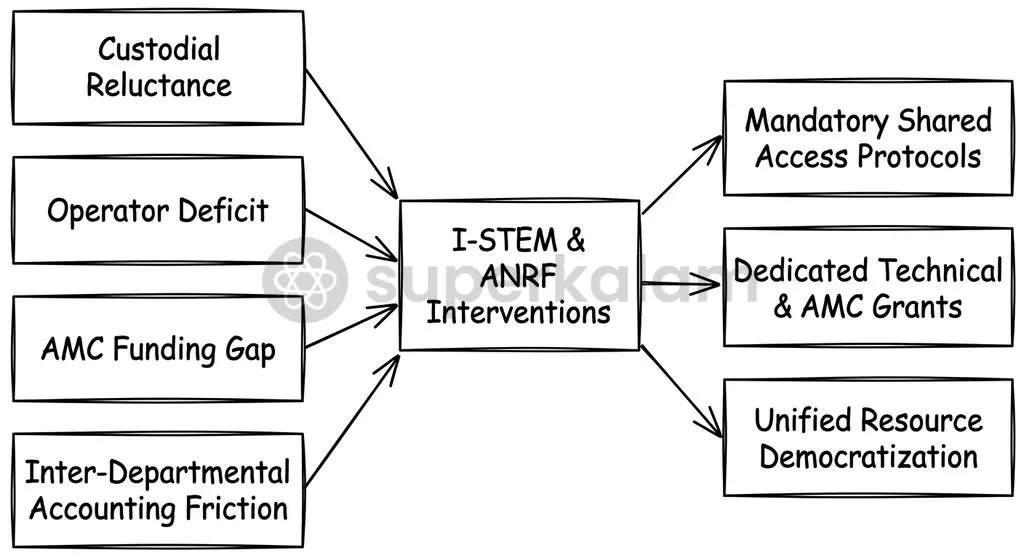
Review meetings by the Office of the PSA reveal critical operational bottlenecks that hinder seamless inter-institutional resource sharing across India. Institutional resistance remains a primary friction point, as custodian departments often display custodial reluctance to grant external scholars access to sensitive instruments. Concerns over sample contamination, scheduling disruptions, and equipment wear frequently result in artificial booking delays on the portal.
Compounding these behavioural barriers are severe technical and financial constraints:
- Shortage of Skilled Operators: High-end instruments require certified technical officers, yet many institutions face acute shortages of dedicated operating staff.
- Annual Maintenance Contract (AMC) Deficits: High recurring maintenance fees strain host department budgets, and booking revenues often fail to offset unexpected hardware repairs.
- Friction in User Fee Remittance: Complex inter-departmental accounting rules complicate the transfer of booking fees between autonomous state universities and central laboratories.
Way Forward: Building a Vibrant Collaborative Research Culture
Aligning I-STEM with the Anusandhan National Research Foundation Act, 2023 provides a statutory framework to institutionalise shared scientific infrastructure across India. The Anusandhan National Research Foundation (ANRF) framework, working alongside the One Nation One Subscription (ONOS) initiative, seeks to democratise both research hardware and academic literature.
To realise this integrated ecosystem, funding agencies must link future departmental research grants directly to verified external utilisation rates recorded on the I-STEM portal. Institutions should also formalise dedicated technical cadres by expanding programmes like WEST to ensure continuous operational uptime. Creating regional maintenance consortiums can pool AMC resources, lowering servicing costs for high-end instruments while guaranteeing reliable access for researchers nationwide.
Discuss with Superkalam
Why has the concentration of 90% of R&D grants in premier institutions exacerbated the research gap in state public universities?
Ask NowKey Takeaways
- Institutional Leadership: I-STEM was conceived under the PM-STIAC mission of the Office of the PSA and is technically hosted by CeNSE at IISc Bengaluru.
- The ₹20 Lakh Rule: Public grant guidelines require all scientific equipment valued above ₹20 lakh to be catalogued on the portal for shared access.
- Resource Democratisation: By offering remote access to simulation software suites like MATLAB, COMSOL, and LabVIEW, I-STEM democratises computational tools for regional colleges and startups.
- Targeted Programmes: The ecosystem runs the Samavesha initiative for regional university outreach and the WEST programme to upskill women researchers in equipment maintenance.
- Operational Hurdles: Successful scaling requires addressing custodial reluctance, technical staff shortages, and AMC funding deficits through alignment with ANRF.
Mains Question
"Historically, roughly 90% of central R&D capital grants have concentrated in premier institutions, while state public universities cater to 95% of higher education students." In the light of the I-STEM portal and the ₹20 lakh procurement rule, critically analyse how shared scientific infrastructure can democratise research in India. (15 Marks)
Evaluate NowMains Question
"Transforming isolated laboratory assets into accessible public goods requires overcoming administrative and behavioural barriers alongside digital integration." Evaluate the efficacy of the I-STEM framework in institutionalising a collaborative research culture in India. (10 Marks)
Evaluate NowPractice MCQs
QUESTION 1
With reference to the Indian Science, Technology, and Engineering facilities Map (I-STEM) portal, consider the following statements:
- It is an initiative conceived under the Prime Minister's Science, Technology, and Innovation Advisory Council (PM-STIAC).
- The technical architecture and database hosting are managed by the Centre for Nano Science and Engineering (CeNSE) at IISc Bengaluru.
- It provides cloud-based access to engineering simulation software suites such as MATLAB, COMSOL Multiphysics, and LabVIEW. Which of the statements given above are correct?
QUESTION 2
Regarding the public procurement guidelines for publicly funded scientific infrastructure in India, consider the following statements:
- The Department of Science and Technology mandates the listing of all publicly funded scientific equipment valued above ₹20 lakh on the I-STEM portal.
- Beneficiaries under schemes like DST-FIST must upload instrument specifications, custodial details, and operational calendars.
- Funding agencies check the national repository to verify whether similar analytical instruments exist in nearby regional clusters before approving new capital grants. Which of the statements given above is/are correct?
QUESTION 3
Consider the following statements regarding specific outreach and capacity-building programmes under the I-STEM ecosystem:
- The Samavesha initiative connects researchers and faculty from state universities with advanced facilities in nearby central institutions.
- The WEST (Women in Engineering, Science, and Technology) programme trains women researchers in operating, maintaining, and fabricating scientific equipment.
- The platform strictly excludes deep-tech startups and MSMEs from booking instrument operational windows. Which of the statements given above is/are correct?
QUESTION 4
According to data from NITI Aayog cited in the context of research infrastructure asymmetry in India, consider the following statements:
- Roughly 90% of central government R&D capital grants have historically flowed to a small group of premier central institutions.
- State public universities enrol approximately 95% of higher education students in India. Which of the statements given above is/are correct?
QUESTION 5
Which of the following statutory frameworks is being aligned with the I-STEM portal to institutionalise shared scientific research infrastructure across India?