Ayurveda Day 2026: 11th Ayurveda Day Theme, Schemes and Key Facts
The 11th Ayurveda Day on 23 September 2026, theme 'Ayurveda for a Healthier Tomorrow': the National Ayush Mission, WHO ICD-11 inclusion, Ayush insurance cover and key schemes.
Sep, 2026
•7 min read

Overview
Mainstreaming Ayurveda into India's primary public healthcare architecture reflects a structural transition from isolated traditional practice to a standardised, evidence-backed pluralistic delivery model. This integration is anchored in constitutional commitments to universal public health.
Policy frameworks aim to bridge preventive traditional wellness with curative allopathy by:
- Institutionalising AYUSH facilities across comprehensive primary healthcare centres.
- Standardising diagnostic codes under international classifications.
- Mandating statutory insurance parity across public and private insurers.
Realising this clinical integration requires overcoming deep-seated cross-practice litigation, closing clinical trial deficits, and enforcing stringent pharmacovigilance across herbal supply chains.
Why in the News: 11th Ayurveda Day Observance and Theme
The Ministry of Ayush observed the 11th Ayurveda Day on 23 September 2026, hosting the national celebrations in Nagpur under the theme 'Ayurveda for a Healthier Tomorrow' (स्वस्थ भविष्य के लिए आयुर्वेद). As of September 2026, the annual observance highlights the institutionalisation of traditional systems within national health programmes and global disease surveillance networks.
Key pillars framing this national observance include:
- Institutional Origins: The Government of India instituted Ayurveda Day in 2016 to coincide with Dhanvantari Jayanti, celebrating the classical healing system's civilisational lineage.
- Constitutional Backing: This public health push draws direct support from Article 47 of the Constitution, which establishes a Directive Principle of State Policy directing the State to regard the improvement of public health and nutrition as among its primary duties.
Discuss with Superkalam
Which classical texts form the theoretical foundation of systemic Ayurvedic medicine?
Ask NowWhat is Ayurveda: Core Principles and Traditional Roots
Ayurveda is an ancient codification of systemic medicine and lifestyle therapeutics. It derives its theoretical foundation from classical treatises, including the Charaka Samhita and Sushruta Samhita. The system conceptualises human physiology through the equilibrium of functional bio-energies, tissue structures, and metabolic processes.
Classical methodology prioritises individualised preventive care alongside multi-herbal pharmacological therapies. Treatment protocols emphasise dietary regulation, lifestyle modifications, and natural formulations to sustain constitutional equilibrium rather than focusing solely on pathogen eradication.
How India Is Integrating Ayurveda into Modern Healthcare
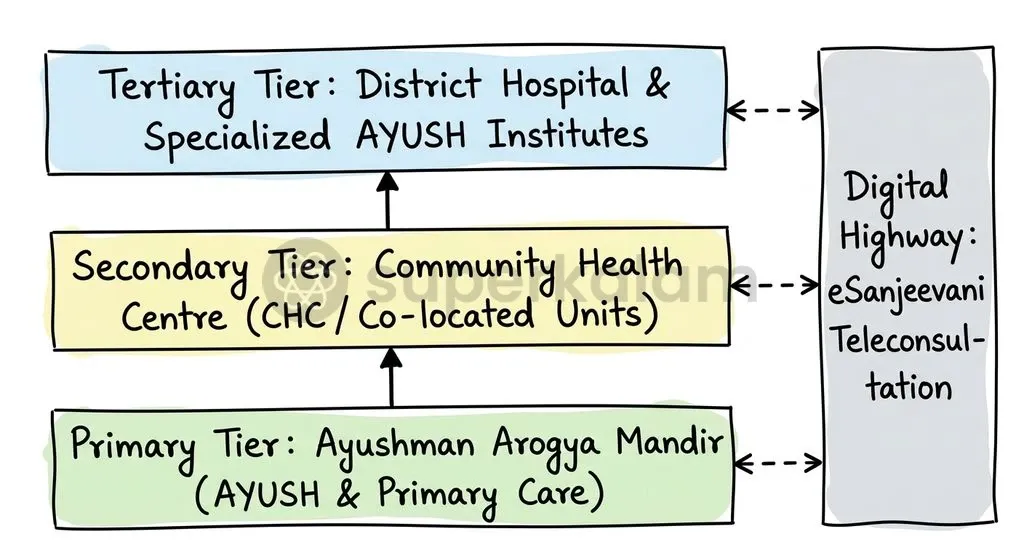
Operational integration of AYUSH into mainstream healthcare delivery relies on physical co-location and digital connectivity across primary, secondary, and tertiary tiers. Under the Centrally Sponsored Scheme of the National Ayush Mission, authorities have approved and operationalised 12,500 Ayush dispensaries as Ayushman Arogya Mandir (Ayush) across States and Union Territories.
National health programmes have accelerated institutional convergence across secondary infrastructure:
- Facility Co-location: Over 13,000 Ayush facilities operate within Primary Health Centres, Community Health Centres, and District Hospitals under the National Health Mission.
- Telemedicine Linkages: The national eSanjeevani platform hosts dedicated Ayush outpatient consultations, interoperable with digital health IDs under the Ayushman Bharat Digital Mission.
- Standardised Diagnostic Coding: The World Health Organization incorporated the ICD-11 Traditional Medicine Module 2, establishing standardised morbidity diagnostic codes for Ayurveda, Siddha, and Unani systems globally.
Discuss with Superkalam
How does the incorporation of ICD-11 Traditional Medicine Module 2 facilitate the global validation of AYUSH?
Ask NowKey Government Schemes and Institutional Architecture Driving AYUSH
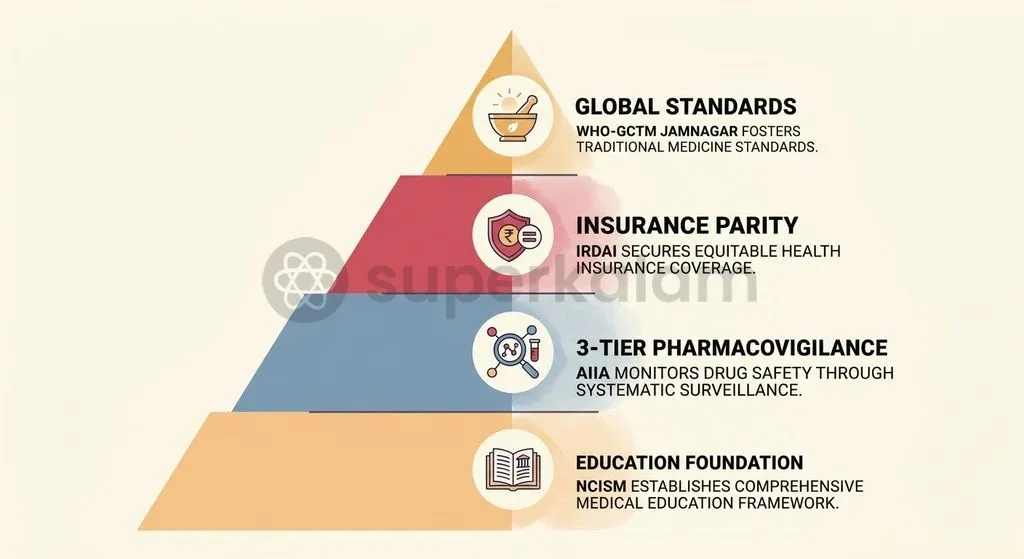
Statutory oversight, dedicated financial missions, and multilateral research hubs form the institutional backbone of India's traditional medicine ecosystem. Parliament enacted the National Commission for Indian System of Medicine Act, 2020, establishing the statutory National Commission for Indian System of Medicine to regulate educational standards, clinical accreditation, and ethical practice.
| Institution / Scheme | Core Mandate & Operational Focus |
|---|---|
| NCISM | Regulates medical education, qualifications, and ethical clinical practice |
| National Ayush Mission (NAM) | Funds public health infrastructure and upgrades 12,500 Ayushman Arogya Mandirs |
| AIIA - NPvCC | Coordinates a three-tier national pharmacovigilance surveillance network |
| WHO Global Centre for Traditional Medicine | Leads international evidence, data standards, and sustainability from Jamnagar |
The Insurance Regulatory and Development Authority of India issued the Master Circular on Health Insurance Business in 2024, mandating general and health insurers to cover AYUSH treatments on par with conventional medical care. To operationalise this mandate, the Ministry of Ayush revised the Benchmark Rates for Insurance Coverage in 2026, defining standardised treatment packages linked to the Insurance Information Bureau's ROHINI registry.
Multilateral institutional leadership is anchored by the WHO Global Centre for Traditional Medicine, established in Jamnagar, Gujarat, as the first dedicated global outposted centre for traditional medicine under a Host Country Agreement with India.
Comparing Integrative Medicine with Conventional Allopathic Models
Integrative public healthcare combines the diagnostic precision of conventional biomedicine with the preventive and holistic therapies of traditional systems. Evaluating the operational distinctions between these models clarifies the scope of clinical collaboration:
| Dimension | Conventional Allopathy | Traditional Ayurveda | Integrative Model |
|---|---|---|---|
| Primary Philosophy | Pathogen-specific, targeted intervention | Constitutional equilibrium, holistic balance | Synergistic prevention and acute intervention |
| Diagnostic Framework | Pathological, imaging, and biochemical markers | Clinical observation, pulse, constitutional profiling | Dual profiling combining laboratory data with holistic assessment |
| Standardisation Basis | Randomised Controlled Trials and molecular chemistry | Pharmacopoeial standards and classical texts | Evidence-based validation, standardised clinical trials |
| System Strengths | Acute trauma, emergency care, surgical procedures | Chronic lifestyle diseases, rehabilitation, wellness | End-to-end continuum of care across life stages |
| Regulatory Statute | National Medical Commission Act, 2019 | NCISM Act, 2020 | Inter-regulatory coordination frameworks |
Discuss with Superkalam
Compare the therapeutic approaches of conventional allopathy and traditional Ayurveda in managing chronic lifestyle disorders.
Ask NowMajor Challenges Facing Ayurveda Integration in Public Health
Professional boundary disputes and clinical validation deficits continue to obstruct seamless institutional collaboration between traditional and modern healthcare providers:
- Cross-Practice Litigation: Persistent cross-practice litigation over pharmacological prescription rights creates professional friction between allopathic and traditional practitioners, according to research published in Frontiers in Medicine.
- Raw Material Supply and Quality: Adulteration and variable botanical potency present significant obstacles to uniform clinical efficacy.
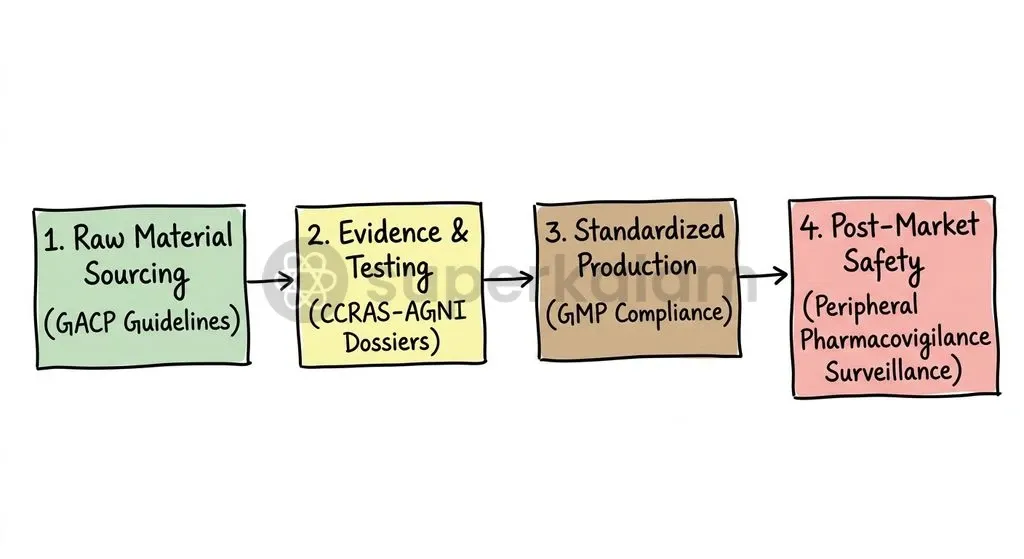
- Standardised Cultivation: The National Medicinal Plants Board implements the Central Sector Scheme on Conservation, Development and Sustainable Management of Medicinal Plants to mitigate raw material deficits and enforce Good Agricultural and Collection Practices.
Ethical and Policy Dimensions in Evidence-Based Traditional Medicine
Safety surveillance and misleading therapeutic claims require transparent, rigorous clinical governance mechanisms. The All India Institute of Ayurveda in New Delhi operates as the National Pharmacovigilance Coordination Centre, administering a three-tier network comprising 5 Intermediary and 99 Peripheral Pharmacovigilance Centres to monitor adverse drug reactions.
The Ministry of Ayush expanded scientific validation tools by launching the CCRAS-AGNI Assessment Scale Web Portal alongside standard safety dossiers on key botanical drugs like Gokshura (Tribulus terrestris) and Chandrasura (Lepidium sativum). Deploying structured pharmacological dossiers protects public safety while generating reproducible clinical evidence for international acceptance.
Discuss with Superkalam
What institutional mechanisms should be instituted between NCISM and NMC to resolve persistent cross-practice litigation?
Ask NowWay Forward: Building a Scalable and Scientifically Validated AYUSH Framework
Mainstreaming traditional medicine requires establishing rigorous, trans-disciplinary clinical protocols that combine modern diagnostics with Ayurvedic therapeutic regimens. The National Commission for Indian System of Medicine must work alongside statutory biomedical regulators to design joint continuing medical education modules, mitigating inter-professional friction.
Expanding research investments into double-blind, placebo-controlled trials for standardised herbal formulations will establish the scientific credibility required for global export integration. Synchronising electronic health records under the Ayushman Bharat Digital Mission will enable longitudinal research, proving long-term health outcomes of integrative medicine across primary care.
Key Takeaways
- Observance and Theme: The 11th Ayurveda Day was observed on 23 September 2026 under the theme 'Ayurveda for a Healthier Tomorrow', commemorating Dhanvantari Jayanti.
- Constitutional Directive: Public health integration aligns with the non-justiciable Directive Principle of State Policy under Article 47 of the Constitution.
- Primary Healthcare Scale: National Ayush Mission operationalised 12,500 Ayushman Arogya Mandirs and co-located over 13,000 facilities in primary and secondary healthcare centres.
- Statutory & Insurance Parity: The NCISM Act, 2020 governs professional standards, while IRDAI regulations mandate health insurance parity for AYUSH treatments.
- Global Standards Integration: The WHO Global Centre for Traditional Medicine operates in Jamnagar, alongside diagnostic integration under WHO ICD-11 TM-2.
Mains Question
"Mainstreaming AYUSH within India's primary public healthcare architecture requires bridging the divide between classical holistic therapies and evidence-based biomedical standards." In this context, evaluate the efficacy of current institutional and regulatory frameworks in achieving clinical integration. (15 Marks)
Evaluate NowMains Question
Examine the role of statutory oversight, digital platforms, and insurance reforms in transforming AYUSH from an isolated traditional practice into a standardized healthcare delivery model. (10 Marks)
Evaluate NowPractice MCQs
QUESTION 1
With reference to the integration of AYUSH into India's public healthcare architecture, consider the following statements:
- The National Commission for Indian System of Medicine Act, 2020 repealed and replaced the National Medical Commission Act, 2019 to regulate traditional practitioners.
- The World Health Organization incorporated the ICD-11 Traditional Medicine Module 2 to standardize diagnostic codes for Ayurveda, Siddha, and Unani systems globally.
- The Insurance Regulatory and Development Authority of India (IRDAI) mandated health insurers to provide AYUSH treatments parity with conventional medical care.
Which of the statements given above are correct?
QUESTION 2
Consider the following statements regarding the institutional and policy frameworks supporting traditional medicine in India:
- The National Pharmacovigilance Coordination Centre (NPvCC) for traditional medicine is administered by the All India Institute of Ayurveda in New Delhi.
- The WHO Global Centre for Traditional Medicine has been established in Jamnagar, Gujarat under a Host Country Agreement.
- Under the National Ayush Mission, 12,500 Ayush dispensaries are operationalized as Ayushman Arogya Mandir (Ayush).
Which of the statements given above are correct?
QUESTION 3
With reference to the core classical foundations and regulatory instruments of Ayurveda, consider the following statements:
- The theoretical foundations of Ayurveda are codified in classical treatises including the Charaka Samhita and Sushruta Samhita.
- Ayurveda Day is observed annually to coincide with Dhanvantari Jayanti, backed constitutionally by the Directive Principles under Article 47.
- The CCRAS-AGNI Assessment Scale Web Portal was launched to enforce Good Agricultural and Collection Practices for medicinal raw materials.
Which of the statements given above is/are correct?
QUESTION 4
Which of the following bodies coordinates the three-tier national pharmacovigilance network comprising Intermediary and Peripheral Pharmacovigilance Centres for traditional medicine surveillance?
QUESTION 5
Consider the following pairs of institutions/initiatives and their primary operational focus:
- National Medicinal Plants Board : Conservation and Good Agricultural and Collection Practices
- Insurance Information Bureau's ROHINI registry : Standardised Ayush benchmark insurance packages
- eSanjeevani : Co-location of physical dispensaries in District Hospitals
Which of the pairs given above is/are correctly matched?