UP Gangsters Act Struck Down: Why the Supreme Court Called It 'Still-Born'
The Supreme Court struck down the UP Gangsters and Anti-Social Activities (Prevention) Act, 1986 because it never defined an offence, leaving crime-creation to the executive.
Sep, 2026
•7 min read

Overview
In a landmark ruling on criminal jurisprudence, the Supreme Court of India held that penal proceedings under the Uttar Pradesh Gangsters and Anti-Social Activities (Prevention) Act, 1986 cannot legally survive because the parent statute fails to create an independent, substantive criminal offence. Criminal liability cannot be manufactured through executive rule-making or administrative listings like police Gang Charts.
By reaffirming that defining crimes is a non-delegable legislative power, the court safeguarded the constitutional guarantees of Article 20(1) and Article 21 against arbitrary state action.
Why in the News: The Supreme Court's Verdict on the UP Gangsters Act
The Supreme Court of India delivered a decisive judgment in August 2026 concerning prosecutions under the Uttar Pradesh Gangsters and Anti-Social Activities (Prevention) Act, 1986. A two-judge Bench comprising Justices J.B. Pardiwala and K. Vinod Chandran ruled in Shiv Pratap Singh Alias Chinu v. State of U.P. & Ors. (2026 INSC 894) that the statute suffers from an incurable legislative defect.
The Bench quashed charge-sheets and criminal proceedings initiated against two practising advocates:
- Shiv Pratap Singh: Proceedings arising from FIR No. 41 of 2024 at Fatehgarh Kotwali.
- Himanshu Srivastava: Proceedings arising from FIR No. 740 of 2022 at Loni Border, Ghaziabad.
The ruling clarified that while proceedings under the special Act cannot stand, prosecutions under regular substantive penal statutes continue unaffected under standard criminal procedure.
What Is the UP Gangsters Act and Why Was It Created?
The Uttar Pradesh Gangsters and Anti-Social Activities (Prevention) Act, 1986 was enacted as a special state enactment designed to curb organised crime, gang syndicates, and anti-social violence. State authorities historically utilised the statute to impose stringent bail restrictions, attach immovable properties, and establish special courts for expedited trials.
The statutory architecture of the enactment relies primarily on two key provisions:
- Section 2: Defines the terms gang and gangster, enumerating various anti-social activities ranging from violent offences to economic disruptions.
- Section 3: Prescribes stringent penalties and imprisonment terms for any person identified as a gangster.
Discuss with Superkalam
What are the two primary sections governing definitions and penalties in the UP Gangsters Act, 1986?
Ask NowThe Core Dispute: Can Executive Rules Create New Criminal Liabilities?
The Supreme Court identified a fatal structural omission in the UP Gangsters Act. While Section 2 defines the status of a gangster and Section 3 prescribes punishment, neither provision explicitly enacts a statutory prohibition or creates an independent substantive offence.
To bridge this void, police authorities relied on the Uttar Pradesh Gangsters and Anti-Social Activities (Prevention) Rules, 2021. Under these delegated rules, the executive prepared internal administrative listings known as Gang Charts. Inclusion in a Gang Chart served as the operational trigger for launching prosecutions and imposing penal liability.
| Legal Dimension | Parent Act (1986 Statute) | Subordinate Rules (2021 Framework) |
|---|---|---|
| Source of Authority | State Legislature | Executive Delegated Rule-Making |
| Substantive Offence | Contains definitions and penalty clauses, but lacks a charging section | Attempts to supply missing ingredients of penal liability |
| Evidentiary Basis | Requires judicial proof of commission of an offence | Relies on executive-prepared Gang Charts |
| Constitutional Validity | Declared still-born due to lack of a substantive crime | Invalidated where rules exceed delegated powers |
The Supreme Court observed that determining guilt was left entirely to the ipse dixit (unsupported assertion) of executive authorities. Delegated rules cannot introduce substantive criminal offences that the legislature omitted from the parent Act.
Discuss with Superkalam
Explain how relying on executive-prepared 'Gang Charts' differs from proving offences under regular substantive criminal law.
Ask NowUnderstanding Article 20(1): Constitutional Shield Against Ex-Post Facto Laws
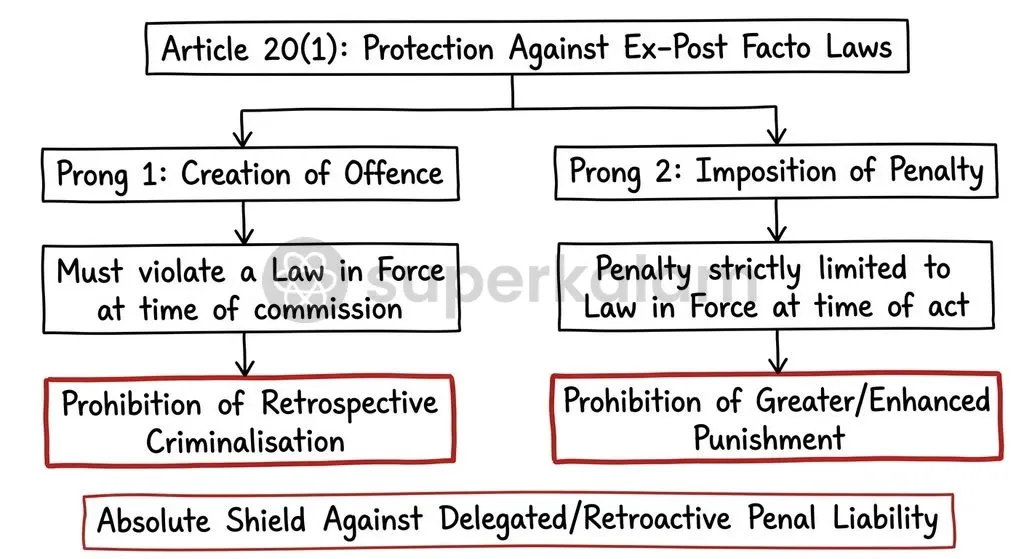
Article 20(1) of the Constitution of India provides an absolute fundamental right against retrospective penal legislation and arbitrary state punishment. The provision incorporates the legal maxim nullum crimen nulla poena sine lege, which dictates that there can be no crime and no punishment without a clear pre-existing law.
Under Article 20(1), two constitutional conditions must be satisfied before the state can impose penal sanctions:
- Violation of a Law in Force: A person can only be convicted for an act that violated a clearly defined, existing statutory law at the exact time of its commission.
- Protection Against Greater Penalty: An accused cannot be subjected to a penalty greater than that prescribed under the law in force when the act occurred.
The Supreme Court ruled that penalising an individual based solely on an executive-assigned status or label violates Article 20(1). A criminal charge must rest on a codified statutory violation rather than an administrative classification.
Why the Supreme Court Termed the Impugned Provision 'Still-Born'
The Supreme Court characterised the penal mechanism of the UP Gangsters Act as still-born because it failed to bring a complete penal offence into legal existence at inception. A penal law that prescribes punishment without defining an enforceable act or omission as a distinct crime cannot sustain criminal prosecution.
The Bench highlighted two primary defects in the operational framework:
- Predetermined Guilt: The court invoked the proverb give a dog a bad name and hang him to describe how police Gang Charts predetermined culpability.
- Bypassing Independent Adjudication: Once listed on a Gang Chart, individuals faced punitive measures irrespective of judicial outcomes under substantive criminal law.
Discuss with Superkalam
If a state government drafts delegated rules to penalise an activity not explicitly prohibited in the parent Act, how would the Doctrine of Ultra Vires apply?
Ask NowThe Constitutional Boundaries of Delegated Legislation in Criminal Matters
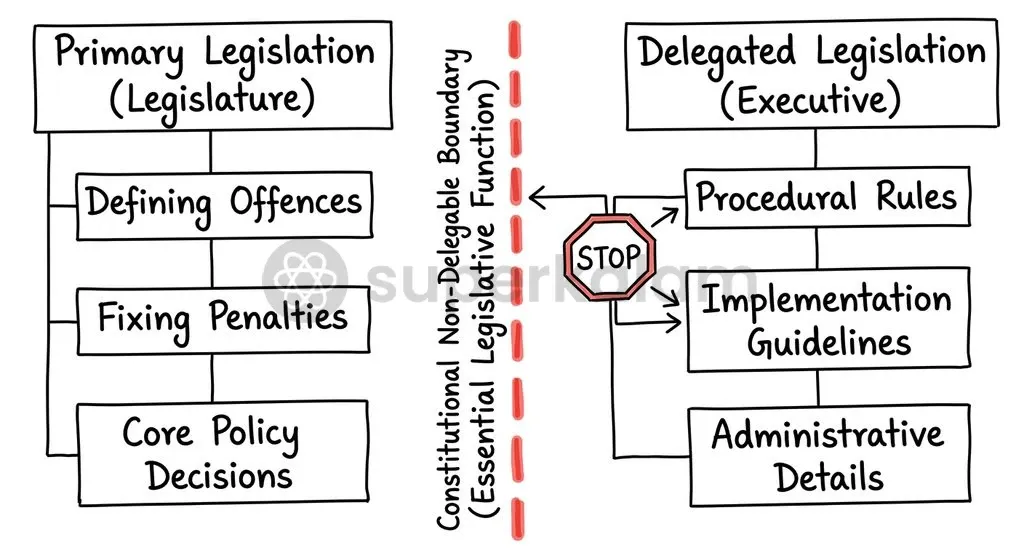
Delegated legislation allows executive bodies to formulate procedural rules, administrative standards, and operational details to implement legislative enactments. However, constitutional jurisprudence establishes that the essential legislative function of determining legislative policy and creating criminal liability cannot be delegated to the executive branch.
Under the Doctrine of Ultra Vires, subordinate rules must remain strictly within the boundaries drawn by the parent enactment:
- Executive rule-making cannot supply missing substantive ingredients of a crime.
- Subordinate legislation cannot widen the statutory scope to penalise actions not made punishable by the primary legislature.
- Administrative convenience cannot substitute for explicit statutory codification passed by Parliament or state legislatures.
Discuss with Superkalam
Analyse the constitutional tension between effective state crime-control powers and procedural due process under Articles 14, 20(1), and 21.
Ask NowKey Precedents: Judicial Review of Subordinate and State Penal Legislation
The Allahabad High Court applied the Supreme Court's ratio in Akhand Pratap Singh v. State of U.P. (September 2026) to reinforce statutory limits on executive action. The High Court reiterated that special anti-gangster enactments must undergo strict judicial construction to prevent executive overreach and administrative misuse.
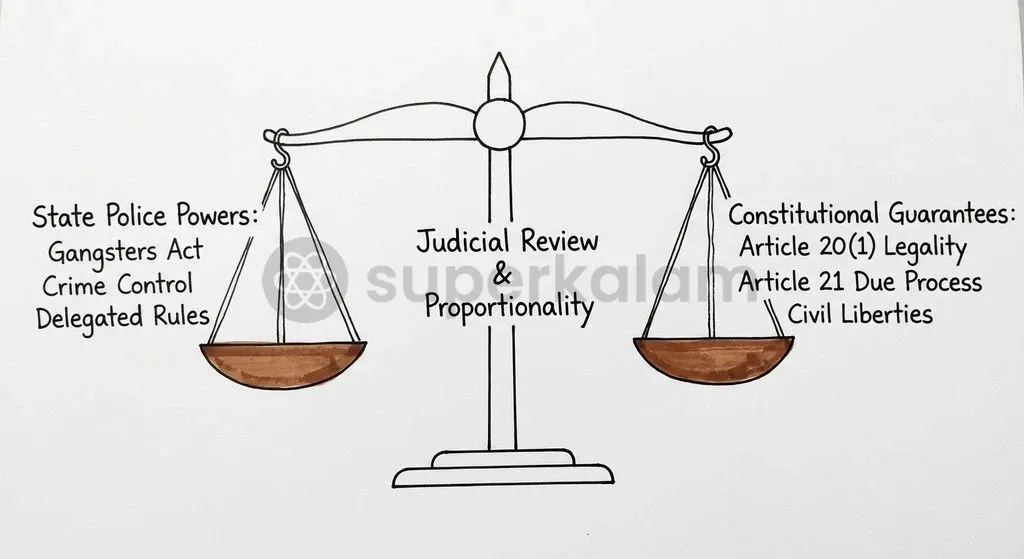
The judiciary has consistently maintained that extraordinary penal statutes granting sweeping powers to executive agencies must satisfy key constitutional tests:
- Procedural fairness under Article 14.
- Substantive due process under Article 21.
When subordinate rules bypass statutory mandates, courts exercise judicial review to declare such administrative mechanisms void ab initio.
Balancing State Police Powers with Due Process and Civil Liberties
The ethical governance of a constitutional democracy requires maintaining an equilibrium between effective law enforcement and the preservation of civil liberties. While state agencies require adequate legal instruments to combat organised crime syndicates, crime-control measures cannot abandon procedural justice.
Executive labelling mechanisms create substantial risks of administrative victimisation:
- Erosion of Presumption of Innocence: Administrative Gang Charts reverse the burden of proof in practice before a judicial determination of guilt.
- Targeting of Legal Practitioners and Citizens: As seen in the quashed proceedings against practising advocates, unchecked executive power can lead to arbitrary harassment.
- Circumvention of Ordinary Penal Safeguards: Special procedural regimes must not be deployed merely to bypass standard evidentiary requirements under general criminal law.
Discuss with Superkalam
Propose institutional safeguards that state drafting bodies should implement to prevent special penal enactments from suffering incurable legislative defects.
Ask NowWay Forward: Standardising Rule-Making to Protect Constitutional Safeguards
The Supreme Court's ruling in Shiv Pratap Singh Alias Chinu provides clear institutional imperatives for state legislatures, executive drafting bodies, and policing authorities:
- Legislative Precision in Penal Statutes: State legislatures must ensure that special penal enactments contain unambiguous charging provisions that clearly codify offences before attaching criminal penalties.
- Restricting Subordinate Legislation to Procedure: Executive rule-making powers under criminal statutes must be strictly confined to regulatory and procedural administration, avoiding any attempt to manufacture substantive offences.
- Institutional Accountability for Executive Listings: Administrative tools such as Gang Charts must be subjected to independent judicial scrutiny and cannot serve as the sole foundation for criminal prosecution.
- Adherence to Substantive Due Process: Law enforcement agencies must pursue organised crime through thorough investigation under substantive penal laws rather than relying on procedural shortcuts.
Key Takeaways
- The Supreme Court held in Shiv Pratap Singh Alias Chinu v. State of U.P. & Ors. (2026 INSC 894) that the UP Gangsters Act fails to create an independent substantive offence, rendering penal proceedings under it unsustainable.
- The creation of crimes and penal liability is an essential legislative function that cannot be delegated to executive rule-making or subordinate legislation.
- Administrative Gang Charts prepared by police under subordinate rules cannot serve as the lawful basis for criminal conviction without violating Article 20(1).
- Article 20(1) embodies the principle of nullum crimen nulla poena sine lege, prohibiting criminal punishment based on executive-assigned status rather than a codified law in force.
- The quashing of proceedings under the special Act does not impede regular criminal prosecutions, which must proceed independently under general substantive penal law.
Mains Question
"Defining crimes is an essential, non-delegable legislative function that cannot be manufactured through executive rule-making." In light of the Supreme Court's ruling on the UP Gangsters Act, examine the constitutional limits of delegated legislation in criminal jurisprudence. (10 Marks)
Evaluate NowMains Question
The deployment of extraordinary penal legislation often creates a friction between state police powers and the constitutional guarantee of civil liberties. Critically analyse how administrative listings like 'Gang Charts' undermine procedural due process and the presumption of innocence. (15 Marks)
Evaluate NowPractice MCQs
QUESTION 1
With reference to the Supreme Court's verdict in Shiv Pratap Singh Alias Chinu v. State of U.P. & Ors. (2026), consider the following statements:
- The Supreme Court held that executive rules cannot create an independent substantive criminal offence omitted by the parent statute.
- Delegating the core legislative power of defining crimes to the executive violates the constitutional protections of Article 20(1) and Article 21.
- Quashing of proceedings under the special Act automatically halts all prosecutions under regular substantive penal statutes.
Which of the statements given above is/are correct?
QUESTION 2
Regarding the constitutional safeguards under Article 20(1) of the Constitution of India, consider the following statements:
- It incorporates the legal maxim nullum crimen nulla poena sine lege.
- It protects an individual from being convicted of an act that was not an offence under the law in force at the time of its commission.
- Penalising a person based solely on an executive-assigned administrative label or status complies with Article 20(1) provided subordinate rules exist.
Which of the statements given above are correct?
QUESTION 3
Consider the following statements regarding the Doctrine of Ultra Vires and delegated legislation in criminal matters:
- Delegated legislation allows executive authorities to define new substantive penal offences to meet administrative exigencies.
- Subordinate legislation cannot widen the statutory scope to penalise actions not made punishable by the primary legislature.
- Determining essential legislative policy and creating criminal liability is a non-delegable function of the legislature.
Which of the statements given above is/are correct?
QUESTION 4
Why did the Supreme Court term the penal operational mechanism under the Uttar Pradesh Gangsters and Anti-Social Activities (Prevention) Act, 1986 'still-born'?
QUESTION 5
Consider the following statements about the statutory architecture of the Uttar Pradesh Gangsters and Anti-Social Activities (Prevention) Act, 1986:
- Section 2 defines the terms 'gang' and 'gangster' alongside enumerating anti-social activities.
- Section 3 prescribes penalties and imprisonment for any person identified as a gangster.
- The 2021 subordinate rules introduced 'Gang Charts' prepared by the executive to operationalise prosecutions.
Which of the statements given above are correct?