Article 22 of Indian Constitution: Arrest Rights, Preventive Detention & SC Rulings
Article 22’s arrest and detention safeguards: written grounds, 24-hour magistrate production, advisory-board review, and the Supreme Court rulings that shaped them.
Sep, 2026
•10 min read
Overview
Article 22 of the Constitution of India guarantees fundamental procedural safeguards against arbitrary arrest and detention. It establishes enforceable rights to legal counsel, timely communication of arrest grounds, and mandatory magisterial oversight within twenty-four hours.
Concurrently, the provision accommodates preventive detention within Part III. This allows executive authorities to detain individuals without antecedent trial to avert anticipated threats to state security or public order.
While the Constitution permits this exceptional executive power, evolving Supreme Court jurisprudence treats strict procedural compliance as the non-negotiable boundary protecting personal liberty against executive overreach.
Why Article 22 and Arrest Powers Are in the News
Recent Supreme Court rulings have raised the constitutional bar for executive arrest powers under Article 22 of the Constitution.
Key judicial developments include:
- Release, not bail, for Article 22(1) breaches: In September 2026, a Supreme Court bench headed by Justice Ujjal Bhuyan held that an arrest made without communicating the grounds of arrest in writing, or without access to legal counsel, violates Article 22(1) and entitles the accused to immediate release. The Court clarified that such release is not bail but freedom from illegal and unconstitutional detention, and that a subsequent chargesheet or an order of cognizance does not validate an unconstitutional arrest. Re-arrest for the same offence is permissible only with a Magistrate's sanction based on recorded reasons.
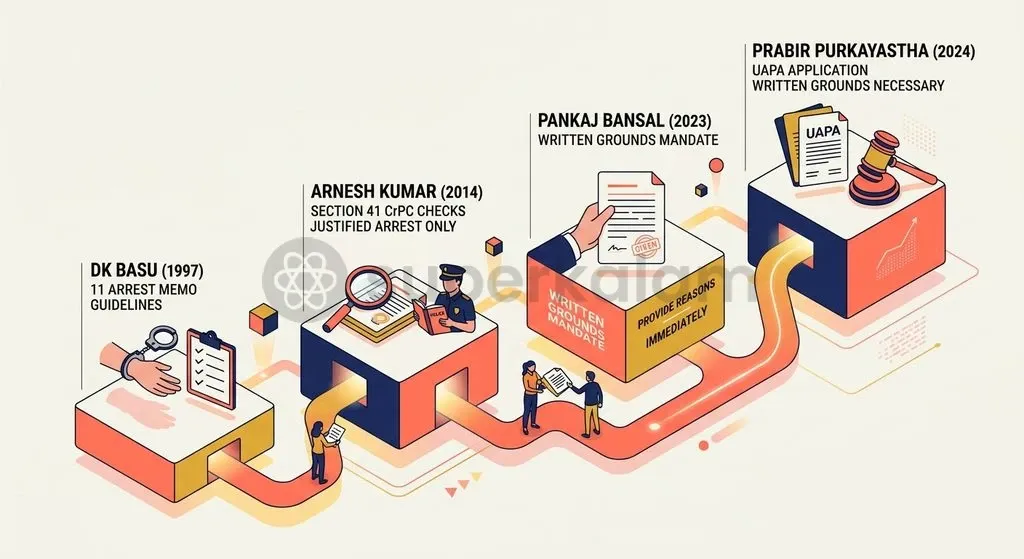
- Mandatory written grounds under UAPA: As of May 2024, the Supreme Court held in Prabir Purkayastha v. State (NCT of Delhi) (2024) that investigating agencies must provide a written copy of the grounds of arrest to an accused detained under the Unlawful Activities (Prevention) Act. Failure to do so invalidates both the arrest and subsequent remand.
- Constitutional mandate under Article 22(1): In Pankaj Bansal v. Union of India (2023), the Supreme Court established that conveying the grounds of arrest in writing is a mandatory constitutional requirement under Article 22(1).
The apex court has repeatedly observed that liberty under Article 21 cannot be abridged through mechanical detention procedures. Because preventive and statutory detentions bypass normal judicial trials, strict procedural compliance is the citizen's primary shield against administrative arbitrariness.
Discuss with Superkalam
Recall the two specific categories of persons who are excluded from the regular arrest safeguards of Article 22(1) and Article 22(2).
Ask NowHow Article 22 Protects Citizens: The Constitutional Baseline
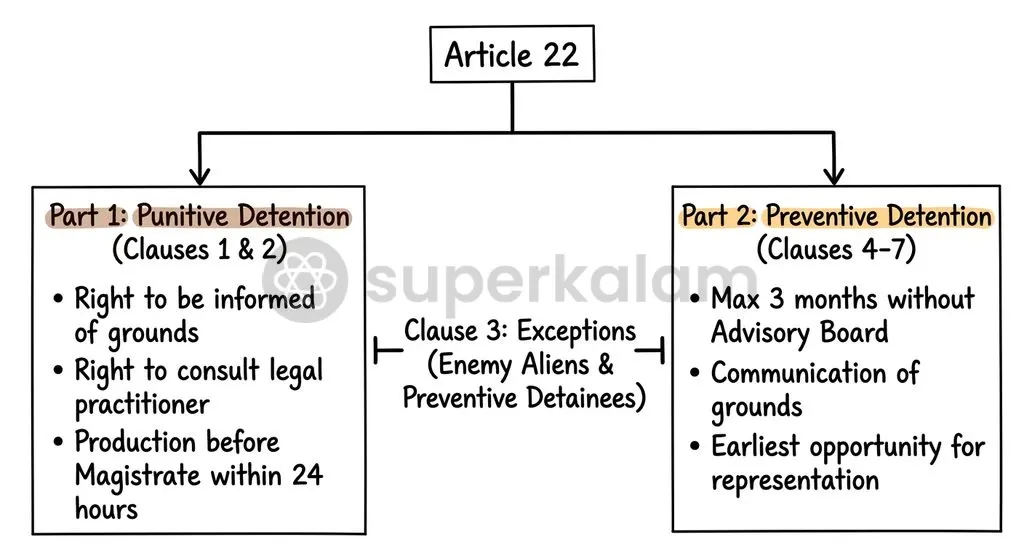
Article 22 of the Constitution of India provides specific fundamental rights to protect arrested persons from illegal detention and executive misconduct. The provision splits into two broad constitutional regimes:
| Branch | Constitutional Scope | Core Protections |
|---|---|---|
| Punitive Safeguards | Clauses (1) and (2) | Knowledge of grounds, legal counsel, 24-hour magistrate rule |
| Preventive Framework | Clauses (4) through (7) | 3-month detention ceiling, Advisory Board review, right of representation |
Article 22(1) establishes two distinct guarantees for every person taken into custody:
- Right to be informed of grounds: The detaining authority must communicate the reasons for arrest as soon as feasible.
- Right to legal representation: The arrested person cannot be denied the right to consult and be defended by a legal practitioner of choice.
Article 22(2) imposes mandatory judicial oversight over police custody:
- Production before a magistrate: Every arrested individual must be produced before the nearest magistrate within twenty-four hours of arrest.
- Exclusion of travel time: The 24-hour limit excludes the time necessary for the journey from the place of arrest to the magistrate's court.
- Prohibition on unauthorised custody: No person can be detained in police custody beyond twenty-four hours without explicit authorisation by a magistrate.
Punitive vs. Preventive Detention: What Sets Them Apart?
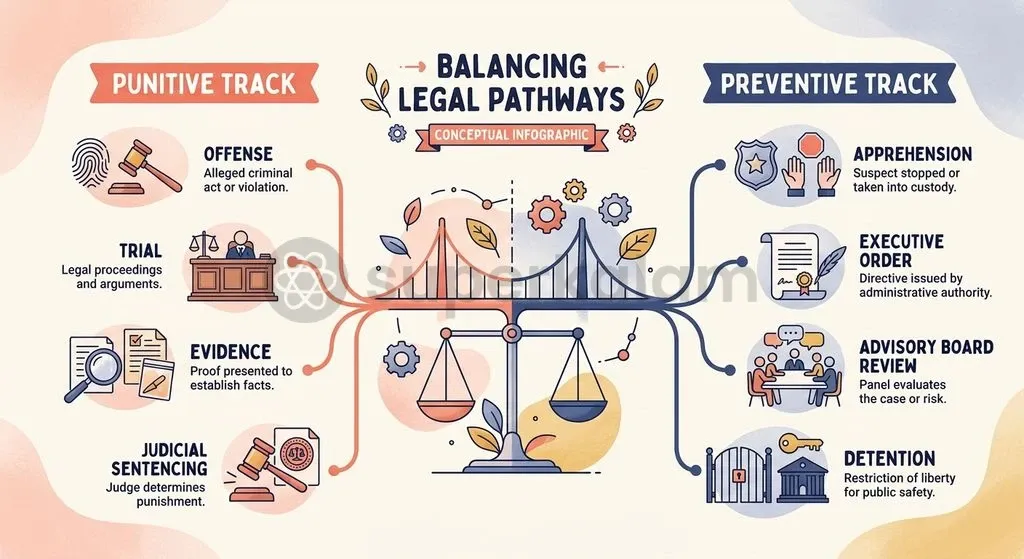
Indian constitutional jurisprudence draws a sharp conceptual boundary between punitive detention following judicial conviction and preventive detention aimed at intercepting potential unlawful acts.
In Haradhan Saha v. State of West Bengal (1975), the Supreme Court clarified that punitive detention punishes an individual for a completed offence established through regular judicial trial. By contrast, preventive detention is precautionary, designed to forestall future actions without an antecedent conviction.
In Ameena Begum v. State of Telangana (2023), the Supreme Court reiterated that preventive detention constitutes an exceptional executive power. It cannot be deployed against routine law and order infractions manageable under ordinary criminal law. The court stressed that preventive detention requires a genuine threat to public order or state security.
| Parameter | Punitive Detention | Preventive Detention |
|---|---|---|
| Primary Objective | Punish a past wrongful act | Prevent an anticipated wrongful act |
| Evidentiary Standard | Proof beyond reasonable doubt | Executive subjective satisfaction |
| Judicial Trial | Mandatory formal trial in court | No antecedent trial or formal charge |
| Governing Safeguards | Article 22(1) and Article 22(2) | Article 22(4) through Article 22(7) |
| Applicable Statutes | Bharatiya Nyaya Sanhita, CrPC / BNSS | NSA, COFEPOSA, PSA |
Discuss with Superkalam
Explain how the Supreme Court differentiates between a routine 'law and order' issue and a threat to 'public order' when assessing preventive detention.
Ask NowComparison: Regular Arrest Rights vs. Preventive Detention Safeguards
The procedural protections available to regular criminal arrestees contrast sharply with the restricted framework provided to preventive detainees under the Constitution.
While a regular arrestee enjoys an immediate constitutional right to legal representation and mandatory magistrate production within 24 hours, a preventive detainee receives administrative oversight through an Advisory Board rather than direct judicial custody hearings.
| Dimension | Regular Criminal Arrest | Preventive Detention |
|---|---|---|
| Grounds of Arrest | Immediate disclosure required (written copy mandatory) | Grounds communicated as soon as feasible |
| Legal Representation | Absolute constitutional right under Article 22(1) | Subject to statutory restrictions and board rules |
| Magisterial Review | Mandatory within 24 hours under Article 22(2) | Excluded under Article 22(3) |
| Maximum Executive Custody | 24 hours without judicial order | Up to three months without board confirmation |
| Oversight Mechanism | Judicial Magistrate / Regular Courts | High Court-qualified Advisory Board |
The Constitutional Exceptions: When Regular Rights Do Not Apply
Article 22(3) of the Constitution explicitly suspends the baseline protections of Clauses (1) and (2) for two specified categories of individuals:
- Enemy aliens: Non-citizens originating from a state engaged in active armed hostilities with India.
- Preventive detainees: Any person arrested or detained under a valid statutory law providing for preventive detention.
To prevent unbridled executive discretion, Clauses (4) through (7) establish a specialised protective scheme for preventive detention:
- Three-month maximum baseline: Article 22(4) mandates that no individual can be detained beyond three months unless an Advisory Board confirms sufficient cause before the period expires.
- Status of 44th Amendment: Section 3 of the Constitution (Forty-fourth Amendment) Act, 1978 sought to reduce this detention ceiling to two months, but executive notification never brought this provision into force.
- Right to make representation: Article 22(5) requires the detaining authority to communicate detention grounds promptly and afford the detainee the earliest opportunity to represent against the order.
- Public interest exception: Article 22(6) permits the state to withhold specific facts if disclosing them harms the public interest.
- Parliamentary authority: Article 22(7) grants Parliament exclusive jurisdiction to prescribe maximum detention periods and Advisory Board procedures.
Major central and state enactments operationalise these constitutional clauses:
- National Security Act (NSA), 1980: Section 3 empowers central and state governments to detain individuals to safeguard defence, foreign relations, state security, and essential supplies.
- COFEPOSA, 1974: Section 3 provides for detention to prevent foreign exchange violations, smuggling, and illicit financial transactions.
- Jammu and Kashmir Public Safety Act (PSA), 1978: Section 8 and Section 18 allow detention up to two years for state security threats and up to one year for public order offences.
Discuss with Superkalam
If an investigating agency fails to deliver written grounds of arrest to a suspect under a special penal law, what constitutional consequence follows based on recent apex court rulings?
Ask NowHow the Supreme Court Has Built Safeguards Against Arbitrary Arrest
The Supreme Court of India has constructed extensive judicial safeguards to contain arbitrary arrest powers and prevent custodial violations during criminal investigations.
Three foundational rulings establish these limits:
- Arrest memo and medical checks: In D.K. Basu v. State of West Bengal (1997), the Supreme Court laid down 11 mandatory guidelines to govern all arrests. These include preparing a formal arrest memo, intimating a relative within 8 to 12 hours, and conducting mandatory medical examinations every 48 hours.
- Necessity checklist for arrests: In Arnesh Kumar v. State of Bihar (2014), the Supreme Court curbed routine arrests for offences carrying imprisonment terms up to seven years. It ordered police officers and magistrates to apply the necessity checklist strictly under Section 41(1)(b) of the Code of Criminal Procedure, now reflected under Section 35 of the Bharatiya Nagarik Suraksha Sanhita.
- Timely consideration of representations: In Rekha v. State of Tamil Nadu (2011), the Supreme Court affirmed that procedural compliance under Article 22(5) must be punctiliously observed. It ruled that undue administrative delays in deciding a detainee's representation invalidate the detention order.
Key Concerns: Routine Misuse, Long Detentions, and Weak Oversight
Executive recourse to preventive detention laws frequently draws institutional criticism regarding procedural lapses, prolonged incarceration, and inadequate administrative scrutiny.
District authorities often employ preventive statutes to bypass standard investigative burdens, invoking national security enactments for petty penal offences. As highlighted in Ameena Begum (2023), conflating local law and order disturbances with grave threats to public order undermines the exceptional character of detention.
Advisory Boards face scrutiny over their institutional independence. Key institutional vulnerabilities include:
- Lack of legal counsel: Detainees are typically denied legal counsel during board hearings, tilting proceedings heavily in favour of the detaining authority.
- Administrative delays: Lapses in communicating grounds or forwarding representations directly weaken the constitutional remedy of habeas corpus.
- Standardised confirmation: Boards frequently endorse executive assessments without probing the evidentiary necessity of preventive custody.
Discuss with Superkalam
Compare the oversight function of an administrative Advisory Board under Article 22(4) with that of a Judicial Magistrate under Article 22(2).
Ask NowGS4 Dimension: Custodial Justice, Police Discretion, and Constitutional Morality
The ethical exercise of state power during arrest and detention involves an acute tension between national security imperatives and fundamental human dignity.
According to the Law Commission of India's 177th Report on the Law Relating to Arrest (2001), arbitrary arrests inflict lasting psychological damage and violate personal dignity. This necessitates strict ethical standards and statutory constraints on police discretion. When state officials bypass standard criminal procedures, administrative expediency supplants constitutional morality.
Custodial power demands institutional accountability:
- Procedural fairness: Ethical governance requires public officials to respect statutory safeguards rather than viewing procedural rules as administrative hurdles.
- Proportionality in enforcement: Executive discretion must balance public order maintenance against individual liberty without resorting to punitive overreach.
- Protection of vulnerable citizens: Arbitrary detention disproportionately affects socio-economically disadvantaged individuals lacking immediate access to legal representation.
Global Perspectives: How Other Democracies Handle Preventive Detention
Democratic legal systems across the world sharply circumscribe peacetime preventive detention, treating administrative internment without formal charge as an extraordinary emergency instrument.
In jurisdictions such as the United Kingdom and the United States, administrative detention without criminal charge is largely restricted to wartime emergencies or extraordinary counter-terrorism situations subject to intensive judicial review . India remains one of the few constitutional democracies that embeds preventive detention powers directly within its peacetime Fundamental Rights chapter.
Discuss with Superkalam
Assess whether the constitutional retention of executive preventive detention during peacetime remains justified in modern democratic governance.
Ask NowWay Forward: Reforming Detention Laws and Strengthening Judicial Review
Modernising India's detention architecture requires operationalising long-pending constitutional reforms, strengthening independent oversight, and enforcing strict judicial accountability across law enforcement agencies.
Key systemic reforms include:
- Operationalising the 44th Amendment: The executive should formally notify Section 3 of the 44th Constitutional Amendment Act to reduce the maximum detention ceiling without Advisory Board confirmation from three months to two months.
- Strengthening Advisory Boards: Ensuring independent administrative secretariats and permitting legal representation before Advisory Boards would balance procedural fairness during review hearings.
- Strict compliance with arrest guidelines: Enforcing the arrest checklists from Arnesh Kumar and written grounds requirements from Pankaj Bansal prevents mechanical detentions under ordinary penal statutes.
- Judicial accountability for procedural delays: High Courts must rigorously apply the ratio in Rekha v. State of Tamil Nadu to quash detention orders whenever state authorities cause unexplained delays in processing representations.
Key Takeaways
- Article 22 baseline protections: Article 22(1) and Article 22(2) guarantee the right to know arrest grounds, the right to consult legal counsel, and mandatory production before a magistrate within twenty-four hours.
- Preventive detention exceptions: Article 22(3) excludes enemy aliens and preventive detainees from standard arrest protections, subjecting them to the separate administrative regime under Clauses (4) through (7).
- Advisory Board timeline: Detention beyond three months requires confirmation from an Advisory Board comprising individuals qualified to serve as High Court judges under Article 22(4).
- 44th Amendment status: Section 3 of the 44th Amendment Act, 1978, which aimed to reduce the detention period without board approval to two months, remains unnotified by the executive.
- Mandatory written grounds: Recent Supreme Court rulings in Pankaj Bansal (2023) and Prabir Purkayastha (2024) mandate the provision of written grounds of arrest to prevent arbitrary remand.
- Global research gap: .
Mains Question
"Because preventive and statutory detentions bypass normal judicial trials, strict procedural compliance is the citizen's primary shield against administrative arbitrariness." In light of recent rulings including Prabir Purkayastha (2024) and Pankaj Bansal (2023), examine how the Supreme Court has reinforced the procedural safeguards under Article 22 of the Constitution. (10 Marks)
Evaluate NowMains Question
The constitutional framework of Article 22 accommodates both punitive arrest safeguards and an exceptional preventive detention regime. Critically analyse the structural tensions between executive power and individual liberty embedded in Clauses (1) through (7) of Article 22. (15 Marks)
Evaluate NowPractice MCQs
QUESTION 1
With reference to Article 22 of the Constitution of India, consider the following statements:
- The right to be informed of the grounds of arrest and to consult a legal practitioner applies to all arrested individuals without any constitutional exception.
- The twenty-four-hour limit for producing an arrested person before a magistrate excludes the time necessary for the journey from the place of arrest to the magistrate's court.
- The baseline maximum period for which a person can be detained under a preventive detention law without Advisory Board confirmation is three months.
Which of the statements given above is/are correct?
QUESTION 2
Consider the following statements regarding preventive and punitive detention in India:
- While punitive detention is based on an antecedent conviction following a formal trial, preventive detention is precautionary and based on executive subjective satisfaction.
- In Ameena Begum v. State of Telangana (2023), the Supreme Court ruled that preventive detention can be routinely deployed for ordinary law and order infractions.
- Under Article 22(6), the detaining authority has the discretion to withhold facts from the detainee if disclosure is considered against the public interest.
Which of the statements given above is/are correct?
QUESTION 3
Consider the following pairs of Supreme Court judgments and their central holdings:
- D.K. Basu v. State of West Bengal: Mandatory preparation of arrest memo and medical examinations every 48 hours.
- Pankaj Bansal v. Union of India: Conveying written grounds of arrest is a mandatory constitutional requirement under Article 22(1).
- Arnesh Kumar v. State of Bihar: Unconditional executive power to order preventive detention for up to two years.
Which of the pairs given above is/are correctly matched?
QUESTION 4
With reference to the Constitution (Forty-fourth Amendment) Act, 1978 and preventive detention, consider the following statements:
- It amended Article 22 to reduce the maximum detention period without Advisory Board approval from three months to two months.
- The reduced two-month detention ceiling became operational immediately upon the passage of the Act without requiring further executive notification.
Which of the statements given above is/are correct?
QUESTION 5
Under the Jammu and Kashmir Public Safety Act (PSA), 1978, what are the maximum statutory detention limits for threats to state security and public order respectively?