Maharashtra Methanol Rules: Why the Supreme Court Struck Them Down
Examining how the Supreme Court's ruling against mandatory chemical adulteration redefines the balance between state police power and industrial freedom.
Sep, 2026
•7 min read
Context
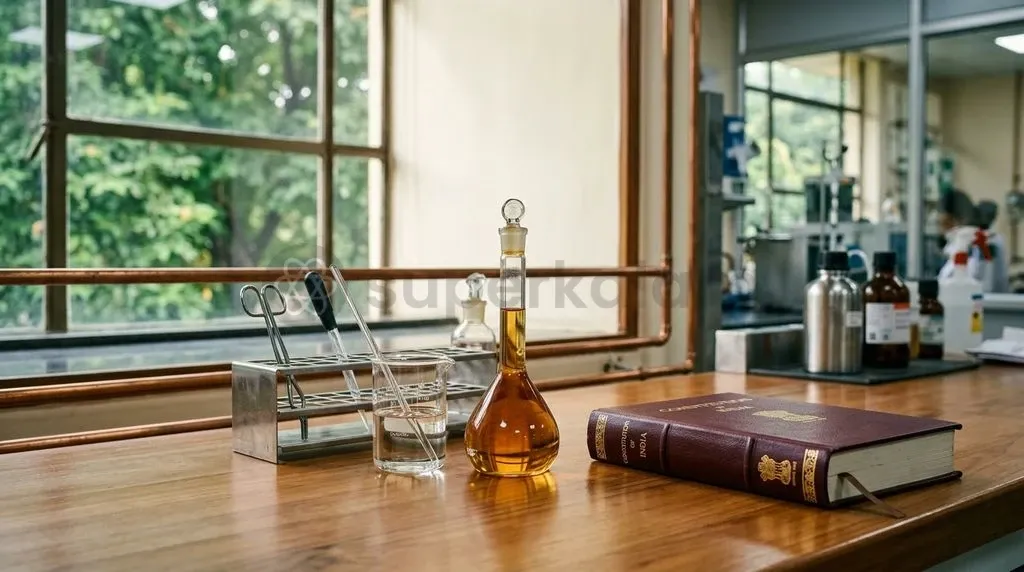
The Supreme Court of India struck down Rules 18A and 18B of the Maharashtra Poisons Rules, 1972. The bench held that mandatory chemical adulteration of industrial methanol violates fundamental rights under Article 14 and Article 19(1)(g).
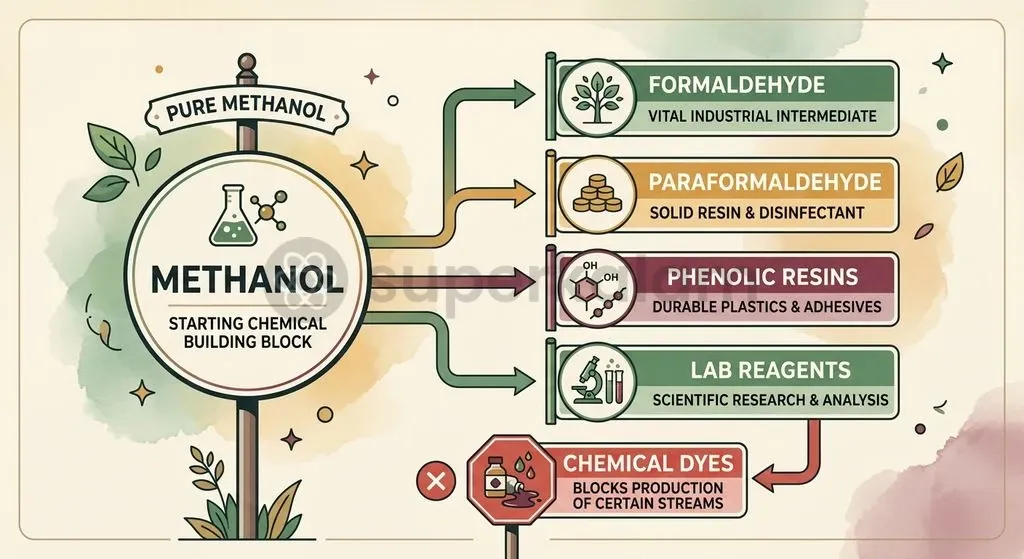
State public safety measures cannot dismantle legitimate industrial supply chains to police illegal bootlegging. Adding bitterants and colourants rendered pure methanol chemically unfit for downstream applications like formaldehydes, resins, and laboratory reagents. This judgment applies the proportionality standard to subordinate legislation governing commercial raw materials.
Why in the News: The Supreme Court Ruling on Rules 18A and 18B
The Supreme Court struck down Rules 18A and 18B of the Maharashtra Poisons Rules, 1972 on 18 September 2026 for violating fundamental rights. As of September 2026, the judgment in M/s Balaji Formalin Pvt. Ltd. & Anr. v. Union of India & Anr. (Civil Appeal No. 13008 of 2026) marks a decisive constitutional check on state subordinate legislation.
The bench ruled that state regulatory mechanisms cannot impose disproportionate compliance burdens on lawful enterprises under the guise of public safety. Industrial units had faced severe operational paralysis under the 2011 state amendments. The Court held that state administrative action under the Poisons Act, 1919 must satisfy the strict proportionality standard under Article 14 and Article 19(1)(g).
What Were Maharashtra Methanol Rules 18A and 18B?
The Maharashtra Government introduced Rules 18A and 18B through Notification No. DRG 2006/1006/C.R. 659/06/DRUGS-2 on 21 January 2011 to tighten control over methanol transactions. These provisions derived their statutory mandate from Sections 2 and 8 of the Poisons Act, 1919.
The regulatory framework imposed two binding requirements on commercial supply chains:
- Rule 18A (Mandatory Adulteration): Mandated that sellers of methanol verify the purchaser's Form A licence. Sellers had to add one gram of methylene carmine (a dye) and four grams of denatonium saccharide (a bitterant) per 100 litres before supplying non-drug manufacturers.
- Rule 18B (Seizure Powers): Authorised executive authorities to carry out the summary seizure and confiscation of any methanol found in the possession of an entity lacking a valid Form A licence.
The state administration framed these rules following the recommendations of the P.R. Parthasarthy Committee. The state appointed this committee after the 1991 Mumbai hooch tragedy at Andheri, which claimed 93 lives due to toxic methanol consumption.
Discuss with Superkalam
Which committee's recommendations after the 1991 Andheri hooch tragedy led to the notification of Rules 18A and 18B in Maharashtra?
Ask NowThe Legal Dispute: Potable Liquor vs Industrial Alcohol Regulation
Industrial manufacturers approached the judiciary because Rule 18A caused irreversible chemical contamination of pure methanol stocks. Pure industrial methanol is an indispensable feedstock across manufacturing sectors.
The technical implications created severe commercial roadblocks for lawful enterprises:
- Downstream Product Degradation: Industrial petitioners proved that mandatory dyes and bitterants chemically altered raw methanol. The additives made it completely unusable for producing formaldehyde, paraformaldehyde, industrial resins, and laboratory-grade reagents.
- Commercial Deadlocks: Manufacturers operating with zero connection to potable liquor production could not use altered raw materials without compromising end-product quality and contractual specifications.
| Dimension | Potable Alcohol | Industrial Methanol |
|---|---|---|
| Primary Chemical Composition | Ethanol ($C_2H_5OH$) fit for human consumption | Methanol ($CH_3OH$), toxic wood alcohol |
| Primary Economic Use | Beverages and spirits | Chemical feedstock for formaldehydes, resins, and labs |
| Constitutional Classification | Intoxicating liquors under Entry 8 of List II | Regulated industry feedstock under Entry 52 of List I |
| State Regulatory Scope | Comprehensive monopoly over production and sale | Restricted to preventing illicit diversion to potable streams |
Why the Court Struck Down the Rules: Article 14 and Article 19(1)(g)
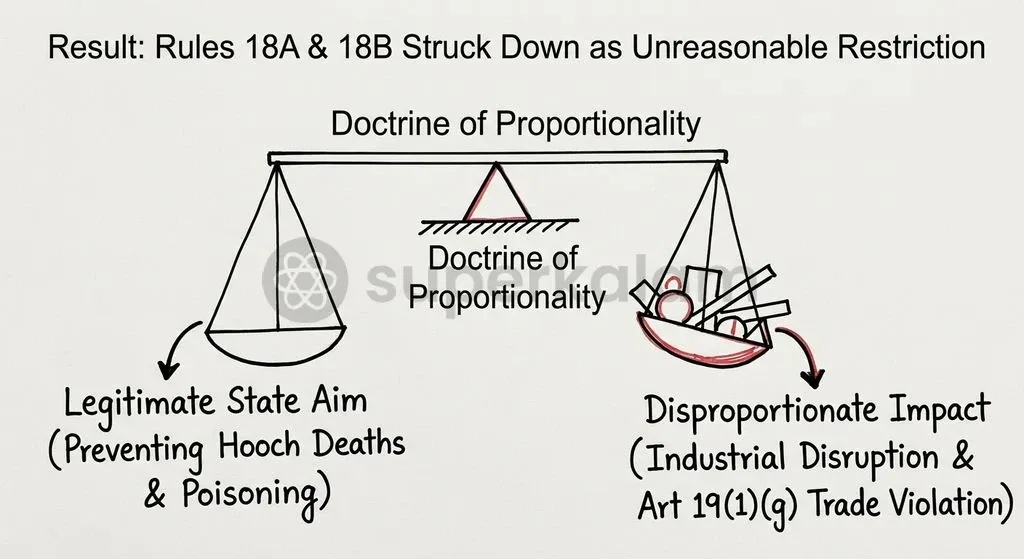
The Supreme Court tested Rules 18A and 18B against the four-pronged proportionality test established in K.S. Puttaswamy v. Union of India (2017). The Court found that the executive rules failed every major standard of constitutional reasonableness.
The judicial review rested on two foundational constitutional grounds:
- Manifest Arbitrariness under Article 14: The Court held that forcing licensed, law-abiding industrial units to chemically ruin their feedstock lacked any rational nexus to curbing illegal bootlegging. Penalising legitimate industry did not address the operational methods of illicit syndicates.
- Unreasonable Trade Restriction under Article 19(1)(g): The mandatory adulteration under Rule 18A effectively destroyed lawful businesses. The bench ruled that this restriction failed the reasonable restriction standard under Article 19(6) because the state possessed less restrictive administrative alternatives.
Discuss with Superkalam
How does chemical adulteration of methanol with dyes and bitterants impact legitimate downstream chemical manufacturing?
Ask NowConstitutional Balance: Union vs State Legislative Competence
The Seventh Schedule of the Constitution divides legislative competence between the Union and the States across distinct fields:
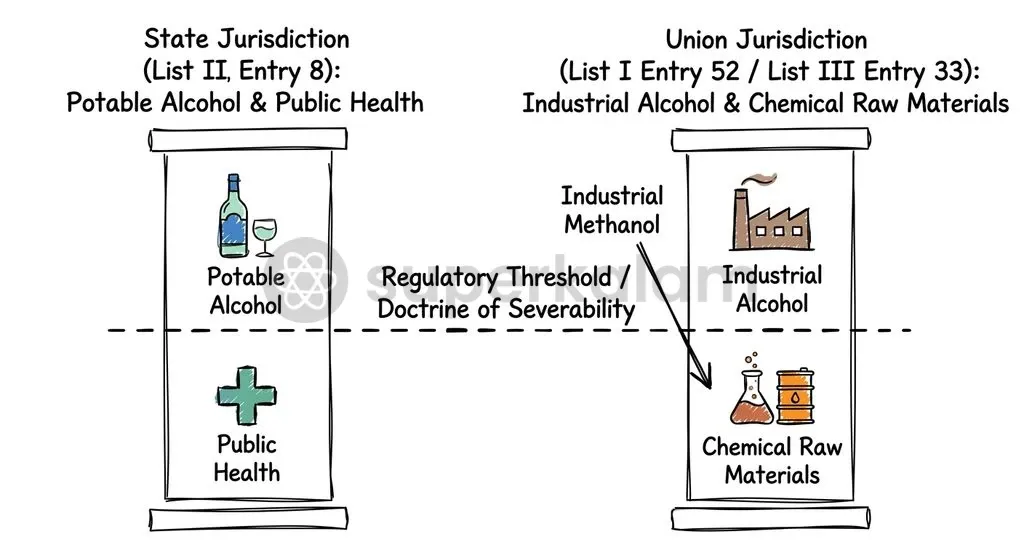
- State Authority over Potable Liquor: Entry 8 of List II (State List) grants state legislatures exclusive authority over intoxicating liquors, which covers potable alcohol fit for human consumption.
- Union Authority over Industrial Feedstocks: Industrial non-potable alcohol falls primarily within Union oversight under Entry 52 of List I (Union List) and the Concurrent List via Entry 33 of List III.
State governments retain subordinate regulatory authority under the Poisons Act, 1919. However, this executive power cannot override parliamentary legislative boundaries or impose irrational operational barriers on national industries.
Discuss with Superkalam
If a State government seeks to prevent hooch tragedies today, how can it deploy the proportionality standard to design compliant regulatory rules?
Ask NowKey Precedents: Synthetics & Chemicals to Recent Nine-Judge Bench Jurisprudence
The Supreme Court has consistently demarcated the boundaries of state taxation and regulation regarding industrial alcohol across four decades of constitutional jurisprudence.
The legal evolution spans two landmark Constitution Bench rulings:
- Synthetics & Chemicals Ltd. v. State of U.P. (1990): A 7-judge Constitution Bench held that the term 'intoxicating liquors' in Entry 8 of List II refers exclusively to potable alcohol. The Union holds jurisdiction over industrial alcohol under Entry 52 of List I, limiting state authority strictly to preventing illicit conversion into intoxicating beverages.
- State of U.P. v. M/s Lalta Prasad Vaish (2024): A 9-judge Constitution Bench ruled that States possess regulatory competence over industrial alcohol under Entry 8 of List II only to the extent necessary to prevent public health hazards and illegal diversion.
The ruling in M/s Balaji Formalin Pvt. Ltd. reinforces the principle settled in Lalta Prasad Vaish (2024). States may regulate industrial methanol to prevent lethal misuse, but such mechanisms cannot take the form of destructive technical mandates that render lawful commerce impossible.
Ethical and Governance Dimensions: Preventing Hooch Tragedies vs Regulatory Overreach
The Supreme Court highlighted that absolute prohibition policies frequently drive alcohol markets underground. Illicit distribution networks bypass legal oversight, leading directly to catastrophic hooch tragedies from tainted brews.
The Court identified five major structural harms associated with heavy-handed alcohol bans:
- Revenue Loss: Substantial erosion of legitimate state excise collections.
- Enforcement Expenditure: Diversion of administrative and fiscal resources toward policing black markets.
- Institutional Corruption: Entrenchment of police complicity and rent-seeking behaviour within illicit supply corridors.
- Illegal Distillation: Proliferation of spurious, unregulated distillation units using hazardous chemical substitutes.
- Substance Abuse Spillovers: Acceleration of secondary illicit drug consumption among vulnerable populations.
Public governance requires a balanced ethical approach. State administrations must safeguard human life from spurious spirits while protecting economic livelihoods and industrial sanity from disproportionate executive overreach.
Discuss with Superkalam
Compare the judicial interpretations of Entry 8 of List II in Synthetics & Chemicals (1990) and Lalta Prasad Vaish (2024).
Ask NowWay Forward: Balancing Public Safety with Freedom of Trade
The Supreme Court directed States and Union Territories to replace chemical denaturation with modern supply-chain monitoring systems. State administrations must adopt intelligent enforcement rather than blunt prohibitions.
The Court outlined three concrete administrative measures to secure industrial chemicals:
- Multi-Department Coordination: Institutionalising joint operational protocols across state police, excise departments, and transport authorities to intercept illicit movements.
- Transport Manifest Tracking: Enforcing end-to-end digital tracking, verified transit permits, and dedicated vehicle manifests for bulk methanol shipments.
- Strict Stock Reconciliation: Conducting periodic physical audits and digital balance reconciliations at production hubs to detect industrial leakage early without altering chemical feedstocks.
Key Takeaways
- Judicial Verdict: The Supreme Court invalidated Rules 18A and 18B of the Maharashtra Poisons Rules, 1972 on 18 September 2026 for violating Article 14 and Article 19(1)(g).
- Flawed Additive Mandate: Rule 18A mandated adding bitterants and colourants to industrial methanol, which chemically contaminated raw materials for formaldehydes and resins.
- Constitutional Jurisprudence: The judgment reaffirms the 9-judge bench ruling in State of U.P. v. M/s Lalta Prasad Vaish (2024), holding that state control over industrial alcohol is strictly limited to preventing public health misuse.
- Proportionality Standard: State measures targeting bootlegging must satisfy the Puttaswamy proportionality test and cannot arbitrarily destroy legitimate commercial activity.
- Administrative Reform: The Supreme Court mandated digital tracking, transport manifests, and inter-departmental enforcement to prevent hooch tragedies instead of physical denaturation.
Mains Question
"State public safety measures cannot dismantle legitimate industrial supply chains under the guise of policing illegal bootlegging." In light of the Supreme Court's judgment in M/s Balaji Formalin Pvt. Ltd. (2026), critically examine how the proportionality doctrine safeguards Article 19(1)(g) against arbitrary subordinate legislation. (15 Marks)
Evaluate NowMains Question
Delineate the constitutional division of legislative competence between the Union and the States regarding potable liquor and industrial alcohol under the Seventh Schedule, with reference to the Synthetics & Chemicals (1990) and Lalta Prasad Vaish (2024) judgments. (10 Marks)
Evaluate NowPractice MCQs
QUESTION 1
With reference to the constitutional distribution of legislative powers regarding alcohol under the Seventh Schedule of the Constitution of India, consider the following statements:
- Entry 8 of List II (State List) empowers State legislatures to regulate intoxicating liquors fit for human consumption.
- Non-potable industrial alcohol falls primarily within Union oversight under Entry 52 of List I.
- In Synthetics & Chemicals Ltd. v. State of U.P. (1990), a seven-judge Constitution Bench held that 'intoxicating liquors' in Entry 8 of List II includes both potable alcohol and industrial methanol.
Which of the statements given above are correct?
QUESTION 2
Consider the following statements regarding the Supreme Court's ruling in M/s Balaji Formalin Pvt. Ltd. v. Union of India (2026):
- The Court struck down Rules 18A and 18B of the Maharashtra Poisons Rules, 1972 on the grounds of Articles 14 and 19(1)(g).
- The contested rules mandated the addition of methylene carmine and denatonium saccharide to pure industrial methanol.
- The judgment affirmed that executive rulemaking under the Poisons Act, 1919 must satisfy the four-pronged proportionality test.
Which of the statements given above is/are correct?
QUESTION 3
Consider the following statements regarding State regulatory authority over industrial chemicals:
- State governments possess subordinate regulatory authority under Sections 2 and 8 of the Poisons Act, 1919.
- According to State of U.P. v. M/s Lalta Prasad Vaish (2024), States possess competence to regulate industrial alcohol to prevent public health hazards and illegal diversion.
- The 1991 Mumbai hooch tragedy at Andheri led to the recommendations of the P.R. Parthasarthy Committee.
Which of the statements given above are correct?
QUESTION 4
In the context of judicial review of administrative action, on which of the following grounds did the Supreme Court hold the mandatory chemical alteration of methanol under Rule 18A to be unconstitutional?
- Manifest arbitrariness under Article 14 due to lack of rational nexus with checking illicit bootlegging.
- Failure to meet the reasonable restriction test under Article 19(6) due to the availability of less restrictive administrative alternatives.
- Violation of parliamentary legislative boundaries under Entry 52 of List I.
Select the correct answer using the code given below:
QUESTION 5
Which of the following measures were recommended by the Supreme Court as legitimate non-destructive alternatives to chemical denaturation of industrial methanol?