Whale Strandings in Gujarat: Recording Gaps and Conservation
Gujarat has 15 compiled blue-whale stranding records, only one after 2000. Read why monitoring gaps matter for marine conservation.
Oct, 2026
•10 min read
Context
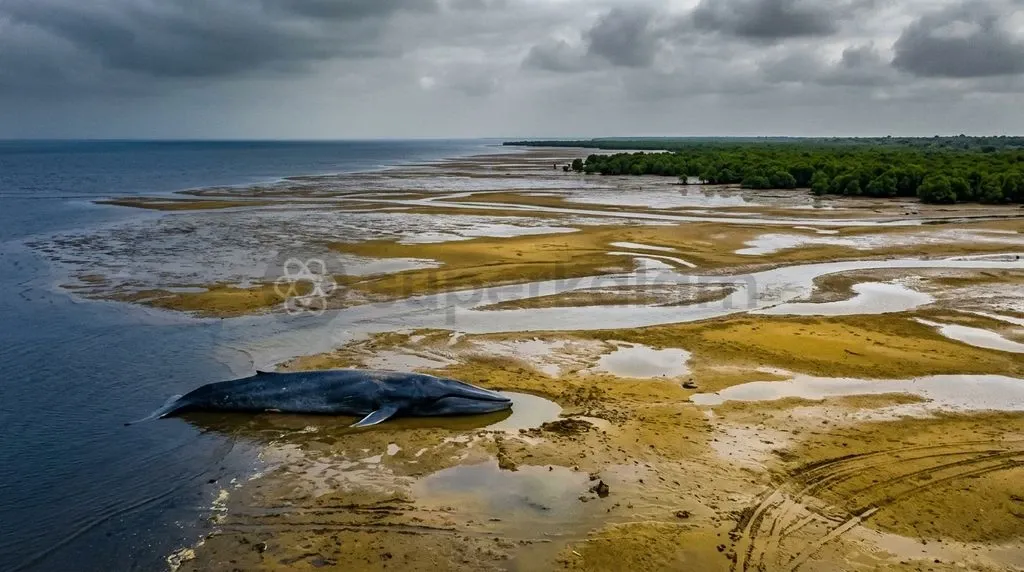
The Hindu's 22 October 2026 article revisits whale strandings along Gujarat's coast through a gap in observation and record-keeping. A compiled record contains 15 blue-whale strandings in Gujarat, 14 from the twentieth century and only one after 2000. That contrast does not establish that whales stopped visiting the coast or that mortality is rising.
Fishers continue to report whale sightings, while older records are concentrated around periods when particular naturalists and researchers were documenting them. The immediate conservation need is to rebuild systematic reporting of sightings and strandings. A stranding record alone does not establish its cause: natural conditions or human pressures may be possible contributors, but a cause for a particular Gujarat event requires investigation rather than assumption.
Why in the News? Recent Cetacean Strandings Along the Gujarat Coastline
The news peg is a monitoring gap, not evidence of a newly established surge in whale deaths. In its 22 October 2026 article, The Hindu notes that Gujarat's compiled record contains 15 blue-whale strandings, with 14 in the twentieth century and just one after 2000. Nine of the records trace to two periods of focused attention: naturalist S.T. Moses's work in the 1940s and a compilation of Gujarat records published in 2001.
The article questions whether systematic recording continued afterwards. It identifies a 2016 news report mentioning a blue-whale stranding in Gujarat that is absent from the global database. Fishers interviewed along the coast also describe continuing whale sightings. Fewer database entries therefore cannot be read as proof that whales no longer occur there.
Stranding records can provide otherwise scarce information about cetacean distribution, seasonal movements and population structure. More complete records would also make it easier to investigate individual deaths. The article calls for people who find a stranded whale or dolphin, alive or dead, to contact the local forest department, take photographs, record the location and date, and contribute the observation to a stranding database.
Possible natural and human-related causes of strandings remain subjects for investigation. The records discussed here do not establish a particular cause for Gujarat's strandings or demonstrate an increasing mortality trend.
Background: What Long-Term Data Reveals About India's Stranding Surge
Historical records establish India's north-western seaboard as an acute mortality hotspot. A spatio-temporal study spanning 270 years of Indian stranding data published in Scientific Reports identified this shoreline, particularly Mumbai and the Saurashtra-Kachchh rim, as an emerging high-density stranding zone.
Field surveys confirm that beaching events are multiplying rapidly across western waters:
- Tenfold Stranding Surge: A stock assessment study conducted by the ICAR-Central Marine Fisheries Research Institute revealed a tenfold surge in whale stranding reports along India's west coast between 2004 and 2023.
- Primary Environmental Drivers: Scientists link this acceleration to heavy vessel traffic, underwater acoustic pollution, shifting oceanographic conditions, and seasonal monsoon upwelling across the Arabian Sea.
Discuss with Superkalam
Can you recall which cetacean subpopulation resident in the Arabian Sea is classified as Endangered with fewer than 250 individuals?
Ask NowWhat Is Cetacean Stranding? Understanding How Marine Mammals Beach
A stranding occurs when a marine mammal grounds itself on land or gets trapped in unnavigable shallows. According to the Convention on the Conservation of Migratory Species of Wild Animals, a stranding involves an animal beaching itself or becoming immobilised in shallows. Mass strandings occur when two or more individuals—excluding a cow-calf pair—ground simultaneously in close proximity.
Physiological and navigational failures frequently trigger these strandings. As detailed in the Marine Mega Fauna Stranding Management Guidelines issued by the Ministry of Environment, Forest and Climate Change, biological mechanisms driving strandings include:
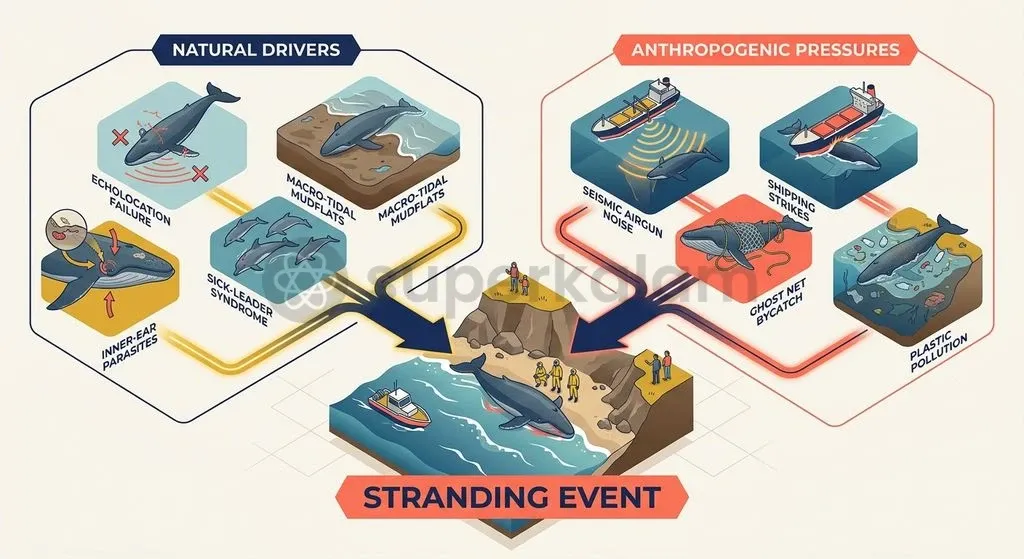
- Echolocation failure: Toothed whales navigate via high-frequency bio-sonar. This signal attenuates and scatters across gently shelving, muddy substrates, producing false bathymetric readings.
- Parasitic inner-ear trauma: Severe endoparasitic infections in the pterygoid sinus or middle-ear cavities destroy the delicate auditory apparatus required for spatial orientation.
- Neurotoxic poisoning: Harmful algal blooms produce bio-accumulative marine biotoxins that impair neurological function and motor control.
- Sick-leader syndrome: In highly cohesive social species, pod members follow a disoriented or diseased matriarch into dangerous coastal shallows.
| Stranding Parameter | Single Stranding | Mass Stranding |
|---|---|---|
| Individual Count | One individual (or a cow-calf pair) | Two or more individuals (excluding cow-calf pairs) |
| Typical Taxa | Baleen whales (Mysticeti) and coastal odontocetes | Highly social pelagic toothed whales (Odontoceti) |
| Primary Causes | Old age, chronic disease, vessel trauma, fishing gear entanglement | Echolocation attenuation over mudflats, social cohesion ("sick-leader"), seismic acoustic shock |
| Ecological Impact | Individual mortality | Severe genetic and demographic loss to local subpopulations |
Why Gujarat? Coastal Topography, Arabian Sea Currents, and Heavy Maritime Traffic
Gujarat's coastal geography forms a natural funnel for disoriented pelagic mammals. Key geographic and infrastructural factors include:
- Extensive Coastline: The state holds India's longest maritime coastline at approximately 1,650 kilometres, representing nearly 21.9% of the national mainland seaboard, flanked by the Gulf of Kachchh and the Gulf of Khambhat, according to the Naval Hydrographic Department.
- Extreme Macro-Tides: Reports from the CSIR-National Institute of Oceanography document an extreme macro-tidal regime in the Gulf of Khambhat, where spring tidal amplitudes exceed 8 to 11 metres. Water recedes rapidly across vast mudflats, trapping foraging whales before they can retreat.
- Dense Shipping Traffic: Environmental profiles compiled by the Gujarat Maritime Board reveal that major commercial ports—including Deendayal at Kandla, Mundra, Hazira, and Dahej—drive heavy vessel congestion. Whales encounter frequent risks of blunt-force hull collisions and acoustic disorientation.
Discuss with Superkalam
How does acoustic noise from seismic airguns and marine traffic physically interfere with cetacean navigation and diving behavior?
Ask NowKey Cetaceans in Indian Waters: Blue Whales, Bryde's Whales, and Endangered Porpoises
Indian territorial waters support a diverse mix of cetaceans across distinct marine habitats. The Arabian Sea hosts several notable species:
- Baleen Whales: Large filter feeders include the blue whale (Balaenoptera musculus), fin whale (Balaenoptera physalus), and Bryde's whale (Balaenoptera edeni).
- Inshore Cetaceans: Nearshore waters support vulnerable delphinids and porpoises, including the Indian Ocean humpback dolphin and the finless porpoise.
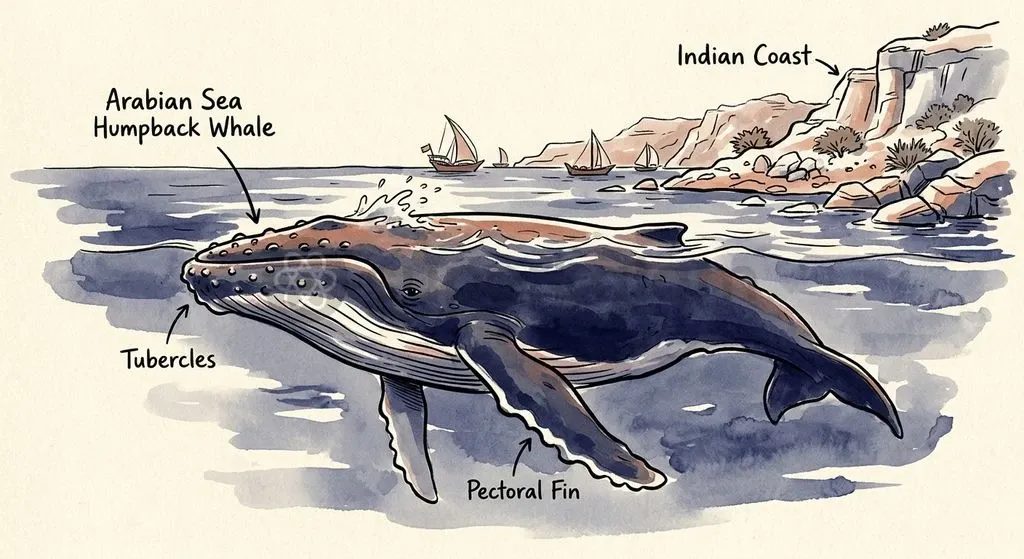
- Arabian Sea Humpback Whale (Megaptera novaeangliae): Data from the IUCN Red List classifies this isolated subpopulation as Endangered, with an estimated abundance of fewer than 250 individuals.
Unlike southern hemisphere humpbacks, this northern Indian Ocean population does not undertake polar feeding migrations. They remain year-round within the tropical Arabian Sea, including India's western seaboard.
Dedicated conservation frameworks address this isolated group. At its 70th meeting in October 2026, the International Whaling Commission formally endorsed a regional Conservation Management Plan, jointly backed by the Convention on Migratory Species, to coordinate cross-border protection across Arabian Sea range states.
Natural vs Anthropogenic Causes: Sonar Disturbance, Ghost Nets, Toxic Spills, and Disease
Human activity converts natural coastal hazards into recurring mortality events. Several distinct anthropogenic pressures drive strandings in the region:
- Seismic Airgun Surveys: Offshore oil and gas exploration generates intense noise. As outlined in guidelines by the Joint Nature Conservation Committee and the International Whaling Commission, marine seismic airgun surveys emit acoustic pulses reaching up to 250 dB re 1 µPa. These sound waves rupture auditory tissues and trigger rapid ascents that cause decompression sickness.
- Commercial Fisheries Bycatch: The MoEFCC Marine Mega Fauna Stranding Management Guidelines estimate that 9,000 to 10,000 cetaceans are accidentally caught annually in mechanised fishing vessels across India. Discarded nylon "ghost nets" drift indefinitely, drowning tangled mammals.
- Synthetic Plastic Ingestion: Solid waste induces fatal digestive blockages. A necropsy documented by the Sasan Gir Forest Division revealed four large synthetic carry bags obstructing the digestive tract of a stranded Longman's beaked whale, triggering systemic perforation.
Discuss with Superkalam
If you were a district administrator responding to a live 20-foot whale stranded on intertidal mudflats, which agencies would you mobilize in the first three hours?
Ask NowLegal and Institutional Protections: Wildlife Protection Act 1972 and International Conventions
Indian statutory law provides rigorous formal protection to all cetacean species inhabiting its territorial waters and exclusive economic zone. Under Schedule I of the Wild Life (Protection) Act, 1972, as amended by the Wild Life (Protection) Amendment Act, 2022, all whales, dolphins, and porpoises receive the highest tier of legal immunity. The law strictly criminalises hunting, capture, or commercial exploitation.
India's domestic legal protections align with several multilateral environmental agreements:
- CITES (Convention on International Trade in Endangered Species): Blue whales, fin whales, and Indian Ocean humpback dolphins are listed under Appendix I, banning commercial international trade in specimens or derived products.
- CMS (Convention on the Conservation of Migratory Species of Wild Animals): India is a party to CMS, which provides cooperative frameworks for conserving migratory cetaceans listed under its Appendices.
- IWC (International Whaling Commission): India adheres to the commercial whaling moratorium established by the IWC, supporting conservation management initiatives across the Indian Ocean Sanctuary.
- MoEFCC Management Directives: In January 2021, the Ministry of Environment, Forest and Climate Change notified the Marine Mega Fauna Stranding Management Guidelines to standardise domestic rescue, refloating, and disposal operations.
Key Bottlenecks: Gaps in Necropsy Facilities, Marine Stranding Networks, and Rapid Response
A substantial gap persists between statutory intent and coastal reality. Frontline personnel face critical operational hurdles:
- Deficits in Veterinary Forensics: As highlighted in MoEFCC guidelines, coastal administrations lack specialised veterinary pathologists trained in marine mammalogy. Carcasses are routinely cremated or buried without detailed histopathology or blubber toxicology screening, discarding vital forensic evidence.
- Inter-Agency Jurisdiction Friction: Emergency operations encounter coordination delays between the State Forest Department, the Indian Coast Guard, the Marine Police, and scientific bodies like CMFRI.
- Inadequate Heavy-Lift Gear: Ground teams routinely lack amphibious pontoons and specialised refloating equipment capable of shifting multi-tonne animals across soft, sinking mudflats.
Global Best Practices in Marine Mammal Rescue and Post-Mortem Protocols
International conservation networks deploy proven technical mechanisms to reduce mortality and examine carcasses. Standard interventions include:
- Dynamic Speed Caps: The International Maritime Organization and the International Whaling Commission recommend acoustic zoning alongside seasonal 10-knot vessel speed caps within Particularly Sensitive Sea Areas, sharply cutting lethal ship strikes.
- Acoustic and Tag Tracking: Marine research protocols in the Aquatic Mammals Journal highlight the deployment of Passive Acoustic Monitoring systems and satellite telemetry tags on refloated animals to assess post-release survival.
- Mobile Necropsy Laboratories: Standardised marine response teams deploy mobile dissection units to collect tissue and inner-ear specimens immediately upon discovery.
Discuss with Superkalam
Compare the impact of natural biological drivers (such as echolocation failure over mudflats) versus anthropogenic drivers (such as shipping channels and ghost nets) in causing cetacean mortality.
Ask NowWay Forward: Building an Integrated Coastal Stranding Network and Dedicated Marine Protocols
Strengthening India's marine mammal conservation framework requires shifting from ad-hoc emergency actions to an institutionalised operational model. Protecting endangered cetaceans along Gujarat's industrial coast calls for clear structural and technical reforms:
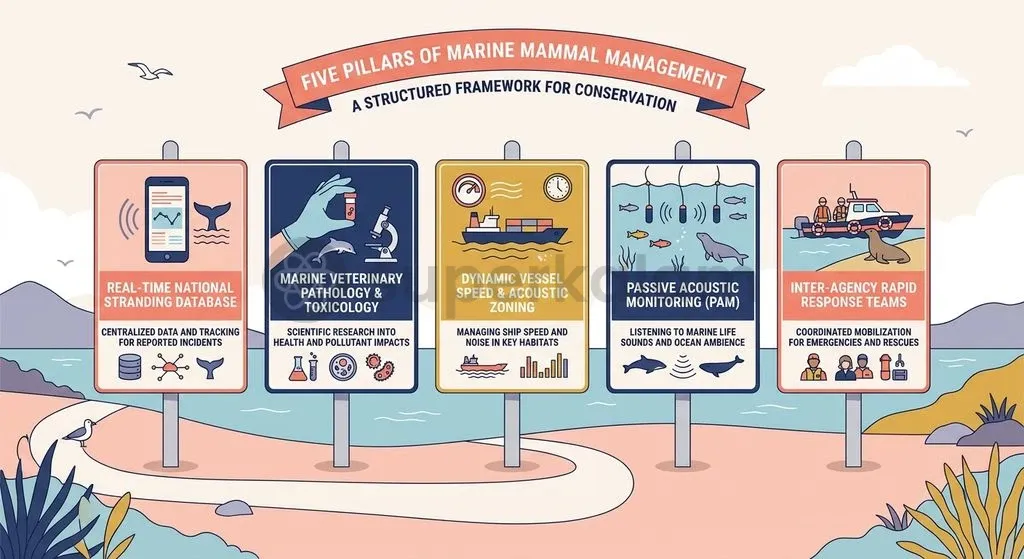
- Establish a National Marine Mammal Stranding Network: India must institutionalise a centrally coordinated network linked to a real-time National Stranding Database, as recommended in peer-reviewed spatial studies, to record baseline mortality trends and map spatial epidemiology across all coastal states.
- Develop Coastal Forensic and Necropsy Infrastructure: State administrations must set up dedicated marine veterinary laboratories equipped with blubber-toxicology testing, acoustic tissue analysis, and mobile necropsy units to ensure no cetacean carcass is discarded without forensic evaluation.
- Institute Dynamic Vessel Speed Regulations: The Ministry of Ports, Shipping and Waterways, in coordination with the MoEFCC and Gujarat Maritime Board, should designate sensitive cetacean corridors in the Gulf of Kachchh and Gulf of Khambhat as speed-restricted zones, imposing mandatory 10-knot speed caps during peak migration periods.
- Deploy Real-Time Acoustic and Satellite Systems: Port authorities and marine parks should deploy continuous Passive Acoustic Monitoring buoys across shipping channels to detect cetacean vocalisation in real time, alerting commercial ships to avoid collisions.
- Form Inter-Agency Rapid Response Teams: Standard operating procedures must formally establish joint task forces integrating the State Forest Department, Indian Coast Guard, Marine Police, and CMFRI scientists, backed by specialised amphibious rescue pontoons and refloating gear.
Key Takeaways
- All cetaceans in Indian waters enjoy highest-tier statutory protection under Schedule I of the Wild Life (Protection) Act, 1972, as amended in 2022, as well as Appendix I of CITES.
- Gujarat's 1,650 km coastline and the extreme 8 to 11 metre spring tidal ranges of the Gulf of Khambhat create natural bathymetric traps that beach disoriented whales on shallow mudflats.
- The isolated Arabian Sea humpback whale subpopulation consists of fewer than 250 individuals, lacks polar migration, and is classified as Endangered on the IUCN Red List.
- Anthropogenic stressors—including bycatch claiming 9,000 to 10,000 cetaceans annually, seismic airguns producing pulses up to 250 dB re 1 µPa, and marine plastic ingestion—accelerate stranding mortality.
- Critical institutional deficits include the lack of specialised marine veterinary pathologists, unconducted blubber necropsies, and inter-agency friction between Forest Departments, the Coast Guard, and fisheries research bodies.
Mains Question
"The recurring strandings of cetaceans along Gujarat's coastline highlight a critical intersection between extreme coastal geomorphology and expanding maritime industrialization." Examine. (10 Marks)
Evaluate NowMains Question
Despite stringent legal protections under Schedule I of the Wild Life (Protection) Act, 1972 and various international conventions, marine megafauna mortality continues to surge along India's western seaboard. Critically analyse the institutional and scientific bottlenecks hindering effective cetacean conservation and stranding response. (15 Marks)
Evaluate NowPractice MCQs
QUESTION 1
With reference to cetacean strandings along the Indian coastline, consider the following statements:
- Under the Wild Life (Protection) Act, 1972, as amended in 2022, all cetaceans receive Schedule I legal protection.
- In mass strandings, the grounding of two or more individuals includes a cow-calf pair according to the Convention on the Conservation of Migratory Species of Wild Animals (CMS).
- Toothed whales navigate using high-frequency bio-sonar, which can scatter over gently shelving, muddy substrates and lead to false bathymetric readings.
Which of the statements given above are correct?
QUESTION 2
Consider the following statements regarding the Arabian Sea subpopulation of the Humpback Whale (Megaptera novaeangliae):
- It is classified as Endangered under the IUCN Red List, with an estimated abundance of fewer than 250 individuals.
- Unlike southern hemisphere humpback populations, it remains year-round within the tropical Arabian Sea and does not undertake polar feeding migrations.
- The subpopulation is covered under a regional Conservation Management Plan formally endorsed by the International Whaling Commission.
Which of the statements given above is/are correct?
QUESTION 3
Which of the following physical and oceanographic characteristics of Gujarat's coast contributes most directly to trapping foraging whales in coastal shallows?
QUESTION 4
With reference to anthropogenic pressures on marine mammals highlighted in the MoEFCC Marine Mega Fauna Stranding Management Guidelines and related studies, consider the following statements:
- Discarded nylon ghost nets drift indefinitely and pose severe drowning risks to tangled cetaceans.
- Seismic airgun surveys for offshore exploration emit acoustic pulses that can exceed 240 dB re 1 µPa, risking auditory trauma and decompression sickness.
- Commercial fisheries bycatch in India accounts for an estimated 9,000 to 10,000 cetaceans accidentally caught annually in mechanised vessels.
Which of the statements given above are correct?
QUESTION 5
Consider the following international frameworks and conventions in relation to cetacean conservation in India:
- CITES lists blue whales, fin whales, and Indian Ocean humpback dolphins under Appendix I, banning commercial international trade in their specimens.
- India adheres to the commercial whaling moratorium established by the International Whaling Commission (IWC).
- The Convention on the Conservation of Migratory Species of Wild Animals (CMS) provides cooperative frameworks for conserving migratory cetaceans.
Which of the statements given above are correct?