Voyager 1 at One Light-Day: Deep Space Physics & Longevity
Operating 24 light-hours away with fading nuclear power, Voyager 1 reveals the engineering endurance and physics vital for deep-space planetary exploration.
Nov, 2026
•12 min read
Overview
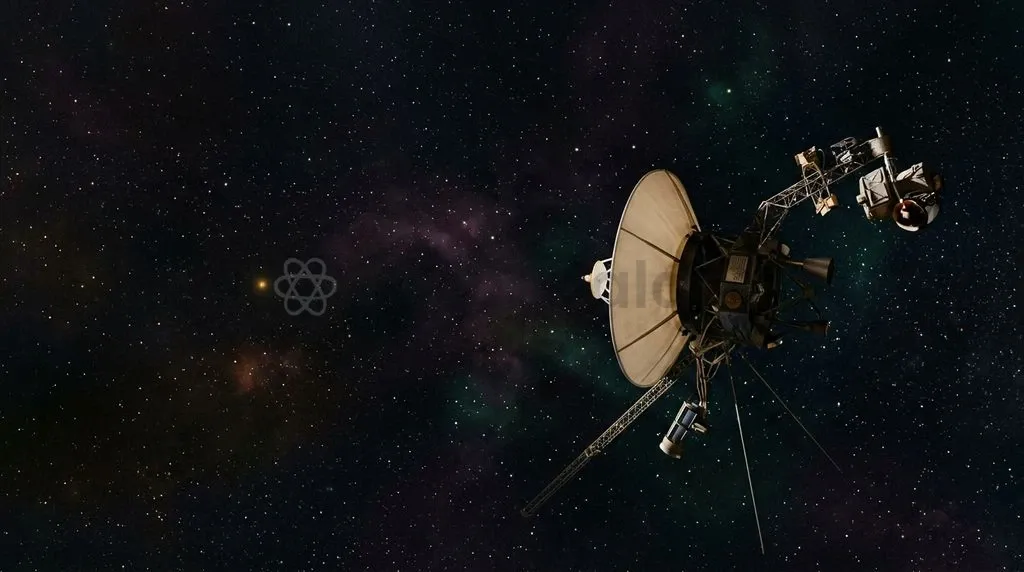
On 18 November 2026, NASA's Voyager 1 spacecraft became the first human-made object to cross a distance of one light-day from Earth. Reaching approximately 25.902 billion kilometres into deep space, the milestone created an operational forty-eight-hour round-trip latency for ground controllers.
Radio signals traversing the vacuum take a full twenty-four hours to arrive one way. Powered by decaying Plutonium-238 inside radioisotope thermoelectric generators, the probe operates under rigid thermal margins. It continues gathering direct in situ data from the local interstellar medium.
As of November 2026, the mission demonstrates that extreme deep-space longevity relies on ruthless power triage, adaptive fault recovery, and ultra-sensitive ground reception rather than active propulsion.
Why in the News: Voyager 1 Crosses the One Light-Day Threshold
NASA confirmed that Voyager 1 crossed the one light-day distance threshold on 18 November 2026, placing the probe roughly 25.902 billion kilometres away from Earth. As reported by the NASA Science Mission Directorate, this distance equals approximately 16.094 billion miles or 173.14 Astronomical Units (AU).
The event represents a purely physical milestone rather than an orbital boundary. It marks the moment when separation between Earth and an artificial craft requires electromagnetic radiation to travel for an entire solar day.
| Parameter | Value |
|---|---|
| Distance | ~25.902 billion km (173.14 AU) |
| Uplink Time | 24 hours |
| Downlink Time | 24 hours |
| Total Round-Trip Latency | 48 hours |
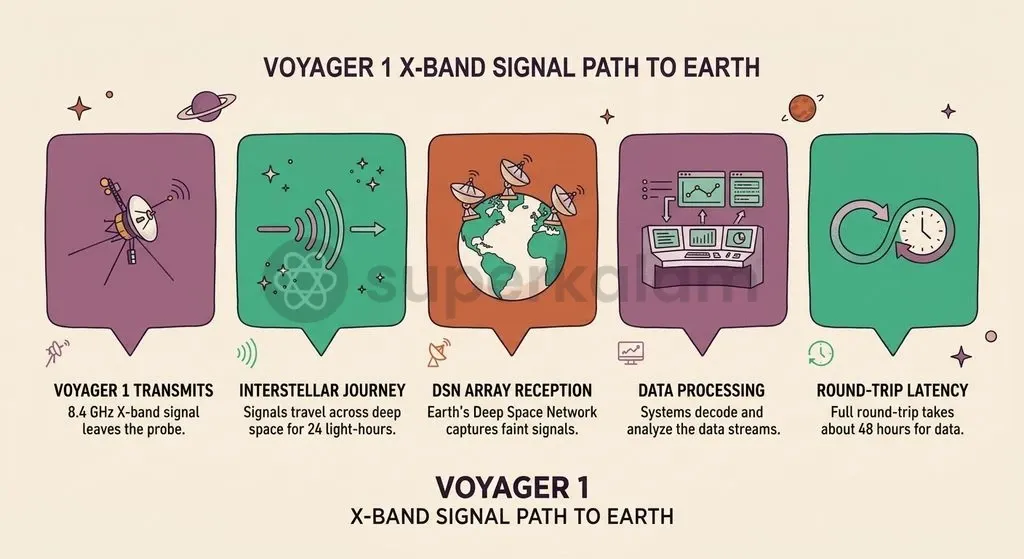
Any operational command uplinked from the Jet Propulsion Laboratory (JPL) now requires a full twenty-four hours to reach the spacecraft's receiver. The subsequent confirmation downlink consumes another twenty-four hours. This reality imposes an unavoidable forty-eight-hour round-trip latency on mission controllers.
For science and technology policy, this milestone is a definitive case study in extreme-distance communications, radioisotope thermoelectric power degradation, and software resilience under physical isolation.
What Is a Light-Day and Where Voyager 1 Sits in the Cosmos
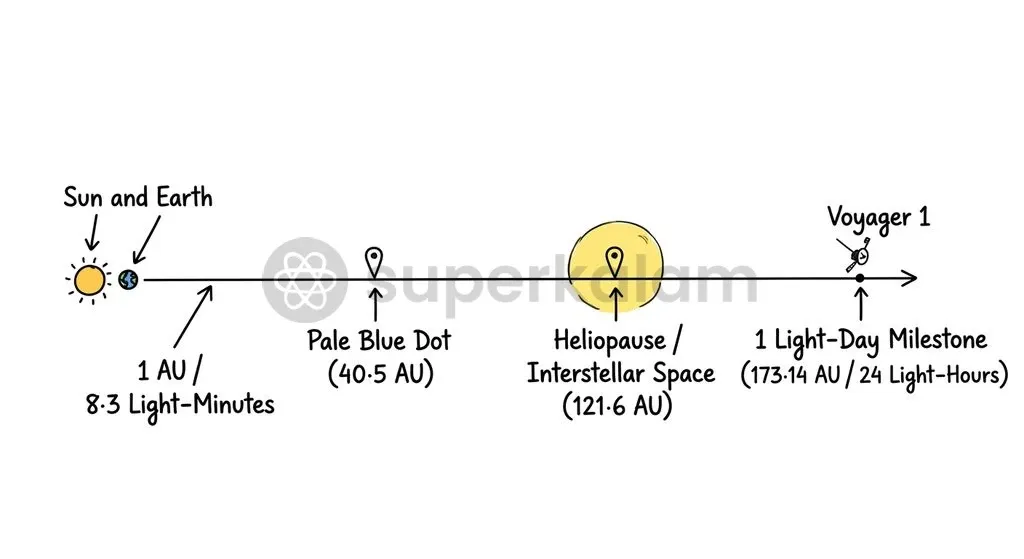
A light-day represents the astronomical distance that electromagnetic radiation travels through a vacuum over twenty-four hours, spanning approximately 25.902 billion kilometres. Distances within the solar system are conventionally measured in Astronomical Units, where one AU equates to the mean distance between the Earth and the Sun (~149.6 million kilometres). One light-day is therefore equivalent to roughly 173.14 AU, placing Voyager 1 far outside the planetary disk of our solar system.
NASA launched Voyager 1 on 5 September 1977 aboard a Titan IIIE-Centaur rocket from Cape Canaveral, sixteen days after its twin probe Voyager 2. The flight profile used an accelerated hyperbolic trajectory optimised for rapid flybys of Jupiter and Saturn, enabling the spacecraft to achieve solar system escape velocity.
On 14 February 1990, Voyager 1 turned its optical cameras backward at a distance of approximately 6 billion kilometres (40.5 AU) to capture the famous Pale Blue Dot photograph of Earth. Engineers then permanently deactivated its imaging subsystems to conserve electrical power.
| Landmark / Metric | Distance from Earth (AU) | Metric Distance (km) | Telemetry One-Way Light Time |
|---|---|---|---|
| Earth-Sun Mean Distance (1 AU) | 1.0 AU | ~149.6 million km | ~8.3 minutes |
| 'Pale Blue Dot' Image (1990) | 40.5 AU | ~6.0 billion km | ~5.5 hours |
| Heliopause Crossing (2012) | 121.6 AU | ~18.2 billion km | ~16.9 hours |
| One Light-Day Milestone (2026) | 173.14 AU | ~25.902 billion km | 24.0 hours |
Voyager 1 sits firmly within the local interstellar medium. Yet it has not departed the gravitational influence of the Sun. The outer boundary of the solar system is defined by the Oort Cloud, a vast spherical reservoir of icy planetesimals extending from approximately 2,000 AU to beyond 100,000 AU. At its current velocity, Voyager 1 will take roughly three centuries to reach the inner edge of the Oort Cloud, confirming that the probe is in interstellar space while remaining gravitationally bound to the Sun.
Discuss with Superkalam
What is the half-life of Plutonium-238, and by how many watts does Voyager 1's power output decline each year?
Ask NowTelemetry Across 24 Light-Hours: How Signals Travel Through the Deep Space Network
Voyager 1 maintains communication across 24 light-hours using an 8.4 gigahertz X-band transmitter that radiates only 22.4 watts of power through a 3.7-metre dish antenna. According to the NASA JPL Voyager Telecommunications System Architecture Document, this transmission power is roughly equivalent to the bulb inside a domestic refrigerator. By the time the signal traverses nearly 26 billion kilometres, the inverse-square law of radiation spreads the wavefront across vast areas of space. This diminishes its received power on Earth to less than a fraction of an attowatt (10⁻¹⁸ watts).
Closing the telecommunications link requires the high-sensitivity tracking assets of the NASA Deep Space Network (DSN). Reception relies on massive 70-metre parabolic dish antennas situated at three equidistant ground stations: Goldstone in California, Madrid in Spain, and Canberra in Australia. These facilities deploy cryogenic ruby maser low-noise amplifiers cooled to liquid helium temperatures, isolating Voyager 1's faint carrier wave from ambient galactic background noise.
Maintaining flight operations at extreme latency requires resilient onboard computing and creative real-time debugging from Earth:
- Autonomous Fault Protection: Because real-time intervention is impossible across a 48-hour command loop, onboard software routines must autonomously handle attitude drift, power fluctuations, and receiver frequency shifts.
- Modular Memory Triage: In November 2023, Voyager 1 halted the downlink of readable telemetry, emitting only an unvarying repeating binary carrier tone. JPL diagnostics isolated the failure to a single malfunctioning hardware chip that stored roughly 3% of the Flight Data System (FDS) memory. Flight software engineers resolved the crisis in 2024 by dividing the affected executable code into smaller functional blocks and relocating them to uncorrupted addresses across memory.
- Propellant Plumbing Workarounds: In September 2024, flight engineers successfully executed a thruster branch swap after microscopic silicon dioxide deposits—leached from an ageing rubber diaphragm inside the fuel tank—clogged the capillary feed tubes of its active attitude-control thrusters.
Discuss with Superkalam
Explain how the Plasma Wave Subsystem confirmed that Voyager 1 had crossed the heliopause into the interstellar medium.
Ask NowPowering Through Decades: RTG Nuclear Decay and Onboard Thermal Budgets
Three Multi-Hundred Watt Radioisotope Thermoelectric Generators powered by Plutonium-238 dioxide spheres provide all electrical energy for the Voyager 1 spacecraft. Developed by the US Department of Energy, Radioisotope Thermoelectric Generators (RTGs) do not rely on nuclear fission. Instead, they convert the natural decay heat of alpha-emitting Plutonium-238 into direct-current electricity through solid-state silicon-germanium thermocouples. Solar arrays were technically non-viable for the outer planets because sunlight intensity diminishes with the square of the distance, falling to negligible levels beyond Saturn.
The electrical output of Voyager 1's power system declines at an approximate rate of 4 watts per year. This degradation stems from two distinct physical processes: the radioactive half-life of Plutonium-238 (87.7 years) and the thermal and mechanical degradation of the bimetallic thermocouple junctions. Having launched with approximately 470 watts of electrical power in 1977, the total output available by late 2026 has dropped to roughly 220 watts, forcing mission operators to manage a shrinking thermal and power budget.
- Total Power at Launch (1977): ~470 W
- Annual Degradation Rate: ~4 W/year
- Primary Degradation Causes: Pu-238 alpha decay and thermocouple ageing
- Operational Response: Selective heater deactivations and scientific instrument triage
To prevent the total electrical load from exceeding available generator output, flight controllers have progressively deactivated non-essential systems. Electrical heaters on science instruments and structural booms have been turned off one by one, allowing critical instruments to operate at temperatures far below their original design qualifications. Through this thermal triage, engineers have kept four fields-and-particles instruments running, ensuring continuous measurements of the interstellar medium even as the spacecraft cools.
Discuss with Superkalam
How might deep-space mission teams apply the lessons from Voyager 1's 2024 Flight Data System memory triage to future probes facing hardware degradation?
Ask NowDirect Measurements of Interstellar Space: Plasma Waves and Galactic Cosmic Rays
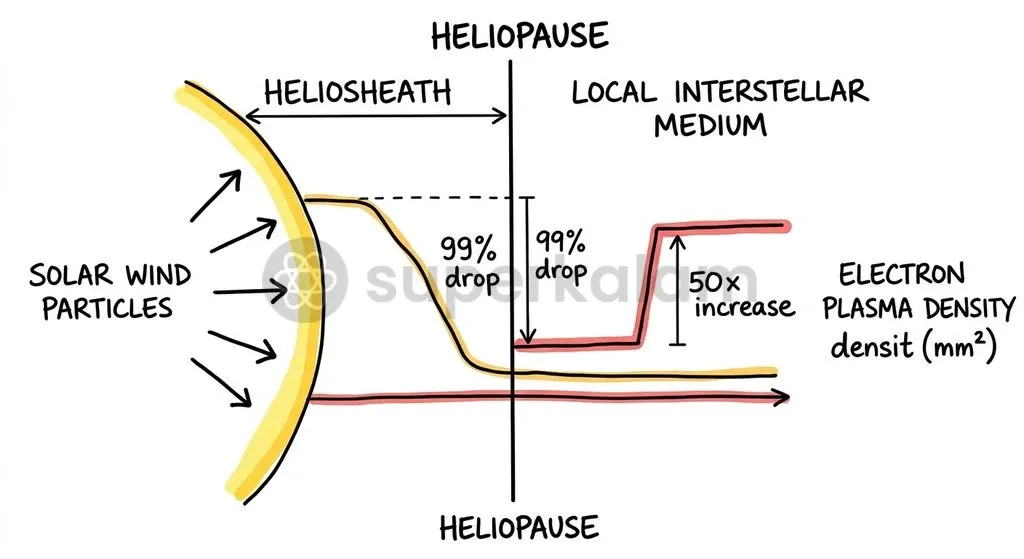
Voyager 1 entered the local interstellar medium on 25 August 2012 at 121.6 astronomical units after crossing the heliopause boundary. According to research published by the mission team, this crossing marked the first direct transition of a human instrument from the solar wind bubble into galactic space. The heliopause represents the boundary where the outward dynamic pressure of hot, dilute solar wind plasma balances against the inward pressure of cold, dense interstellar gas.
Direct in situ confirmation of this crossing came from the Plasma Wave Subsystem (PWS). When coronal mass ejections from the Sun triggered oscillations in the surrounding medium, the PWS detected an electron plasma density jump from roughly 0.002 electrons per cubic centimetre within the outer heliosheath to between 0.08 and 0.11 electrons/cm³ in the interstellar medium. This fifty-fold increase in plasma density confirmed that the spacecraft had traversed the boundary zone.
| Environmental Metric | Outer Heliosheath (Inside Heliopause) | Local Interstellar Medium (Voyager 1 Location) |
|---|---|---|
| Electron Plasma Density | ~0.002 electrons/cm³ | ~0.08 to 0.11 electrons/cm³ (High density) |
| Solar Wind Ions | Dominant low-energy flux | Drops by >99% (Near-total disappearance) |
| Galactic Cosmic Rays (GCRs) | Heavily attenuated by solar magnetic field | Increases by ~9% (Pristine galactic flux) |
| Magnetic Field Alignment | Dynamic, guided by solar rotation | Aligns closely with solar direction with drape effects |
Concurrent readings from the Cosmic Ray Subsystem revealed that lower-energy solar energetic particles dropped by over 99%, while the flux of high-energy Galactic Cosmic Rays rose by approximately 9%. This sudden change proved that the heliosphere is a radiation shield, deflecting the vast majority of energetic particles produced by supernovae across the galaxy.
Concurrently, Voyager 1's triaxial fluxgate Magnetometer (MAG) demonstrated that the interstellar magnetic field exhibits unexpected drape effects around the heliopause. It aligns closely with the Sun's magnetic direction rather than shifting abruptly.
Engineering Lessons for Deep Space Missions and India's Space Program
ISRO leverages deep-space tracking capabilities through the Indian Deep Space Network at Byalalu to support planetary probes beyond low Earth orbit. Located near Bengaluru, Karnataka, the Byalalu complex operates under the ISRO Telemetry, Tracking and Command Network (ISTRAC). The installation contains an indigenous 32-metre wheel-and-track Cassegrain antenna alongside an 18-metre antenna, providing the dual-band S-band and X-band links that supported Chandrayaan-1, Mars Orbiter Mission (Mangalyaan), and Aditya-L1.
As the Indian space programme advances toward outer-planet exploration, such as proposed missions to Venus and the outer gas giants, Voyager 1's fifty-year operational lifecycle provides critical engineering takeaways:
- Deep-Space Power Architectures: Solar photovoltaic panels lose efficiency past the asteroid belt due to the inverse-square drop in solar flux. To overcome this limitation, ISRO's UR Rao Satellite Centre (URSC) and the Bhabha Atomic Research Centre (BARC) initiated joint development of a 100-watt class Radioisotope Thermoelectric Generator. Mastering nuclear power systems is essential for India's future outer-system landers and deep probes.
- Autonomous Systems and Fault Trees: Communicating at multiple light-hours prevents interactive real-time troubleshooting. Spacecraft computers must be designed with segmented software architectures, autonomous watchdog resets, and modular code structures that can be patched over degraded radio links.
- Extreme-Distance Link Budgets: Expanding deep-space science requires large aperture ground antennas, cryogenic amplifiers, and advanced forward-error-correction encoding. India's IDSN infrastructure will require higher transmitter power and wider apertures as missions travel deeper into interplanetary space.
Discuss with Superkalam
Analyse the trade-offs mission controllers face when choosing between turning off scientific instrument heaters and deactivating entire instruments to conserve power.
Ask NowThe Way Forward: Managing the Final Operational Years
NASA flight controllers manage the final operational phase of Voyager 1 by rationing instrument power until RTG output drops below operational thresholds. Power reserves are projected to decline by roughly 4 watts every year.
The spacecraft faces a sequential shutdown timeline:
- Instrument Deactivation: Mission engineers will eventually be forced to deactivate the four remaining science instruments one by one as electrical reserves diminish.
- Telemetry Termination: By the late 2020s or early 2030s, electrical generation will drop below the minimum threshold needed to operate the X-band transmitter, bringing an end to engineering telemetry.
- Silent Drift: Once communication ceases, Voyager 1 will drift silently through the Milky Way as an inert physical artefact.
Secured to the spacecraft's exterior is the Golden Record, a 12-inch gold-plated copper phonograph record containing 115 analogue images, spoken greetings in 55 languages, diverse music, and natural sounds from Earth. The record is protected by an aluminium cover electroplated with an ultra-pure sample of Uranium-238, which is a radioactive clock allowing any extraterrestrial recipient to determine the probe's launch era by measuring its decay products.
Voyager 1's traversal of the one light-day mark illustrates how long-term mission success depends on balancing physical laws against conservative systems engineering. For India and global space agencies, the spacecraft proves that long-duration deep-space exploration demands three non-negotiable technologies:
- Compact radioisotope power to operate past the practical reach of solar flux.
- Resilient distributed computing capable of autonomous fault recovery over days-long latency.
- High-gain planetary tracking networks backed by cryogenic ground reception systems.
Key Takeaways
- The One Light-Day Threshold: On 18 November 2026, Voyager 1 reached approximately 25.902 billion kilometres (173.14 AU) from Earth, creating an unavoidable 48-hour round-trip telemetry latency.
- Deep Space Communication: Downlink telemetry relies on an 8.4 GHz X-band transmitter operating at just 22.4 watts, captured on Earth by the NASA Deep Space Network's 70-metre parabolic dishes.
- RTG Power Degradation: Powered by three Multi-Hundred Watt Radioisotope Thermoelectric Generators fuelled by Plutonium-238, the probe loses roughly 4 watts of electrical power annually.
- Interstellar Science Insights: Instruments like the Plasma Wave Subsystem documented a plasma density jump to 0.08–0.11 electrons/cm³ at the heliopause, while cosmic ray detectors confirmed that the heliosphere blocks over 99% of low-energy solar particles.
- Strategic Value for India: India's IDSN facility at Byalalu (housing 32-metre and 18-metre antennas) and the joint ISRO-BARC 100-watt RTG initiative represent the exact tracking and nuclear technologies required for India's long-term deep-space exploration.
Mains Question
'Extreme deep-space longevity relies on ruthless power triage, adaptive fault recovery, and ultra-sensitive ground reception rather than active propulsion.' In the context of Voyager 1 crossing the one light-day distance threshold, examine the technological paradigms that enable extended outer-solar-system exploration. (15 Marks)
Evaluate NowMains Question
Highlighting the in situ observations of the heliopause and the local interstellar medium made by Voyager 1, elucidate the scientific significance of direct measurements beyond the solar wind bubble. (10 Marks)
Evaluate NowPractice MCQs
QUESTION 1
With reference to the Voyager 1 mission and its crossing of the 'one light-day' distance threshold, consider the following statements:
- A light-day is an orbital boundary that marks the outer gravitational limit of the Sun's Oort Cloud.
- Reaching a distance of one light-day results in an operational forty-eight-hour round-trip communication latency for ground controllers.
- The spacecraft relies on Radioisotope Thermoelectric Generators (RTGs) converting alpha-decay heat from Plutonium-238 into electricity. Which of the statements given above is/are correct?
QUESTION 2
Consider the following statements regarding the transition of Voyager 1 into the local interstellar medium:
- Voyager 1 crossed the heliopause at approximately 121.6 Astronomical Units in August 2012.
- In situ measurements by the Plasma Wave Subsystem detected a significant drop in electron plasma density upon traversing the heliopause.
- The heliopause represents the boundary where the outward dynamic pressure of solar wind plasma balances the inward pressure of interstellar gas. Which of the statements given above are correct?
QUESTION 3
With reference to deep space telecommunications and the Deep Space Network (DSN) as described for Voyager 1, consider the following statements:
- Voyager 1 transmits telemetry using an 8.4 GHz X-band transmitter operating at an output of approximately 22.4 watts.
- The DSN utilizes 70-metre parabolic dish antennas equipped with cryogenic ruby maser low-noise amplifiers cooled to liquid helium temperatures.
- The received signal strength on Earth is reduced to less than an attowatt primarily due to the inverse-square law of radiation. Which of the statements given above is/are correct?
QUESTION 4
Which of the following factors is responsible for the approximately 4 watts per year degradation in the electrical output of Voyager 1's Radioisotope Thermoelectric Generators (RTGs)?
QUESTION 5
Consider the following operational challenges encountered by the Voyager 1 mission and their engineering resolutions:
- Clogging of attitude-control thruster feed tubes by silicon dioxide was mitigated by performing a thruster branch swap.
- Corrupted Flight Data System (FDS) telemetry caused by a failed memory chip was restored by segmenting and relocating executable code to uncorrupted memory addresses. Which of the statements given above is/are correct?
Discuss with Superkalam
Evaluate whether extreme longevity in robotic deep-space exploration is primarily an achievement of onboard hardware design or of adaptive ground engineering.
Ask Now