RBI Microfinance Rules: Can Lending Limits Prevent Debt Traps?
As the central bank curbs errant lenders, paper-based debt caps clash with informal credit realities and fortnightly reporting lags across rural households.
Nov, 2026
•9 min read

Overview
The Reserve Bank of India regulates microfinance through a lender-agnostic framework that caps household debt outflows at 50 percent of monthly income, aiming to prevent destructive debt spirals among families earning up to ₹3,00,000 annually while deregulating interest caps to encourage competitive, risk-based institutional lending. This harmonised architecture shifts supervision from institutional identity to loan activity, covering commercial banks, small finance banks, and non-banking financial company microfinance institutions uniformly. However, the framework's capacity to end structural debt traps remains constrained by field-level information gaps. Because underwriting processes still depend on self-reported informal earnings, fortnightly credit bureau reporting creates latency, and unrecorded moneylender borrowings remain invisible to formal systems, prudential caps on paper do not automatically prevent over-indebtedness on the ground.
Why in the News? Fresh Stress and Surveillance in the Microfinance Sector
The Reserve Bank of India has intensified supervisory scrutiny over microfinance institutions following persistent violations of fair lending norms and pricing discipline. Under Section 45L(1)(b) of the Reserve Bank of India Act, 1934, the central bank directed four non-banking financial entities, including Asirvad Micro Finance and Arohan Financial Services, to cease and desist loan sanctions due to excessive interest rate spreads and usurious pricing.
Regulators have also raised alarms regarding the practical dilution of underwriting guardrails. According to an address by RBI Deputy Governor S. C. Murmu at the MFIN Microfinance Review Launch, the mandatory 50 percent debt-servicing cap serves as a non-negotiable prudential ceiling rather than a disbursement target, prompting the central bank to firmly reject industry demands to exclude principal repayments from the calculation. As of November 2026, supervisory reviews have simultaneously highlighted the systemic hazard of pseudo consent, where low-income borrowers sign complex loan documents without comprehending contractual obligations, underscoring that formal expansion must not outpace borrower protection.
The Anatomy of a Debt Trap: How Borrowers End Up Over-Indebted
Microfinance debt traps develop when vulnerable households accumulate overlapping loan liabilities that exceed their volatile, informal monthly cash flows. In typical low-income rural and peri-urban settings, household earnings do not arrive as steady salaries. Agricultural wages and micro-enterprise revenues fluctuate sharply across seasons. When adverse events occur, such as medical emergencies or localized crop damage, families experience immediate liquidity deficits that formal credit products rarely accommodate.
Borrowers frequently turn to multiple lender exposure, commonly known as loan stacking, to manage these sudden disruptions. A borrower acquires debt from three or four microfinance institutions simultaneously to pay off preceding installments. The Microfinance Industry Network reports that borrower vulnerability peaks during agrarian lean seasons and post-harvest price crashes, where rigid weekly or monthly schedules force households into debt-evergreening through high-cost local bridge financing.
Discuss with Superkalam
Recall the net asset qualifying threshold for NBFC-MFIs under the 2022 RBI directions compared to the previous 2011 regime.
Ask Now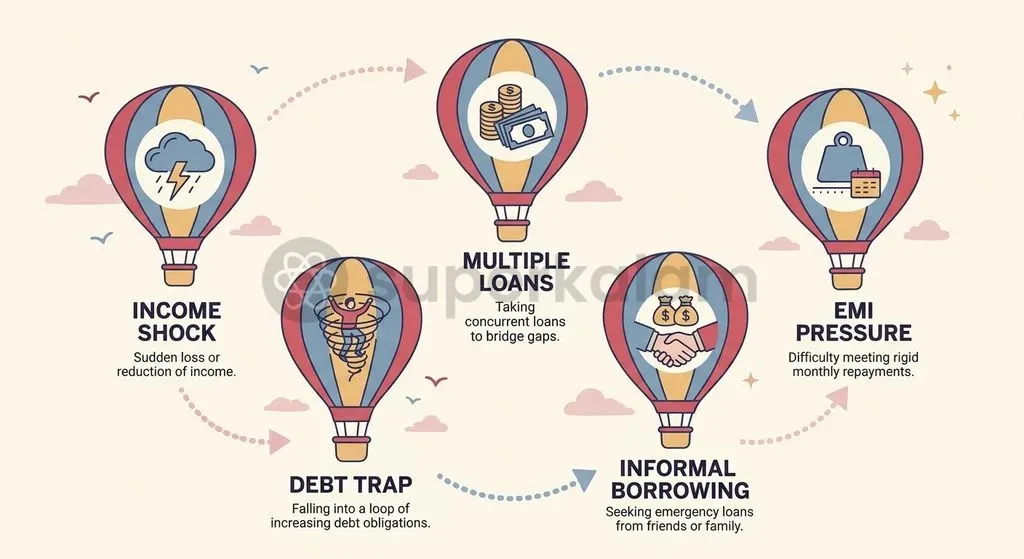
The Shift to Harmonized Rules: Leaving the Malegam Era Behind
The Reserve Bank of India overhauled the sector in 2022 by replacing the entity-based Y.H. Malegam Committee framework with an activity-based regulatory architecture. Under the preceding 2011 regime, stringent regulations applied almost exclusively to non-banking financial company microfinance institutions (NBFC-MFIs). Commercial banks and small finance banks, which controlled an expanding share of micro-credit, operated under separate standards, creating regulatory arbitrage and uneven consumer protection.
The Master Direction – Reserve Bank of India (Regulatory Framework for Microfinance Loans) Directions, 2022 harmonised these provisions across all regulated entities, establishing a uniform activity-based definition. The framework also lowered the qualifying assets threshold for NBFC-MFIs from 75 percent to 60 percent of total net assets, permitting institutions greater room to diversify into non-microfinance portfolios.
| Regulatory Dimension | Malegam Committee Regime (2011) | Harmonised Framework (2022 Directions) |
|---|---|---|
| Regulatory Scope | Entity-based; focused heavily on NBFC-MFIs | Activity-based and lender-agnostic across all commercial, small finance, and co-operative banks |
| Household Income Ceiling | Differentiated rural (₹1 lakh) and urban/semi-urban limits (₹1.6 lakh) | Uniform annual income up to ₹3,00,000 regardless of geography |
| Interest Rate Governance | Rigid margin caps (10-12%) and overall interest rate ceilings | Deregulated interest rates, subject to board-approved, non-usurious pricing models |
| Indebtedness Metrics | Absolute borrowing limits per borrower across a capped number of MFIs | Mandatory 50 percent repayment outflow cap (FOIR) across all institutional debt |
| Qualifying Assets Rule | Minimum 75% of net assets invested in microfinance loans | Relaxed to 60 percent of net assets, aiding balance-sheet diversification |
Discuss with Superkalam
Explain how shifting from an entity-based regulatory structure to an activity-based architecture eliminates regulatory arbitrage in micro-lending.
Ask NowHow the RBI Framework Fights Over-Indebtedness on Paper
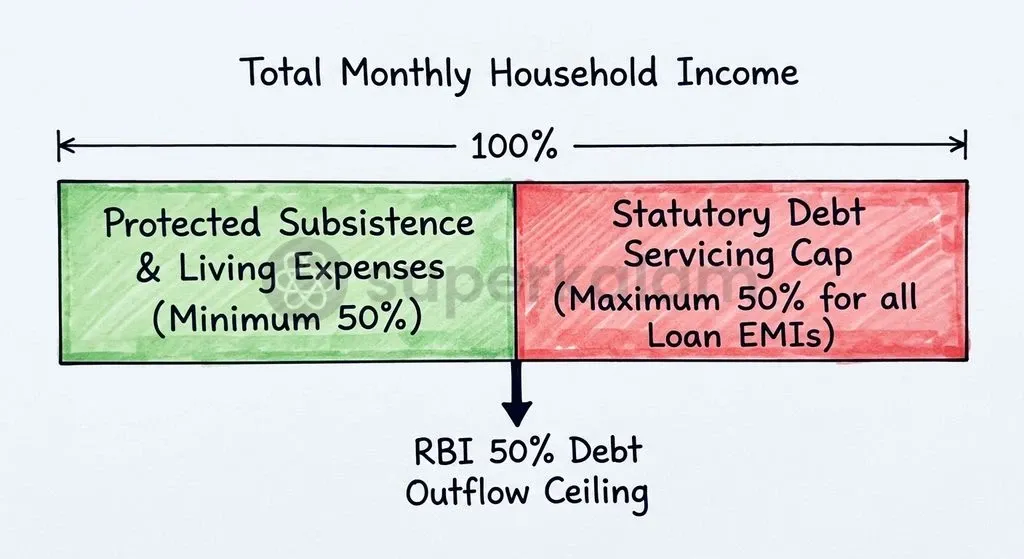
The Master Direction of 2022 targets borrower distress by establishing an income-linked eligibility ceiling and a mandatory debt-servicing cap across all formal lenders. A microfinance loan is officially defined as a collateral-free loan granted to a household with an annual household income of up to ₹3,00,000 across both rural and urban areas.
Under the revised guidelines, monthly debt servicing is strictly disciplined:
- Outflows for monthly loan repayment obligations must not exceed a maximum of 50 percent of the monthly household income.
- This Fixed Obligation to Income Ratio (FOIR) calculation incorporates all outstanding institutional loans, whether collateral-free or collateralised.
- Lenders are strictly barred from demanding any collateral or margin money, preserving the unsecured nature of the facility.
The framework also introduced pricing flexibility alongside enhanced transparency. The Reserve Bank of India deregulated interest rate caps to foster market competition, requiring institutions to implement a board-approved pricing policy ensuring that interest rates and charges are not usurious. Lenders must provide prospective borrowers with a standardized Key Facts Statement (KFS) that discloses the Annual Percentage Rate (APR) and a full amortisation schedule before loan execution. Furthermore, regulations strictly prohibit any penalty for prepayment, allowing borrowers to extinguish high-cost liabilities without financial friction.
Discuss with Superkalam
If a rural household already pays 40 percent of its monthly income to service an existing bank vehicle loan, how would an MFI apply the 50 percent FOIR rule to a new micro-loan request?
Ask NowThe Ground Reality Gap: Flaws in Income Checks and Data Lags
Credit Information Companies face operational blind spots that prevent the full containment of microfinance over-indebtedness across rural and semi-urban markets. Lenders are legally required to report borrower credit data to Credit Information Companies (CICs) on a fortnightly reporting cycle, specifically as on the 15th and last day of each month within seven calendar days of the cut-off. This reporting latency creates a multi-day window during which an aggressive borrower can secure credit from multiple institutions before bureau profiles reflect the newly incurred liabilities.
THE INFORMATION VISIBILITY DEFICIT
| Visible to Credit Bureaus (CICs) | Invisible to Credit Bureaus |
|---|---|
| Commercial Bank Loans | Village Moneylender Debt |
| Small Finance Bank Loans | Agricultural Input Dealer Credit |
| NBFC-MFI Collateral-Free Loans | Daily/Monthly Chit Funds |
| Gold Loans & Vehicle Loans | Unregistered Shopkeeper Credit |
CONSEQUENCE: The mandatory 50% FOIR cap is computed on an incomplete balance sheet, understating the household’s actual debt burden.
Underwriting practices at the branch level introduce further vulnerabilities. Because the unorganised sector lacks verifiable salary slips or audited balance sheets, regulated entities rely heavily on oral income declarations and expenditure proxy methods. Loan officers driven by volume-based incentives routinely accept inflated income figures, artificially suppressing the calculated repayment ratio.
Compounding this problem is the complete exclusion of the unorganised financial sector. Microfinance credit bureaus capture only formal institutional borrowings, leaving informal debts from village moneylenders, agricultural input traders, and unregistered chit funds entirely unrecorded. When household budgets face informal debt servicing at exorbitant rates, the 50 percent FOIR calculation fails to reflect the family's true financial insolvency.
Discuss with Superkalam
Analyse the structural reasons why rigid repayment schedules cause vulnerable agricultural households to resort to high-cost bridge financing during lean seasons.
Ask NowThe Ethics of Debt Collection: Why Fair Recovery Rules Matter
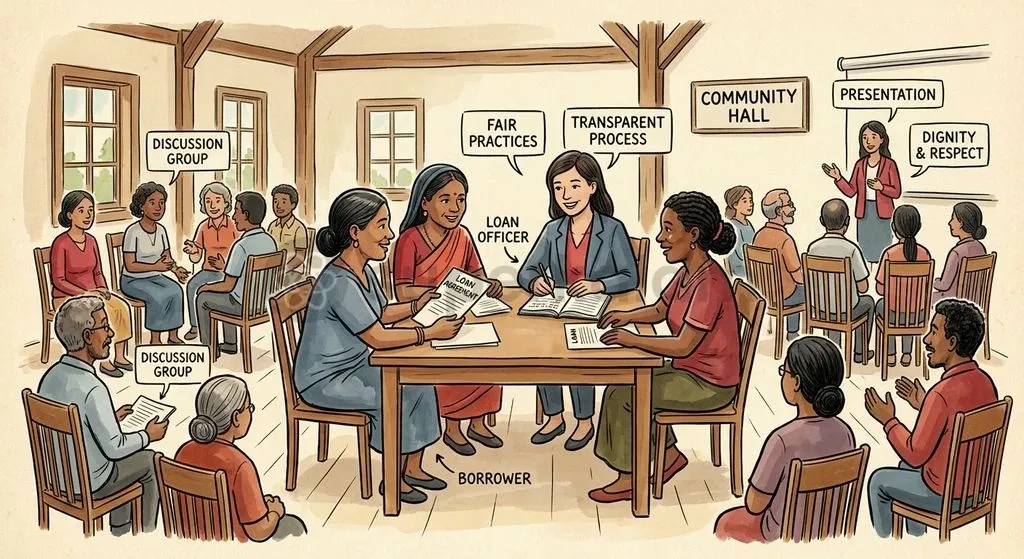
The Reserve Bank of India enforces a statutory Fair Practices Code to eliminate coercive debt-recovery tactics within vulnerable borrower communities. Low-income lending often operates in fragile social environments where aggressive field collection can trigger severe psychological distress. The central bank's code explicitly bars recovery staff from using verbal or physical intimidation, public humiliation, or unsolicited intrusions into family privacy.
Field collections are governed by mandatory operational guardrails:
- Collection personnel are prohibited from contacting borrowers before 08:00 hrs and after 19:00 hrs.
- Loan repayments must occur at a mutually designated central location, such as a village community point or branch center.
- Field staff may visit a borrower’s residence only if that borrower fails to appear at the central collection venue on two or more successive occasions.
- Institutions must operate dedicated mechanisms to identify borrowers experiencing genuine repayment distress, offering restructuring guidance instead of punitive legal or recovery action.
Despite these operational boundaries, structural collection challenges persist within Joint Liability Groups (JLGs). While group lending provides peer-based social collateral in place of physical assets, a NABARD assessment found that collective liability often transforms into coercive social pressure. When an individual defaults, the group becomes responsible for the shortfall. To avoid village ostracisation, distressed group members frequently take emergency bridge loans from local moneylenders to meet joint collection deadlines, illustrating how informal debt absorption shields formal balance sheets at great social cost.
Way Forward: Fixing Underwriting and Protecting Vulnerable Borrowers
Structural reform in microfinance underwriting requires the Reserve Bank of India and industry stakeholders to transition from self-reported estimates to verifiable digital data. The central bank's Report on Trend and Progress of Banking in India advocates integrating Account Aggregator cash-flow footprints and utility bill payment histories to construct objective financial profiles for low-income households. Automated cash-flow analysis reduces dependence on arbitrary field declarations and curbs deliberate income inflation.
Addressing systemic latency also necessitates shifting from fortnightly bureau cycles to near-real-time CIC reporting. When credit bureaus update debt records within hours of loan sanction, concurrent loan stacking across multiple institutions becomes operationally impossible. In parallel, Self-Regulatory Organisations (SROs) such as the Microfinance Institutions Network (MFIN) and Sa-Dhan must actively enforce Industry Codes of Conduct through unannounced branch audits.
Finally, consumer protection frameworks must eradicate the practice of pseudo consent. Field agents must be mandated to deliver the Key Facts Statement in the borrower's primary local language, ensuring that terms regarding interest compounding, penalty waivers, and grievance procedures are genuinely understood before funds are disbursed.
Discuss with Superkalam
Weigh the benefits of deregulated interest rates against the risk of usurious pricing: has market-based pricing protected microfinance borrowers or intensified distress?
Ask NowKey Takeaways
- Microfinance loans are defined as collateral-free credit extended to households with an annual income of up to ₹3,00,000, governed uniformly across all commercial, small finance, and NBFC lenders.
- The mandatory Fixed Obligation to Income Ratio (FOIR) limits monthly debt outflows to a maximum of 50 percent of household income across all formal borrowings, serving as a non-negotiable prudential ceiling.
- Interest rate caps and margins were deregulated in 2022, but the RBI actively disciplines usurious pricing under Section 45L(1)(b) of the Reserve Bank of India Act, 1934.
- Underwriting remains vulnerable to fortnightly credit bureau lags and reliance on unverified oral income declarations, which hide concurrent loan stacking.
- Credit information bureaus capture formal debts only, leaving informal moneylender borrowing unrecorded and distorting true household debt-service capacity.
- The Fair Practices Code prohibits recovery visits between 19:00 and 08:00 hrs and limits home visits, yet Joint Liability Groups continue to exert coercive social pressure during economic shocks.
Mains Question
"The Reserve Bank of India's shift from an entity-based to an activity-based microfinance architecture aims to level the playing field, yet field-level information gaps threaten borrower protection." Critically examine. (15 Marks)
Evaluate NowMains Question
"The mandatory 50 percent debt-servicing cap serves as a non-negotiable prudential ceiling rather than a disbursement target." In light of recent supervisory interventions under Section 45L of the RBI Act, 1934, evaluate the efficacy of regulatory caps in preventing microfinance distress. (10 Marks)
Evaluate NowPractice MCQs
QUESTION 1
Consider the following statements regarding the Reserve Bank of India's Regulatory Framework for Microfinance Loans Directions, 2022:
- A microfinance loan is defined as a collateral-free loan provided to a household having an annual income of up to ₹3,00,000 across both rural and urban areas.
- The framework retains the rigid interest rate margin caps of 10 to 12 percent originally prescribed under the Malegam Committee recommendations.
- The qualifying assets threshold for NBFC-MFIs was reduced from 75 percent to 60 percent of total net assets. Which of the statements given above are correct?
QUESTION 2
With reference to the debt-servicing safeguards under the Reserve Bank of India's 2022 microfinance directions, consider the following statements:
- Monthly debt servicing outflows across all institutional loans are capped at a maximum of 50 percent of monthly household income.
- The calculation of the 50 percent debt-servicing limit excludes collateralised institutional liabilities.
- Regulated entities are strictly prohibited from charging any penalty for prepayment on microfinance loans. Which of the statements given above is/are correct?
QUESTION 3
Consider the following statements comparing the 2011 Malegam Committee regime and the 2022 Master Direction on microfinance loans:
- The 2011 regime prescribed differential household income ceilings for rural and urban borrowers, whereas the 2022 framework introduced a unified ceiling.
- The 2011 regime was entity-based, whereas the 2022 architecture is activity-based and lender-agnostic.
- The 2022 directions reinstated absolute borrowing caps restricting an individual to borrowing from a maximum of two MFIs. Which of the statements given above are correct?
QUESTION 4
Under which statutory provision did the Reserve Bank of India direct non-banking financial entities, including NBFC-MFIs, to cease and desist loan sanctions due to excessive interest rate spreads and usurious pricing?
QUESTION 5
With reference to credit information reporting and monitoring in the microfinance sector, consider the following statements:
- Lenders are required to report borrower credit information to Credit Information Companies on a fortnightly cycle.
- Submissions to credit bureaus must be made as on the 15th and last day of each month within seven calendar days of the cut-off date.
- Credit Information Companies capture non-institutional credit liabilities, including informal moneylender debt, within their regular reports. Which of the statements given above is/are correct?