Green Energy Open Access and the Crisis of State Discoms
As commercial power buyers abandon traditional grid supply for cheaper renewables, state discoms face an existential crisis over lost cross-subsidies.
Nov, 2026
•11 min read
Overview
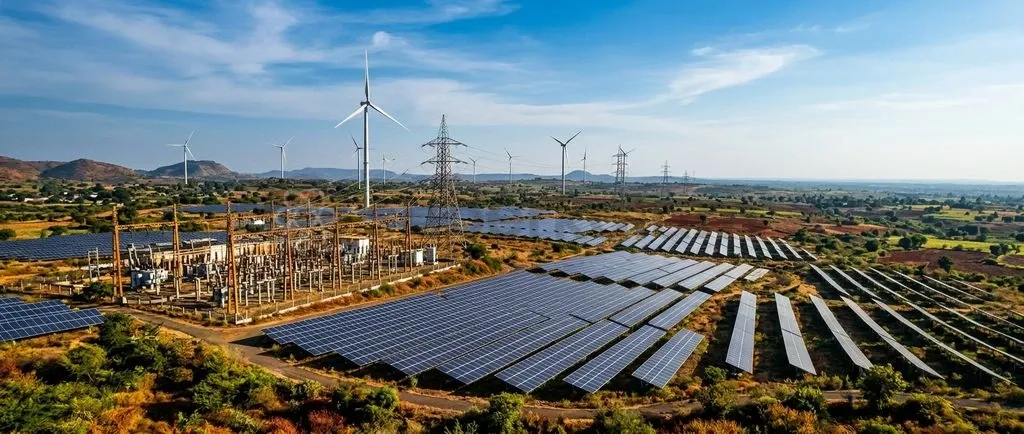
Green energy open access allows commercial consumers to procure renewable power directly from independent generators. This shift accelerates India's non-fossil decarbonisation goals. However, it exposes state distribution utilities to acute revenue losses as paying industrial consumers abandon traditional grid supply.
Under the Green Energy Open Access Rules, 2022, the Ministry of Power lowered the transaction threshold from one megawatt to one hundred kilowatts. This opened clean power buying to medium-scale commercial enterprises and hyperscale data centres.
State distribution companies rely on high industrial tariffs to cross-subsidise agricultural and low-income domestic users. Because of this cross-subsidy structure, commercial defection threatens the financial survival of state utilities. Resolving this friction requires moving away from defensive regulatory surcharges toward cost-reflective tariffs, energy storage integration, and direct benefit transfers.
Why in the News: Big Tech's Growing Clean Energy Footprint in India
Amazon announced plans to invest an additional $7 billion in Indian renewable energy projects by 2030, marking an aggressive commercial shift toward off-site green energy procurement. According to a corporate statement released alongside the Ministry of New and Renewable Energy in November 2026, this capital commitment is directed specifically toward off-site Power Purchase Agreements (PPAs) and renewable generation offtake. This capital outlay operates separately from capital expenditure allocated directly to physical hyperscale cloud data centre facilities.
Large multinational corporations operating in India are scaling up renewable energy procurement to meet international net-zero mandates. As of November 2026, corporate off-site clean energy demand is a major private-sector catalyst supporting national climate milestones:
- Decarbonisation targets: Corporate procurement directly advances India's Panchamrit goals pledged at COP26, which mandate establishing 500 GW of non-fossil capacity by 2030.
- Commercial scale: India's cumulative commercial and industrial renewable open access capacity expanded rapidly to 18.7 GW by FY2024, recording a compound annual growth rate of 46% between FY2022 and FY2024 per a joint report by the Institute for Energy Economics and Financial Analysis and JMK Research.
Discuss with Superkalam
What was the specific contracted capacity threshold reduction enacted by the Green Energy Open Access Rules, 2022?
Ask NowThis rapid adoption transforms corporate power procurement from a public relations exercise into a mainstream financial strategy. High-consumption commercial users increasingly bypass conventional state distribution utilities to access cheaper generation across state lines.
How Green Open Access Works: The Shift in Corporate Power Buying
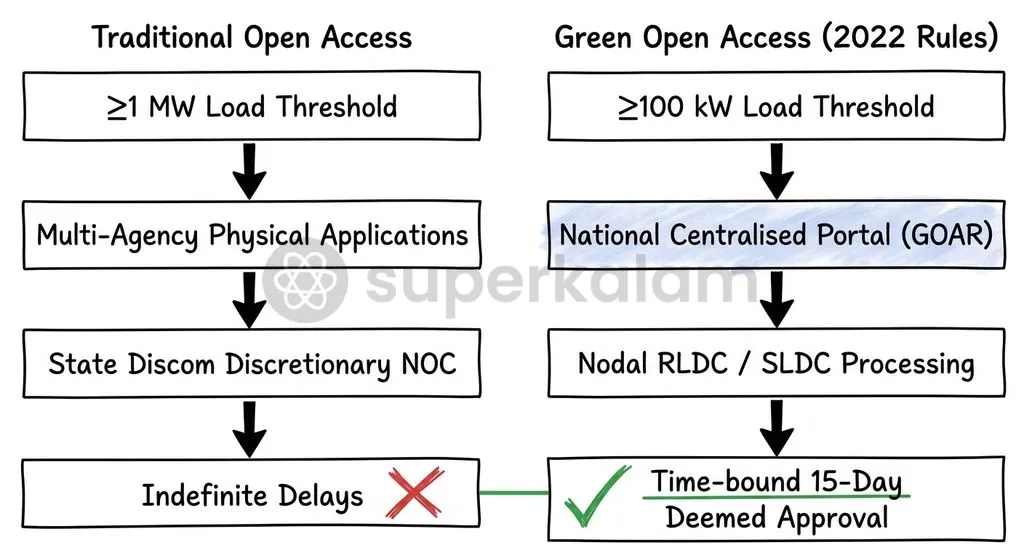
The Ministry of Power notified the Green Energy Open Access Rules, 2022 to democratise renewable energy procurement across commercial and industrial consumers. Under the Gazette of India Notification G.S.R. 418(E) issued on 6 June 2022, the central government reduced the minimum contracted capacity threshold for open access from 1 MW down to 100 kW for green power. This policy shift allowed medium-scale enterprises, commercial complexes, and mid-sized data centres to procure off-site solar and wind energy directly from independent power producers.
Administrative delays historically undermined commercial open access under state utilities. To resolve this procedural bottleneck, Rule 7 of the Green Energy Open Access Rules, 2022 mandated that all applications must be submitted and processed through the central Green Open Access Registry portal. Distribution utilities and nodal transmission agencies must clear applications within 15 days of submission, failing which regulatory approval is statutorily deemed to have been granted.
| Regulatory Parameter | Standard Open Access Framework | Green Energy Open Access Rules, 2022 |
|---|---|---|
| Sanctioned Capacity Limit | Minimum 1 MW contracted capacity | Reduced to 100 kW for green energy |
| Approval Mechanism | Bilateral approvals via individual state nodal agencies; prone to indefinite administrative delays | Centralised clearing via the Green Open Access Registry with 15-day deemed approval |
| Cross-Subsidy Surcharge Cap | Formula-determined by State Commissions with frequent unpredictable upward revisions | Capped at a maximum of 50% above initial year rate for a 12-year window |
| Additional Surcharge Liability | Levied routinely on open access power to recover stranded utility assets | Explicitly exempted if fixed demand charges are paid or captive power is utilised |
| Procurement Scope | Primarily limited to heavy industrial units and large manufacturing plants | Expanded to include small and medium enterprises alongside large data centres |
Corporate consumers utilise several contracting structures to wheel electricity over state and national grids. In a third-party open access model, a developer constructs a utility-scale solar or wind project and wheels power through the transmission network directly to corporate facilities under a long-term contract. Alternatively, under a group captive framework, corporate buyers purchase an equity stake in the generating plant to secure statutory exemptions from cross-subsidy levies.
The Discom Trap: Why State Utilities Resist Commercial Green Defection
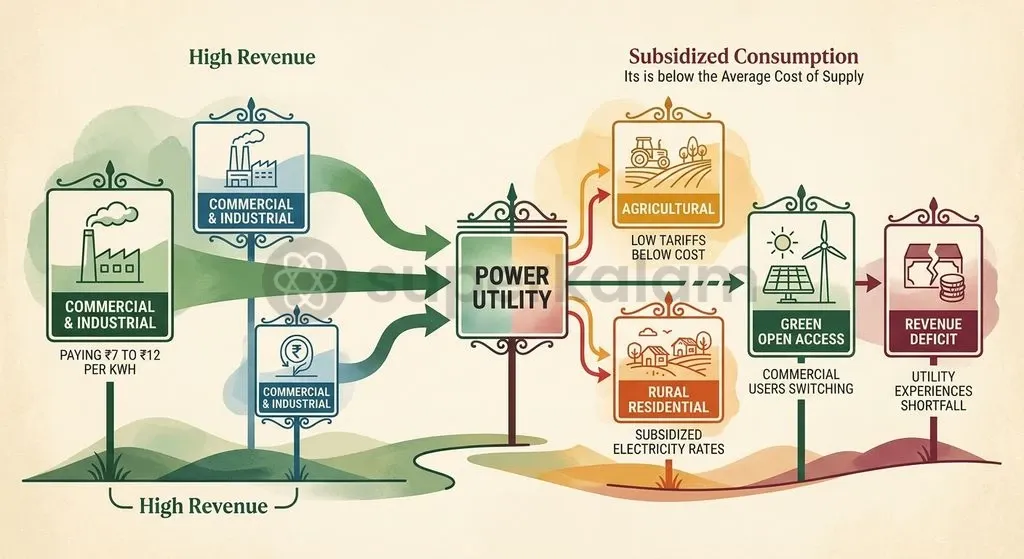
State electricity distribution companies resist green open access because the departure of high-paying corporate consumers destabilises their operating finances. Research published in National Institute of Public Finance and Policy Working Paper No. 394 establishes that commercial and industrial consumers generate the overwhelming majority of distribution utility profit margins. These industrial consumers pay elevated retail tariffs of ₹7 to ₹12 per kWh, which utilities use to subsidise low-income residential and agricultural consumers.
When profitable commercial users switch to off-site green open access, state utilities enter what economists describe as a utility death spiral:
- Revenue contraction: The utility loses its most profitable paying customers while remaining legally bound to supply low-tariff or unmetered agricultural consumers at rates far below the Average Cost of Supply.
- Fixed thermal liability: Utilities remain contractually trapped in two-part thermal Power Purchase Agreements, obligating them to pay mandatory capacity charges to idle coal-fired plants even when industrial demand drops.
Discuss with Superkalam
Explain how the 'utility death spiral' develops when high-tariff industrial consumers defect from state discoms to green open access.
Ask NowThis structural tension has sparked direct legal battles between central reform bodies and state authorities. Section 42(2) of the Electricity Act, 2003 statutorily empowers State Electricity Regulatory Commissions to phase in open access and determine the applicable cross-subsidy surcharge within their respective jurisdictions. Citing this statutory autonomy, the Karnataka High Court struck down the Central Green Energy Open Access Rules, 2022 and Karnataka's corresponding state regulations in the judgment Brindavan Hydropower Pvt. Ltd. v. Union of India, ruling them ultra vires the Electricity Act, 2003.
According to regulatory filings tracked by legal practices AZB & Partners and Neeti Niyaman, this High Court judgment has been appealed to the Supreme Court of India and remains pending adjudication. While the case awaits final determination, the Green Energy Open Access Rules, 2022 remain fully operational across other Indian states through individual state commission regulations, maintaining an uneasy coexistence between federal clean energy goals and state-level tariff protectionism.
Cross-Subsidies at Risk: Can Power Utilities Survive Without Industry Tariffs?
State Electricity Regulatory Commissions deploy defensive tariff barriers to prevent corporate power consumers from abandoning local distribution networks. State regulators balance utility commercial viability against consumer choice by managing two statutory levers:
- Cross-Subsidy Surcharge: To protect green buyers from arbitrary tariff inflation, Rule 9(1) of the Green Energy Open Access Rules, 2022 specifies that the Cross-Subsidy Surcharge cannot exceed 50% of the initial surcharge determined during the year open access was approved, locking in this protection for a twelve-year period.
- Additional Surcharge: Rule 9(2) explicitly provides that consumers buying clean energy shall not be liable to pay any Additional Surcharge if they maintain payment of fixed demand charges to the local distribution licensee, or if the energy is generated from a captive facility.
Despite these central directives, state regulators frequently push back through local regulatory determinations. A report by the Institute for Energy Economics and Financial Analysis found that multiple state commissions have restricted energy banking by shifting settlement cycles from an annual to a monthly basis, while introducing steep banking fees of 8% to 10% on injected energy.
These banking restrictions impair the economics of off-site solar procurement. Solar developers generate power exclusively during peak daytime hours, requiring the local grid to absorb excess electricity and bank it for nighttime consumption. By curtailing banking allowances and levying high fees, state utilities discourage industrial flight and protect their fragile balance sheets.
State distribution companies are simultaneously attempting to repair their balance sheets under broader structural turnaround programmes. The Union Cabinet approved the Revamped Distribution Sector Scheme with an overall outlay of ₹3,03,758 crore, supported by central government budgetary assistance of ₹97,631 crore. The scheme ties fiscal disbursements directly to operational benchmarks, aiming to compress pan-India Aggregate Technical and Commercial losses down to 12-15% while eliminating the persistent gap between the Average Cost of Supply and the Average Revenue Realised.
Discuss with Superkalam
Analyse the structural conflict between the Centre's 500 GW Panchamrit target and the statutory powers granted to State Commissions under Section 42(2) of the Electricity Act, 2003.
Ask NowGrid Realities: Matching 24/7 Data Centers with Intermittent Clean Energy
Hyperscale data centres operating in India demand continuous power, creating operational friction with variable solar and wind generation profiles. According to a Central Electricity Authority report on data centre power requirements, critical digital infrastructure facilities operate on an uncompromising standard of 99.999% operational uptime, widely known as five-nines reliability. In contrast, standard solar arrays generate power for roughly six to eight hours a day, while wind power fluctuates sharply depending on seasonal monsoon conditions.
This intermittency creates operational challenges across two fronts:
- Backup dependence: When off-site renewable power drops during cloud cover or still evenings, corporate consumers must rely on conventional grid electricity or burn diesel in on-site generation sets.
- Grid balancing costs: This shifting demand forces distribution licensees to maintain spinning thermal reserves to meet sudden commercial surges without receiving proportional base-load revenue.
To facilitate dynamic, long-distance power wheeling, the Central Electricity Regulatory Commission introduced the Connectivity and General Network Access Regulations, 2022. This regulatory overhaul dismantled the antiquated contract-path transmission model, replacing it with open network access across the entire inter-state transmission system. Corporate buyers can draw transmission capacity across regional corridors without negotiating rigid, physical contract pathways from specific generating plants.
Transmission operational procedures have evolved in parallel to support short-term commercial adjustments. Grid Controller of India Limited issued Revision 2 of the Temporary General Network Access procedure in June 2026 to govern open access approvals managed via the National Open Access Registry. This regulatory framework allows commercial and industrial buyers to dynamically book interstate transmission capacity, providing technical mechanisms to balance intermittent green offtake with reliable grid stability.
Discuss with Superkalam
Evaluate whether capping cross-subsidy surcharges is justified when state utilities remain contractually locked into two-part thermal power capacity charges.
Ask NowThe Way Forward: Balancing Clean Energy Targets with Utility Health
Sustainable power sector decarbonisation requires reforming state utility finances rather than penalising commercial renewable energy buyers. Erecting protectionist surcharges to restrict commercial defection clashes with national emission-reduction pledges and increases industrial production costs across the economy. Resolving this contradiction requires addressing the root financial flaw of India's power architecture: the distortionary cross-subsidy system.
As recommended in the NITI Aayog report Turning Around the Power Distribution Sector, state governments must progressively transition toward Direct Benefit Transfer for agricultural power. Under a Direct Benefit Transfer framework, state governments deposit electricity subsidies directly into farmers' bank accounts, requiring agricultural users to pay metered rates to utilities. This policy shift accomplishes two critical objectives:
- Decouples state welfare obligations from distribution utility commercial billing, allowing tariffs to reflect true supply costs.
- Removes the financial incentive for distribution companies to misreport unmetered distribution losses under the guise of agricultural consumption.
State commissions must also implement dynamic pricing models that reflect operational realities across the transmission grid. The Ministry of Power took an initial step by notifying the Electricity (Rights of Consumers) Amendment Rules, 2023, which established mandatory Time of Day tariffs for commercial and industrial consumers starting in April 2024. These rules require that electricity tariffs during solar hours be at least 20% lower than standard rates, while peak-hour tariffs must be 10% to 20% higher.

Widespread deployment of Time of Day pricing incentivises industrial users to align electricity-heavy operations with daytime solar peaks. Complementing dynamic tariffs with investments in grid-scale battery energy storage systems will allow commercial buyers to build true round-the-clock renewable energy portfolios. By harmonising interstate transmission access and adopting cost-reflective retail tariffs, India can achieve its 500 GW non-fossil capacity target while safeguarding the financial solvency of state power utilities.
Key Takeaways
- The Green Energy Open Access Rules, 2022 lowered the contracted capacity threshold for green power procurement from 1 MW to 100 kW, granting small and medium enterprises access to off-site clean electricity.
- Administrative clearances for green open access are streamlined through the central Green Open Access Registry portal, which mandates a 15-day deemed approval window.
- Commercial and industrial consumers pay high retail tariffs of ₹7 to ₹12 per kWh to cross-subsidise agricultural and low-income domestic users, meaning their transition to open access threatens utility revenue.
- State regulators frequently counter corporate defection by imposing high Cross-Subsidy Surcharges, limiting green energy banking, and levying banking fees of 8% to 10%.
- In Brindavan Hydropower Pvt. Ltd. v. Union of India, the Karnataka High Court invalidated the 2022 Central Rules and state regulations as ultra vires the Electricity Act, 2003; the decision is currently under appeal before the Supreme Court of India.
- Long-term power sector viability depends on phasing in Direct Benefit Transfer for farm power and implementing Time of Day tariffs to align industrial consumption with variable renewable generation.
Mains Question
"The lowering of the open access threshold under the Green Energy Open Access Rules, 2022 threatens to accelerate a 'utility death spiral' for state distribution companies." Critically examine. (15 Marks)
Evaluate NowMains Question
Section 42(2) of the Electricity Act, 2003 grants State Electricity Regulatory Commissions statutory authority over open access and surcharge determination. In light of Brindavan Hydropower Pvt. Ltd. v. Union of India, elucidate the federal and regulatory friction between central decarbonisation rules and state utility viability. (10 Marks)
Evaluate NowPractice MCQs
QUESTION 1
With reference to the Green Energy Open Access Rules, 2022 notified under G.S.R. 418(E), consider the following statements:
- The minimum contracted capacity threshold for green energy open access was reduced from 1 MW to 100 kW.
- Applications must be processed through the central Green Open Access Registry portal, with regulatory approval statutorily deemed after 15 days if not cleared.
- Distribution utilities are prohibited from levying any Cross-Subsidy Surcharge on green power procurement across all commercial consumer categories. Which of the statements given above are correct?
QUESTION 2
Consider the following statements regarding the regulatory provisions of the Green Energy Open Access Rules, 2022:
- The Cross-Subsidy Surcharge is capped at a maximum of 50% above the initial rate determined during the year open access was approved, for a period of twelve years.
- Consumers purchasing clean energy are entirely exempt from Additional Surcharges if they continue to pay fixed demand charges or source electricity from captive facilities. Which of the statements given above is/are correct?
QUESTION 3
Regarding the legal and regulatory framework governing power distribution in India, consider the following statements:
- Section 42(2) of the Electricity Act, 2003 statutorily empowers State Electricity Regulatory Commissions to determine cross-subsidy surcharges.
- In Brindavan Hydropower Pvt. Ltd. v. Union of India, the Karnataka High Court struck down the Central Green Energy Open Access Rules, 2022, ruling them ultra vires the Electricity Act, 2003. Which of the statements given above is/are correct?
QUESTION 4
Under the Revamped Distribution Sector Scheme (RDSS) approved by the Union Cabinet to support state power utilities, what is the target set for pan-India Aggregate Technical and Commercial (AT&C) losses?
QUESTION 5
Consider the following statements regarding energy banking and commercial tariffs in the power sector:
- Commercial and industrial consumers pay retail tariffs of ₹7 to ₹12 per kWh, which utilities use to cross-subsidise agricultural and low-income domestic consumers.
- Multiple State Electricity Regulatory Commissions have supported green procurement by shifting energy banking settlement cycles from monthly to annual periods. Which of the statements given above is/are correct?