India's Space Security Doctrine: 10 Pillars Beyond ASAT
Beyond kinetic ASAT tests, India's orbital security demands integrated tri-service commands, small-satellite swarms, and non-kinetic counterspace defenses.
Nov, 2026
•15 min read

Overview
India requires a comprehensive space security doctrine to protect its vital orbital infrastructure against escalating non-kinetic counterspace threats, moving past the narrow deterrence established by its 2019 direct-ascent anti-satellite missile test. Modern warfare increasingly relies on space-based telemetry, surveillance, and secure communications. Hostile adversaries now deploy sophisticated counterspace capabilities, including electronic jamming, satellite spoofing, cyber intrusions, and ground-based directed energy dazzling. By integrating resilient satellite constellations, deep space situational awareness, indigenous radiation-hardened semiconductors, and unified tri-service command structures, India can secure its sovereign space assets and establish credible cross-domain deterrence across the contested orbital domain.
Why Space Security Is Back in the Spotlight
The operational safety of India's orbital infrastructure faces unprecedented exposure to non-kinetic and asymmetric counterspace weapons. As of September 2025, regional military modernisation and orbital congestion have turned space from a benign operating environment into an actively contested strategic battlespace. India crossed a critical technical threshold in March 2019 under Mission Shakti, intercepting its own Microsat-R satellite at an altitude of 283 kilometres in Low Earth Orbit using a ballistic missile interceptor developed by the Defence Research and Development Organisation (DRDO), according to the Ministry of External Affairs FAQ on Mission Shakti.
That demonstration confirmed direct-ascent kinetic anti-satellite (ASAT) capabilities. However, modern space conflict has evolved well past debris-generating kinetic strikes. Hostile electronic warfare systems regularly target satellite communications across conflict zones. The Chief of Defence Staff and the Indian Armed Forces formally addressed this evolving operational reality on 16 September 2025 by releasing the Joint Military Space Doctrine during the Combined Commanders' Conference. The document establishes an operational framework to transition India from fragmented military space applications to integrated, continuous space domain control.
Where India Stands Today: From Civilian Pride to Strategic Asset
India's space programme evolved from a purely civilian initiative focused on national development into a critical dual-use strategic pillar. The Indian Space Research Organisation (ISRO) historically prioritised remote sensing, tele-education, meteorology, and agricultural planning. Dedicated military space integration accelerated with the launch of GSAT-7 (Rukmini) in 2013 for the Indian Navy, followed by GSAT-7A in 2018 to establish secure, networked connectivity for the Indian Air Force.
The institutional architecture took a decisive structural step in 2019. The Union government established the Defence Space Agency (DSA) as an integrated tri-services agency based in Bengaluru, operating under the Chief of Defence Staff. To provide specialised technical capability, the Cabinet Committee on Security sanctioned the Defence Space Research Agency (DSRA), tasking it with developing dedicated space-warfare hardware and countermeasures.
Civilian governance underwent a parallel reform. The Department of Space notified the Indian Space Policy 2023, codifying the statutory and operational role of IN-SPACe (Indian National Space Promotion and Authorisation Centre) as an autonomous single-window nodal body to regulate non-government private entities across the space value chain. Space assets now underpin India's economic life, precision strike coordination, and national security surveillance.
Beyond Kinetic Weapons: The Expanding Threat Landscape in Orbit
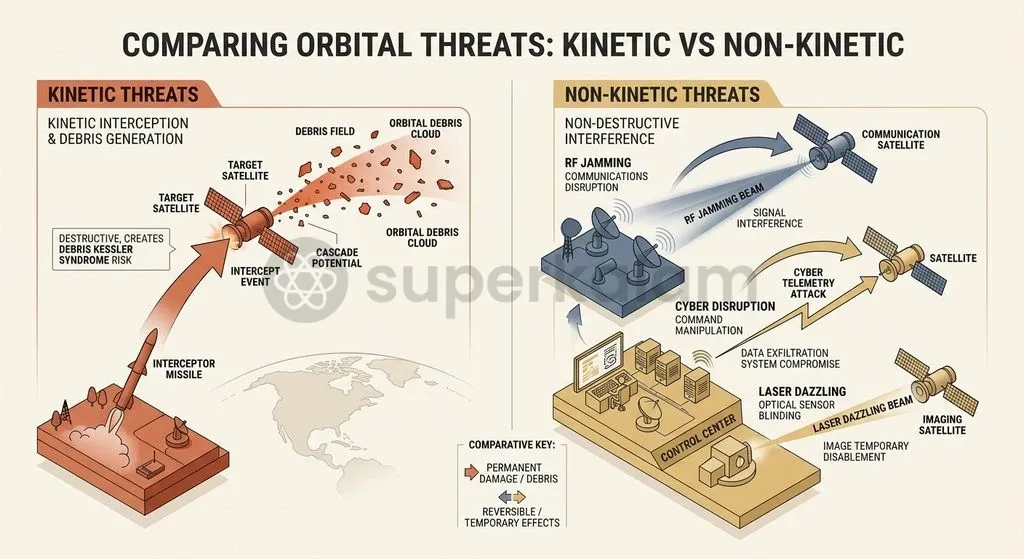
Direct-ascent anti-satellite missiles represent an obsolete single-point deterrent due to extreme operational blowback and orbital collateral damage. High-velocity kinetic impacts generate thousands of pieces of hypervelocity debris that persist in orbit for months or decades. The Inter-Agency Space Debris Coordination Committee (IADC) Guidelines emphasise that untracked orbital debris elevates the catastrophic risk of the Kessler syndrome, where cascading collisions render critical orbital planes permanently unusable.
Modern military space doctrine recognises that non-kinetic counterspace weapons pose immediate, deniable threats without generating physical orbital debris. Hostile militaries field terrestrial and airborne jammers that disrupt radiofrequency uplinks and downlinks, blinding battlefield commanders. Cyber intrusions can compromise command telemetry, while ground-based lasers dazzle satellite optical sensors.
| Threat Category | Operational Mechanism | Strategic Impact | Reversibility | Attribution Difficulty |
|---|---|---|---|---|
| Kinetic Physical | Direct-ascent interceptors, co-orbital rams | Total physical destruction of satellite bus | Irreversible (creates persistent debris) | Low (launch radar detection) |
| Electronic Warfare | Uplink/downlink jamming, GPS/NavIC spoofing | Sensor blindness, positional telemetry errors | Temporary (restored when signal ceases) | High (signal origin masking) |
| Cyber Counterspace | Malicious code insertion into ground telemetry | Loss of bus control, data theft, thruster sabotage | Variable (patchable or terminal) | Very High (proxy routing) |
| Directed Energy | Ground-based lasers, high-power microwaves | Sensor dazzling, subsystem blinding, component fry | Reversible to permanent structural damage | Moderate to High |
Discuss with Superkalam
Recall the operational altitude and target satellite involved in India's 2019 Mission Shakti ASAT test.
Ask Now10 Essential Pillars of India's Future Space Security Doctrine
India must transition its space strategy from ad-hoc operational responses to a unified institutional architecture. A robust national space security doctrine requires ten interconnected pillars that balance active orbital defence with diplomatic deterrence.
1. Doctrinal Clarity: Defining Redlines, Deterrence, and Proportionality
Clear strategic thresholds prevent adversaries from exploiting ambiguous operational grey zones in orbit. The Joint Military Space Doctrine emphasises that India requires declared redlines outlining what constitutes an act of war in space. Ambiguity invites incremental hostile aggression, such as localized electronic jamming or satellite dazzling.
Counterspace deterrence requires pre-planned cross-domain response options. Hostile interference with India's space-based early warning, communication, or surveillance satellites must trigger proportional asymmetric responses in the cyber, electronic, or conventional terrestrial domains. A credible doctrine explicitly connects space domain protection to India's overarching national security framework.
2. Resilient Space Architecture: Responsive Launch and Satellite Constellations
Disaggregated orbital constellations deny hostile adversaries the strategic advantage of single-point decapitation strikes. Large, monolithic geostationary satellites present vulnerable, high-value targets during armed conflict. Deploying distributed small-satellite swarms across Low Earth Orbit ensures that the loss of an individual bus does not degrade national communication or surveillance capabilities.
Responsive reconstitution forms the operational backbone of space resilience. ISRO engineered the Small Satellite Launch Vehicle (SSLV) to provide on-demand, rapid launch capability capable of injecting payloads up to 500 kg into low Earth orbit within a 72-hour turnaround time. Rapid launch infrastructure allows armed forces to reconstitute degraded orbital constellations during sustained military hostilities.
3. Counter-Space Defenses: Jamming, Cyber Hardening, and Directed Energy
Defensive space countermeasures protect vulnerable satellite payloads from electronic and directed energy interference. Space platforms require onboard radiofrequency shielding, frequency-hopping communication channels, and anti-jam antennas to resist hostile electronic warfare. Satellite optical sensors require mechanical shutters and filtering optics to prevent permanent damage from ground-based laser dazzling.
Cyber protection must secure terrestrial satellite command segments. Malicious intrusions into ground control stations can seize telemetry, tracking, and command (TT&C) loops, permitting hostile actors to adjust orbital attitudes or vent onboard thruster propellant. Hardening uplink encryption through post-quantum cryptographic standards prevents hostile command spoofing and operational disruption.
Discuss with Superkalam
Explain how electronic warfare against telemetry links differs from kinetic strikes in terms of reversibility and collateral risk.
Ask Now4. Deep Space Situational Awareness and Threat Attribution
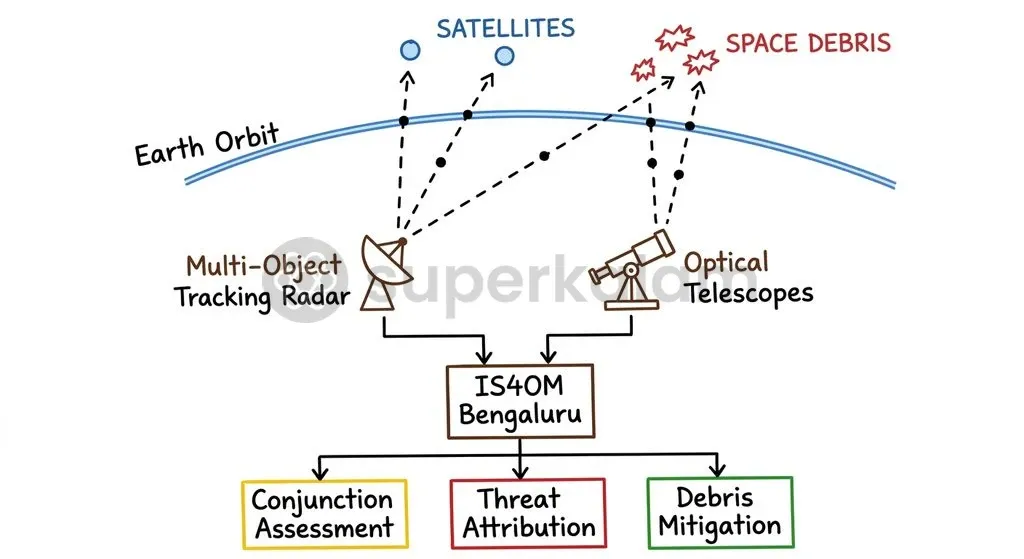
Space Domain Awareness (SDA) expands civilian tracking into predictive military threat detection. Standard Space Situational Awareness monitors orbital ephemeris and debris to prevent accidental collisions. SDA integrates real-time telemetry, threat characterisation, rendezvous and proximity operations (RPO) monitoring, and hostile actor attribution.
ISRO established the foundational ground network through Project NETRA (Network for Space Object Tracking and Analysis). The facility deploys indigenous optical telescopes and tracking radars capable of detecting and tracking 10-centimetre debris objects at ranges up to 3,400 kilometres. Bengaluru hosts the ISRO System for Safe and Sustainable Operations Management (IS4OM), operationalised in July 2022 to provide continuous collision avoidance for Indian operational assets. Military SDA must build directly upon this civilian radar telemetry.
5. Commercial and Civil Integration: Protecting Private Space Operators
Commercial space infrastructure represents a vital national security resource requiring formal state protection. Non-government entities licenced through IN-SPACe construct earth observation constellations, launch vehicles, and downstream satellite communication terminals. Modern conflicts demonstrate that commercial communication and imaging satellites are primary targets for hostile electronic interference and cyber operations.
The national space security doctrine must establish clear civil-military integration protocols. Government agencies should define technical cybersecurity baselines for private space operators while extending sovereign defensive umbrellas over domestic commercial infrastructure. Pre-negotiated commercial reserve agreements can guarantee military access to private imaging and communication bandwidth during national emergencies.
6. Space Domain Governance: Joint Military Commands and Inter-Agency Roles
Unified operational command structures eliminate bureaucratic friction between civilian scientific institutions and military operators. The Defence Space Agency manages operational requirements across the Indian Army, Navy, and Air Force. However, India's broader space apparatus remains structurally fragmented across the Department of Space, national intelligence bodies, and the Ministry of Defence.
India needs an integrated Space Command structure under the Chief of Defence Staff. Strategic planning requires permanent coordination mechanisms connecting the DSA, ISRO, and private industry through IN-SPACe. Unified governance prevents duplicate space research investments while streamlining intelligence dissemination directly to frontline tactical commanders.
7. Offensive Counter-Space Capabilities Beyond Debris-Creating Missiles
Deterrence demands non-destructive, reversible counterspace options that disable adversary capabilities without producing orbital debris. Kinetic ASAT weapons trigger severe diplomatic condemnation and generate indiscriminate debris fields that endanger neutral and domestic assets alike. Non-kinetic capabilities grant operational flexibility without permanently contaminating shared orbital space.
India's research establishments must prioritise ground-based radiofrequency jammers, airborne tactical electronic warfare suites, and directed energy dazzlers. Directed energy technologies can disrupt adversary optical reconnaissance satellites during sensitive military movements. High-power microwave systems can scramble internal electronics without causing physical fragmentation, delivering effective deterrence below the threshold of kinetic war.
Discuss with Superkalam
How can responsive launch platforms like the SSLV alter a nation's deterrence posture during a localized conventional conflict?
Ask Now8. Norm-Building and Global Space Diplomacy
Constructive multilateral diplomacy enables India to shape international orbital governance in line with sovereign interests. India has consistently championed negotiations at the Conference on Disarmament for a legally binding treaty on the Prevention of an Arms Race in Outer Space (PAROS). Active participation in the United Nations Committee on the Peaceful Uses of Outer Space (UN COPUOS) balances security readiness with global norms.
Multilateral leadership requires practical commitments to sustainable space practices. India announced its Debris Free Space Mission (DFSM) at the 42nd IADC meeting in April 2024, committing to zero-debris space operations across all governmental and non-governmental missions by 2030. Simultaneously, India signed the Artemis Accords on 21 June 2023, endorsing transparent, peaceful, and interoperable principles for international space cooperation.
9. Secure Supply Chains and Indigenous Semiconductor Self-Reliance
Hardware autonomy protects critical military space platforms from foreign supply chain interdiction and covert hardware trojans. Strategic space payloads require radiation-hardened microprocessors, mixed-signal Application-Specific Integrated Circuits (ASICs), and monolithic microwave integrated circuits (MMICs). Relying on foreign semiconductor foundries exposes national space defense systems to geopolitical sanctions and covert electronic tampering.
India maintains domestic strategic fabrication facilities to secure component access. The Semi-Conductor Laboratory (SCL) in Mohali, Punjab operates an indigenous 180nm CMOS wafer fabrication facility producing radiation-hardened ASICs and flight-grade microprocessors for ISRO and defence platforms. SCL and ISRO qualified the radiation-hardened Vikram 32-bit and 1601 microprocessor series for launch vehicle avionics.
STRATEGIC DOMESTIC SEMICONDUCTOR INFRASTRUCTURE
| Facility | Role |
|---|---|
| Semi-Conductor Laboratory (SCL), Mohali | 180nm CMOS fabrication for rad-hard ASICs and flight computers. Modernised via Rs 4,500 cr allocation under India Semiconductor Mission. |
| GAETEC (Gallium Arsenide Enabling Technology Centre), Hyderabad | DRDO-operated facility producing compound semiconductor MMICs. Essential for military radar, EW pods, and satellite transponders. |
| SITAR (Society for Integrated Circuit Technology), Bengaluru | DRDO foundry for specialized silicon microelectronics. Dedicated cryptographic and sensor-processing silicon hardware. |
To expand domestic output, the Ministry of Electronics and Information Technology allocated ₹4,500 crore under the ₹76,000 crore India Semiconductor Mission (ISM) to modernise the SCL facility. DRDO complements this ecosystem through the Gallium Arsenide Enabling Technology Centre (GAETEC) in Hyderabad and the Society for Integrated Circuit Technology and Applied Research (SITAR) in Bengaluru. These dedicated units fabricate specialised compound semiconductors for radar, electronic warfare, and cryptographic payloads.
10. Space Situational Intelligence Sharing with Strategic Partners
Collaborative tracking networks multiply national sensor coverage to secure complete orbital domain awareness. Ground-based radars and optical sensors face inherent geographic coverage limits. India cannot track low-altitude counterspace assets traversing the Southern Hemisphere or Western Pacific solely from domestic radar stations.
Bilateral and multilateral intelligence partnerships close critical observational gaps. Coordinating data sharing through initiatives like the Combined Space Operations (CSpO) construct and bilateral Basic Exchange and Cooperation Agreements improves regional orbital monitoring. Integrated sensor sharing ensures early warning against suspicious co-orbital manoeuvres and hostile rendezvous and proximity operations targeting Indian satellites.
Global Precedents: How the US, China, and France Structure Space Defense
Major space powers have established dedicated military commands backed by sustained budget outlays to protect sovereign orbital assets. Examining these institutional structures provides clear templates for India's evolving national space security doctrine.
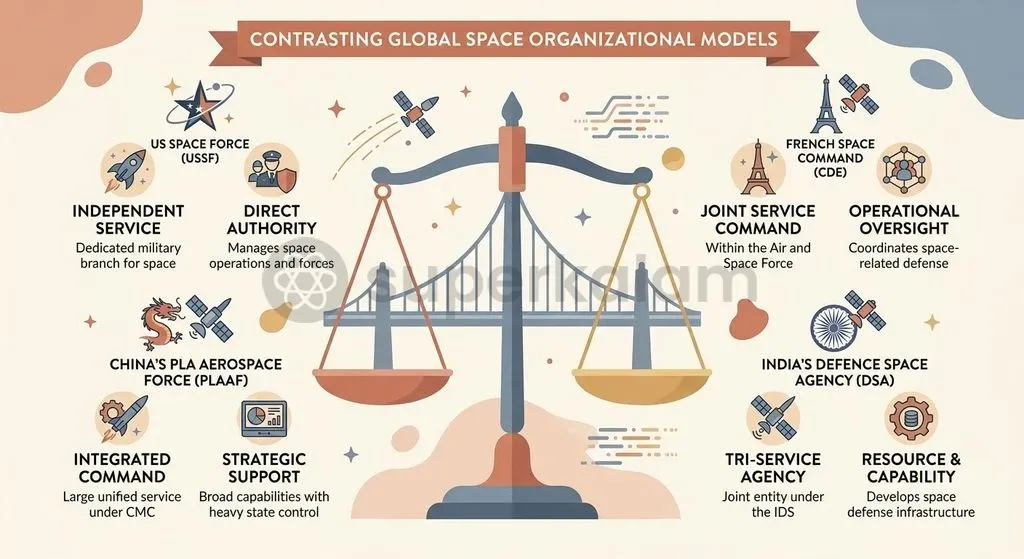
The United States established the United States Space Force (USSF) as an independent armed service branch under Title 10, Section 9081 of the U.S. Code via the FY2020 National Defense Authorization Act. Backed by an enacted budget of $29.4 billion for Fiscal Year 2025—including $18.7 billion for research, development, test, and evaluation—the USSF operates unified global tracking constellations, military satellite communications, and counterspace capabilities.
China restructured its strategic military assets on 19 April 2024 by dissolving the PLA Strategic Support Force and creating the People's Liberation Army Aerospace Force (ASF) under the direct control of the Central Military Commission. The ASF commands military launch facilities, telemetry stations, space surveillance networks, and operational counterspace weapons. France instituted the French Space Command (Commandement de l'Espace) within its Air and Space Force, backing its operations with a €6.0 billion allocation under the Military Programming Law 2024–2030.
| Metric / Dimension | United States Space Force (USSF) | PLA Aerospace Force (China) | French Space Command (CDE) | India (DSA / Current Framework) |
|---|---|---|---|---|
| Command Structure | Independent Military Service Branch under Air Force Dept | Independent Strategic Arm under Central Military Commission | Joint Command integrated into Air and Space Force | Tri-Services Agency under Chief of Defence Staff |
| Statutory / Legal Basis | Title 10, U.S. Code § 9081 (FY2020 NDAA) | Central Military Commission Directive (April 2024) | Ministerial Decree (Arrêté du 3 septembre 2019) | Executive Cabinet Decision (CCS Sanction, 2019) |
| Dedicated Funding | $29.4 billion enacted (FY 2025) | Integrated into PLA Defence Budget | €6.0 billion total (2024–2030 LPM) | Tri-service allocations |
| Primary Counterspace Focus | Resilient SDA swarms, EW, cyber defence | Co-orbital manipulation, direct-ascent ASAT, EW | Orbit patrol, laser blinding, SDA integration | Emerging SDA (Project NETRA), electronic hardening |
Discuss with Superkalam
Analyse the trade-offs between deploying large geostationary satellites versus distributed Low Earth Orbit small-satellite swarms for defence communications.
Ask NowKey Hurdles: Budget Constraints, Dual-Use Dilemmas, and Debris Risks
Institutional and economic constraints complicate the implementation of India's space security doctrine. Foremost among these challenges is fiscal allocation. While global powers commit tens of billions of dollars to dedicated military space commands, Indian defence spending remains primarily absorbed by conventional personnel costs, border infrastructure, and naval modernisation.
The dual-use dilemma creates persistent bureaucratic and diplomatic friction. India's civilian space achievements rely on open international scientific partnerships and commercial launch contracts through ISRO. Aggressive militarisation risks attracting scrutiny from international export control regimes, potentially restricting access to high-end optical components, space-grade raw materials, and specialised testing infrastructure.
Legal vacuums compound these operational risks. Article IV of the 1967 Outer Space Treaty prohibits placing nuclear weapons or weapons of mass destruction in orbit. However, the treaty remains silent on conventional kinetic ASAT missiles, ground-based lasers, high-power microwave systems, and cyber weapons. Navigating this lack of clear international prohibitions requires India to build credible deterrence while avoiding reckless tests that generate persistent orbital debris.
Discuss with Superkalam
Evaluate whether declaring explicit operational redlines in space enhances strategic deterrence or restricts response flexibility against grey-zone aggression.
Ask NowThe Way Forward: Towards a Comprehensive National Space Law and Doctrine
India must formalise its military space governance through primary statutory legislation enacted by Parliament. While the Indian Space Policy 2023 established regulatory clarity for commercial launch providers through IN-SPACe, it omitted national security mandates. A dedicated National Space Act must establish clear statutory authority for military operations in orbit, define liability for commercial assets during wartime, and institutionalise long-term funding streams for defense space projects.
The Armed Forces must expand the Defence Space Agency into a fully empowered, theatre-level Joint Space Command. Operational security requires expanding the Space Based Surveillance (SBS) program across low Earth and geostationary orbits to maintain continuous surveillance over regional security vectors. Pairing responsive SSLV launch infrastructure with indigenous Gallium Arsenide microelectronics from GAETEC and radiation-hardened silicon from SCL Mohali will secure India's strategic autonomy across the contested space domain.
Key Takeaways
- India's space security posture must transition from one-off kinetic ASAT demonstrations (Mission Shakti, March 2019) to a continuous, resilient, and non-kinetic doctrinal framework.
- The Indian Armed Forces formalised tri-service operational doctrine by releasing the Joint Military Space Doctrine on 16 September 2025.
- Kinetic ASAT interceptors create catastrophic orbital debris and Kessler syndrome risks; modern counterspace doctrines prioritise electronic jamming, cyber defence, and directed energy dazzlers.
- Space Domain Awareness (SDA) is anchored by ISRO's Project NETRA and the IS4OM facility, tracking 10-centimetre debris up to 3,400 kilometres.
- Strategic hardware independence relies on domestic semiconductor fabrication at SCL Mohali (180nm CMOS, Vikram microprocessors), GAETEC Hyderabad, and SITAR Bengaluru.
Mains Question
"Direct-ascent anti-satellite missiles represent an obsolete single-point deterrent due to extreme operational blowback and orbital collateral damage." In light of this statement and the release of the Joint Military Space Doctrine, examine the expanding spectrum of non-kinetic counterspace threats confronting India's orbital infrastructure. (10 Marks)
Evaluate NowMains Question
Transitioning from civilian space achievements to robust orbital deterrence requires moving beyond ad-hoc responses towards a cohesive institutional architecture. Discuss the essential pillars of a comprehensive space security doctrine for India. (15 Marks)
Evaluate NowPractice MCQs
QUESTION 1
With reference to India's institutional architecture for space defence and governance, consider the following statements:
- The Defence Space Agency (DSA) is an integrated tri-services agency functioning under the Chief of Defence Staff.
- The Defence Space Research Agency (DSRA) was sanctioned to develop dedicated space-warfare hardware and countermeasures.
- IN-SPACe was established under the Joint Military Space Doctrine as an exclusive military intelligence body for orbital surveillance.
Which of the statements given above is/are correct?
QUESTION 2
Consider the following statements regarding India's space assets and operational capabilities:
- Under Mission Shakti in March 2019, India intercepted the Microsat-R satellite at an altitude of 283 kilometres in Low Earth Orbit.
- The Small Satellite Launch Vehicle (SSLV) is designed to inject payloads up to 500 kg into Low Earth Orbit within a 72-hour turnaround time.
- Project NETRA is primarily an offensive directed-energy weapon platform developed to neutralize hostile orbital assets.
Which of the statements given above is/are correct?
QUESTION 3
Regarding different categories of counterspace threats, consider the following statements:
- Electronic warfare attacks on satellite downlinks and telemetry have reversible effects once the jamming signal ceases.
- Direct-ascent kinetic counterspace attacks carry a high risk of orbital blowback through persistent debris generation.
- Cyber counterspace intrusions present low attribution difficulty because signal origin masking is technically unfeasible.
Which of the statements given above is/are correct?
QUESTION 4
Consider the following statements regarding dedicated communication satellites of the Indian Armed Forces:
- GSAT-7 (Rukmini) was launched in 2013 to cater to the operational networking requirements of the Indian Navy.
- GSAT-7A was launched in 2018 to establish secure connectivity for the Indian Air Force.
Which of the statements given above is/are correct?
QUESTION 5
Which of the following terms describes the catastrophic orbital scenario where cascading hypervelocity collisions of debris render critical orbital planes permanently unusable?