India's First Indigenous H5N1 Bird Flu Vaccine: Biosecurity Strategy and One Health
Shifting from mass culling to poultry vaccination redefines India's biosecurity, protecting rural livelihoods and curbing dangerous zoonotic spillover risks.
Nov, 2026
•10 min read

Overview
India has developed its first indigenous inactivated H5N1 bird flu vaccine for chickens. Formulated by the ICAR-National Institute of High Security Animal Diseases, the vaccine establishes a vital biosecurity defence against avian influenza. It shifts national policy beyond reactive culling to protect poultry livelihoods and public health from zoonotic spillover.
The single-dose formulation targets the circulating Clade 2.3.2.1a strain and confers up to six months of protective immunity in domestic poultry. This technological advance shields India's 851.81 million birds, curbing epidemics that have disrupted smallholder incomes and egg production across 24 States and Union Territories.
By suppressing viral replication within the animal reservoir, the vaccine operationalises a proactive One Health approach to avert human transmission risks.
Why in the News? India's Breakthrough in Avian Influenza Defence
As of November 2026, the Indian Council of Agricultural Research announced the successful development of India's first indigenous inactivated poultry vaccine against Highly Pathogenic Avian Influenza subtype H5N1. Scientists at the ICAR-National Institute of High Security Animal Diseases (ICAR-NIHSAD) in Bhopal engineered the candidate vaccine. It specifically targets the circulating Clade 2.3.2.1a virus strain.
This scientific breakthrough responds directly to an endemic biosecurity challenge across Indian agriculture:
- Recurrent Epidemics: India has registered more than 500 combined outbreaks of H5N1 and H5N8 subtypes across 24 States and Union Territories since domestic detection first began at Navapur, Maharashtra in 2006.
- Recent Hotspots: Per outbreak notifications from the Department of Animal Husbandry (as reported in November 2026), active H5N1 infections in late 2026 forced localized culling operations across poultry clusters in Andhra Pradesh and Tamil Nadu.
- Strategic Policy Reversal: Shifting from reactive stamping-out culls to prophylactic vaccination marks a turning point in national biosecurity strategy, safeguarding rural livelihoods and mitigating zoonotic spillover.
Understanding H5N1: The Pathogen, Transmission, and Zoonotic Threat
Avian influenza subtype H5N1 is a lethal viral pathogen that causes severe systemic disease in domestic poultry and carries dangerous zoonotic potential. Belonging to the Influenzavirus A genus, the virus is classified by combinations of surface haemagglutinin and neuraminidase glycoproteins. In domestic flocks, Highly Pathogenic Avian Influenza (HPAI) triggers rapid internal haemorrhaging and near-total mortality within 48 hours.
Wild waterfowl act as natural reservoirs and drive regional transmission. India sits directly beneath the Central Asian Flyway, a major migratory corridor traversed by bar-headed geese and ruddy shelducks. These birds carry viral lineages from Central and Northern Asia to wintering wetlands across India, where wild flocks intermix with free-ranging village poultry.
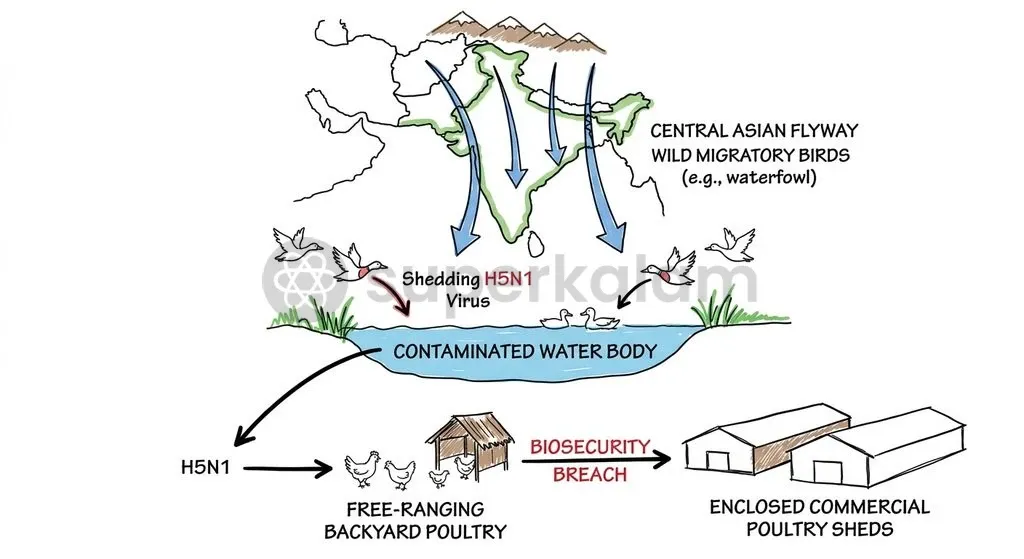
The genomic trajectory of H5N1 has evolved across distinct clades, creating divergent challenges for domestic and global biosecurity.
| Feature | Clade 2.3.2.1a | Clade 2.3.4.4b |
|---|---|---|
| Primary Geographic Focus | Endemic in Indian domestic poultry systems | Dominant driver of the global panzootic since 2020 |
| Target of Indigenous Vaccine | Specifically matched by the ICAR-NIHSAD vaccine | Subject of global surveillance and foreign candidate vaccines |
| Ecological Profile | Persistent circulation in domestic chicken populations | Unprecedented transmission across wild bird and mammal species |
| Sourcing Baseline | ICAR-NIHSAD Scientific Brief / WOAH Technical Reports | ICAR-NIHSAD Scientific Brief / WOAH Technical Reports |
Beyond veterinary destruction, H5N1 poses a severe global public health risk. According to World Health Organization surveillance data cited in the PIB release, between 2003 and 2026, healthcare agencies confirmed 1,003 human cases of H5N1 infection across 25 countries, resulting in 479 fatalities—a case fatality rate near 48 percent. Most human infections stem from direct contact with sick birds, making the suppression of domestic poultry outbreaks our primary firewall against mammalian adaptation.
Discuss with Superkalam
Which specific viral clade does India's indigenous inactivated poultry vaccine target, and which research institution developed it?
Ask NowHow the New Inactivated Vaccine Works in Poultry
The ICAR-NIHSAD poultry vaccine employs an inactivated virus formulation. It triggers a targeted immune response without causing viral replication or shedding in inoculated flocks.
To produce the candidate, researchers follow a precise manufacturing process:
- Controlled Cultivation: Technicians propagate the field-isolated Clade 2.3.2.1a strain inside high-containment biosafety facilities.
- Chemical Inactivation: Viral particles are rendered completely non-infectious using chemical agents, eliminating any risk of reversion to virulence.
- Adjuvant Blending: The killed antigen is blended with an immunological adjuvant that amplifies antibody production in the recipient bird.
According to the PIB Delhi release on India's First Indigenous H5N1 Chicken Vaccine, the vaccine provides domestic chickens with protective immunity for up to six months following a single administered dose.
Administering a killed preparation ensures safety because non-viable virus cannot shed or mutate with circulating field strains. Inoculated birds generate neutralising antibodies in high titres, rapidly curbing viral replication if birds encounter live infection. This suppression reduces environmental viral shedding and halts transmission across local farms.
Discuss with Superkalam
How does the physical intersection of the Central Asian Flyway with rural backyard poultry systems heighten India's vulnerability to avian influenza outbreaks?
Ask NowCulling Versus Vaccination: A Shift in India's Biosecurity Strategy
India's Department of Animal Husbandry and Dairying has long enforced a strict stamping-out policy. This mandate requires culling all poultry within a one-kilometre radius of any confirmed outbreak.
Governed by the national Action Plan for Prevention, Control and Containment of Avian Influenza, this protocol aimed to snuff out viral reservoirs through mass depopulation, carcass burning, and chemical disinfection. The Prevention and Control of Infectious and Contagious Diseases in Animals Act, 2009 empowers veterinary authorities to enforce quarantine zones.
Yet reactive culling inflicts heavy costs on smallholders and strains public budgets via compensation payouts. It also discourages early reporting by farmers who dread having their flocks destroyed.
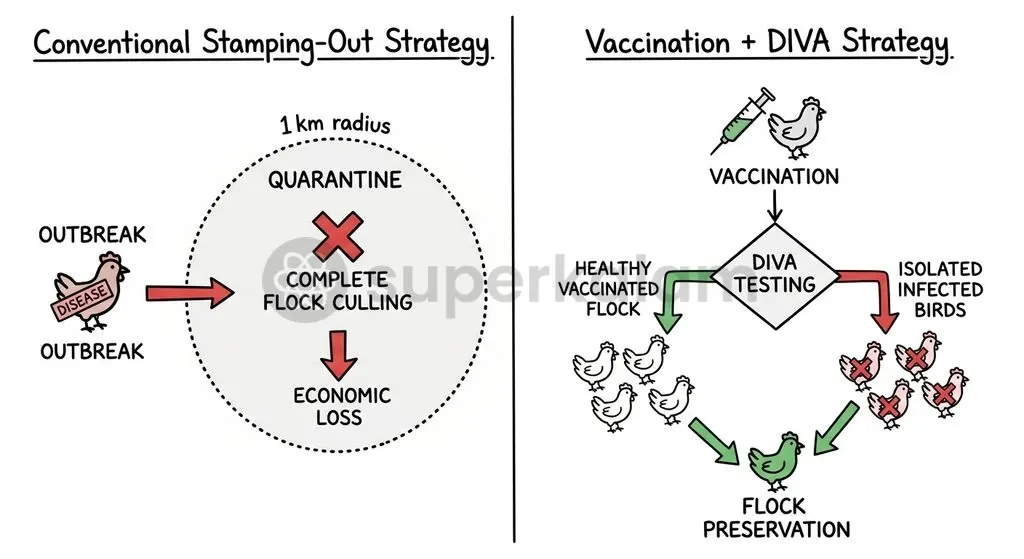
Integrating prophylactic vaccination alongside emergency culling introduces a structural biosecurity paradigm.
| Dimension | Stamping-Out Culling Strategy | Strategic Vaccination with DIVA Strategy |
|---|---|---|
| Primary Mechanism | Total eradication of exposed birds within a 1 km radius | Immunological suppression of viral loads and shedding |
| Economic Burden | Complete asset loss for farmers; heavy state compensation | Preventive input cost; preservation of productive flock assets |
| Trade Status Impact | Historically preferred for quick regain of disease-free status | Protected under WOAH Chapter 10.4 when surveillance is active |
| Diagnostic Marker Need | Routine standard diagnostic serology | Requires companion marker tests or unvaccinated sentinels |
| Primary Sourcing | Action Plan for Prevention, Control and Containment | WOAH Terrestrial Code / WOAH Diagnostic Manual |
Reluctance to vaccinate poultry once stemmed from trade barriers, as standard serological assays could not distinguish vaccinated birds from naturally infected ones. The World Organisation for Animal Health addressed this trade obstacle in Chapter 10.4 of its Terrestrial Animal Health Code.
According to the WOAH Terrestrial Animal Health Code (Chapter 10.4), poultry vaccination does not disqualify a nation or export zone from maintaining avian-influenza-free trade status, provided veterinary agencies conduct active surveillance proving the absence of circulating field virus.
Surveillance integrity relies on the DIVA strategy, which stands for Differentiating Infected from Vaccinated Animals. Detailed in Chapter 3.3.4 of the WOAH Manual of Diagnostic Tests and Vaccines for Terrestrial Animals, the DIVA approach employs companion serological marker tests targeting specific viral proteins absent in inactivated vaccines, or relies on placing unvaccinated sentinel birds within vaccinated flocks to detect covert field exposure.
Discuss with Superkalam
How does the DIVA (Differentiating Infected from Vaccinated Animals) strategy resolve the technical conflict between mass vaccination and international poultry trade restrictions?
Ask NowEconomic Stakes: Protecting Livelihoods and Affordable Protein
India's poultry sector provides vital financial security across rural communities, sustaining diverse agrarian operations:
- Flock Composition: The 20th Livestock Census recorded a national flock of 851.81 million birds, comprising 534.74 million commercial birds raised in intensive facilities and 317.07 million backyard poultry kept by smallholders.
- Livelihood Safety Nets: Backyard poultry provides supplementary household income, especially for rural women and landless families.
- National Protein Supply: According to the Basic Animal Husbandry Statistics 2025 published by the Ministry of Fisheries, Animal Husbandry & Dairying, India produced an estimated 149.11 billion eggs during 2024-25, ranking second globally with an annual per capita availability of 106 eggs.
Recurring H5N1 incursions disrupt these rural supply chains, hitting farm cash flows and sparking wild price swings. According to estimates by the Ministry of Agriculture and Farmers Welfare, an uncontrolled major avian influenza epidemic could threaten more than 20 percent of India's national flock and reduce overall national GDP growth by up to 1.5 percent. Widespread stamping-out culls wipe out farmer capital, while consumer panic shrinks market demand.
Discuss with Superkalam
Weigh the fiscal and welfare trade-offs between reactive compensation-based stamping-out policies and preventive nationwide poultry vaccination programs.
Ask NowThe One Health Imperative: Preventing the Next Animal-to-Human Spillover
The One Health framework coordinates veterinary, environmental, and public health systems to stop pathogens from acquiring human-to-human transmission. Because novel human influenza pandemics typically arise from reassortment events between avian and mammalian viruses, agricultural environments form our frontline defense line.
Unvaccinated poultry flocks serve as dangerous amplification vessels where rapid viral replication triggers spontaneous genomic mutations. According to the Quadripartite One Health Joint Plan of Action developed by FAO, UNEP, WHO, and WOAH, reducing avian influenza virus replication in domestic flocks via vaccination substantially minimises viral shedding into farm soil, water, and air.
Vaccine-mediated suppression halts zoonotic spillover through distinct protective pathways:
- Workplace Protection: Curtailing environmental contamination shields farm hands, poultry dressers, and transport handlers from high-titre viral exposure.
- Community Buffers: Suppressing airborne and waterborne pathogen dispersal insulates rural populations living adjacent to intensive poultry clusters.
- Mammalian Receptor Blocking: Lowering the total quantum of replicating virus directly curtails opportunities for H5N1 to mutate and adapt to mammalian cellular receptors.
Challenges in Rollout: Cold Chains, Mutation Tracking, and Regulatory Approval
Rolling out an avian influenza vaccine across India demands navigating strict logistical constraints, updating veterinary regulations, and monitoring continuous antigenic changes in wild lineages. Moving candidate vaccines from pilot validation to field delivery involves clearing distinct operational hurdles.
A nationwide vaccination programme faces distinct operational hurdles:
- Regulatory Framework Transition: India's national action plan has historically prohibited field vaccination in favour of stamping-out culls. The Department of Animal Husbandry and Dairying must formally amend veterinary protocols to approve commercial release, licensing, and standardised field administration.
- Cold Chain Infrastructure: Inactivated vaccines require continuous refrigerated storage between 2°C and 8°C. Preserving vaccine potency across remote rural districts and backyard poultry belts necessitates substantial cold chain logistics.
- Backyard Poultry Access: Administering individual injectable doses to 317.07 million free-ranging backyard birds across remote villages demands extensive community veterinary personnel.
- Antigenic Drift and Lineage Shifts: Avian influenza viruses mutate continuously. While the indigenous vaccine targets Clade 2.3.2.1a, biosecurity agencies must track whether foreign migratory strains, such as Clade 2.3.4.4b, establish local domestic transmission, necessitating frequent vaccine strain updates.
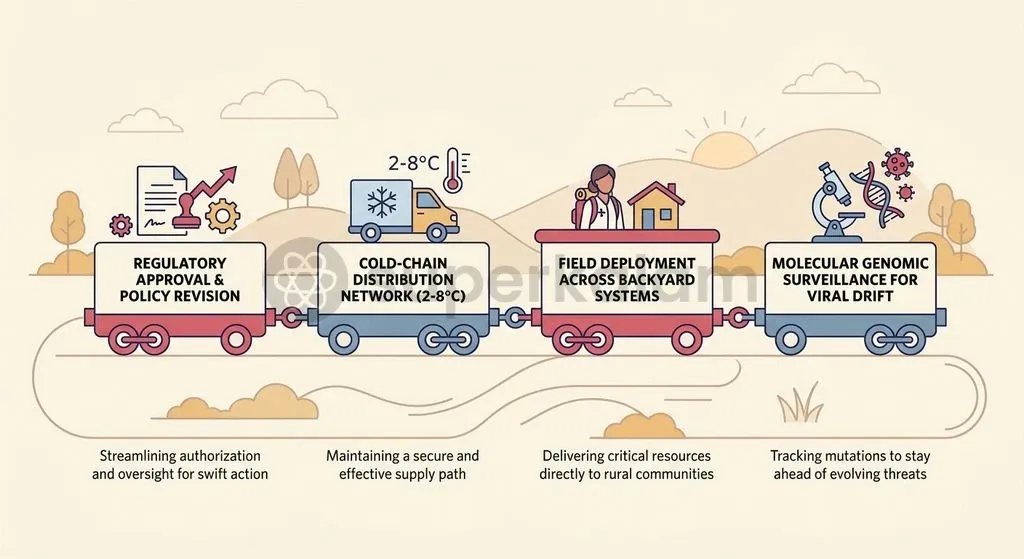
Addressing these structural constraints requires institutional alignment across state veterinary departments, biological manufacturers, and epidemiological laboratories.
Discuss with Superkalam
Design an inter-agency surveillance protocol integrating veterinary departments, wildlife wardens, and rural health clinics to operationalise a local One Health response against H5N1.
Ask NowThe Road Ahead: Building an Integrated Biosecurity Architecture
Strengthening India's veterinary biosecurity requires integrating targeted vaccination, active molecular surveillance, and enhanced on-farm hygiene under a cohesive national policy. A single tool cannot replace comprehensive herd health management; rather, vaccination must reinforce standard biosecurity controls.
A balanced implementation pathway involves several structural initiatives:
- Adopting a Targeted Ring-Vaccination Strategy: Veterinary authorities should prioritise prophylactic immunisation in designated high-risk zones, such as poultry clusters situated adjacent to major bird sanctuaries and Central Asian Flyway stopovers.
- Institutionalising the DIVA Testing Protocol: State veterinary diagnostic networks must roll out companion serological test kits alongside the vaccine to ensure field virus transmission is detected promptly, preserving India's agricultural export credibility under WOAH guidelines.
- Upgrading Flyway and Wetland Monitoring: The Indian Council of Agricultural Research, State Forest Departments, and animal husbandry directorates should formalise joint seasonal sampling of migratory waterbirds to anticipate incoming viral variants.
- Enhancing Farm-Level Biosecurity Infrastructure: Physical barriers separating domestic birds from wild waterfowl, combined with disinfected farm perimeters, must remain mandatory for commercial farms and subsidised for vulnerable smallholders.
Key Takeaways
- Developed by ICAR-NIHSAD in Bhopal, India's first indigenous inactivated poultry vaccine provides chickens with protective immunity against H5N1 Clade 2.3.2.1a for up to six months.
- The vaccine addresses endemic avian influenza pressures across India, where more than 500 combined outbreaks of H5N1 and H5N8 have hit 24 States and Union Territories since 2006.
- Prophylactic immunisation protects rural livelihood stability and a sector producing 149.11 billion eggs annually, avoiding catastrophic culls that threaten up to 20 percent of the national flock.
- In line with WOAH Chapter 10.4 standards, adopting a DIVA strategy allows India to deploy poultry vaccination without automatically sacrificing avian-influenza-free trade status.
- Suppressing avian viral replication operationalises the One Health mandate, limiting environmental shedding and reducing catastrophic zoonotic spillover threats to human populations.
Mains Question
"Shifting from reactive stamping-out culls to prophylactic vaccination marks a turning point in national biosecurity strategy." In light of the development of India's first indigenous H5N1 vaccine, elucidate how the Differentiating Infected from Vaccinated Animals (DIVA) strategy addresses both epidemic containment and international trade compliance. (10 Marks)
Evaluate NowMains Question
"With over 851 million birds and persistent migratory inflows along the Central Asian Flyway, India's poultry economy faces severe vulnerability to avian influenza." Critically analyse the economic and zoonotic implications of recurrent H5N1 epidemics, and evaluate the role of an indigenous inactivated vaccine in operationalising the One Health paradigm. (15 Marks)
Evaluate NowPractice MCQs
QUESTION 1
With reference to Avian Influenza and the newly developed indigenous poultry vaccine in India, consider the following statements:
- The candidate vaccine developed by ICAR-NIHSAD uses a live-attenuated viral formulation targeting Clade 2.3.4.4b.
- A single dose of the vaccine confers protective immunity in domestic chickens for up to six months.
- Clade 2.3.2.1a has been persistently circulating within India's domestic poultry systems. Which of the statements given above is/are correct?
QUESTION 2
Regarding international animal health regulations and disease management strategies, consider the following statements:
- Under Chapter 10.4 of the World Organisation for Animal Health (WOAH) Terrestrial Animal Health Code, poultry vaccination permanently revokes a country's avian-influenza-free trade status.
- The Differentiating Infected from Vaccinated Animals (DIVA) strategy relies on companion serological tests or unvaccinated sentinel birds.
- The statutory power to establish poultry quarantine zones during outbreaks in India stems from the Prevention and Control of Infectious and Contagious Diseases in Animals Act, 2009. Which of the statements given above are correct?
QUESTION 3
Consider the following statements regarding the epidemiology and transmission dynamics of Avian Influenza in India:
- India lies along the Central Asian Flyway, where migratory waterfowl such as bar-headed geese act as natural reservoirs of the virus.
- Highly Pathogenic Avian Influenza (HPAI) belongs to the Influenzavirus A genus and is classified by surface haemagglutinin and neuraminidase glycoproteins.
- Human infections of H5N1 documented between 2003 and 2026 exhibited a case fatality rate of less than 10 percent. Which of the statements given above is/are correct?
QUESTION 4
According to official data cited regarding India's livestock and poultry sector, consider the following statements:
- Commercial poultry outnumbers backyard poultry in India's total national flock as recorded in the 20th Livestock Census.
- The national Action Plan for Prevention, Control and Containment of Avian Influenza prescribes stamping-out culls within a five-kilometre radius of an outbreak epicenter. Which of the statements given above is/are correct?
QUESTION 5
The first domestic outbreak of Highly Pathogenic Avian Influenza in India was detected in 2006 at which of the following locations?