Climate Overshoot Pathways: Why 1.5°C Warming Cannot Be Reversed
Banking on late-century carbon removal to reverse a 1.5°C temperature breach ignores physical hysteresis, creating irreversible risks for India's climate.
Nov, 2026
•10 min read

Overview
Climate overshoot pathways model a temporary breach of the 1.5°C Paris Agreement limit before returning to safer levels by 2100. They depend on speculative net-negative emissions. Earth-system science shows this approach is a dangerous fallacy that risks irreversible ecological tipping points.
According to the Intergovernmental Panel on Climate Change (IPCC), physical dynamics like ice sheet disintegration and marine collapse show severe hysteresis. Pulling atmospheric carbon down decades later cannot restore these damaged systems. Heavy reliance on unproven Carbon Dioxide Removal (CDR) also creates acute moral hazard, distracting international talks from immediate fossil fuel phaseouts. For vulnerable nations like India, an overshoot brings unmanageable adaptation costs and deadly heat stress.
Why in the News: The 1.5°C Threshold and the Rise of Overshoot Scenarios
As of November 2026, the UNFCCC COP31 summit is underway in Antalya, Türkiye, under joint leadership with Australia. International negotiations face a harsh reality: current national climate pledges cannot keep global heating below the 1.5°C limit agreed in Paris.
Immediate global mitigation continues to fall short of scientific benchmarks. In response, diplomatic debates have turned toward "climate overshoot" trajectories. These pathways assume the planet can temporarily exceed 1.5°C and pull temperatures back down through late-century carbon extraction.
Key benchmarks and initiatives framing the COP31 discussions include:
- Mandatory Pre-2025 Peak: To keep 1.5°C within reach, the IPCC AR6 Synthesis Report establishes that global greenhouse gas emissions must peak before 2025 at the latest and fall by approximately 43% by 2030 relative to 2019 levels.
- The 35-by-35 Electrification Pledge: Introduced by the COP31 Presidency and backed by IRENA and GWEC, this push seeks to raise electricity's share of global final energy consumption from ~20% to 35% by 2035.
Discuss with Superkalam
What are the specific emissions reduction benchmarks set by the IPCC AR6 Synthesis Report for global emissions to keep 1.5°C within reach?
Ask NowWhat Is a Climate Overshoot Pathway?
The IPCC defines climate overshoot pathways as routes where global temperatures exceed a target ceiling before returning below it by 2100. As detailed in the IPCC AR6 Working Group III report, these models rely on large-scale Carbon Dioxide Removal to deliver net-negative emissions in the late 21st century. Under these plans, carbon extraction must outpace ongoing emissions to force surface temperatures downward.
The IPCC categorises 1.5°C-compatible mitigation pathways into two distinct groups:
- Category C1 (No or Limited Overshoot): Trajectories holding warming to 1.5°C throughout the 21st century, limiting overshoot to a brief margin below 0.1°C before stabilising.
- Category C2 (High Overshoot): Trajectories allowing temperatures to breach 1.5°C for decades before dropping back below 1.5°C by 2100.
| Pathway Feature | Category C1: Low or No Overshoot | Category C2: High Overshoot |
|---|---|---|
| Peak Warming Trajectory | Capped at or marginally above 1.5°C | Substantially exceeds 1.5°C before 2100 |
| Near-Term Mitigation Required | Steep, immediate fossil fuel cuts by 2030 | Slower near-term decarbonisation |
| Scale of Carbon Dioxide Removal | Limited, focused on neutralising residual sectors | Requires up to hundreds of gigatonnes of net-negative CO2 |
| Earth-System Tipping Risk | Minimised by avoiding critical thermal thresholds | Severe risk of triggering irreversible feedbacks |
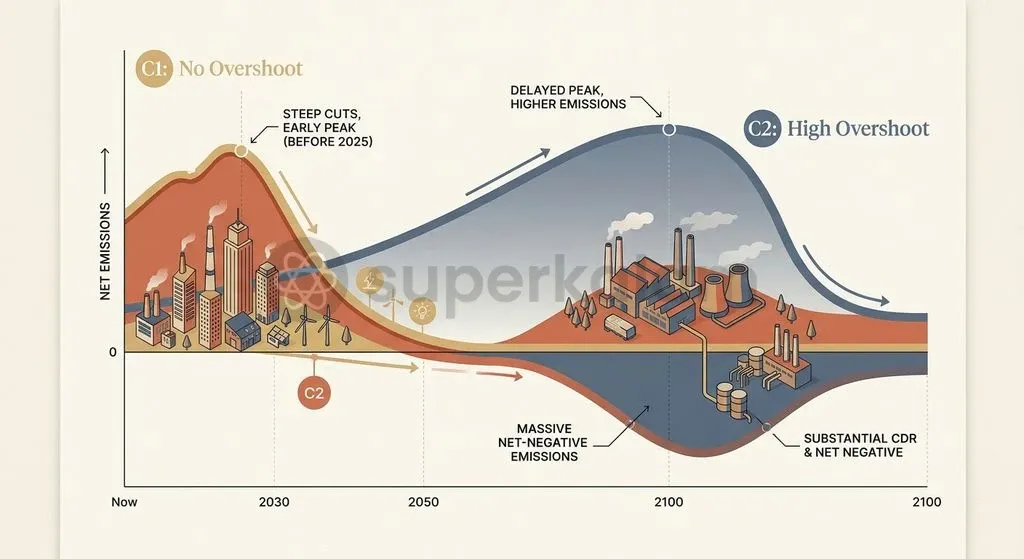
Category C2 pathways demand cumulative net-negative removals on the order of hundreds of gigatonnes of carbon dioxide after 2050. In policy circles, high-overshoot models treat the global carbon budget like a financial overdraft. They assume future generations can repay the debt using unproven technologies.
The Physics Problem: Why Lowering Temperatures Later Cannot Undo Climate Damage
Physical Earth-system responses exhibit pronounced hysteresis. This dynamic prevents natural systems from recovering even if atmospheric carbon levels and surface temperatures eventually fall. Hysteresis describes a thermodynamic state where an outcome depends on its historical path rather than its current conditions. Cooling the planet back down in 2090 does not recreate the physical climate baseline of 2020.
Several physical and ecological thresholds demonstrate why late-century cooling fails to reverse damage:
- Cryosphere and Ocean Inertia: Glaciers and polar ice sheets operate across multi-century timescales. Melting Greenland and Antarctic ice sheets permanently raises sea levels, while thermal expansion of warming waters continues for centuries regardless of surface cooling.
- Irreversible Permafrost Carbon Pulses: High temperatures thaw permafrost, prompting ancient organic matter to decay. As established by IPCC Working Group I, these permafrost carbon pulses do not re-freeze or re-sequester as surface temperatures drop, causing an irreversible drawdown of the remaining global carbon budget.
- Marine Ecosystem Collapses: Living systems face extinction rather than hysteresis. IPCC Working Group II assessed that coral reefs face 70% to 90% loss at 1.5°C and over 99% extirpation at 2.0°C. An overshoot destroys thermal refugia, driving species loss that later cooling cannot undo.
Discuss with Superkalam
How does the thermodynamic principle of hysteresis explain why late-century temperature reductions cannot recreate previous environmental baselines?
Ask NowThe Technological Limit: Why Carbon Removal Cannot Rescue the Carbon Budget
Carbon Dioxide Removal methods face hard land, energy, and permanence constraints. These barriers make offsetting ongoing fossil fuel emissions at multi-gigatonne scales unworkable. High-overshoot models rely chiefly on Bioenergy with Carbon Capture and Storage (BECCS) and Direct Air Carbon Capture and Storage (DACCS).
BECCS requires growing fast-turnover biomass, burning it for power, and sequestering the emissions geologically. According to IPCC Working Group III findings:
- Land-Use Footprint: Removing the 700 to 900 GtCO2 required in aggressive overshoot scenarios demands cultivating several hundred million hectares of land.
- Food Security Conflict: Allocating prime farmland to monoculture energy crops sparks fierce land competition. This drives food price inflation across developing nations.
- Water and Ecological Depletion: Heavy bioenergy farming drains local water basins and speeds up biodiversity loss via habitat fragmentation.
Direct Air Carbon Capture and Storage extracts carbon dioxide straight from ambient air using chemical sorbents, avoiding land trade-offs. Yet DACCS remains at a medium technology readiness level. The IPCC reports DACCS carries high costs, ranging from USD 100 to 300 per metric ton of CO2 removed, along with massive thermal and electric energy penalties. Diverting clean power to DACCS slows the decarbonisation of electricity grids.
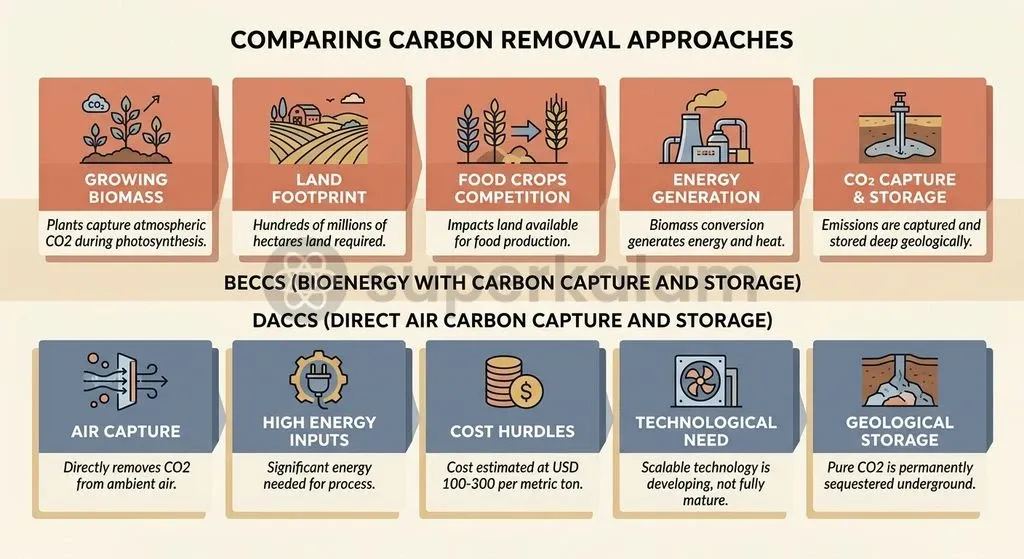
Storage permanence creates another structural obstacle. Biological sinks like forests hold carbon for decades to centuries, remaining vulnerable to fires, heatwaves, and pests. Geological stores provide permanence exceeding 10,000+ years, but worldwide underground injection sites remain limited.
Banking on theoretical future CDR fosters mitigation deterrence and moral hazard. Promising a speculative technological rescue decades down the road justifies continued fossil fuel investment today.
Discuss with Superkalam
If an economy diverts substantial clean electricity to power Direct Air Carbon Capture and Storage (DACCS), how might that impact its broader industrial decarbonisation targets?
Ask NowThe Diplomatic Trap: How Overshoot Weakened Commitments from COP28 to COP29
Multilateral climate negotiations have normalised overshoot trajectories by elevating technical removal language while starving developing countries of public finance. This diplomatic dilution accelerated during the First Global Stocktake at COP28 in Dubai.
The COP28 UAE Consensus cover decision (Decision 1/CMA.5, paragraph 28) formally integrated carbon capture and utilisation and storage (CCUS) and carbon removal into its core transition roadmap. Equating technological removals with gross emission cuts gave political cover for prolonged fossil fuel extraction.
This trend hardened into a finance stalemate at COP29 in Baku. Developing nations need dependable public funds to decarbonise rapidly and bypass high-overshoot paths:
- NCQG Settlement: Countries adopted a New Collective Quantified Goal (NCQG) of USD 300 billion annually by 2035 from developed states, tied to a broader private mobilisation target of USD 1.3 trillion yearly.
- Developing World Rejection: The Government of India rejected this USD 300 billion NCQG package, calling it abysmally poor and too little and too distant in parliamentary responses, emphasizing that it violates the principle of Common but Differentiated Responsibilities and Respective Capabilities (CBDR-RC).
- Loss and Damage Shortfall: While the Loss and Damage Fund was established at COP27 (Decision 2/CP.27 and 2/CMA.4) and operationalised at COP28, actual financial pledges remain negligible relative to the losses an overshoot will bring.
Without upfront public finance, developing nations cannot fund capital-intensive energy transitions. This resource vacuum locks the climate into the very overshoot pathways diplomats claim to avoid.
What Prolonged Overshoot Means for India and the Global South
India faces severe socio-ecological upheaval during any prolonged warming overshoot. Disrupted atmospheric systems threaten human survival, agricultural output, and economic growth across the subcontinent. Reversing temperatures decades later cannot undo these compounding impacts:
- Lethal Wet-Bulb Heat Stress: Extensive regions in India are projected to cross deadly wet-bulb temperatures between 31°C and 35°C. At 35°C wet-bulb, the human body cannot shed heat through sweating, causing fatal hyperthermia within hours. This threatens an economy reliant on outdoor physical labour in agriculture and construction.
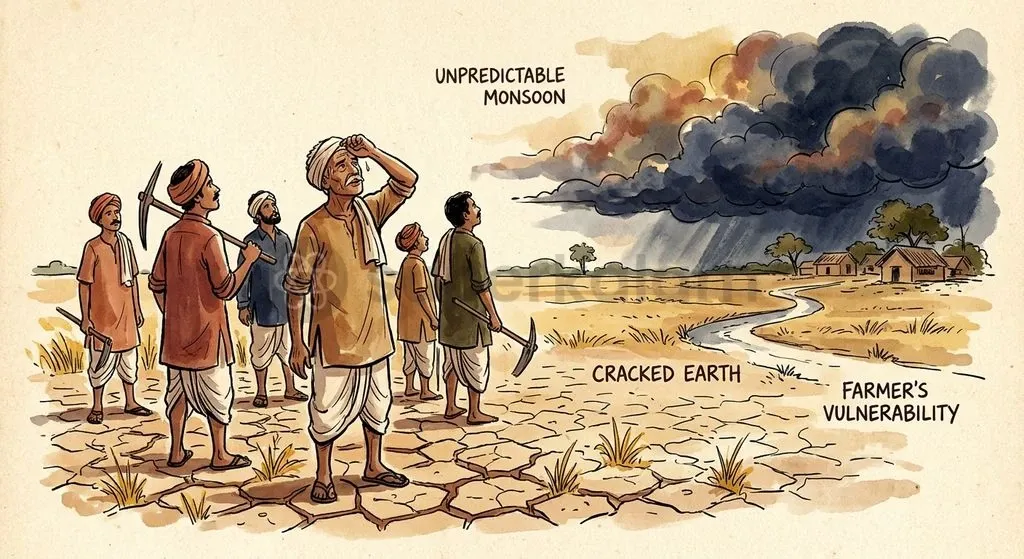
- Monsoon Breakdown and Water Insecurity: Temperatures above 1.5°C alter the thermal gradients that govern the South Asian Summer Monsoon. Instead of reliable rains, India faces swings between prolonged agricultural droughts and concentrated cloudbursts. Himalayan glacial retreat will first spur destructive flash floods, followed by systemic dry-season river shortages.
- Compounding Climate Injustice: Developing countries that contributed little to historical emissions shoulder the immediate physical trauma of warming. Meanwhile, the financial and technological burden of late-century atmospheric carbon removal is passed on to future generations.
Discuss with Superkalam
Compare the systemic risks of relying on biological carbon sinks versus geological storage regarding permanence and ecological trade-offs.
Ask NowThe Way Forward: Cutting Emissions Now Instead of Banking on Removals Later
Preventing an overshoot requires deep, immediate cuts in gross emissions rather than diplomatic reliance on future carbon removal. Policy priorities must shift from managing overshoot models to closing the pre-2030 emissions gap directly.
- Enforcing Absolute Gross Decarbonisation: Global greenhouse gas emissions must fall by approximately 43% by 2030 relative to 2019 levels to keep 1.5°C reachable without overshoot. Talks must focus on phasing out fossil fuels over technological offsets. Initiatives like the COP31 '35-by-35' Global Electrification Pledge to expand electricity's share of final energy consumption from ~20% to 35% by 2035 represent the type of sector-wide operational roadmaps needed.
- Separating Emissions Reductions from Carbon Removals: To halt mitigation deterrence, multilateral frameworks must mandate strictly separated, non-fungible national targets for gross emissions reductions and technological removals. Removal credits must never substitute for gross decarbonisation in compliance markets; their role belongs strictly to balancing residual emissions in hard-to-abate sectors.
- Fulfilling Public Climate Finance and Loss and Damage: Developed nations must deliver public, grant-equivalent climate finance aligned with CBDR-RC. The current USD 300 billion NCQG agreed at Baku must be revised upward to deliver real mobilization toward developing nations' calculated needs. Concurrently, the Loss and Damage Fund established under Decision 2/CP.27 must be capitalised with hundreds of billions of dollars to compensate vulnerable nations facing irreversible climate damages during the near-term warming trajectory.
Treating overshoot as an acceptable risk is an untenable gamble. The laws of physics dictate that damage done to ice sheets, oceans, ecosystems, and human societies during an overshoot cannot simply be undone by cleaning up the atmosphere decades later.
Key Takeaways
- Physical Irreversibility: Climate overshoot pathways rely on the false assumption that reversing temperatures restores the climate; physical hysteresis ensures that ice sheet loss, ocean thermal expansion, and coral reef extinction remain permanent on human timescales.
- Biogeochemical Feedbacks: Permafrost thaw triggered by warming releases substantial carbon dioxide and methane that do not re-sequester upon cooling, permanently reducing the remaining global carbon budget.
- Technological Limits of CDR: Large-scale BECCS threatens global food security by requiring hundreds of millions of hectares of agricultural land, while DACCS remains constrained by costs between USD 100 and 300 per metric ton and high energy penalties.
- Diplomatic Weakening: Embedding CCUS and CDR into the COP28 UAE Consensus and settling on an insufficient USD 300 billion NCQG at COP29 institutionalises overshoot while shifting mitigation duties away from developed nations.
- Subcontinental Vulnerability: A temperature overshoot exposes India to deadly wet-bulb temperatures between 31°C and 35°C and destabilises the South Asian Summer Monsoon, presenting existential risks to human health and agriculture.
- Target Separation: International policy must establish strictly separate, non-fungible accounting frameworks for gross emissions reductions and carbon removals to prevent CDR from delaying fossil fuel phaseouts.
Mains Question
"Relying on late-century carbon extraction to reverse a breach of the 1.5°C threshold treats the global carbon budget as a financial overdraft while ignoring Earth-system hysteresis." Elucidate. (15 Marks)
Evaluate NowMains Question
The inclusion of technological removal options alongside an 'abysmally poor' New Collective Quantified Goal (NCQG) risks normalising climate overshoot at the expense of developing nations. Critically analyse. (10 Marks)
Evaluate NowPractice MCQs
QUESTION 1
With reference to the mitigation pathways classified by the Intergovernmental Panel on Climate Change (IPCC) in its AR6 Working Group III report, consider the following statements:
- Category C1 pathways limit warming overshoot to a brief margin below 0.1°C throughout the 21st century.
- Category C2 pathways rely on cumulative net-negative carbon dioxide removals on the order of hundreds of gigatonnes after 2050.
- Both Category C1 and Category C2 pathways avoid critical thermal thresholds, resulting in minimal risk of triggering irreversible Earth-system feedbacks. Which of the statements given above are correct?
QUESTION 2
Regarding Earth-system dynamics and the concept of hysteresis under climate overshoot conditions, consider the following statements:
- Hysteresis describes a state where natural systems fail to recreate historical baselines because outcomes depend on their historical path rather than current temperatures.
- IPCC assessments indicate that permafrost carbon pulses released during warming will rapidly re-freeze and re-sequester once surface temperatures are lowered.
- Thermal expansion of warming ocean waters continues for centuries even if atmospheric temperatures are subsequently reduced. Which of the statements given above is/are correct?
QUESTION 3
Consider the following statements regarding Carbon Dioxide Removal (CDR) technologies highlighted in climate mitigation discourse:
- Direct Air Carbon Capture and Storage (DACCS) currently operates at a high technology readiness level with negligible electrical and thermal energy penalties.
- Bioenergy with Carbon Capture and Storage (BECCS) at aggressive overshoot scales (700 to 900 GtCO2) requires cultivating several hundred million hectares of land.
- Geological carbon storage provides permanence exceeding 10,000 years, whereas biological sinks remain vulnerable to disturbances such as wildfires and pests. Which of the statements given above are correct?
QUESTION 4
With reference to multilateral climate finance and negotiations under the UNFCCC, consider the following statements:
- The New Collective Quantified Goal (NCQG) adopted at COP29 in Baku set a public finance target of USD 300 billion annually by 2035 from developed nations.
- The Government of India rejected the COP29 NCQG settlement, terming it inadequate and violative of the principle of Common but Differentiated Responsibilities and Respective Capabilities (CBDR-RC).
- The Loss and Damage Fund was established at COP27 and formally operationalised at COP28. Which of the statements given above is/are correct?
QUESTION 5
The '35-by-35 Electrification Pledge', introduced in the context of the COP31 discussions, specifically seeks to:
Discuss with Superkalam
Weigh the diplomatic argument for treating CCUS and carbon removal as transitional solutions against the critique that they generate moral hazard and dilute near-term mitigation.
Ask Now