Horticulture Production in India: Record Output and the Smallholder Crisis
A record 386.92 MT harvest reveals a structural paradox: rising farm output continues to outpace post-harvest cold chains and smallholder price protections.
Nov, 2026
•11 min read
Overview
India's horticulture production reached an estimated record of 386.92 million tonnes in 2025-26. According to the Ministry of Agriculture and Farmers Welfare, this harvest outpaced total foodgrain output despite occupying under twenty percent of gross cropped area. Yet this milestone conceals an acute vulnerability: smallholders face recurring farmgate price collapses, severe cold-chain deficits, and missing floor-price protections.
Over 86% of Indian landholders are small and marginal farmers. These cultivators manage a disproportionate share of perishable crops without institutional safety nets. As of March 2026, transforming bumper output into enduring agrarian prosperity requires shifting policy from volumetric expansion toward post-harvest logistics, cluster processing, and comprehensive market price stabilisers.
Why in the News?
Horticulture output in India surged to an estimated record of 386.92 million tonnes in the 2025-26 agricultural season, expanding by 4.36% over the preceding year. Per the Ministry of Agriculture & Farmers Welfare release on Third Advance Estimates of Horticulture Crops 2025-26, this volume expansion occurred alongside a contraction in total cultivated area, confirming notable yield gains. The Economic Survey 2025-26 reported that horticulture has continuously outpaced foodgrain production since 2012-13, solidifying a structural transition toward high-value commercial agriculture.
Physical yields tell only half the story. During harvest peaks, small cultivators across regional belts confront severe price volatility. Perishable produce remains excluded from open-ended statutory procurement, leaving rural farmgates exposed to acute downward price pressures.
Discuss with Superkalam
What share of India's gross cropped area is currently occupied by horticultural crops?
Ask NowThe Production Shift: How Horticulture Overtook Foodgrain Volumes
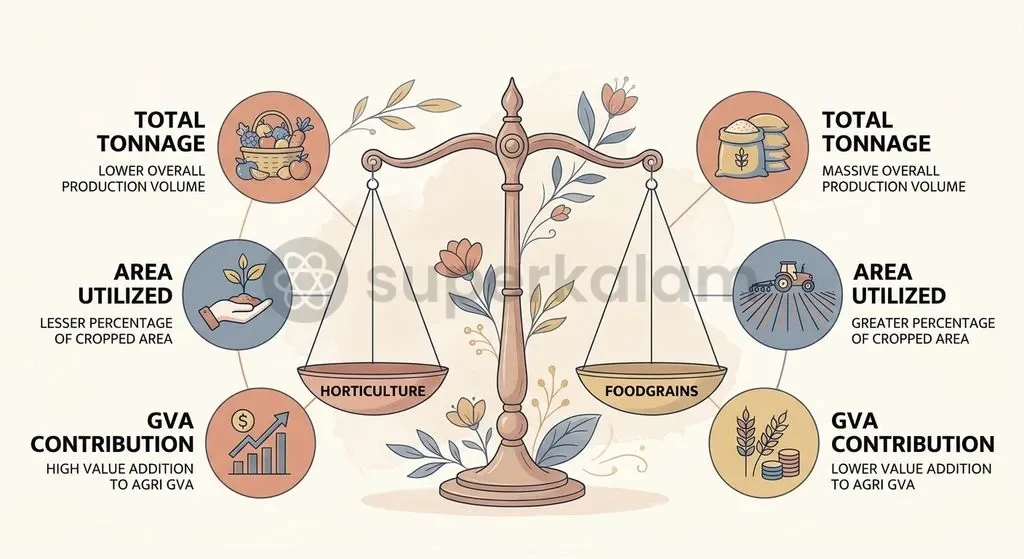
Indian horticulture surpassed total foodgrain production over a decade ago. Data from the Economic Survey 2025-26 shows that the 2025-26 horticulture harvest of 386.92 million tonnes comfortably exceeded the 357.73 million tonnes of foodgrains recorded in 2024-25. This milestone reflects shifting dietary demand toward micro-nutrient-dense foods and farm diversification away from staple cereals.
Horticultural crops deliver this volume on a remarkably small footprint. They occupy between 15% and 18% of the country's gross cropped area of nearly 200 million hectares. By comparison, cereal and pulse production utilises the vast majority of remaining acreage, indicating the far greater land productivity of fruit and vegetable systems.
| Performance Indicator | Horticulture Sector | Foodgrain Sector | Strategic Context |
|---|---|---|---|
| National Production | 386.92 million tonnes (2025-26) | 357.73 million tonnes (2024-25) | Structural shift established since 2012-13 |
| Share of Gross Cropped Area | 15% to 18% (under 20%) | Over 60% of total gross cropped area | High land productivity per hectare |
| Agricultural GVA Contribution | Approximately 33% | Remainder spread across cereals, livestock, forestry | High economic density within crop farming |
| Crop Sector Output (GVO) | Nearly 37% | Dominant physical acreage, lower value density | Engine of commercial farm monetization |
The sector carries substantial weight in rural income generation. The Economic Survey 2025-26 notes that horticulture accounts for approximately 33% of agricultural GVA and nearly 37% of the Gross Value of Output within the national crop segment.
Vegetables drive the bulk of this expansion. According to the Third Advance Estimates for 2025-26 from the Ministry of Agriculture, vegetable output grew by 4.35% year-on-year to 227.27 million tonnes across 11.93 million hectares, led by potato, tomato, and seasonal greens. Fruit production reached 123.07 million tonnes, registering an annual increase of 4.60% (5.42 million tonnes) over 2024-25 levels.
The Bumper Crop Paradox: Surging Harvests Meet Crashing Farmgate Prices
Perishable bumper harvests routinely end in farmgate price collapses because horticultural crops possess narrow consumption windows and zero on-farm holding capacity. The Ashok Dalwai Committee on Doubling Farmers' Income documented that bumper harvests frequently generate negative economic returns for small growers due to classic Cobweb price cycles.
Three structural bottlenecks intensify this market instability for growers:
- Uncoordinated Planting Cycles: High prices in one season spur uncontrolled planting. When harvest arrives, uncoordinated mandi inflows create immediate regional gluts.
- Smallholder Asset Constraints: Smallholders owning under two hectares constitute over 86% of Indian landholders. They grow perishables for fast cash flow, but lack the capital or on-farm infrastructure to defer distress sales.
- Rapid Perishability: A study by NABCONS on post-harvest losses indicated that between 4.6% and 15.88% of produce spoils along domestic fruit and vegetable supply chains.
Without immediate access to cold chains or village processing units, growers must offload produce at prevailing mandi rates. The financial surplus transfers almost entirely to wholesale intermediaries.
Discuss with Superkalam
How does open-ended cereal procurement create a disincentive for crop diversification in the northwestern agricultural belt?
Ask NowRegional Asymmetry: Why the Horticulture Shift Bypassed the Green Revolution Belt
Horticultural diversification remains geographically uneven across India, concentrating heavily in peninsular and western agricultural zones. Official records from the National Horticulture Board confirm this marked divergence across two distinct agrarian models:
- The Peninsular and Western Commercial Hubs: Commercial expansion is clustered across Maharashtra, Andhra Pradesh, Gujarat, Karnataka, and Tamil Nadu. Early investments linked progressive farming clusters to private pack-houses, export aggregators, and urban consumption corridors.
- The Northwestern Monoculture: The Indo-Gangetic cereal belt of Punjab and Haryana has largely resisted commercial diversification into perishable produce. Open-ended cereal procurement anchored to assured Minimum Support Price mechanisms de-risks cereal cultivation, locking growers into wheat-paddy systems. Shifting to horticulture means absorbing full price and weather volatility without an institutional floor.
This divide carries serious ecological fallout. The wheat-paddy cycle continues to deplete groundwater reserves and degrade regional soils. Yet small farmers cannot rationalise shifting away from foodgrains without structured price guarantees or integrated marketing contracts.
Discuss with Superkalam
If you were advising a state government facing tomato price crashes, how would you address the fiscal disincentive inherent in the 50:50 MIS loss-sharing formula?
Ask Now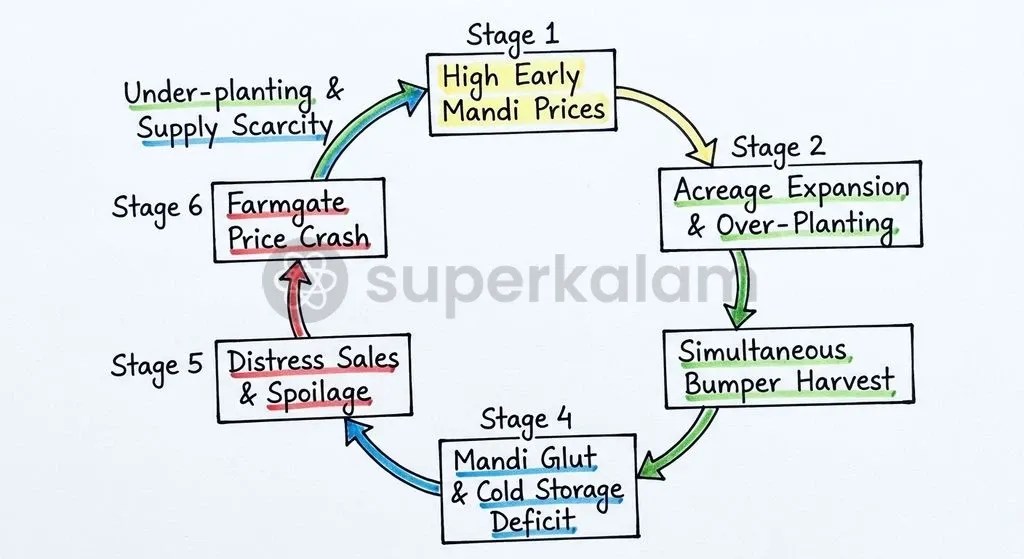
Safety Net Failure: Why Price Support Mechanisms Fail Perishable Crops
Perishable horticulture lacks statutory price guarantees, leaving small cultivators without an institutional floor when mandi rates crash below production costs. While staple crops benefit from open-ended procurement through the Food Corporation of India, fruits and vegetables rely on fragmented executive schemes with limited reach.
The primary safety net mechanism remains the Market Intervention Scheme under the Pradhan Mantri Annadata Aay Sanrakshan Abhiyan. Operational guidelines from the Department of Agriculture & Farmers Welfare outline the structural limits of this framework:
- Restrictive Activation Criteria: The Market Intervention Scheme provides only ad-hoc relief. It triggers exclusively when wholesale market prices fall by at least 10% below normal previous-year levels.
- Constraining Fiscal Ratios: Financial losses incurred during procurement operations are divided 50:50 between the Centre and States, easing to 75:25 only for North-Eastern States. State governments with limited fiscal resources routinely avoid formally notifying market interventions, fearing open-ended budgetary liabilities.
- Logistical Constraints: The physical procurement of highly perishable commodities requires rapid field sorting, immediate cold storage, and organized distribution channels, which state-designated procurement agencies rarely maintain.
The Ministry of Food Processing Industries administers Operation Greens to moderate extreme price fluctuations, yet its scope does not constitute a comprehensive floor price. Originally launched for Tomato, Onion, and Potato and subsequently widened to 22 perishables under 'TOTAL', the scheme targets supply-chain logistics. Scheme guidelines confirm that short-term relief is restricted to a 50% transport and storage subsidy rather than open-ended farmgate purchase. Consequently, commercial price risks remain entirely with the farmer.
Discuss with Superkalam
Compare the impact of bulk cold storage availability versus first-mile pack-house availability on preventing distress sales by smallholders.
Ask NowThe Broken Cold Chain: Measuring the Gaps Identified by the NCCD
Post-harvest logistics in India suffer from acute structural imbalances that prevent perishable produce from reaching remunerative distant markets. Findings from the National Centre for Cold-chain Development infrastructure assessment report prove that India's cold-chain architecture is severely deficient at the first mile, despite holding substantial bulk warehouse capacity.
| Infrastructure Component | Existing Units | Required Units | National Deficit |
|---|---|---|---|
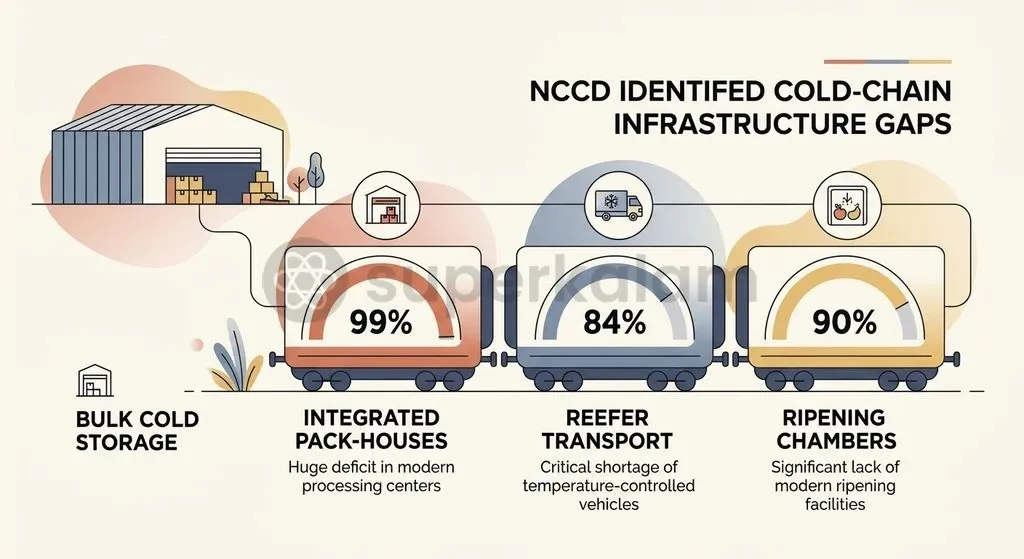
| Integrated Pack-Houses | ~675 units | 83,041 units | 99% Deficit |
| Refrigerated Trucks (Reefers) | ~11,000 units | 70,035 units | 84% Deficit |
| Modern Ripening Chambers | ~1,232 units | 12,654 units | 90% Deficit |
| Bulk Cold Storage Capacity | Substantial | Adequate (Gross) | ~10% Deficit |
The National Centre for Cold-chain Development documented these specific hardware deficits:
- Integrated Pack-Houses: India maintains an estimated 99% national deficit, with approximately 675 units operational against an evaluated requirement of 83,041 facilities. Farmgate pre-cooling and grading infrastructure remains virtually missing across standard village mandis.
- Reefer Transport Vehicles: The country operates roughly 11,000 refrigerated trucks against a national baseline requirement of 70,035 vehicles, creating an 84% operational deficit in temperature-controlled transit.
- Ripening Facilities: Modern ripening chambers stand at about 1,232 units compared to a national necessity of 12,654 units, resulting in a 90% capacity gap.
- Single-Crop Bulk Distortions: Gross bulk cold storage registers a mild 10% capacity deficit, but approximately 75% of existing capacity is dedicated entirely to single-commodity bulk potato storage across Uttar Pradesh, West Bengal, and Gujarat. Multi-chamber, multi-commodity cold stores for high-value fruits and green vegetables remain scarce.
The Ashok Dalwai Blueprint: Fixing Post-Harvest Infrastructure and Market Access
The Ashok Dalwai Committee on Doubling Farmers' Income presented a comprehensive strategy to resolve post-harvest bottlenecks and market volatility for horticulture producers. Emphasising a paradigm shift from production quantity to secondary processing and value realization, the Dalwai Committee outlined actionable institutional mechanisms:
- Development of Secondary Agriculture: Volumes VIII and IX of the Dalwai Report urge the development of village-level processing enterprises to absorb peak-season harvest surpluses before they enter saturated physical mandis. Primary processing, drying, and semi-processing at the rural level provide smallholders with an immediate economic buffer against distressed crop dumping.
- Cluster Value Chains and FPOs: The committee highlighted that unorganised individual farmers possess zero bargaining power within wholesale channels. It recommended organising cultivators into Farmer Producer Organisations to aggregate output, achieve scale, negotiate directly with commercial buyers, and eliminate layers of commission agents.
- Contract Farming and APMC Deregulation: Dalwai recommendations advocate the legal facilitation of contract farming frameworks coupled with structural reforms to State Agricultural Produce Market Committee laws. Enabling modern retailers, agri-businesses, and processors to purchase directly at the farmgate reduces transit handling, circumvents mandi levies, and improves realized prices.
To implement targeted interventions, the central government has utilised the Mission for Integrated Development of Horticulture. By late 2025, the Ministry of Agriculture had approved 58 Centres of Excellence and identified 55 dedicated crop belts under the Horticulture Cluster Development Programme to modernise cultivation techniques and link production hubs with integrated cold chains.
Discuss with Superkalam
Propose an alternative market price stabilization model that could protect perishable fruit and vegetable growers without requiring physical procurement by state agencies.
Ask NowWay Forward: Building Structural Resilience for Smallholders
Rebalancing the horticulture value chain requires synchronised reforms across primary infrastructure, financial hedging mechanisms, and regulatory market structures. A durable policy roadmap must transition from reactive post-harvest subsidies toward proactive smallholder shielding:
- Prioritise First-Mile Infrastructure: Public capital expenditure under the Agriculture Infrastructure Fund must pivot directly toward eliminating the 99% deficit in farmgate pack-houses. Pre-cooling facilities at Gram Panchayat levels can double the shelf life of seasonal harvests and curb distress sales.
- Restructure Price Stabilisation Architecture: The central government should modify Market Intervention Scheme financing by absorbing a higher proportion of operating losses, shielding fiscally constrained state administrations from catastrophic liability. Expanding Operation Greens beyond transportation subsidies into transparent price-deficiency payment models would compensate farmers without forcing direct physical state handling.
- Incentivise Diversification in the Cereal Bowl: States like Punjab and Haryana must develop structured incentive schemes that compensate growers for shifting land from water-guzzling paddy to horticultural clusters. These transition programmes should bundle input support, assured private procurement contracts, and multi-peril crop insurance.
- Scale Cluster Infrastructure via FPOs: The Horticulture Cluster Development Programme must integrate Farmer Producer Organisations into modern logistics corridors. Linking cluster hubs to dedicated reefer transport and processing parks ensures that smallholders participate in value addition rather than acting as captive commodity suppliers.
Key Takeaways
- National horticulture output reached an estimated record 386.92 million tonnes in 2025-26, consistently exceeding total foodgrain production since 2012-13 despite occupying under 20% of gross cropped area.
- Horticulture contributes approximately 33% of agricultural GVA and nearly 37% of crop sector output, making it central to agricultural economic growth.
- Small and marginal farmers comprise over 86% of Indian landholders and shoulder the greatest price-collapse risk during seasonal gluts due to high perishability and lack of farmgate holding infrastructure.
- Commercial horticulture remains concentrated in western and southern states, while the Indo-Gangetic belt stays anchored to wheat-paddy monoculture due to assured, open-ended cereal procurement.
- According to the National Centre for Cold-chain Development, India faces a 99% deficit in integrated pack-houses and an 84% deficit in reefer trucks, whereas bulk storage remains heavily skewed toward potatoes.
- Price stabilisation tools like the Market Intervention Scheme and Operation Greens remain structurally inadequate due to strict activation triggers, 50:50 state fiscal loss sharing, and an absence of guaranteed farmgate floor pricing.
Mains Question
"While horticultural crops demonstrate significantly higher economic and land productivity than staple foodgrains, their bumper harvests often translate into farmgate price crashes rather than agrarian prosperity." Critically examine the structural and institutional factors responsible for this paradox. (15 Marks)
Evaluate NowMains Question
Data from the National Centre for Cold-chain Development (NCCD) reveals severe front-end and logistical deficits in India's post-harvest infrastructure. Evaluate the extent to which these bottlenecks hinder market integration for perishable agricultural commodities. (10 Marks)
Evaluate NowPractice MCQs
QUESTION 1
With reference to the Market Intervention Scheme (MIS) under PM-AASHA, consider the following statements:
- It is triggered only when wholesale market prices fall by at least 10% below normal previous-year levels.
- Under standard operational guidelines, procurement losses are shared equally between the Centre and States.
- For North-Eastern States, the procurement loss-sharing ratio between the Centre and States is 75:25. Which of the statements given above are correct?
QUESTION 2
Consider the following statements regarding the horticulture sector in India as reported in the Economic Survey 2025-26:
- Total horticulture production has consistently outpaced foodgrain production since 2012-13.
- Horticultural crops occupy over 30% of India's gross cropped area.
- Horticulture contributes approximately 33% of the agricultural Gross Value Added (GVA). Which of the statements given above is/are correct?
QUESTION 3
Regarding the cold-chain infrastructure deficits evaluated by the National Centre for Cold-chain Development (NCCD), consider the following statements:
- Integrated pack-houses face an estimated national deficit of nearly 99%.
- India faces an acute shortage in refrigerated transport vehicles, with an operational deficit of around 84%.
- Bulk cold storage capacity suffers from a severe national deficit exceeding 70%. Which of the statements given above is/are correct?
QUESTION 4
Under the Ministry of Food Processing Industries' 'Operation Greens' scheme, what specific short-term market intervention is provided to manage price volatility for notified perishable crops?
QUESTION 5
Consider the following statements regarding the structural dynamics of Indian horticulture:
- Vegetables account for over 220 million tonnes of production, outstripping total fruit production.
- Small and marginal farmers holding under two hectares constitute more than 86% of Indian landholders.
- The Indo-Gangetic belt of Punjab and Haryana has emerged as the primary hub of commercial horticulture diversification. Which of the statements given above is/are correct?