JIMEX Exercise: India-Japan Shift to Undersea Deterrence
As Chinese submarines probe vital Indo-Pacific choke points, India and Japan are moving beyond basic naval drills to forge an integrated undersea barrier.
Nov, 2026
•9 min read
Context
The Japan-India Maritime Exercise has transformed from symbolic flag-showing manoeuvres into a sophisticated operational drill focused on high-end anti-submarine warfare. Expanding Chinese naval deployments and the need to secure vital subsurface chokepoints across the Indo-Pacific corridor drive this shift.
Naval engagements between the Indian Navy and the Japan Maritime Self-Defense Force now reflect an integrated undersea deterrence posture. Operating from northern waters off Honshu to Indian Ocean entry channels, both forces link long-range patrol aviation, rotary dipping sonar systems, and reciprocal logistics networks to counter undersea threats.
Why in the News? The Shift Toward Undersea Deterrence
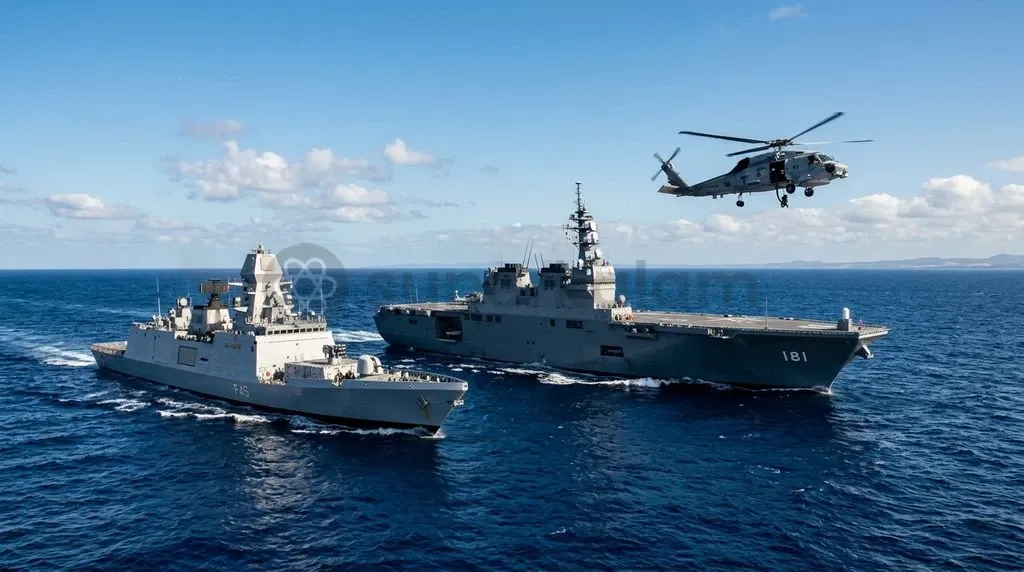
As of November 2026, the Indian Navy stealth frigate INS Sahyadri conducted advanced tactical drills alongside the Japan Maritime Self-Defense Force helicopter destroyer JS Ise south of Honshu. The bilateral engagement concentrated on several synchronised operational tasks according to the:
- Coordinated fleet movements: Executing synchronised tactical manoeuvres in formation.
- Joint communications: Validating secure naval communication procedures across platforms.
- Deck interoperability: Conducting cross-deck helicopter landing operations between combatants.
Official communications have progressively transitioned exercise nomenclature toward JAIMEX while preserving continuity with the foundational Japan-India Maritime Exercise series established over a decade ago per the. This dual rendering in official and media releases designates the identical bilateral warfighting framework.
Bilateral priorities have decisively left basic passage exercises behind. The current operational agenda prioritises combined anti-submarine warfare and tactical domain awareness designed to track quiet undersea platforms traversing vital Indo-Pacific sea routes.
Evolution of Bilateral Drills: Tracing JIMEX Since 2012
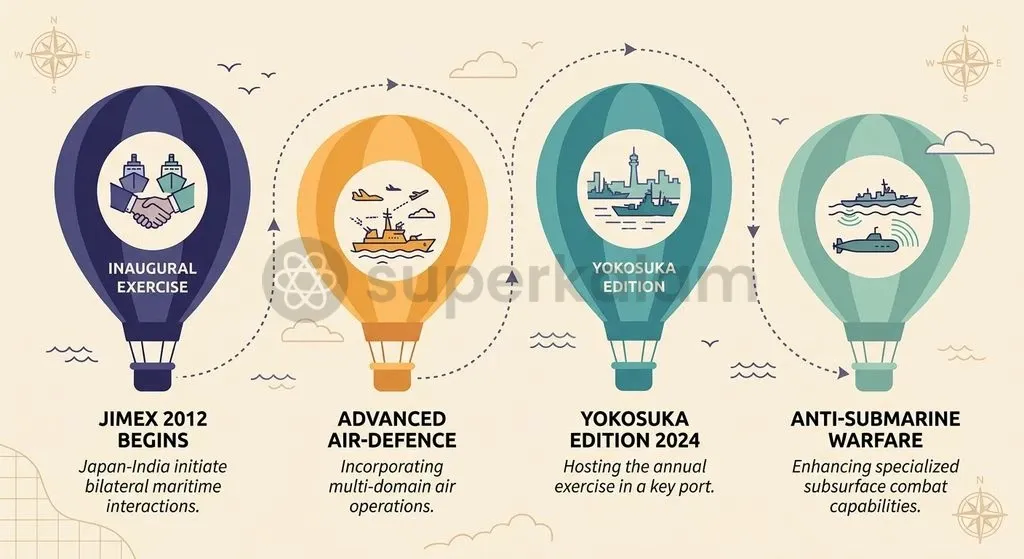
The bilateral maritime exercise between India and Japan commenced formally in January 2012 to institutionalise naval cooperation across the Indo-Pacific. The operational scope has widened across three distinct phases:
- Foundational Phase (2012): Emphasised basic communication protocols, search-and-rescue drills, and reciprocal port calls.
- Multi-Threat Expansion: Broadened from basic surface gunnery into complex anti-air defence and subsurface tracking scenarios.
- Eighth Edition (JIMEX 24): Conducted off Yokosuka, Japan, in June 2024, pairing the Indian Navy guided-missile stealth frigate INS Shivalik with the Japanese destroyer JS Yugiri.
Recent editions demonstrate an institutionalised cadence of high-end sea phases. The interaction between INS Sahyadri and the aviation-capable JS Ise south of Honshu illustrates how surface combatants train directly for coordinated fleet protection and aviation-integrated submarine prosecution.
Discuss with Superkalam
Which surface combatants from the Indian Navy and JMSDF participated in the tactical cross-deck operations conducted south of Honshu in November 2026?
Ask NowThe Undersea Imperative: PLAN Submarine Expansion in the Indian Ocean
Expanding People's Liberation Army Navy submarine patrols have compelled New Delhi and Tokyo to prioritise undersea deterrence across key maritime chokepoints. Subsurface deployments by the Chinese military routinely feature Type 093 nuclear-powered attack submarines alongside quiet Type 039A/B Yuan-class conventional submarines fitted with air-independent propulsion according to the.
Chinese naval submarines transit from the South China Sea into the Indian Ocean basin through shallow focal bottlenecks. They primarily transit the Malacca Strait alongside deep-water routes through the Sunda and Lombok Straits. The Malacca Strait presents acoustic and navigational hazards for submerged transit. In contrast, deep bathymetric trenches in the Sunda and Lombok passages let submarines enter the eastern Indian Ocean while running submerged and silent.
Dual-use oceanographic and hydrographic survey vessels from China, including the Shi Yan and Da Yang vessel series, have undertaken extensive ocean research across these Indian Ocean corridors. These survey vessels measure seawater temperature, salinity gradients, and seabed topography:
- Thermocline profiling: Identifying acoustic shadow zones where sonar performance degrades, allowing submarines to evade surface detection.
- Bathymetric mapping: Plotting deep undersea trenches and ridges to ensure safe submerged navigation through geographic chokepoints.
- Acoustic propagation analysis: Gathering sound-speed data to calibrate onboard sonar algorithms for future offensive deployments.
Discuss with Superkalam
Explain how thermocline profiling conducted by oceanographic research vessels influences the tactical cat-and-mouse game between submarines and surface sonars.
Ask NowTechnical Convergence: Coordinating Long-Range Patrol Aircraft and Shipborne ASW
Tactical anti-submarine warfare between India and Japan relies on the operational pairing of fixed-wing maritime patrol aircraft with shipborne rotary aviation. Tactical exercises coordinated by multinational commands highlight how long-range platforms like India's Boeing P-8I Neptune collaborate with Japan's Kawasaki P-1 and Mitsubishi SH-60K helicopters.
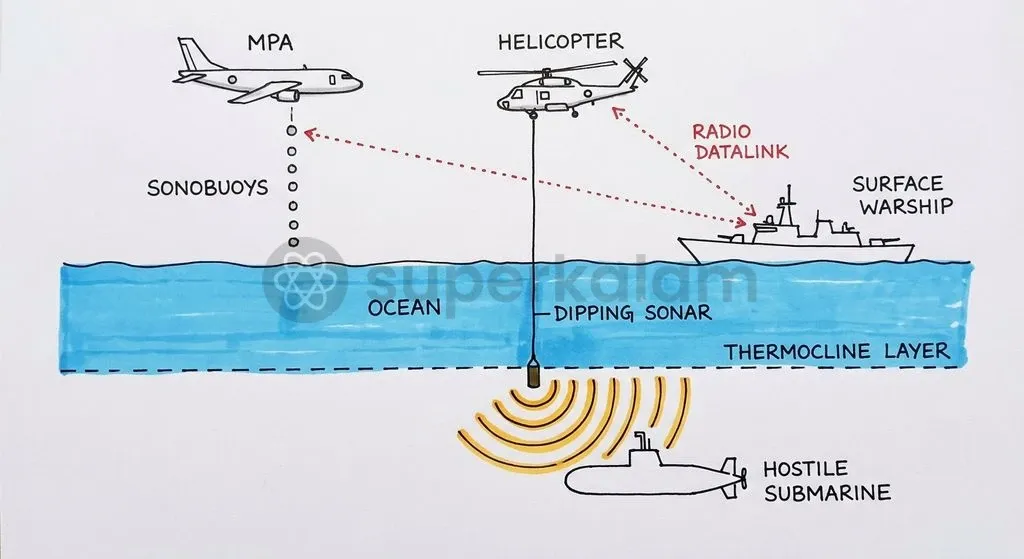
Long-range aircraft establish wide-area acoustic screening lines by laying synchronised sonobuoy barriers across projected submarine transit lanes. Once an anomalous contact is picked up, shipborne anti-submarine helicopters deploy active dipping sonar systems into the water column to pin down the target's precise bearing and depth.
| Dimension | Indian Navy Capability | Japan Maritime Self-Defense Force (JMSDF) | Operational Convergence |
|---|---|---|---|
| Primary MPA Platform | Boeing P-8I Neptune | Kawasaki P-1 | Wide-area sonobuoy barrier laying and acoustic search |
| Shipborne Rotary Wing | Multi-role naval helicopters | Mitsubishi SH-60K | Localised dipping sonar prosecution and weapon delivery |
| Surface Combatants | Indigenous Shivalik-class stealth frigates (e.g., INS Sahyadri) | Hyuga-class helicopter destroyers (e.g., JS Ise) | Cross-deck aviation handling and escort screening |
| Operational Mandate | Net security provider across the Indian Ocean Region | Sea Line of Communication protection out to 1,000 nautical miles | Synchronized surveillance covering Indo-Pacific focal points |
Surface combatants such as INS Sahyadri and JS Ise carry out cross-deck helicopter landing operations to validate shipboard handling procedures during joint hunts. Cross-deck aviation compatibility ensures that a helicopter from one navy can land, refuel, and transfer tactical contact assessments aboard a partner's warship during continuous operations.
Doctrinal Alignment: Reconciling Senshu Boei with India's Net Security Role
Harmonising divergent strategic doctrines forms the conceptual foundation for sustained naval interoperability across the Indian Ocean. Both nations operate under distinct mandates:
- Japan's Constitutional Limits: Formally anchored in Article 9 and its established senshu boei (exclusively defence-oriented policy), this legal framework constrains the Japan Maritime Self-Defense Force to homeland defence and protecting vital sea lines of communication out to 1,000 nautical miles.
- India's Regional Strategy: Codified in 'Ensuring Secure Seas: Indian Maritime Security Strategy' under the SAGAR framework, the doctrine tasks the Indian Navy as a primary net security provider across the broader Indian Ocean.
These contrasting frameworks converge on shared maritime security needs. Tokyo's legal responsibility to protect energy shipments through regional shipping lanes matches New Delhi's mandate to maintain sea control over transit corridors. Both navies preserve freedom of navigation without breaching domestic legal boundaries.
Discuss with Superkalam
Analyze how the complementary capabilities of long-range maritime patrol aircraft (P-8I/P-1) and rotary-wing aircraft (SH-60K) establish layered anti-submarine screening lines.
Ask NowThe Logistics Backbone: Operationalising the 2020 ACSA
The Acquisition and Cross-Servicing Agreement signed in September 2020 provides the legal and logistical framework for reciprocal naval support between India and Japan. Concluded on 9 September 2020, the pact establishes procedures for the reciprocal provision of supplies, port services, and engineering support during bilateral deployments and peacekeeping activities.
The agreement translates tactical exercises into sustained operational reach across the Indo-Pacific theatre. According to the, the pact facilitates:
- Indian Navy access to Djibouti: Facilitating operational turnaround and logistics replenishment for Indian warships patrolling the Bab-el-Mandeb and Gulf of Aden.
- JMSDF access to Indian naval facilities: Allowing Japanese destroyers and patrol aircraft to use mainland ports and strategic installations, including facilities in the Andaman and Nicobar Islands.
- Reciprocal underway replenishment: Enabling warships to receive fuel, provisions, and spare parts at sea, extending continuous patrol durations without returning to base.
The strategic value of this logistical compact rests on geographic positioning. Naval access to the Andaman and Nicobar archipelago places Japanese units alongside Indian forces at the western mouth of the Malacca Strait, anchoring shared surveillance over chokepoints across the busiest trade corridor in Asia.
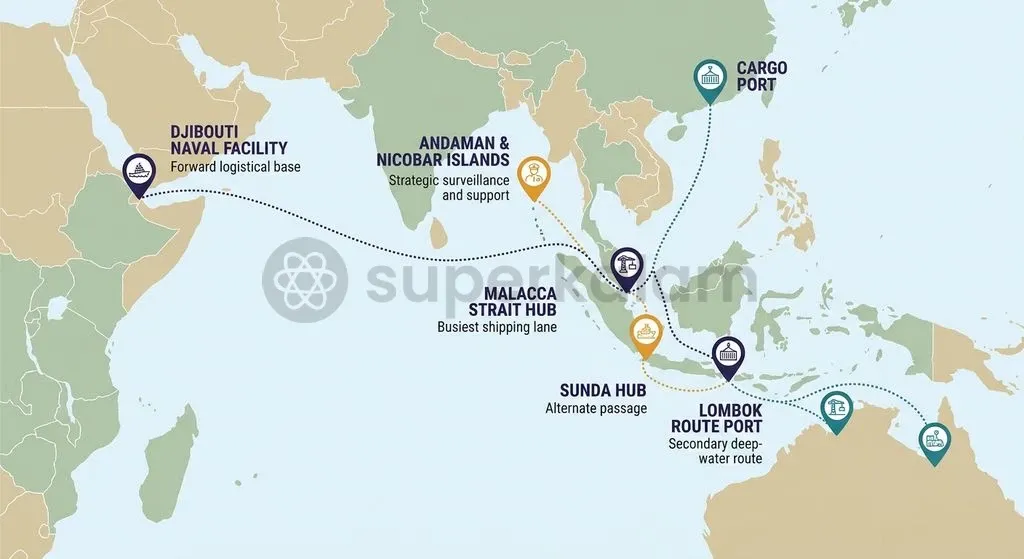
Operational Hurdles: Datalinks, Hydroacoustic Data, and Interoperability
Technological and bureaucratic friction points continue to challenge the rapid operational integration of Indian and Japanese naval platforms. Three distinct structural hurdles define this friction:
- Datalink Incompatibility: The Japan Maritime Self-Defense Force operates standard Link 16 and Link 22 datalinks integrated across Western allied networks. The Indian Navy relies on sovereign networks like Link II, creating real-time transmission bottlenecks per.
- Hydroacoustic Secrecy: Both navies keep sovereign classification boundaries over raw bathymetric contours and sound-velocity profiles, which limits automatic data sharing per. Without shared oceanographic baselines, targeting systems cannot rapidly correlate subsurface contacts.
- Hardware Divergence: Reconciling disparate radio frequencies and antenna architectures on surface combatants has traditionally slowed joint sensor integration.
Progress came during the 2024 India-Japan 2+2 Ministerial Dialogue. Both governments finalised cooperation to transfer the UNICORN stealth antenna system (Unified Complex Radio Antenna / NORA-50) mast system to the Indian Navy. The UNICORN dome consolidates multiple communication and tactical antennas within a single housing, lowering radar cross-sections while streamlining radio frequency compatibility.
Discuss with Superkalam
Evaluate whether the geographic placement of the Andaman and Nicobar Islands offsets the operational limitations imposed by Japan's Article 9 in securing the Malacca Strait corridor.
Ask NowWay Forward: Building Coordinated Undersea Domain Awareness
Developing a coordinated Undersea Domain Awareness architecture requires institutionalising acoustic intelligence exchange and joint acoustic surveillance patrols across choke points. While surface ships and aircraft demonstrate routine operational interoperability, subsurface monitoring requires structured institutional mechanisms that endure beyond annual calendar exercises.
- Acoustic Signature Exchange: Both navies should transition from general operational contacts to exchanging declassified acoustic libraries of non-allied submarines, using existing bilateral security arrangements to bypass data classification barriers.
- Chokepoint Surveillance Coordination: New Delhi and Tokyo should establish coordinated maritime patrol corridors across the Sunda and Lombok exit corridors, synchronising P-8I and Kawasaki P-1 flights to sustain unbroken acoustic tripwires.
- Sensor Mast Integration: Accelerate the industrial rollout of the UNICORN stealth antenna system across Indian Navy shipyards to establish common hardware baselines for tactical communications.
- Operationalising Fusion Centres: Leverage Japan's resident International Liaison Officer at the Information Fusion Centre - Indian Ocean Region (IFC-IOR) in Gurugram to move beyond surface merchant shipping tracking toward fused subsurface contact indications.
Establishing an integrated underwater sensor posture ensures that the Indian Navy and the Japan Maritime Self-Defense Force can maintain transparent operational visibility over Indo-Pacific maritime chokepoints. By resolving tactical datalink differences and pooling hydroacoustic resources, both democracies convert bilateral training into durable maritime stability across the Indo-Pacific.
Key Takeaways
- Operational Reorientation: The bilateral maritime exercise (historically designated JIMEX and indexed in recent releases as JAIMEX) has shifted focus from basic seamanship toward high-end Anti-Submarine Warfare.
- Geographic Catalyst: Expanded People's Liberation Army Navy patrols by Type 093 nuclear attack submarines and Type 039A/B Yuan-class conventional boats via the Malacca, Sunda, and Lombok straits drive bilateral deterrence.
- Aviation Synergy: Coordinated operations combine India's Boeing P-8I Neptune with Japan's Kawasaki P-1 patrol aircraft and shipborne Mitsubishi SH-60K helicopters for sonobuoy tracking and dipping sonar prosecution.
- Logistics Framework: The September 2020 Acquisition and Cross-Servicing Agreement enables mutual port replenishment, linking Japan's Djibouti base with India's facilities in the Andaman and Nicobar Islands.
- Technological Bottlenecks: Real-time data integration faces hurdles due to datalink differences between NATO Link 16/22 networks and Indian sovereign systems, alongside strict sovereign classification of raw hydroacoustic sound speed data.
Mains Question
"Japan's constitutional adherence to senshu boei and India's posture as a regional net security provider represent distinct legal-strategic traditions that converge on maritime deterrence." Examine how both navies reconcile their doctrinal mandates to enhance anti-submarine cooperation in the Indo-Pacific. (10 Marks)
Evaluate NowMains Question
"The 2020 Acquisition and Cross-Servicing Agreement (ACSA) acts as an operational multiplier for India-Japan maritime security cooperation across vital Indo-Pacific chokepoints." Evaluate the strategic and logistical utility of this pact in sustaining undersea deterrence. (15 Marks)
Evaluate NowPractice MCQs
QUESTION 1
Consider the following statements regarding Indo-Pacific maritime chokepoints and undersea transit corridors:
- The Malacca Strait features deep bathymetric trenches that enable submerged and silent submarine transit into the eastern Indian Ocean.
- The Sunda and Lombok Straits provide deep-water channels that allow submarines to enter the Indian Ocean while running submerged.
- The Type 039A/B Yuan-class conventional submarines operated by China are equipped with air-independent propulsion systems. Which of the statements given above are correct?
QUESTION 2
With reference to the Acquisition and Cross-Servicing Agreement (ACSA) signed between India and Japan in September 2020, consider the following statements:
- It formalises procedures for the reciprocal provision of supplies, port services, and engineering support.
- It permits the Japan Maritime Self-Defense Force operational access to Indian naval facilities in the Andaman and Nicobar Islands.
- It facilitates logistics replenishment and operational turnaround for Indian Navy warships in Djibouti. Which of the statements given above are correct?
QUESTION 3
Consider the following statements regarding the doctrinal frameworks of India and Japan:
- Japan's policy of 'senshu boei' under Article 9 restricts the JMSDF to homeland defence and protecting sea lines of communication out to 1,000 nautical miles.
- India's maritime posture under the SAGAR framework designates the Indian Navy as a primary net security provider across the Indian Ocean.
- Both India and Japan deploy the Kawasaki P-1 as their primary long-range maritime patrol aircraft. Which of the statements given above is/are correct?
QUESTION 4
In the context of bilateral anti-submarine warfare coordination between India and Japan, what is the primary operational role assigned to shipborne rotary platforms such as the Mitsubishi SH-60K?
QUESTION 5
With reference to oceanographic and hydrographic survey activities conducted in the Indian Ocean, consider the following statements:
- Thermocline profiling identifies acoustic shadow zones where sonar performance degrades.
- Bathymetric mapping plots undersea trenches and ridges to ensure safe submerged navigation.
- Acoustic propagation analysis collects sound-speed data to calibrate onboard sonar algorithms. Which of the statements given above are correct?