Indian Seafarers: Can Mission 20% Deliver 20% Global Share by 2030?
While India commands 13.41% of global merchant officers, resolving onboard sea-time training deficits is vital to reaching a 20% workforce share by 2030.
Nov, 2026
•10 min read
Overview
The Directorate General of Maritime Administration is spearheading 'Mission 20%' under Maritime India Vision 2030 to expand India's share of the global seafaring workforce from 12.16% to 20%. This push requires scaling the national maritime pool from 311,936 maritime professionals to approximately 5.44 lakh by 2030.
Achieving this target requires resolving an acute shortage of mandatory onboard sea-time training. That deficit stems directly from India's limited merchant fleet capacity. While India commands a 13.41% share in global merchant officers, sustaining this expansion hinges on regulatory overhauls under the Merchant Shipping Act, 2025. It also requires rigorous quality control across academies and dependable welfare protections under international conventions.
Why in the News?
India has emerged as the world's second-largest supplier of seafarers as of 2026, according to data released by the Ministry of Ports, Shipping and Waterways. The achievement marks a major milestone under the government's long-term maritime development agenda, reflecting rapid workforce formalisation and international credential acceptance.
The central government accelerated policy implementation following the announcement of the 'Seafarers' Safety Initiative' at the 21st East Asia Summit in Manila on 17 November 2026. This initiative advocates coordinated maritime disaster responses, joint naval safety drills, and enhanced crew protection protocols across strategic shipping corridors.
India's maritime expansion addresses a fundamental imbalance in global commerce, where commercial shipping carries over 80% of global merchandise trade. India's drive to supply one-fifth of the world's seafarers by 2030 represents a viable economic transition into high-value global services. However, its durability depends on solving the domestic onboard training deficit rather than merely expanding classroom admissions.
Discuss with Superkalam
Can you recall the minimum onboard sea-time training required by the STCW Convention before a cadet can take Certificate of Competency examinations?
Ask NowWhere India Stands: Current Numbers in the Global Maritime Workforce
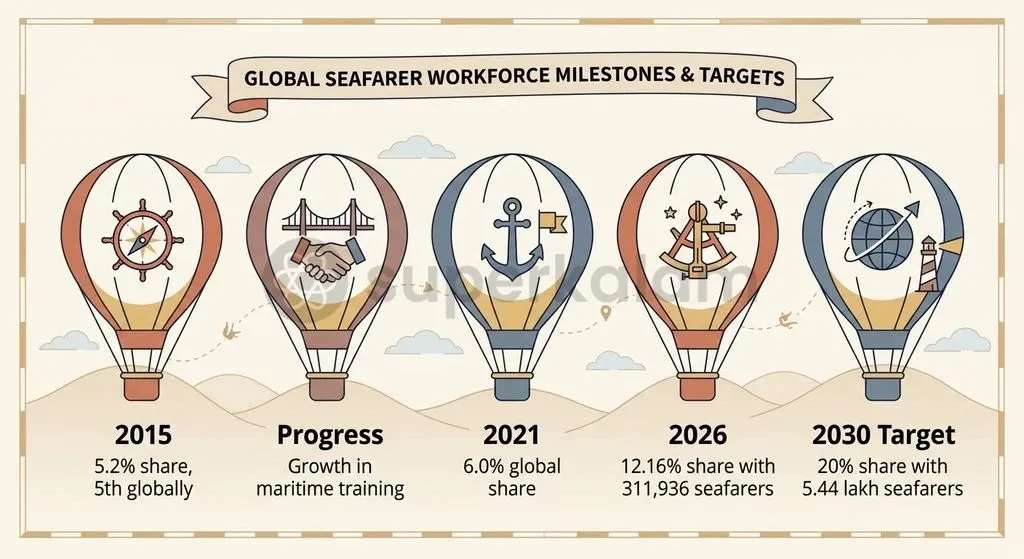
The Directorate General of Maritime Administration records that India contributes 311,936 maritime professionals to the global maritime fleet as of 2026. This deployment represents 12.16% of the global seafaring human resource pool, positioning the nation firmly as the second-largest crewing supplier worldwide.
India's trajectory demonstrates a sustained upward trend over the past decade:
- 2015 baseline: India held fifth position globally, providing 5.2% of the international seafaring workforce.
- 2021 intermediate phase: The national share expanded incrementally to 6.0% amid disruptions across global logistics chains.
- 2026 milestone: The domestic maritime workforce doubled its relative presence to reach 12.16% of global crewing personnel.
The composition of India's seafaring talent reflects a pronounced advantage in technical leadership. According to the Ministry of Ports, Shipping and Waterways, Indian seafarers include 140,718 certified officers, accounting for 13.41% of the global merchant fleet officer corps. In parallel, the country supplies 171,218 ratings, which constitute 11.29% of international deck and engine-room operational ratings.
Female participation has simultaneously registered rapid structural progress. Data published by the Directorate General of Maritime Administration shows an increase of 340% in female seafarers between 2021 and 2025, rising from 1,600 personnel (0.78% of the workforce) to 7,000 active female seafarers representing 2.17% of the national pool.
What Is Maritime India Vision 2030?
Maritime India Vision 2030 is the Ministry of Ports, Shipping and Waterways' ten-year operational blueprint to modernise coastal logistics, port throughput, and maritime human capital. The strategy operates alongside Maritime Amrit Kaal Vision 2047, mandating long-term targets to position India among the top five global shipbuilding nations and expand national-flagged merchant fleet capacity.
Under this framework, the Directorate General of Maritime Administration formulated 'Mission 20%', an operational roadmap targeting a 20% global market share by 2030. Reaching this goal requires expanding India's active seafarer cadre to approximately 5.44 lakh skilled personnel.
The global maritime market presents an urgent recruitment window that justifies these targets:
- Current officer deficit: A joint assessment by BIMCO and the International Chamber of Shipping projects a worldwide shortfall of 39,100 certified merchant officers in 2026.
- Projected demand by 2030: This shortfall expands to a cumulative global requirement of 113,735 additional officers by 2030.
- Cadet training ramp-up: Domestic training academies must expand annual throughput from approximately 18,800 cadets to 70,400 cadets per year by 2030, representing a 3.7-fold increase over 2025 output levels.
Discuss with Superkalam
Explain how the limited deadweight tonnage of India's merchant fleet directly impedes the career progression of domestic maritime graduates.
Ask NowKey Bottlenecks: Why Indian Seafarers Face Training and Job Barriers
Mandatory onboard training berths constitute the single most severe bottleneck hindering qualified Indian maritime graduates from completing their professional certifications. Regulation I/11 and Chapter II of the International Convention on Standards of Training, Certification and Watchkeeping for Seafarers (STCW 1978, as amended) require pre-sea cadets to complete 12 to 18 months of sea-time on commercial vessels before appearing for their Certificate of Competency examinations.
The structural roots of this training deficit stem from the modest scale of the domestic merchant fleet:
- Tonnage deficit: India's national-flagged merchant fleet accounts for only around 1.2% of global deadweight tonnage, according to an assessment by the Observer Research Foundation (as reported in February 2026).
- Cadet wait-times: Because domestic vessels cannot absorb the institutional throughput, thousands of certified candidates wait months or years to secure cadet berths on foreign-flagged ships.
- Placement vulnerability: The shortage of training slots forces cadets to negotiate precarious terms with overseas crewing managers, limiting career mobility.
A second critical vulnerability lies in the commercialisation of domestic maritime education. The rapid expansion of more than 160 private Maritime Training Institutes has created acute regulatory oversight friction, resulting in uneven simulator facilities, outmoded workshop technologies, and wide disparities in campus placement rates.
Unscrupulous recruitment entities compound these vulnerabilities. Unregulated intermediaries lacking a valid Recruitment and Placement Services License (RPSL) frequently solicit illicit capitation fees from young cadets, funneling inexperienced mariners onto non-compliant 'flag of convenience' ships that evade international safety inspections.
Discuss with Superkalam
If you were advising the Directorate General of Maritime Administration, how would you design regulatory safeguards to eliminate unlicensed recruitment intermediaries charging illicit capitation fees?
Ask NowHow India Compares with the Philippines and China in Maritime Crewing
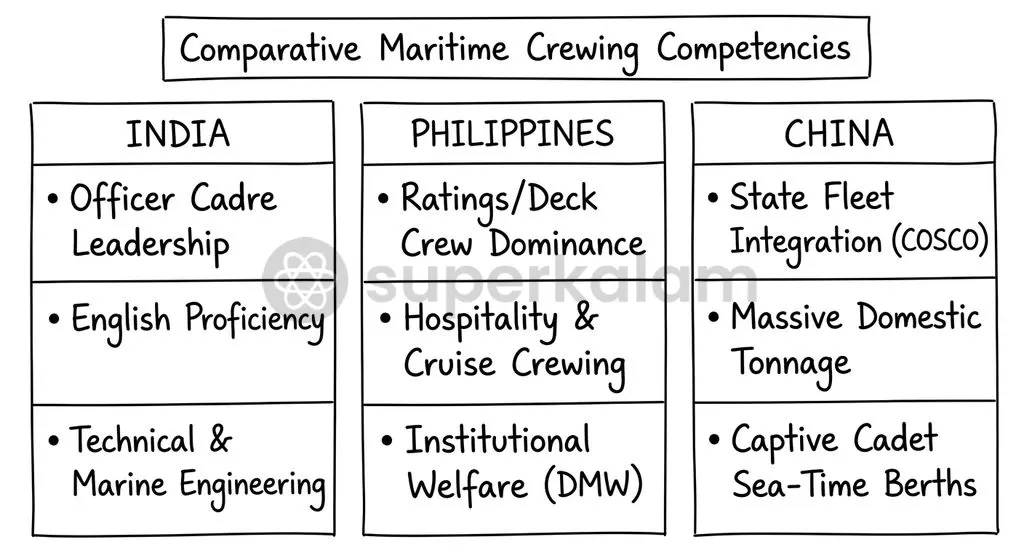
Global maritime crewing displays distinct regional specialisations, with the Philippines, India, and China commanding the primary shares of international shipboard employment. The following comparison illustrates how these three crewing nations balance cadre composition, state support, and global competitiveness:
| Analytical Parameter | India | The Philippines | China |
|---|---|---|---|
| Global Workforce Share | 12.16% (311,936 seafarers) | Roughly 25% of global crewing | Roughly 11% of global crewing |
| Cadre Specialisation | Heavy concentration in certified officer ranks (140,718 officers) | Dominance in operational ratings and cruise hospitality | Balanced deck ratings and engineering officers |
| Fleet Support Mechanism | Small national flag; reliant on foreign vessels for berths | Pure labour exporter; relies on foreign vessel contracts | Massive state-owned merchant fleets (e.g., COSCO) guarantee cadet berths |
| Institutional Governance | Directorate General of Maritime Administration under Merchant Shipping Act, 2025 | Dedicated government deployment via Department of Migrant Workers | State-managed maritime universities and domestic cabotage quotas |
| Language & Global Fit | Strong English-language technical proficiency across engineering branches | High English fluency and customer service adaptation | Language barriers restrict broader placement on foreign-flag vessels |
India maintains a strong competitive advantage in nautical engineering and navigation officer roles, where command of technical English and analytical problem-solving are essential. However, the Philippines retains market supremacy in high-volume deck ratings and hospitality crews, backed by an integrated institutional apparatus under its Department of Migrant Workers.
China benefits from a different structural model. Massive state-owned conglomerates such as COSCO ensure guaranteed shipboard cadet berths for domestic trainees, shielding Chinese academies from sea-time shortages. Yet China's global commercial reach remains curtailed by language constraints and high domestic fleet retention, preserving an expanding window for Indian officers.
Government Interventions and the Cabinet Policy Response
The Parliament of India fundamentally overhauled domestic maritime governance by enacting the Merchant Shipping Act, 2025 (Act No. 24 of 2025). This legislation replaced the outdated Merchant Shipping Act, 1958, consolidating vessel registration, modernising maritime safety norms, and formally codifying international convention obligations.
Under this statutory mandate, administrative authorities executed critical restructuring:
- Establishment of the DGMA: The former Directorate General of Shipping was reconstituted and empowered as the Directorate General of Maritime Administration (DGMA), expanding its regulatory authority over maritime education, safety compliance, and crewing operations.
- Coastal Shipping Act, 2025: Parliament enacted the Coastal Shipping Act, 2025 (Act No. 20 of 2025), removing burdensome licensing requirements for Indian-flagged vessels in coastal trade to foster a citizen-owned domestic fleet capable of hosting cadet training berths.
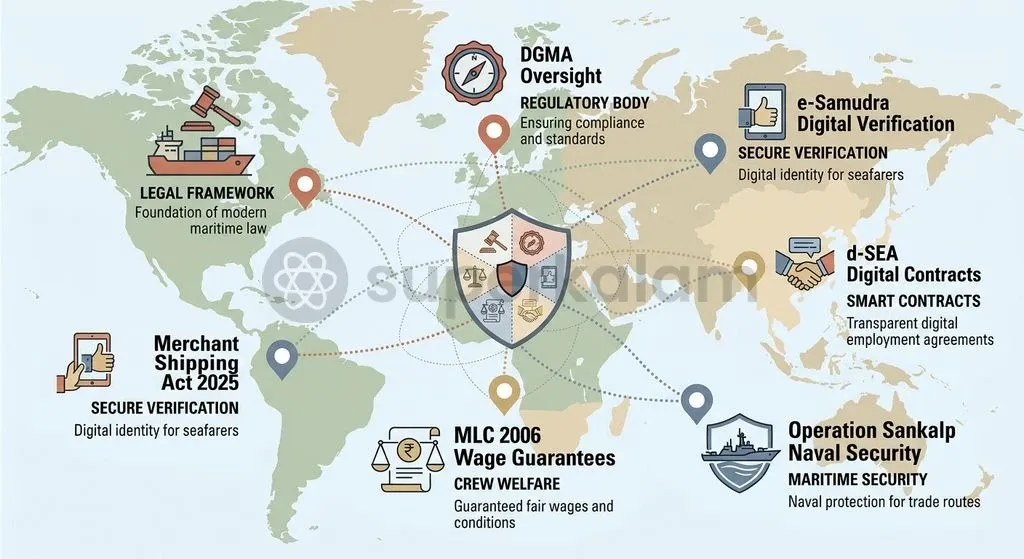
- Integrated digital governance: On 8 August 2026, the Ministry launched 'e-Samudra', a unified platform integrating over 15 maritime domains, including Continuous Discharge Certificate (CDC) verification, seafarer certification, and vessel registry.
Administrative authorities complemented these structural statutes with specialised supervisory technology. The DGMA established the 'e-NAVIK' 24x7 online grievance redressal portal and rolled out the Digital Seafarers Employment Agreement (d-SEA), preventing illicit contract substitution and tracking seafarer deployments in real time.
To eliminate fraudulent certifications, the DGMA integrated with the 'ISF Verify' digital certification network on 4 November 2026, joining the International Chamber of Shipping and Lloyd's Register OneOcean. This international partnership enables instantaneous cloud verification of STCW qualifications across 30% of global seafarers.
Industrial policy has also targeted complementary maritime infrastructure. On 28 October 2026, the Union Cabinet approved the Container Manufacturing Promotion Scheme with an allocation of ₹10,000 crore, designed to scale domestic container fabrication tenfold to 7.5 lakh Twenty-Foot Equivalent Units (TEUs) by FY 2039-40, reinforcing national merchant shipping ecosystems.
Discuss with Superkalam
Compare the state-supported fleet model of China with India's foreign-vessel dependent model in securing cadet sea-time training berths.
Ask NowWelfare at Sea: Abandonment, Mental Health, and Maritime Rights
Safeguarding seafarers spans statutory labour protections, high-seas security deployments, and tailored social security access:
- Compulsory financial protections: The Maritime Labour Convention, 2006 (MLC, 2006), adopted under the International Labour Organization, is the global bill of rights for commercial maritime workers. The convention mandates that registered vessel owners maintain compulsory financial security to cover repatriation expenses, medical care, and up to four months of accrued contractual wages in instances of crew abandonment.
- Naval escort operations: Commercial mariners face severe operational risks across volatile maritime routes. The Indian Navy maintains continuous protection through Operation Sankalp, deploying naval assets across the Gulf of Aden, Arabian Sea, and Western Indian Ocean to escort commercial vessels, deter pirate skiffs, and conduct humanitarian boardings on distressed vessels crewed by Indian and international sailors.
- Pension access reforms: Social security frameworks have adapted to migratory seafaring careers. On 17 November 2026, the Pension Fund Regulatory and Development Authority amended Know-Your-Customer rules, allowing Indian seafarers serving on foreign vessels to submit their Continuous Discharge Certificate and certified employment contracts as valid overseas residence proof to open National Pension System accounts.
Way Forward: Expanding Training Berths and Institutional Reforms
Expanding shipboard cadet berths requires targeted fiscal incentives that encourage domestic and foreign-flagged shipping companies to embark Indian trainees. The government could implement dedicated tonnage-tax offsets or port-tariff rebates for commercial operators that allocate a mandatory percentage of ship berths to Indian pre-sea cadets completing their STCW sea-time obligations.
Institutional governance across private training academies demands structured reforms:
- Auditing training quality: The DGMA should institute a transparent, data-driven grading framework for all 160 approved Maritime Training Institutes, linking annual admission intakes strictly to verified campus placement and sea-berth completion ratios.
- Enforcing RPSL compliance: Law enforcement authorities must coordinate with port state regulators to shut down unaccredited recruitment agencies, imposing severe criminal penalties on fraudulent operators charging capitation fees.
- Expanding rating programmes: India should leverage its demographic dividend to expand training infrastructure for operational ratings, closing the volume gap with the Philippines across hospitality and general deck operations.
- Expanding multilateral safety agreements: India can build upon the Seafarers' Safety Initiative announced in Manila to institutionalise multilateral crew protection protocols and shared search-and-rescue databases across Indo-Pacific maritime partners.
Discuss with Superkalam
To what extent can expanding classroom simulator training substitute for real merchant vessel berths without compromising maritime safety and international certification standards?
Ask NowKey Takeaways
- India ranks as the world's second-largest supplier of seafarers as of 2026, deploying 311,936 maritime professionals and capturing 12.16% of the global seafaring workforce.
- The Directorate General of Maritime Administration has launched 'Mission 20%' under Maritime India Vision 2030, targeting a 20% global market share (approximately 5.44 lakh seafarers) by 2030.
- India possesses a decisive qualitative advantage in certified merchant officers, commanding 13.41% of the world's officer corps, but lags behind the Philippines in deck and hospitality ratings.
- The acute scarcity of mandatory onboard training berths (12 to 18 months sea-time under STCW conventions) remains the core bottleneck, driven by India's modest national-flagged merchant fleet.
- Statutory consolidation under the Merchant Shipping Act, 2025 and Coastal Shipping Act, 2025, alongside digital platforms like e-Samudra and d-SEA, establishes an accountable framework for seafarer security and international regulatory compliance.
Mains Question
'While India has emerged as the world's second-largest supplier of seafarers, achieving the ambitious targets of Mission 20% under Maritime India Vision 2030 remains constrained by structural deficits in domestic merchant fleet capacity.' Critically analyse. (15 Marks)
Evaluate NowMains Question
Comparing the crewing models of India, the Philippines, and China, evaluate how differences in domestic fleet support mechanisms and cadre specialisations shape their respective global maritime competitiveness. (10 Marks)
Evaluate NowPractice MCQs
QUESTION 1
With reference to the global maritime workforce and India's position as of 2026, consider the following statements:
- India accounts for over 12% of the global seafaring workforce, making it the world's second-largest supplier of seafarers.
- In terms of cadre distribution, India has a higher absolute number of certified merchant officers than operational ratings.
- The national-flagged merchant fleet of India constitutes around 1.2% of global deadweight tonnage.
Which of the statements given above is/are correct?
QUESTION 2
Consider the following statements regarding the regulatory requirements under the STCW Convention (1978, as amended) and Indian maritime training:
- Pre-sea cadets are mandated to complete 12 to 18 months of onboard sea-time training prior to Certificate of Competency examinations.
- The requirement for sea-time training can be fully substituted by simulator training in private Maritime Training Institutes under the Merchant Shipping Act, 2025.
- 'Mission 20%' under Maritime India Vision 2030 targets a cadet throughput expansion to over 70,000 cadets per year by 2030.
Which of the statements given above is/are correct?
QUESTION 3
With reference to global maritime crewing models described in the context of India, the Philippines, and China, consider the following statements:
- Unlike India, China leverages state-owned merchant shipping lines to guarantee cadet onboard training berths.
- The Philippines commands approximately one-quarter of global crewing, with a dominant concentration in operational ratings and cruise hospitality.
- Indian seafarers command a larger global share of certified merchant officers than operational deck and engine ratings.
Which of the statements given above are correct?
QUESTION 4
Which of the following international forums served as the platform for announcing the 'Seafarers' Safety Initiative' involving coordinated disaster responses and crew protection protocols?
QUESTION 5
Consider the following statements regarding female participation in India's seafaring workforce:
- Between 2021 and 2025, the number of active Indian female seafarers grew by over 300%.
- By 2025, female seafarers constituted over 10% of India's total maritime workforce.
Which of the statements given above is/are correct?