Union Budget 2027-28: Corporate Tax vs Fiscal Consolidation
As India Inc petitions for corporate tax parity, the Centre must weigh supply-side relief against strict FRBM debt rules and persistent demand constraints.
Nov, 2026
•11 min read

Context
As pre-budget consultations gather momentum for Union Budget 2027-28, the Union Ministry of Finance faces an acute macroeconomic trade-off. It must weigh corporate demands for sweeping direct tax relief against preserving fiscal consolidation under the Fiscal Responsibility and Budget Management framework.
Industry bodies have petitioned for corporate tax parity, capital gains tax rationalisation, and duty structure revisions to revive sluggish private investment. Yet historical evidence from the 2019 corporate tax cuts suggests that supply-side tax concessions alone cannot unlock durable private capital formation without sustained consumption demand and structural customs reform.
Why Pre-Budget Demands Matter Ahead of Budget 2027-28
Pre-budget consultations between the Union Ministry of Finance and industry bodies establish the operational ground rules for domestic capital allocation. As of November 2026, these consultations for Union Budget 2027-28 are underway across New Delhi. This timing means final policy allocations, direct tax revisions, and tariff decisions for FY 2027-28 have not been legislated.
These annual discussions offer institutional platforms where apex chambers present formal representations. Both the Confederation of Indian Industry (CII) and the Federation of Indian Chambers of Commerce and Industry (FICCI) table detailed wishlists. The Ministry evaluates these demands against macroeconomic constraints, statutory fiscal targets, and public revenue requirements:
- Corporate expectations: Industry bodies view tax concessions as essential levers to revive domestic capital expenditure.
- Fiscal obligations: Public finance analysts stress the government's dual obligation of funding infrastructure while adhering to debt consolidation targets under the Fiscal Responsibility and Budget Management (FRBM) Act.
Discuss with Superkalam
What was the estimated annual revenue forgone by the public exchequer due to the 2019 corporate tax rate cuts?
Ask NowWhat Corporate India Is Asking For: From Tax Relief to Tariff Cuts
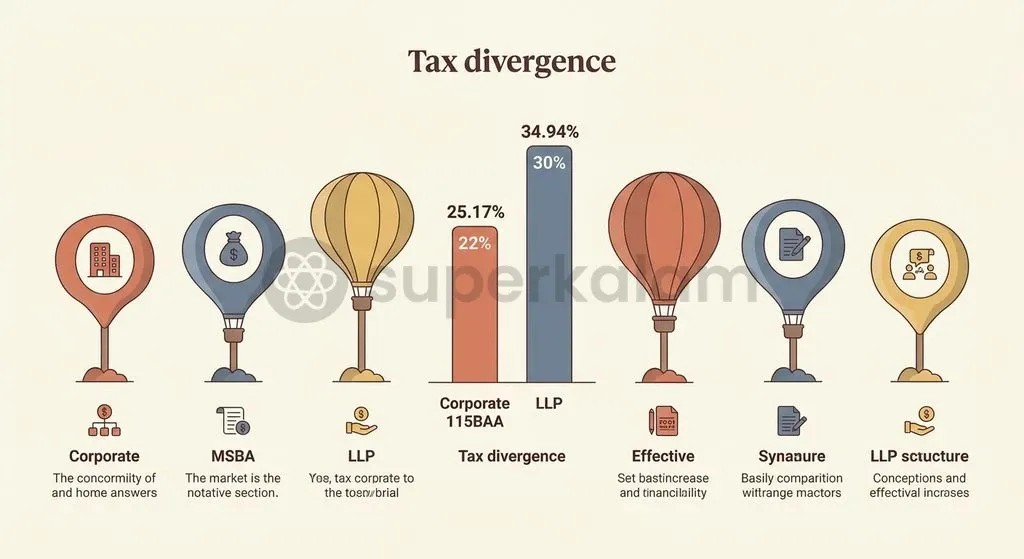
The Confederation of Indian Industry and allied industry chambers have submitted detailed memoranda demanding tax rate rationalisation across corporate forms. According to the Confederation of Indian Industry (CII) & Bombay Chamber Pre-Budget Memorandum, industry bodies have demanded tax rate parity for Limited Liability Partnerships (LLPs).
LLPs currently face a flat base corporate rate of 30% alongside a 12% surcharge and 4% cess. This structure creates an effective tax rate of 34.94% for partnerships, compared to 25.17% for corporate entities registered under Section 115BAA of the Income-tax Act, 1961.
Beyond non-corporate business entities, industry chambers have concentrated their lobbying on four primary fiscal interventions:
- Manufacturing Sunset Extension: India Inc has petitioned the Union Government for a revival and multi-year extension of the concessional 15% corporate tax rate under Section 115BAB, as reported by the CII Pre-Budget Recommendations on Industrial Manufacturing in November 2026. This proposal aims to prevent the diversion of greenfield manufacturing capital to regional competitors in Southeast Asia.
- Scientific Research Incentives: Industry bodies led by CII and ASSOCHAM have requested the reinstatement of weighted tax deductions for scientific research under Section 35(2AB) of the Income-tax Act, 1961. According to the Department of Scientific and Industrial Research (DSIR) Office Memorandum No. IRDPP/FI/Misc./2025, these deductions were progressively scaled back from 200% to 100% and barred under the simplified corporate tax regime.
- Capital Gains Rationalisation: In pre-budget submissions reported in November 2026, FICCI urged the Ministry of Finance to reconsider the capital gains tax hikes enacted under the Finance (No. 2) Act, 2024. That legislation raised the Long-Term Capital Gains (LTCG) tax rate on listed financial assets from 10% to 12.5% and Short-Term Capital Gains (STCG) on specified equity assets to 20%. Industry proposals suggest restoring a full LTCG exemption on listed equities. Alternatively, they propose a tiered holding-period structure of 10% for 1–2 years, 5% for 2–3 years, and nil beyond three years, offset by calibrated adjustments to the Securities Transaction Tax.
- MSME Tax Rationalisation: Engineering export associations have advocated for non-corporate manufacturing enterprises to be taxed at a uniform rate of 25%, as reported in representations to the Ministry of Finance in January 2026. This adjustment seeks to remove the 8 to 9 percentage point tax disadvantage non-corporate firms face against large corporations.
The 2019 Corporate Tax Cut Test: Did Lower Rates Spur Private Capex?
The Taxation Laws (Amendment) Act, 2019 delivered the sharpest reduction in corporate tax rates in independent India's history to ignite private capital formation. According to the Ministry of Finance, this reform slashed the base corporate income tax rate for existing domestic companies to 22% under Section 115BAA. That resulted in an effective tax rate of 25.17% inclusive of applicable surcharge and cess.
Section 115BAB simultaneously introduced a base rate of 15% (effective 17.16%) for newly incorporated domestic manufacturing companies, provided they commenced production by March 31, 2024.
This supply-side fiscal stimulus came at an immense cost to the public exchequer. Press Information Bureau releases from the Ministry of Finance estimated the annual revenue forgone from these corporate rate reductions at approximately ₹1.45 lakh crore. Economic policymakers justified the revenue sacrifice on the theoretical premise that retained corporate earnings would translate into expanded Gross Fixed Capital Formation (GFCF).
| Policy Dimension | Baseline Regime (Pre-September 2019) | Section 115BAA (Existing Companies) | Section 115BAB (New Manufacturing) |
|---|---|---|---|
| Base Corporate Tax Rate | 30% (standard domestic corporate rate) | 22% | 15% |
| Effective Rate (Cess & Surcharge) | ~34.94% (for top surcharge bracket) | 25.17% | 17.16% |
| Minimum Alternate Tax (MAT) | Applicable at 18.5% base rate | Exempt from MAT provisions | Exempt from MAT provisions |
| Sunset Clause on Operations | No production commencement cut-off | Ongoing operational applicability | Commercial output by March 31, 2024 |
| Deduction Eligibility | Eligible for weighted deductions (e.g. Sec 35) | Forfeits profit-linked deductions | Forfeits special investment allowances |
Empirical findings from the Reserve Bank of India indicate that corporate windfalls did not produce the intended investment boom. According to the Reserve Bank of India Bulletin, private non-government non-financial companies utilised the tax savings primarily to deleverage balance sheets. This drove down median debt-to-equity ratios below 0.50 rather than committing to immediate greenfield capital outlays.
RBI working papers further demonstrate that corporate tax reductions generate an output multiplier of approximately -1.0 or lower during demand-constrained phases, as retained earnings are hoarded as liquid reserves.
Discuss with Superkalam
Explain why corporate tax cuts might yield a negative output multiplier during phases of sluggish aggregate demand.
Ask NowThe Tariff Dilemma: Fixing Inverted Duty Structures in Manufacturing
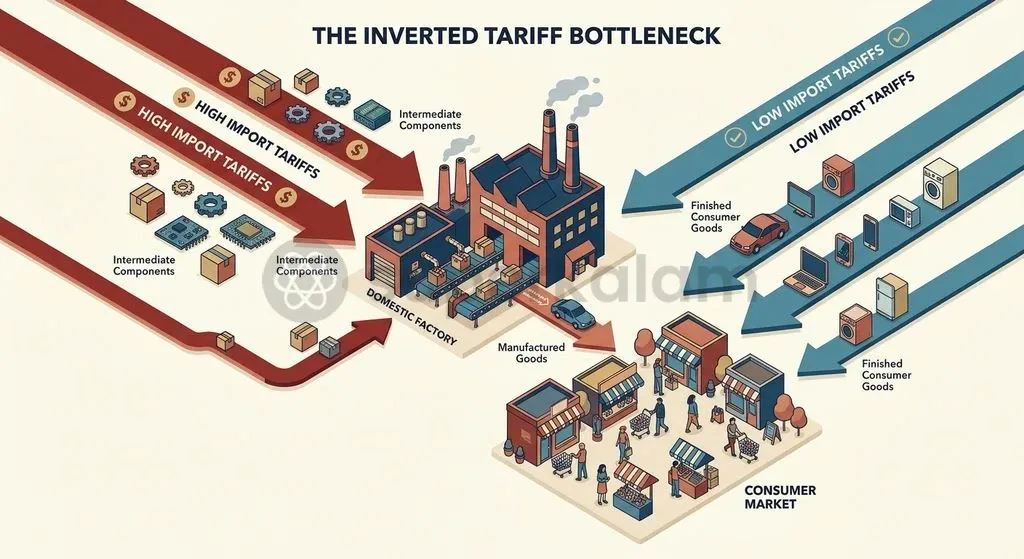
The Indian manufacturing sector confronts structural friction stemming from an inverted duty structure across vital value chains. An inverted duty structure emerges when import tariffs or Goods and Services Tax rates on intermediate inputs and raw materials exceed the customs duties levied on finished imported goods.
This inversion penalises domestic value addition. Consequently, it makes local manufacturing less competitive against finished foreign goods across electronics, synthetic textiles, and specialty chemicals.
| Value Chain Stage | Tariff Treatment | Operational Impact |
|---|---|---|
| Intermediate Inputs & Raw Materials | Subject to higher import tariffs | Inflates baseline production costs |
| Domestic Assembly & Processing | Input taxes exceed output taxes | Accumulates unrefunded input tax credits |
| Finished Imported Goods | Enjoys lower customs duties | Underprices locally produced goods |
To counter this disincentive, the Department of Revenue launched a systematic review of basic customs duty exemptions covering 118 tariff lines expiring in 2027, as reported in administrative reviews in late 2026. The exercise aims to correct tariff anomalies that discourage domestic component fabrication.
Legislative reforms have also sought to alleviate working capital blockages caused by inverted duties under indirect taxation. The Finance Act, 2026 amended Section 54(6) of the Central Goods and Services Tax (CGST) Act to extend a 90% provisional refund within seven days to manufacturers operating under inverted duty conditions.
Corporate Wishlist vs Macro Reality: Balancing Growth and the Fiscal Glide Path
The Central Government faces narrow fiscal headroom that limits its capacity to grant uncompensated direct tax cuts. Union Minister of Finance Nirmala Sitharaman highlighted in the Budget 2026-27 presentation that the Centre fulfilled its post-pandemic fiscal commitments. It reduced the fiscal deficit to 4.4% of GDP in RE 2025-26 and budgeted 4.3% of GDP for BE 2026-27.
Rather than focusing exclusively on headline deficit numbers, the government has transitioned its medium-term consolidation target under the FRBM framework to debt metrics:
- Debt-to-GDP glide path: The Centre aims to reduce the central debt-to-GDP ratio to 50±1% by 2030-31, projecting central debt at 55.6% of GDP in BE 2026-27 compared to 56.1% in RE 2025-26.
- Sanctioned capex distribution: Reserve Bank of India project finance data shows total capital investment sanctioned for private corporate projects reached ₹4.4 lakh crore in 2025-26, up from ₹3.7 lakh crore in 2024-25. However, this growth was led predominantly by infrastructure investments rather than broad-based industrial manufacturing.
Accommodating fresh corporate tax relief would compromise this debt trajectory. Because corporate leverage has already fallen without sparking an industrial capex wave, additional corporate tax sops risk eroding public receipts without guaranteeing private asset creation.
Discuss with Superkalam
How can the amendment granting a 90% provisional GST refund within seven days under Section 54(6) resolve working capital stress for an electronics component manufacturer?
Ask NowHow the 16th Finance Commission Constraints Shape the Budget Math
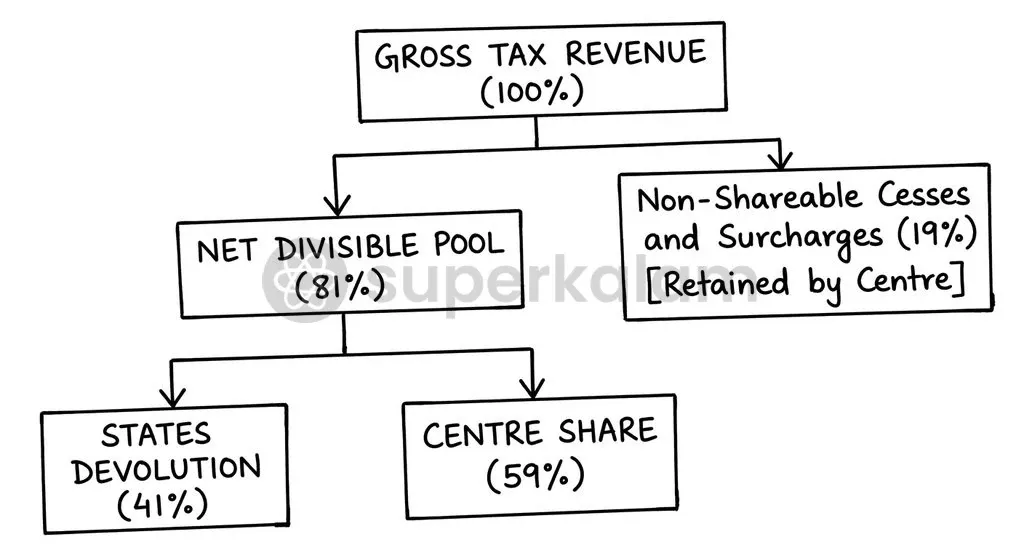
The 16th Finance Commission recommendations establish fixed statutory boundaries for the Union Government's net tax receipts over the award period 2026-31. The Commission, chaired by Dr. Arvind Panagariya, recommended that the vertical devolution share of States in the divisible pool of central taxes remain unchanged at 41%.
Three structural formula revisions directly shape the Centre's available fiscal space:
- Horizontal devolution overhaul: The Commission allocated a 10% weight to 'Contribution to GDP' while eliminating the earlier 'Tax and Fiscal Efforts' criterion.
- General government debt target: The Commission's fiscal roadmap projected the combined General Government (Centre plus States) debt-to-GDP ratio to decline from 77.3% in 2026-27 to 73.1% by 2030-31.
- Divisible pool contraction: Non-shareable cesses and surcharges levied by the Central Government constitute approximately 19% of Gross Tax Revenue. This restricts the net divisible tax pool shared with States to roughly 81% of total tax collections.
This structural reliance on cesses restricts the Centre's ability to absorb general corporate rate cuts. Granting broad relief would force a sharp contraction in developmental expenditure.
Way Forward: Shifting from Corporate Concessions to Demand Revival
The structural constraint stalling India's private investment cycle is deficient aggregate demand rather than high corporate taxation. Reserve Bank of India Order Books, Inventories and Capacity Utilisation Surveys (OBICUS) indicate that average manufacturing capacity utilisation has fluctuated around the 74-75% threshold, remaining below the sustained level required to trigger broad-based, debt-financed private capital expenditures.
Policymakers should recalibrate fiscal allocations away from untargeted supply-side tax concessions toward public capital formation and strategic support. Econometric estimates by the National Institute of Public Finance and Policy (NIPFP) demonstrate that public capital expenditure delivers an economic multiplier of 2.45 to 3.25, compared to revenue transfers which generate multipliers of approximately 0.98 to 1.0. Sustaining public capital outlays crowds in private investment more effectively than corporate tax cuts.
To support manufacturing competitiveness, the Union Budget 2027-28 can rely on targeted mechanisms:
- Rectifying Customs Tariffs: Accelerate the review of the 118 tariff lines to systematically eliminate inverted duties, ensuring domestic processors do not pay higher import levies on components than foreign exporters pay on finished products.
- Expanding Strategic Sectoral Schemes: Direct resources toward targeted manufacturing frameworks rather than across-the-board corporate tax reductions. For instance, Union Budget 2026-27 demonstrated this discipline by allocating ₹10,000 crore over five years for the Bio Pharma Shakti programme and launching India Semiconductor Mission 2.0 to support strategic value chains.
- Supporting Consumption at the Base: Address urban and rural consumption stagnation through targeted programmatic outlays. Boosting bottom-of-the-pyramid disposable incomes stimulates consumer demand, raising factory capacity utilisation above the 75% threshold and organically driving private corporate capex.
Discuss with Superkalam
Compare the economic outcomes of supply-side corporate tax deductions against direct public capital expenditure in driving sustained economic growth.
Ask NowKey Takeaways
- Corporate Demands: Apex chambers CII and FICCI seek corporate tax parity for LLPs (currently facing an effective tax rate of 34.94% versus 25.17% for Section 115BAA companies), extension of Section 115BAB concessional manufacturing tax rates, and rationalisation of capital gains tax regimes.
- The 2019 Tax Cut Lesson: The Taxation Laws (Amendment) Act, 2019 cost roughly ₹1.45 lakh crore annually in forgone revenue, yet private firms primarily channeled these tax windfalls into balance sheet deleveraging (pushing median debt-to-equity below 0.50) rather than fresh Gross Fixed Capital Formation.
- Inverted Duty Structure: Manufacturing competitiveness in synthetic textiles, electronics, and chemicals remains impaired by higher duties on inputs than finished imports; administrative reviews of 118 tariff lines and Section 54(6) CGST amendments aim to rectify this imbalance.
- Fiscal Consolidation Constraints: The Union Government achieved a fiscal deficit of 4.4% of GDP in RE 2025-26 and budgeted 4.3% in BE 2026-27, anchoring its medium-term target to reducing central debt to 50±1% of GDP by 2030-31 under FRBM directives.
- 16th Finance Commission Framework: With vertical devolution held at 41% and cesses accounting for 19% of Gross Tax Revenue, the Union Government has limited revenue space to accommodate broad corporate tax reductions.
- Demand-Led Capex Revival: Sustained private investment depends on boosting capacity utilisation past the current 74-75% stagnation point, which is achieved through high-multiplier public capex (2.45 to 3.25) rather than supply-side corporate tax cuts.
Mains Question
"Supply-side tax concessions alone cannot unlock durable private capital formation without sustained consumption demand." In the light of the 2019 corporate tax reductions and current pre-budget demands, critically examine this statement. (15 Marks)
Evaluate NowMains Question
Examine how inverted duty structures impair domestic manufacturing competitiveness and evaluate the statutory and administrative measures taken to address them. (10 Marks)
Evaluate NowPractice MCQs
QUESTION 1
With reference to the corporate tax reforms under the Taxation Laws (Amendment) Act, 2019, consider the following statements:
- Section 115BAA introduced a base tax rate of 22% for existing domestic companies, exempting them from Minimum Alternate Tax (MAT) provisions.
- Newly incorporated domestic manufacturing companies opting for the concessional rate under Section 115BAB were required to commence commercial production by March 31, 2024.
- Companies electing to be taxed under Section 115BAA retain their eligibility to claim weighted tax deductions for scientific research under Section 35(2AB). Which of the statements given above is/are correct?
QUESTION 2
Regarding fiscal consolidation and budget parameters cited under recent Union Budgets, consider the following statements:
- The revised fiscal deficit estimate (RE) for 2025-26 was reduced to 4.4% of GDP.
- Under the Fiscal Responsibility and Budget Management framework, the Centre aims to bring the central debt-to-GDP ratio to 50±1% by 2030-31.
- The central debt-to-GDP ratio was projected at 55.6% in Budget Estimates (BE) 2026-27. Which of the statements given above are correct?
QUESTION 3
Consider the following statements regarding inverted duty structures and customs rationalisation:
- An inverted duty structure arises when import tariffs on intermediate raw materials are lower than the duties levied on finished imported goods.
- An inverted duty structure leads to the accumulation of unrefunded input tax credits for domestic manufacturers.
- The Finance Act, 2026 amended Section 54(6) of the Central Goods and Services Tax (CGST) Act to extend a 90% provisional refund within seven days to affected manufacturers. Which of the statements given above is/are correct?
QUESTION 4
According to empirical findings by the Reserve Bank of India cited in the context of the 2019 corporate tax cuts, how did non-government non-financial private companies primarily utilize their tax savings?
QUESTION 5
With reference to the tax treatment of business entities as highlighted in pre-budget representations, consider the following statements:
- Limited Liability Partnerships (LLPs) face an effective tax rate of 34.94% inclusive of base corporate rate, surcharge, and cess.
- Under the Finance (No. 2) Act, 2024, the Long-Term Capital Gains (LTCG) tax rate on listed financial assets was raised from 10% to 12.5%. Which of the statements given above is/are correct?
Discuss with Superkalam
Should the Union Government extend the concessional 15% Section 115BAB tax rate for new manufacturing at the expense of its 50±1% debt-to-GDP fiscal target?
Ask Now