Quad Manila Summit 2026: Pivoting to the First Island Chain
By shifting its summit directly to the First Island Chain, the Quad balances deterrence against grey-zone tactics while testing India's strategic autonomy.
Nov, 2026
•9 min read
Overview
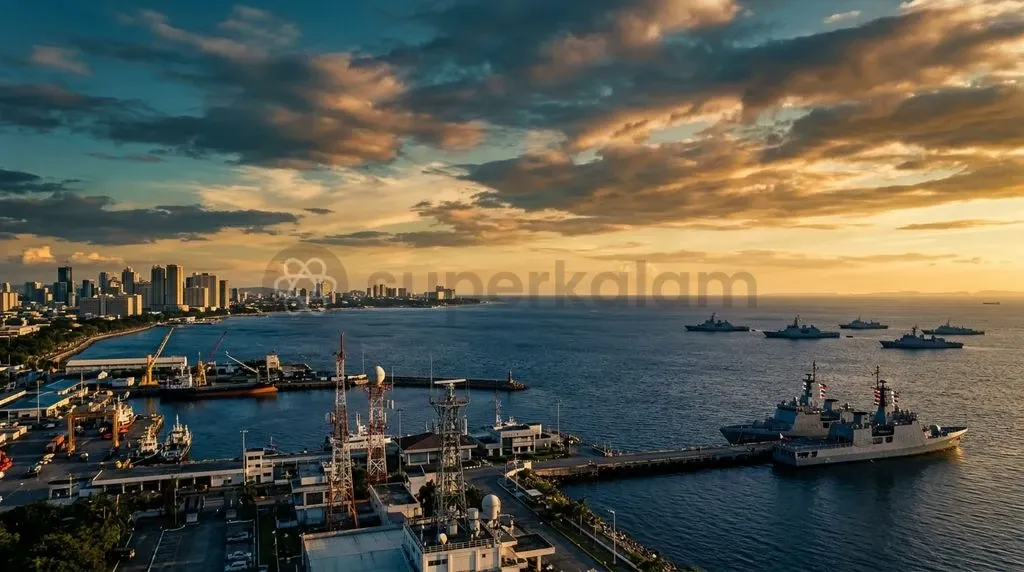
The Quadrilateral Security Dialogue convened its seventh leaders' summit in Manila, Philippines. The move shifts the grouping's diplomatic footprint directly onto the First Island Chain, bolstering maritime domain awareness against coercive grey-zone activities in the South China Sea. According to the Ministry of External Affairs, this gathering marks the first time the four-nation partnership has held its top-level summit in a non-member littoral state.
This transition signals a pivot from open-ocean diplomacy toward targeted coastal surveillance, supply-chain mapping, and dual-use technological deterrence. By combining satellite radio-frequency tracking with regional capacity building, the partnership seeks to supply public goods while actively maintaining regional stability.
For India, the Manila summit reinforces the Act East policy and the MAHASAGAR doctrine. It anchors regional maritime order without committing New Delhi to an external collective defence pact.
Why in the News?
The 7th Quad Leaders' Summit convened in Manila on November 17, 2026. This date marks the first time the four-nation grouping gathered in a non-member Southeast Asian capital. According to The White House, the summit coincided with the tenth anniversary of the Free and Open Indo-Pacific vision introduced in 2016 and occurred nearly a decade after the group's official revival in Manila in November 2017.
As of November 2026, the four partner states have focused collective diplomacy on countering unilateral attempts to alter the regional status quo through economic coercion and maritime grey-zone operations. Although India was originally scheduled to host the gathering in 2025, scheduling constraints and bilateral trade frictions deferred the summit to the late 2026 ASEAN sidelines, as reported by The Indian Express.
Why Holding the Quad in Manila Changes the Strategic Playing Field
Holding the 7th Quad Leaders' Summit in Manila positions the dialogue directly on the First Island Chain, adjacent to contested maritime features in the South China Sea. This geographic realignment signals that the partnership will address acute maritime friction points rather than restricting consultations to distal waters. The selection of Manila connects minilateral diplomacy directly with littoral states experiencing daily coercive pressure at sea.
Geographic proximity transforms the political credibility of the partnership across several fronts:
- Frontline political backing: Assembling in the Philippines demonstrated tangible backing for frontline nations facing pressure around disputed features such as Second Thomas Shoal.
- Direct stance on sovereignty: The Ministry of External Affairs noted that the joint statement explicitly opposed unilateral actions seeking to alter the status quo by force or coercion.
- Countering external perceptions: Moving the venue to Southeast Asia counters perceptions that the dialogue operates exclusively as an external blue-water coalition detached from immediate littoral flashpoints.
Deterrence in the Indo-Pacific has migrated from symbolic naval manoeuvres to localised technological resilience. Conventional naval deployments alone cannot deter deniable, low-threshold maritime incursions.
Grounding the summit in Manila anchors minilateral cooperation to coastal radar networks, commercial space data, and regional capacity building. Consequently, this posture generates deterrence without requiring a formal military alliance.
From Open Oceans to the First Island Chain: The Maritime Security Agenda
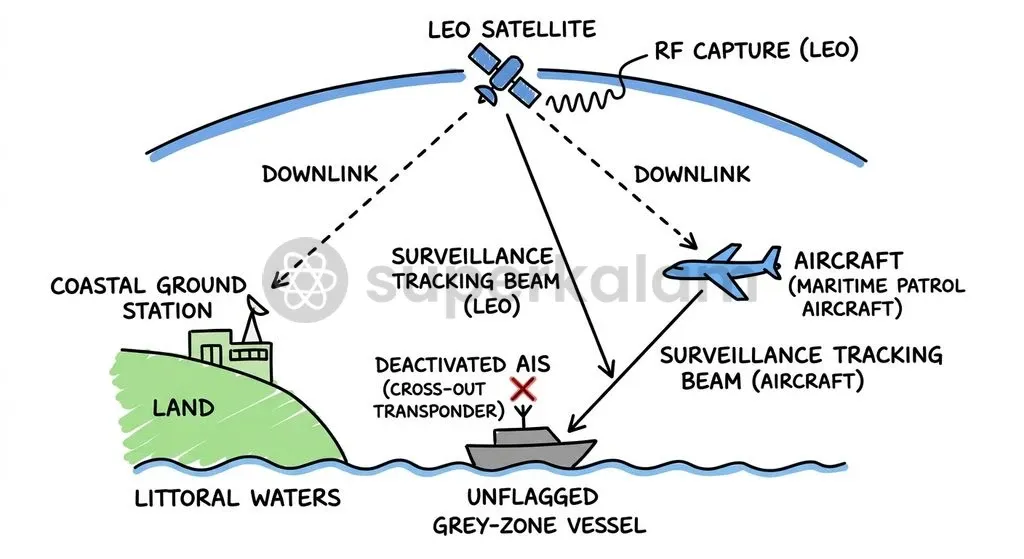
The Quad maritime agenda in Manila prioritises operational monitoring along the First Island Chain through the Indo-Pacific Partnership for Maritime Domain Awareness and coordinated aerial patrols. Under the initiative, member countries deliver commercial satellite radio frequency data and automated vessel tracking to regional maritime security agencies. This capability enables littoral authorities to pinpoint dark vessels—ships that deliberately deactivate their mandatory Automatic Identification System transponders to conduct illegal fishing or execute grey-zone intimidation.
Aerial coordination reinforces these space-based tracking streams. The Australian Prime Minister's office confirmed that the leaders endorsed the Indo-Pacific Maritime Surveillance Collaboration, scheduling an inaugural joint maritime exercise in early 2027 featuring P-8 and P-3C maritime patrol aircraft. Deploying long-range maritime patrol aircraft creates an integrated reconnaissance network linking the eastern Indian Ocean with the South China Sea.
| Operational Dimension | Traditional Quad Maritime Approach | Manila First Island Chain Framework |
|---|---|---|
| Geographic Focus | Open-ocean lanes across the broader Indo-Pacific | Chokepoints and littoral margins along the First Island Chain |
| Surveillance Architecture | High-end sovereign military naval patrols | Commercial satellite radio frequency and automated vessel tracking |
| Operational Target | Blue-water surface and sub-surface power projection | Unflagged dark vessels and coercive grey-zone operations |
| Regional Integration | External naval exercises among dialogue members | Information sharing with domestic maritime law-enforcement bodies |
| Legal Foundation | General adherence to high-seas freedom of navigation | Explicit enforcement of the 1982 UNCLOS framework |
Adherence to international legal norms underpins every tier of this operational framework. According to the Ministry of Foreign Affairs of Japan, the leaders emphasised that all maritime activities must strictly align with the 1982 United Nations Convention on the Law of the Sea (UNCLOS), safeguarding freedom of navigation and overflight. Structuring surveillance as an enforcement mechanism for international law allows the dialogue to challenge maritime overreach while avoiding the escalatory traps of unilateral military containment.
Discuss with Superkalam
What does the acronym MAHASAGAR stand for, as articulated in India's regional maritime doctrine?
Ask NowBeyond Warships: How Dual-Use AI and Undersea Cables Reshape Surveillance
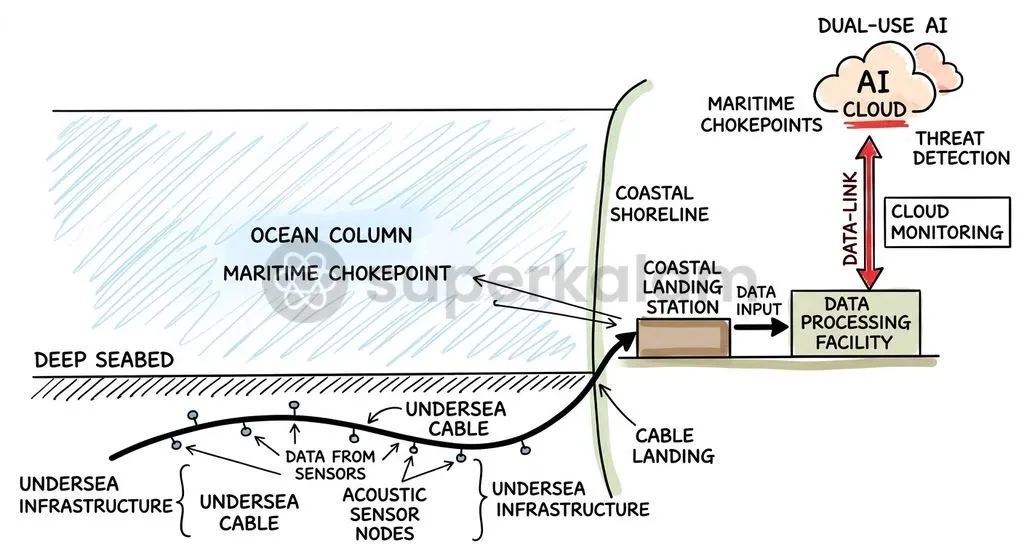
The Quad AI Accelerator and cable resilience initiatives expand regional maritime security beyond traditional naval presence into critical technological and telecommunication domains. Emerging maritime competition relies heavily on processing voluminous sensor data and protecting undersea digital backbones. The White House confirmed that partner nations pledged over $85 million in technical and financial assistance to establish trusted Artificial Intelligence ecosystems across the Indo-Pacific.
Dual-use artificial intelligence algorithms analyse disparate surveillance feeds to distinguish routine civilian traffic from coordinated paramilitary flotillas. Automated anomaly detection allows small coast guards to process vast maritime zones without purchasing prohibitive naval platforms. Complementing software investments, the US Department of State reported that member states initiated joint mapping programmes to resolve supply chokepoints and single-source dependencies across advanced semiconductor and hardware manufacturing chains.
Subsea physical connectivity forms the second pillar of this architecture through targeted investments:
- Expanded cable protection: During the summit proceedings, Australia expanded its contribution to the Cable Connectivity and Resilience Centre to encompass undersea electricity transmission cables alongside communications infrastructure.
- Indian Ocean connectivity: The Ministry of External Affairs highlighted the rollout of complementary undersea communications cable projects spanning the Indian Ocean to secure regional digital pathways.
- Network defence: The leaders instituted enhanced Cybersecurity Cooperation to mitigate cross-border cyber intrusions directed at regional critical infrastructure, shielding lines against state-sponsored sabotage.
Discuss with Superkalam
Explain how commercial satellite radio frequency data and AI algorithms help littoral coast guards identify 'dark vessels' without deploying high-end warships.
Ask NowThe ASEAN Dilemma: Deterrence Against Beijing vs. Fears of Entrapment
Southeast Asian nations view the Quad presence in Manila through divergent lenses, balancing maritime deterrence against concerns over great-power confrontation and institutional dilution. Regional leaders frequently debate whether minilateral defence initiatives deter adventurism or provoke sharper militarisation. State media commentaries from Beijing condemned the Manila summit as an effort to build an Asian NATO designed for geopolitical containment.
Perceptions within the Association of Southeast Asian Nations remain structurally fragmented:
- Maritime claimant states: According to the S. Rajaratnam School of International Studies, claimant nations like the Philippines welcome enhanced surveillance support and prioritise external capacity-building against daily coastal friction.
- Continental inland capitals: Inland members such as Cambodia and Laos express hesitation over escalating major-power rivalries, fearing economic retaliation from disrupted trade partnerships.
Member states addressed these frictions by formally reiterating their unwavering support for ASEAN centrality and unity in the summit communiqué. The grouping deliberately avoids mutual defence language, emphasising that its programmes supply non-lethal public goods accessible to regional partners. Reassuring Southeast Asian capitals preserves the grouping's diplomatic legitimacy and prevents regional institutions from fracturing into opposing geopolitical blocs.
Discuss with Superkalam
Compare the strategic security priorities of maritime Southeast Asian states with those of continental ASEAN capitals regarding Quad minilateralism.
Ask NowIndia's Tightrope: Deepening Indo-Pacific Reach Without Military Entanglement
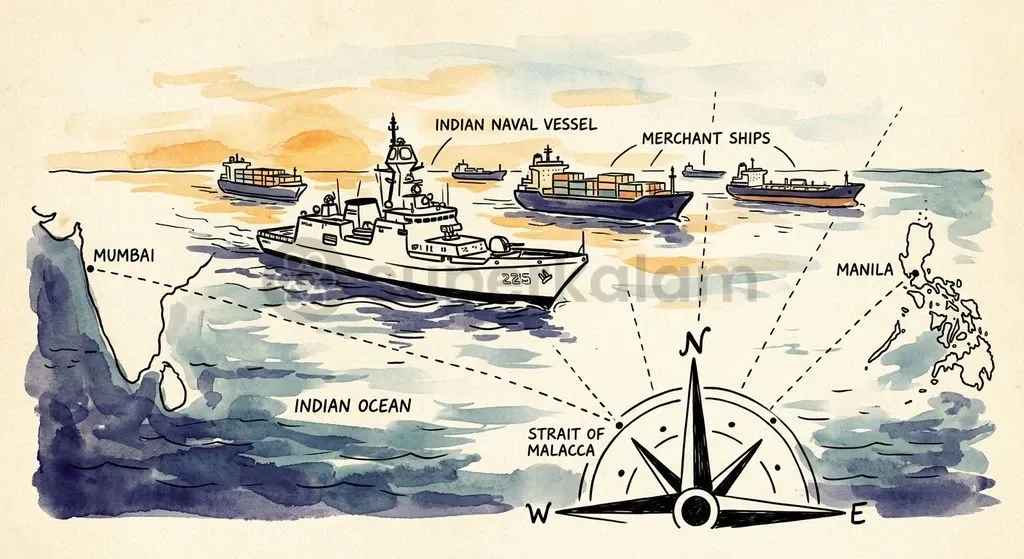
India maintains a calibrated posture within the Quad by championing regional public goods and strategic autonomy while avoiding binding mutual defence commitments in the South China Sea. New Delhi refuses to convert the dialogue into a military alliance, ensuring its operational commitments remain aligned with independent national interests. As reported by The Indian Express, Indian representatives emphasised that the grouping operates as a non-military, pluri-lateral partnership dedicated to international law rather than collective defence.
India's summit diplomacy advances three core strategic objectives:
- Doctrinal alignment: Official departure statements linked New Delhi's participation to the Act East Policy and the MAHASAGAR doctrine—an acronym representing Mutual and Harmonious Advancement of Security and Growth for All in the Region.
- Private capital mobilisation: In Manila, India announced that it will host the inaugural Quad Business Leaders' Forum in Mumbai in early 2027 to mobilise private investment into trusted supply networks.
- Supply-chain de-risking: New Delhi collaborated on the Quad Critical Minerals Initiative Framework, which aims to diversify critical mineral extraction and de-risk supply chains from single-nation refining dominance.
Discuss with Superkalam
Weigh whether transitioning the Quad from an open-ocean dialogue to First Island Chain surveillance strengthens regional stability or increases the risk of great-power conflict.
Ask NowSetting the Manila Benchmarks: What a Meaningful Compact Must Deliver
A credible Quad framework emerging from Manila must deliver concrete technological capacity, institutional transparency, and economic resilience without undermining Southeast Asian diplomatic centrality. Sustained regional buy-in requires moving past diplomatic statements to deploy operational assets that regional coast guards can integrate directly into daily patrols.
A meaningful compact must achieve three core benchmarks:
- Operationalise joint surveillance: The immediate priority centres on operationalising the Indo-Pacific Maritime Surveillance Collaboration through the early 2027 joint flights of P-8 and P-3C aircraft, integrating unclassified IPMDA tracking into national maritime operation centres.
- Deploy targeted technology: Member states must direct the $85 million AI Accelerator funding toward practical coastal surveillance algorithms and localised automated monitoring.
- De-risk strategic trade: The upcoming Mumbai Business Leaders' Forum in 2027 must establish joint investments in critical mineral processing and semiconductor resilience to insulate developing littoral economies against arbitrary export curbs.
Grounding every operational milestone within the 1982 UNCLOS framework ensures the Quad strengthens international law while securing a rules-based Indo-Pacific.
Key Takeaways
- The 7th Quad Leaders' Summit in Manila on November 17, 2026, established the grouping's first summit in a non-member littoral state along the First Island Chain.
- Maritime security cooperation transitioned toward operational detection, launching an aerial patrol collaboration for early 2027 alongside space-based satellite tracking for dark vessels.
- Critical technology commitments expanded via an $85 million Quad AI Accelerator and expanded undersea cable resilience covering both data and electricity transmission networks.
- India preserved its policy of strategic autonomy, balancing active participation under the Act East policy and MAHASAGAR doctrine against entangling military pacts.
- The summit confronted regional anxieties over an Asian NATO by reaffirming explicit backing for ASEAN centrality and international compliance under UNCLOS 1982.
Mains Question
"Deterrence in the Indo-Pacific has migrated from symbolic blue-water naval manoeuvres to localised technological resilience along the First Island Chain." Elucidate the significance of this strategic shift in the light of the 2026 Quad Manila Summit. (10 Marks)
Evaluate NowMains Question
Examine how India reconciles its active engagement in the Quadrilateral Security Dialogue with its traditional aversion to external collective defence arrangements, with particular reference to its 'Act East' policy and the MAHASAGAR doctrine. (15 Marks)
Evaluate NowPractice MCQs
QUESTION 1
With reference to the Indo-Pacific Partnership for Maritime Domain Awareness (IPMDA) and the Quad's maritime surveillance framework, consider the following statements:
- It utilises commercial satellite radio frequency data and automated vessel tracking to track dark vessels.
- The framework mandates that dark vessels are tracked primarily via their operational Automatic Identification System (AIS) transponders.
- The surveillance framework explicitly roots its legal enforcement in the 1982 United Nations Convention on the Law of the Sea (UNCLOS). Which of the statements given above are correct?
QUESTION 2
Consider the following statements regarding the 7th Quad Leaders' Summit held in Manila in 2026:
- It represents the first time the Quad leaders convened a summit in a non-member littoral state.
- The summit marked the launch of a binding collective defence pact among the four partner nations.
- The gathering coincided with the tenth anniversary of the Free and Open Indo-Pacific vision introduced in 2016. Which of the statements given above is/are correct?
QUESTION 3
Regarding critical technology and infrastructure initiatives highlighted at the 2026 Quad Manila Summit, consider the following statements:
- Partner nations pledged financial and technical assistance to establish trusted Artificial Intelligence ecosystems in the Indo-Pacific.
- Australia expanded its contribution to the Cable Connectivity and Resilience Centre to encompass undersea electricity transmission cables.
- Joint mapping programmes were initiated to address supply chokepoints in advanced semiconductor manufacturing chains. Which of the statements given above are correct?
QUESTION 4
The acronym 'MAHASAGAR', referenced in the context of India's maritime posture at the Quad Manila Summit, stands for:
QUESTION 5
With reference to the Indo-Pacific Maritime Surveillance Collaboration endorsed at the Manila Summit, consider the following statements:
- It includes an inaugural joint maritime exercise scheduled for early 2027.
- The joint aerial coordination framework features P-8 and P-3C maritime patrol aircraft. Which of the statements given above is/are correct?