Janjatiya Gaurav Diwas: Birsa Munda and Tribal Autonomy
Commemorating Birsa Munda requires bridging historical memory with genuine constitutional self-rule, moving beyond executive welfare to legal autonomy.
Nov, 2026
•11 min read
Overview
The Union Cabinet established Janjatiya Gaurav Diwas on 15 November to commemorate Bhagwan Birsa Munda's birth anniversary. The date celebrates anti-colonial tribal resistance. It also refocusses policy attention on whether executive welfare matches constitutional self-governance under the Fifth Schedule and PESA.
National commemorations combine historical remembrance with substantial financial commitments, including large infrastructure allocations for tribal districts, according to the Press Information Bureau. Bridging historical memory with real empowerment requires moving past bureaucratic delivery toward enforceable legal sovereignty. This analysis examines how statutory safeguards, community forest rights, and indigenous self-determination intersect with executive welfare programmes across India's tribal heartlands.
Why in the News: The Significance of November 15
Janjatiya Gaurav Diwas marks the birth anniversary of Dharti Aaba Bhagwan Birsa Munda, officially designated by the Union Cabinet on 10 November 2021. The national observance honours the contributions of tribal freedom fighters during India's anti-colonial struggle. It integrates indigenous uprisings directly into the mainstream national historical consciousness.
As of November 2026, the nationwide commemoration culminated in the 151st birth anniversary celebrations at Gadchiroli in Maharashtra, marking the conclusion of the Janjatiya Gaurav Pakhwada. The central government inaugurated development initiatives worth approximately ₹3,000 crore at the national event, as reported by the Press Information Bureau. The Ministry of Tribal Affairs is establishing 11 dedicated Tribal Freedom Fighters Museums across India. These include the Bhagwan Birsa Munda Memorial Park and Museum in Ranchi and the Ropuiliani Museum in Mizoram, institutionalising the historical legacy of tribal self-assertion.
The observance provides an opening to assess whether modern governance delivers the autonomy promised under Article 244. Contemporary public policy frequently emphasises financial outlays and target-driven schemes. Historical tribal mobilisations fought primarily for structural self-determination and tenure security. Examining this annual milestone requires assessing whether state delivery models genuinely advance indigenous rights or merely substitute executive patronage for legal autonomy.
The Legacy of Birsa Munda: What the Ulgulan Was Really Fighting For
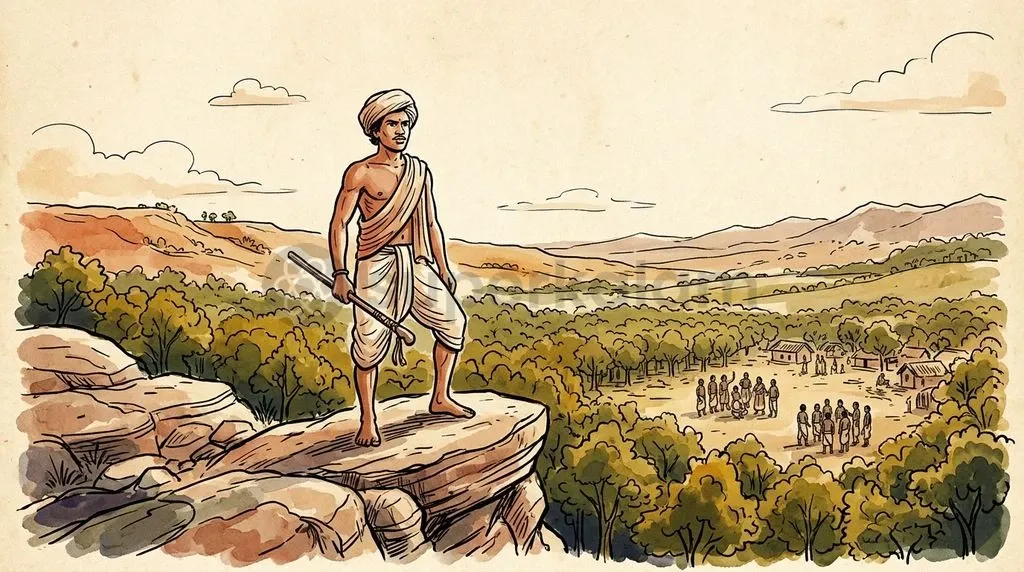
The Ulgulan was an anti-colonial tribal uprising led by Birsa Munda between 1899 and 1900 across the Chotanagpur plateau. The movement resisted British colonial policies that dismantled indigenous resource sovereignty and disrupted customary social arrangements.
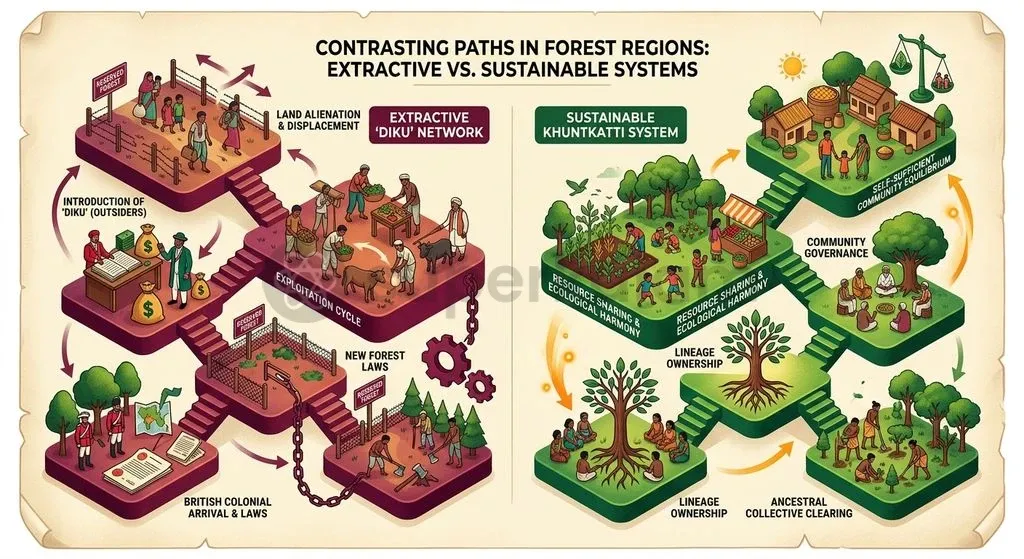
Colonial intervention broke tribal autonomy across three distinct fronts:
- Forest reservations: Imperial acts criminalised traditional forest collection and curtailed access to community woodlands.
- Agrarian exploitation: Outside landlords and usurious moneylenders, locally termed Dikus, entrenched debt bondage and alienated ancestral holdings.
- Tenure destruction: This system eroded the traditional Khuntkatti tenure system, a customary Munda institution based on the collective ownership of cleared forest land by original settler lineages.
The struggle sought complete freedom from colonial administrative subjugation and economic exploitation. In response to the rebellion's intensity, the British administration enacted the Chotanagpur Tenancy Act, 1908 (Bengal Act 6 of 1908). This statute established landmark protections by giving statutory recognition to Khuntkatti rights and prohibiting the alienation and mortgaging of tribal land to non-tribals. Birsa Munda’s legacy demonstrates that tribal resistance was fundamentally a battle for institutional self-rule, cultural dignity, and customary resource sovereignty.
Discuss with Superkalam
Which customary land tenure system was given statutory recognition by the Chotanagpur Tenancy Act of 1908?
Ask NowConstitutional Protections: The Fifth and Sixth Schedules Explained
Article 244 of the Indian Constitution establishes distinct administrative architectures for tribal territories through the Fifth and Sixth Schedules. The constitutional scheme recognises that standard bureaucratic arrangements cannot safeguard indigenous social fabrics from rapid demographic disruption and economic exploitation.
The Fifth Schedule governs Scheduled Areas across 10 states under Article 244(1). It vests Governors with sweeping discretionary authority to direct that specific Central or State laws do not apply or apply only with modifications to Scheduled Areas. The Schedule mandates the creation of Tribes Advisory Councils to deliberate on community welfare and land protection. In Samatha v. State of Andhra Pradesh (1997), the Supreme Court delivered an 8:1 ruling affirming that the state itself constitutes a "person" under land transfer regulations, ruling that granting mining leases to private corporations in Fifth Schedule areas is null and void.
Article 244(2) read with the Sixth Schedule establishes an alternate model of decentralised self-governance in Assam, Meghalaya, Tripura, and Mizoram. It empowers Autonomous District Councils (ADCs) and Regional Councils with direct legislative, executive, and customary judicial autonomy over land allocation, forest administration, and village justice.
| Governance Dimension | Fifth Schedule (Article 244(1)) | Sixth Schedule (Article 244(2)) |
|---|---|---|
| Geographic Coverage | 10 States across central, western, and southern India | 4 Northeastern States: Assam, Meghalaya, Tripura, Mizoram |
| Primary Administrative Body | Tribes Advisory Council (advisory body to the Governor) | Autonomous District Councils and Regional Councils |
| Legislative Autonomy | No direct law-making power; Governor modifies or suspends statutes | Direct legislative powers over land, forests, and customary laws |
| Judicial Powers | Operates under standard state judiciary; no separate council courts | Customary village councils and district council courts try minor suits |
| Executive Oversight | Direct oversight through the Governor and state executive machinery | Substantial regional autonomy exercised by elected council executives |
Discuss with Superkalam
How does the legislative authority of a Sixth Schedule Autonomous District Council fundamentally differ from the role of a Fifth Schedule Tribes Advisory Council?
Ask NowThe Promise and Dilution of the PESA Act 1996
The PESA Act 1996 operationalised Part IX of the Constitution across Fifth Schedule areas by making the village Gram Sabha the core unit of self-governance. Enacted as Act No. 40 of 1996, the statute sought to reverse decades of bureaucratic centralisation by recognising customary community authority.
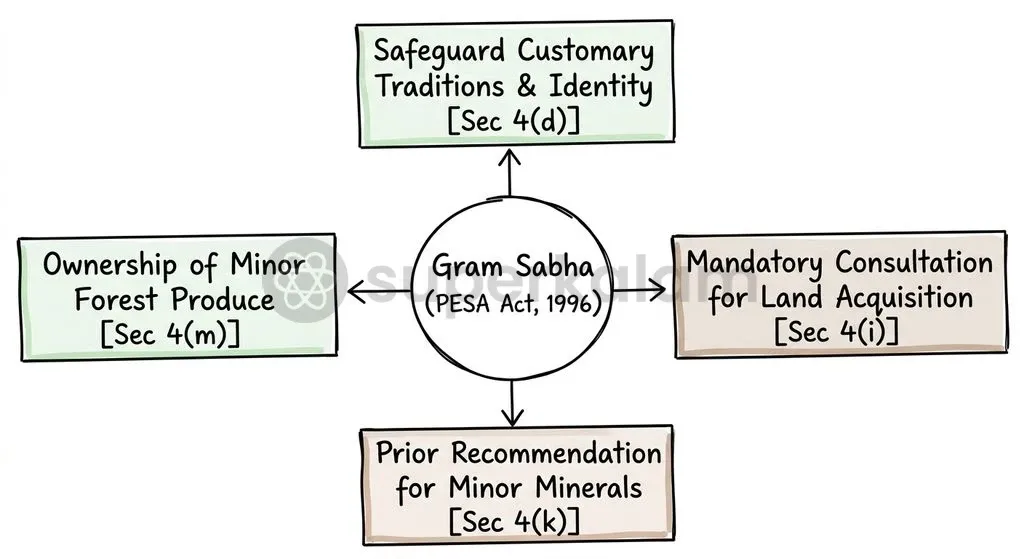
Under Section 4(i) and Section 4(k) of the statute, state legislatures must ensure that the Gram Sabha or intermediate Panchayats are consulted before acquiring land for development projects. Prior recommendation from the Gram Sabha is mandatory before granting prospecting licences or mining leases for minor minerals in Scheduled Areas. The framework designates the Gram Sabha as competent to safeguard religious traditions, preserve community resources, and manage local dispute resolution.
| Statutory Provision | Mandated Gram Sabha Authority |
|---|---|
| Section 4(i) | Mandatory consultation prior to land acquisition for development projects |
| Section 4(k) | Prior recommendation mandatory for prospecting licences and mining leases for minor minerals |
| Customary Domain | Authority to preserve cultural traditions, manage community resources, and resolve local disputes |
Despite its legal provisions, PESA faces deep operational dilution. Multiple state governments delayed framing state-specific PESA rules for over two decades, blunting local execution. Executive authorities routinely interpret Gram Sabha consultation as a non-binding formality rather than statutory consent. Excluding major commercial minerals from the Gram Sabha’s purview leaves community oversight weakest precisely where large-scale extraction occurs.
Discuss with Superkalam
If a commercial mining company applies for a bauxite extraction lease in a Fifth Schedule area, what legal constraints established under the Samatha judgment and PESA apply?
Ask NowThe Virginius Xaxa Committee: A Diagnostic of Structural Neglect
The Virginius Xaxa Committee submitted its landmark report to the Prime Minister's Office on 29 May 2014, detailing a structural crisis across Indian tribal society. Appointed to examine socioeconomic, educational, and health deficits, the committee analysed five systemic issues:
- Livelihood insecurity: Declining forest access and land dispossession.
- Employment decline: Loss of traditional subsistence economies.
- Educational deficits: Severe dropout rates and absent mother-tongue schooling.
- Health infrastructure gaps: Chronic vacancies exceeding 80% among specialists in tribal Primary Health Centres.
- Involuntary displacement: Massive community uprooting without fair rehabilitation.
The committee highlighted a glaring democratic paradox. Scheduled Tribes comprise approximately 8.6% of India’s population under Census 2011, yet they constitute an estimated 40% to 50% of all internally displaced persons caused by dams, mining projects, and industrial corridors over six decades. This massive displacement has systematically driven landlessness across indigenous belts.
Economic patterns show severe proletarianisation of tribal communities, where dispossession transforms self-sufficient forest dwellers and peasants into unorganised wage labour. Traditional subsistence economies collapsed under private resource concessions and legal disenfranchisement, forcing families into insecure agricultural and construction labour. In primary education, tribal students face high dropout rates because schools lack instruction in indigenous mother tongues. Health infrastructure exhibits severe deprivation, with the committee recording a vacancy shortfall of medical specialists exceeding 80% across Primary Health Centres located in tribal areas.
Discuss with Superkalam
What factors explain why tribal communities represent roughly 8.6% of the national population yet account for 40% to 50% of internally displaced persons?
Ask NowFrom Forest Rights to PM-JANMAN: Evaluating Modern Tribal Welfare
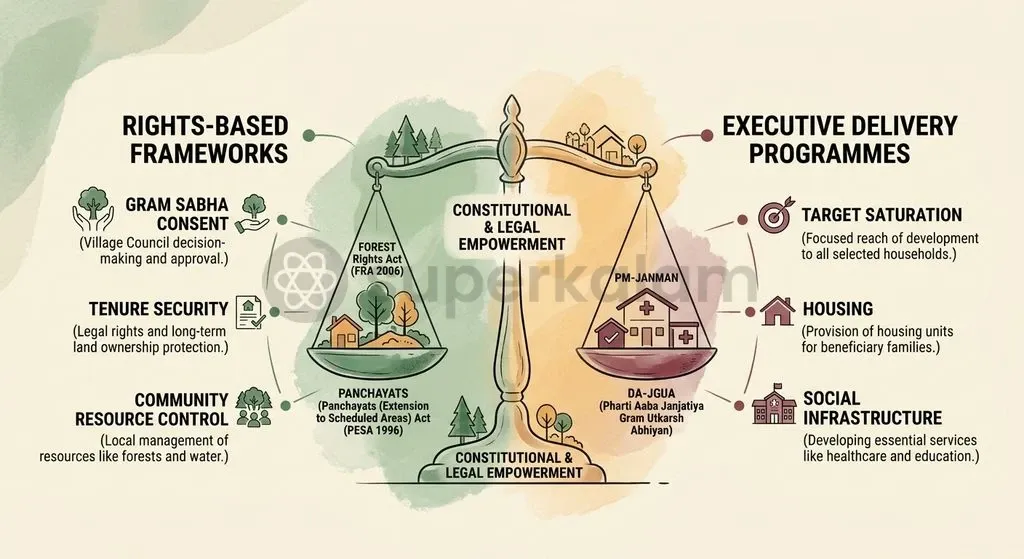
The Scheduled Tribes and Other Traditional Forest Dwellers (Recognition of Forest Rights) Act, 2006 marked a historic transition toward a rights-based statutory framework. Enacted as Act No. 2 of 2007, the legislation vests the Gram Sabha with statutory authority to receive and verify claims for Individual Forest Rights, Community Rights, and Community Forest Resource rights.
In Orissa Mining Corporation v. Ministry of Environment and Forests (2013), commonly known as the Niyamgiri case, the Supreme Court affirmed the Gram Sabha’s legal supremacy. The court ruled that the Dongria Kondh Gram Sabhas possess sole authority to decide whether bauxite mining infringes upon their religious, cultural, and customary rights. As of August 2026, cumulative national implementation has resulted in the distribution of roughly 25.42 lakh individual and community titles covering around 238 lakh acres of forest land, according to the Ministry of Tribal Affairs.
Recent policy thrusts rely on executive welfare programmes aimed at basic infrastructure saturation:
- PM-JANMAN: Launched on 15 November 2023 with an outlay of ₹24,104 crore over three fiscal years, delivering 11 critical interventions across 75 Particularly Vulnerable Tribal Groups.
- Dharti Aaba Janjatiya Gram Utkarsh Abhiyan: Launched on 2 October 2024 from Hazaribagh, committing ₹79,156 crore across 63,000 tribal-majority villages in 30 States and Union Territories.
- Eklavya Model Residential Schools: Parallel investments target 728 sanctioned institutions in blocks with over 50% Scheduled Tribe populations, seeking to provide secondary education to over 3.5 lakh students.
These programmes address acute basic amenity deficits, yet analysts note a persistent tension between rights-based legislation and target-driven executive schemes. Programmes like PM-JANMAN deliver material assets, but they cannot replace the decentralised resource sovereignty guaranteed by PESA and the Forest Rights Act.
Ethical and Governance Dilemmas: Development Versus Cultural Autonomy
Constitutional morality requires balancing national economic priorities against the sovereign rights of indigenous communities. Jawaharlal Nehru articulated this balance in 1958 through his Tribal Panchsheel guidelines, which cautioned against imposing external administrative models on tribal societies.
The Panchsheel doctrine rests on foundational governance principles:
- Communities should develop along the lines of their own genius without imposition.
- Tribal rights in land and forests must be respected and protected.
- Administration should train and build a team of indigenous people for governance.
- Progress must be judged by the quality of human character, not by statistical expenditures.
Large-scale mineral extraction and linear infrastructure projects create severe constitutional tensions when planned without genuine community concurrence. International standards, particularly the United Nations Declaration on the Rights of Indigenous Peoples (2007), enshrine Free, Prior, and Informed Consent. Indian constitutional jurisprudence, reaffirmed in the Niyamgiri judgment, aligns with this principle by acknowledging that resource exploitation cannot override indigenous cultural identity and local survival. Overlooking community consent erodes democratic legitimacy and violates the fiduciary duties the Constitution assigns to the state.
Discuss with Superkalam
Between top-down financial outlays and decentralised statutory decision-making, which approach offers a more sustainable path to indigenous autonomy?
Ask NowWay Forward: Moving from Paternalistic Welfare to Genuine Self-Rule
Establishing genuine tribal autonomy requires institutional reforms that align administrative practice with constitutional provisions. Executive welfare schemes provide necessary material relief, but sustainable progress depends upon establishing uncompromised statutory self-governance.
Priority institutional steps include:
- Statutory harmonization: State governments must align land, revenue, and mining codes with PESA and the Forest Rights Act.
- Binding consent: Section 4 consultations under PESA must become mandatory consent requirements, particularly for major mineral extraction and land transfers.
- Expedited title distribution: State administrations must eliminate procedural delays in issuing Community Forest Resource titles.
- Public service capacity: Address specialist vacancies in tribal Primary Health Centres and implement mother-tongue primary education in line with the Xaxa Committee recommendations.
- Constitutional oversight: Governors must actively exercise their Fifth Schedule powers, converting Tribes Advisory Councils into vigilant bodies protecting tribal land rights.
Honouring the legacy of Bhagwan Birsa Munda ultimately demands transitioning from bureaucratic benevolence to substantive constitutional self-rule.
Key Takeaways
- The Union Cabinet designated 15 November as Janjatiya Gaurav Diwas in 2021 to honour Dharti Aaba Bhagwan Birsa Munda and indigenous freedom fighters.
- Birsa Munda’s Ulgulan (1899–1900) resisted colonial forest reservations, moneylender exploitation, and the destruction of the customary Munda Khuntkatti land system, leading directly to the Chotanagpur Tenancy Act, 1908.
- Article 244 provides institutional safeguards: the Fifth Schedule operates via Governors and Tribes Advisory Councils across 10 states, while the Sixth Schedule establishes elected Autonomous District Councils in four northeastern states.
- The PESA Act 1996 vests Gram Sabhas with statutory oversight over minor minerals and community assets, but administrative implementation is weakened by non-binding consultations and delayed state rules.
- The Virginius Xaxa Committee (2014) documented structural neglect, showing that Scheduled Tribes make up 8.6% of India's population but account for 40% to 50% of development-induced displacement.
- Modern initiatives like PM-JANMAN (₹24,104 crore) and DA-JGUA (₹79,156 crore) deliver essential public infrastructure, yet long-term tribal empowerment requires enforceable self-determination over forests and lands.
Mains Question
"The transition from customary resource sovereignty to state-led development models has often accelerated the proletarianisation of indigenous communities." In light of the findings of the Virginius Xaxa Committee, critically analyse this statement. (15 Marks)
Evaluate NowMains Question
Differentiate between the constitutional architectures of the Fifth and Sixth Schedules under Article 244, and evaluate the extent to which the PESA Act, 1996 has succeeded in securing self-governance in Scheduled Areas. (10 Marks)
Evaluate NowPractice MCQs
QUESTION 1
Consider the following statements regarding the Chotanagpur Tenancy Act, 1908:
- It was enacted in response to the Ulgulan led by Birsa Munda.
- It provided statutory recognition to the customary Khuntkatti tenure system.
- It lifted all restrictions on transferring and mortgaging tribal lands to non-tribals. Which of the statements given above is/are correct?
QUESTION 2
With reference to the constitutional provisions governing tribal areas under Article 244, consider the following statements:
- The Fifth Schedule applies to Scheduled Areas across 10 states.
- In Fifth Schedule areas, Tribes Advisory Councils exercise direct law-making powers.
- Under the Sixth Schedule, Autonomous District Councils possess legislative powers over land, forests, and customary laws. Which of the statements given above is/are correct?
QUESTION 3
Regarding the Provisions of the Panchayats (Extension to the Scheduled Areas) Act, 1996 (PESA), consider the following statements:
- Under Section 4(i), consultation with the Gram Sabha or intermediate Panchayats is mandatory prior to acquiring land for development projects.
- Under Section 4(k), prior recommendation of the Gram Sabha is mandatory for granting prospecting licences or mining leases for major commercial minerals. Which of the statements given above is/are correct?
QUESTION 4
In the landmark judgment Samatha v. State of Andhra Pradesh (1997), the Supreme Court of India ruled that:
QUESTION 5
According to the findings of the High-Level Committee chaired by Virginius Xaxa (2014) mentioned in the article, consider the following statements:
- Scheduled Tribes constituted an estimated 40% to 50% of all internally displaced persons caused by development projects over six decades.
- Vacancies among medical specialists in tribal Primary Health Centres exceeded 80%. Which of the statements given above is/are correct?